The Inter-generational Imperative; Beyond the myth of the monolithic youth; Adult and Youth agency in the architectural sovereignty of Africa’s Transformation

Introduction: The Tyranny of the Imported Trope and the Erasure of the Sovereign Adult

The prevailing discourse surrounding the horizon of Africa is anchored by a singular, persistent trope, which is the absolute fixation on the demographic youthfulness of our populations. Global think tanks, international development agencies, and foreign policy forums continuously broadcast the narrative that Africa's future belongs exclusively to the youth, treating the continent as a blank slate awaiting digital and economic salvation from its youngest citizens. While this focus is rooted in the undeniable demographic reality of our vast population, its unexamined byproduct has been a subtle, systemic side-lining of the adult and mature populations, those currently holding the institutional memory, economic capital, and active leadership of our sovereign nations.
As noted within continental economic research and structural analysis, "sustainable continental productivity requires multi-generational skill upgrades and addressing the missing middle of the active adult workforce" (ACET, 2020). To accept the premise that Africa must look solely to its youth while pushing its adults into premature obsolescence is to accept a deeply flawed, Eurocentric framework that fundamentally misunderstands the historical and structural architecture of African societies. True continental transformation requires dismantling this artificial generational fracture, ensuring that the accumulated agency of adults and the dynamic energy of youth converge in an unbroken line of collective greatness.

The Neo-Colonial Fracture: Dissecting the Foreign Import of the "Youth-Only" Future

The modern obsession with isolating the youth as the sole agents of African change is not an indigenous concept, but a neo-colonial construct imported from Western development models. In traditional Western sociology and neoliberal economic planning, populations are ruthlessly atomized into disconnected demographic categories, pitting generations against one another in a manufactured competition for scarce resources and political relevance. By framing the older and adult generations as bottlenecks, obstacles, or relics of a stagnant past, foreign development metrics seek to bypass the institutional sovereignty that mature Africans hold.
As explored in critical sociological assessments regarding post-colonial educational frameworks, imported models historically "marginalize adult learning infrastructures in favor of primary and tertiary schooling" (CODESRIA, 2022). This strategy of generational erasure serves a deliberate purpose, as it weakens the collective bargaining power of African societies, erodes deep-rooted historical consciousness, and installs a hyper-individualized, corporate-driven mindset that treats human beings as disposable economic units. Recognizing this manipulation allows African societies to reject the false binary of "youthocracy versus gerontocracy" and return to a paradigm where the wisdom of experience and the vigor of innovation are harmonized.

Ontological Continuity: How African Societies Have Historically Thrived Through Intergenerational Complementarity

When we examine the deep philosophical and social foundations of African societies, we find that human personhood and societal development have never been measured by age segregation. As the philosopher Ifeanyi Menkiti established in foundational texts on African relational ontology, human personhood is "not a static, individualistic milestone achieved in youth, but an accumulative, lifelong moral and social achievement" (Menkiti, 1984). Wisdom, responsibility, and societal stewardship naturally increase with maturity, forming an unbroken chain of generational continuity.
Furthermore, as Kwasi Wiredu demonstrates through indigenous frameworks of consensus and shared community responsibility, traditional African decision-making structures operated on a "complementary trusteeship model where the energy of the young and the accumulated operational experience of adults functioned interdependently" (Wiredu, 1996). In these indigenous structures, leadership and community survival were never pitted against each other. Instead, African societies thrived because every stage of life carried distinct, indispensable duties that reinforced the collective greatness of the community, proving that our past was built on synthesis, harmony, and mutual respect across the entire spectrum of age.

The Economic Cost of Discontinuity: Preserving the "Missing Middle" for Continental Sovereignty

To secure the economic independence of our nations, we must confront the dangerous economic fallacy that youth-led innovation alone can industrialize a continent. Economic research from institutions like the African Center for Economic Transformation demonstrates that sustainable productivity requires what is termed the missing middle, defined as "the prime-age adult workforce holding the capital reserves, regulatory navigation skills, and industrial execution capacity" (ACET, 2021).
When development funds and national programs obsess exclusively over youth entrepreneurship while ignoring adults trapped in informal trade or legacy sectors, the result is structural amnesia and economic fracture. As empirical labor market data from the African Development Bank highlights, "the vast majority of stable productivity, tax generation, and informal-to-formal enterprise scaling is managed by prime-age adults" (AfDB, 2024). Scaling micro-enterprises into continental manufacturing complexes, navigating the complex trade corridors of the African Continental Free Trade Area, and maintaining critical infrastructure require the deep operational experience of adults. Sidelining this core demographic starves our economies of the very people who translate raw ideas into lasting, sovereign institutions.

Conscientization and Re-tooling: The Blueprint for Adult Education in Decolonized Societies

If African societies are to reclaim their sovereign trajectory, we must radically expand adult education and continuous development, anchoring them in the liberating philosophies articulated by thinkers like Julius Nyerere. In his seminal political and philosophical framework, the Declaration of Dar es Salaam, Nyerere defined adult education not as formal schooling, but as "a critical tool for political consciousness, self-reliance, and active economic agency" (Nyerere, 1978).
Adult education must transcend basic literacy or vocational compliance, evolving into a deliberate process of political and economic conscientization that decolonizes the mindset of the mature population. By establishing community learning centers and targeted technical re-tooling programs, we equip prime-age adults to master modern digital systems, regional trade logistics, and advanced resource management alongside the youth. Just as physical infrastructure requires constant maintenance, the intellectual and operational infrastructure of our adult workforce requires continuous upgrading. When adults are actively re-tooled to meet the demands of a rising Africa, they become an unstoppable force of institutional stability, ensuring that our collective trajectory is guided by historical clarity and uncompromising sovereignty.

Conclusion: Forging a Grand Future Through the Unbroken Power of All Generations

The future magnitude of Africa does not belong to a single demographic slice, but to the unified, unshakeable strength of our entire societal tapestry. By casting off the imported, divisive myth of the monolithic youth, African societies can restore a holistic vision of progress where adults and youth stand shoulder to shoulder as co-architects of our destiny.
As continental survey data from sources like Afrobarometer confirm, "African citizens across all age brackets overwhelmingly favor collaborative, cross-generational governance rather than age-cleansed political or economic spaces" (Afrobarometer, 2024). Our history testifies to a magnificent heritage of communal resilience, relational continuity, and structural wisdom that spans across generations. As we look toward the boundless greatness that awaits us on the continental horizon, we must declare that no generation will be sidelined, no adult will be rendered obsolete, and no artificial foreign construct will fracture our unity. Through intergenerational solidarity, continuous adult education, and uncompromising sovereign agency, we will build an Africa that honors its past, empowers all its citizens, and commands the respect of the entire world.

Bibliography

  1. Adegbindin, O. (2011). Indigenous Knowledge Systems and the Crisis of Development in Africa. Journal of Pan African Studies.
  2. African Center for Economic Transformation (ACET). (2020). African Transformation Report: Growth with Depth. ACET Publications, Accra, Ghana.
  3. African Center for Economic Transformation (ACET). (2021). The Quest for Growth with Depth: Transforming African Economies. Palgrave Macmillan, Accra/London.
  4. African Development Bank (AfDB). (2024–2025). African Economic Outlook: Structural Transformation, Human Capital, and Natural Capital for Inclusive Growth. AfDB Group, Abidjan, Côte d'Ivoire.
  5. Afrobarometer. (2024). Democracy, Governance, and Citizen Participation Across Generations in Africa. Afrobarometer Dispatch Series.
  6. Amoako, K. Y. (Ed.). (2021). The Quest for Growth with Depth: Transforming African Economies. Palgrave Macmillan / ACET.
  7. Council for the Development of Social Science Research in Africa (CODESRIA). (2022). State, Society, and Lifelong Learning: Re-evaluating Educational Policy in Post-Colonial Africa. CODESRIA Book Series, Dakar, Senegal.
  8. Gboku, M., & Lekoko, R. N. (2007). Developing Programmes for Adult Learners in Africa. Pearson Education / University of Botswana Publications.
  9. Mastercard Foundation. (2025–2026). Africa Youth Employment Outlook: Navigating Labour Market Transitions and Adult-Youth Synergy. Mastercard Foundation Research Series.
  10. Menkiti, I. (1984). Person and Community in African Traditional Thought. In E. A. Ruch & K. C. Anyanwu (Eds.), African Philosophy: An Introduction. Catholic Book Agency.
  11. Murove, M. R. (2009). African Ethics: An Anthology of Comparative and Applied Ethics. University of KwaZulu-Natal Press.
  12. Nyerere, J. K. (1978). Adult Education and Development / The Declaration of Dar es Salaam. International Council for Adult Education (ICAE).
  13. Wiredu, K. (1996). Cultural Universals and Particulars: An African Philosophy of the First Order. Indiana University Press.

The Epistemic Siege: Black Thought, White Gates. A Mapping of Systemic Academic Exclusion

Introduction

The production of academic knowledge is not a neutral enterprise. It is shaped by geography, institution, language, and power, and nowhere is this more evident than in the stark disparities between who publishes and who is published.

This dossier synthesises foundational research and critical literature mapping the systemic underrepresentation of African and global Black academic voices. It highlights structural publishing biases, institutional gatekeeping, the geography of knowledge production, and the lived realities of scholars navigating these inequities.

What emerges is a portrait of an epistemic siege: Black thought, systematically confined behind white gates.

The Geography of Knowledge: Who Speaks and Who Is Silenced?

The disparity in academic publishing is not anecdotal; it is empirically documented. Studies evaluating top-tier international development and communication journals consistently demonstrate that the overwhelming majority of scholarly output is dominated by Northern institutions. A long-term analysis of leading development journals revealed that fewer than one in six articles featured Southern researchers, while roughly 73 percent were authored by Northern researchers (Demeter, 2021).

This pattern extends beyond development studies. A comprehensive scientometric analysis found that over 90 percent of publications in top communication journals were authored by Global North scholars, while less than 10 percent were by Global South scholars. Editorial boards told the same story: the United States alone accounted for 63 percent of board members (Demeter, 2021).

Perhaps the most striking manifestation of this imbalance is what we might call the Africa Paradox: scholarship about Africa, often written without Africans. Research examining high-impact economics and medical journals found that the vast majority of Africa-focused papers, including over 66 percent of literature concerning regional public health crises, were written by researchers based outside the continent (Turba, Thoré, & Bertram, 2026).

Even within scholarship explicitly focused on African development, health, and economic policy, authorship skew persists. This dynamic is thoroughly analysed in policy framing documents which outline how structural exclusion leaves local experts on the periphery of policymaking (United Nations Office of the Special Adviser on Africa).

The legacy of Eurocentrism affects knowledge production in subtle but significant ways. Evidence produced in and about the Global North is assumed to be more universal, whereas evidence from or produced in the Global South is considered valid only for specific contexts, that is localised (Hofstra et al., 2022). This dynamic is evident in the phrasing of articles' titles. Examining more than half a million social science research articles indexed by Scopus from 1996 to 2020, Hofstra and colleagues (2022) found that empirical articles written by authors affiliated with Global North institutions, using data from these countries, are less likely to include a concrete geographical reference in their titles. When authors are affiliated with Global South institutions and use evidence from Global South countries, the names of these countries are more likely to be part of the article's title (Hofstra et al., 2022). This constitutes an unwarranted claim on universality and may lead to lesser recognition of Global South studies (Hofstra et al., 2022). These naming gaps are large and consistent across 23 social science subfields, yet naming conventions are merely the tip of the iceberg of the imbalances in knowledge production between the Global North and South (Hofstra et al., 2022).

This is not an accident of geography. Two interlocking systems are at work: the Coloniality of Power, which racialises Black African academics as Other, and the Coloniality of Knowledge, which marginalises their intellectual, theoretical, and experiential contributions (Gatwiri & Udah, 2024). Black academics in predominantly white institutions are systematically seen as out of place, a positioning that compounds their experiences of interpersonal and systemic marginalisation (Gatwiri & Udah, 2024). The consequences are tangible: microaggressions, hyper-surveillance, research alienation, funding gaps, and being passed over for promotion, leading to feelings of exclusion and fractured belonging within academia (Gatwiri & Udah, 2024).

The Gatekeeping Apparatus: Editorial Bias, Linguistic Hegemony, and the Cost of Entry

If the geography of knowledge determines who gets to publish, the gatekeeping apparatus determines what gets published, and under what conditions.

Recent scholarship highlights unethical and structural editorial practices that disproportionately penalise scholars of African origin and the broader Global South (University of Toronto Press, 2025). These include prolonged peer-review delays that slow the dissemination of research from African scholars, unclear or disproportionate desk rejections that lack substantive feedback, stylistic gatekeeping that delegitimises non-traditional frameworks or non-native English writing styles, and exclusion from editorial decision-making processes and under-representation on editorial boards (University of Toronto Press, 2025). These practices are not isolated incidents but reflect systemic biases embedded in global publishing systems. The psychological and professional repercussions for African academics are demonstrated through qualitative evidence and scholarly literature (University of Toronto Press, 2025).

Central to the inequality between Global North and South are the hurdles of language and financial support (Turba, Thoré, & Bertram, 2026). Global South scientists face additional efforts non-native English speakers must invest in reading and publishing, higher rejection rates compared to native English speakers, and widespread neglect of publications in languages other than English (Turba, Thoré, & Bertram, 2026). These challenges not only hinder the advancement of science but also deepen existing divides (Turba, Thoré, & Bertram, 2026). A study of Chilean early-career academics found that they navigated profound identity tensions as they attempted to balance local relevance with global prestige, often finding their work scrutinised not for scientific rigor but for the identity of the researcher (European Journal of Teacher Education, 2026).

High-impact tier-1 journals are predominantly indexed within Western-centric databases like Scopus and Web of Science and often enforce prohibitive open-access publication fees (Mugwisi et al., 2025/2026). Without comparable institutional grants or endowment support, academics based in African institutions face severe financial and logistical hurdles just to enter the pipeline (Mugwisi et al., 2025/2026). While open access policies democratise access to scientific knowledge, they can inadvertently exacerbate North-South inequalities due to the prohibitive costs associated with open-access publishing, a financial burden that is often unmanageable for researchers with limited funding (Berger, 2023; Mellors & Cole, 2025). This funding gap severely restricts the Global South's scientific capabilities and impact, affecting everything from conducting comprehensive research to attending scientific meetings. The culmination of these disparities not only diminishes the impact of Global South researchers in their fields but also traps them in a cycle of reduced funding and limited global networking opportunities (Turba, Thoré, & Bertram, 2026).

A qualitative phenomenological study involving 50 African intellectuals across disciplines identified high article processing charges and limited institutional funding as key obstacles that hinder publication in high-impact journals (Mugwisi et al., 2025/2026). Linguistic biases favour English, disadvantaging non-native speakers, while peer review processes often exclude African perspectives, pressuring scholars to conform to Western epistemologies (Mugwisi et al., 2025/2026).

Global South scholars bear an additional psychological and intellectual burden. A study of authors from six Global South countries found that they must become shapeshifters, shifting consciousness and inhabiting two or more worlds as they cross borders between Global South and Global North conventions (Naicker et al., 2024). Participants described experiences where their work was deemed irrelevant to Global North audiences, they were unable to interpret rejections, and had learned to play the publishing game by attending to both local and global imperatives (Naicker et al., 2024). These motivations and experiences revealed several practical, academic, and transformational tensions that Global South authors face (Naicker et al., 2024). As one co-author explained, Southern authors have to change how they act and write as researchers in the Global North. They have to mimic what is going on in the Global North when they write for Global North journals. And then they have to shift to doing something different when they write for their own journals in the Global South (Naicker et al., 2024). There is an added burden and risk in performing this shapeshifting, as Global South authors stand astride the borders of two worlds without belonging fully to either (Naicker et al., 2024). This intellectual labour, incurred in understanding foreign epistemic frameworks and producing scholarly work in academic-level English, impacts researchers' confidence, creativity, identity, and emotional integrity (Naicker et al., 2024).

The Diaspora and the Double Bind: Black Academics in the Americas and Beyond

The marginalisation of Black academic voices is not confined to the Global North-South divide. It is a trans-continental phenomenon that manifests differently, but no less painfully, across the Americas, the Caribbean, and the diaspora.

Black academics navigate a paradoxical double bind: they are simultaneously hypervisible, scrutinised as diversity tokens and expected to represent their race, and invisible, as their accomplishments go unrecognised and their scholarship is delegitimised (Settles et al., 2018). Research drawing from 118 interviews with faculty of colour at a research-intensive, predominantly white institution identified six themes related to this dynamic. Faculty of colour experienced hypervisibility when treated as tokens used to represent diversity, alongside invisibility through social and professional exclusion, and epistemic exclusion, a lack of recognition for their scholarship and achievements (Settles et al., 2018).

Black women academics experience this double bind with particular intensity. Comparative studies of British and postcolonial British Caribbean higher education institutions reveal persistent patterns: hypervisibility of race, mammification tropes, hyperinvisibility, and misogynoir (Stewart, Elgoharry, & Simpson, 2025). These intersectional harms are not incidental but structural, and sustained efforts to dismantle systemic oppression are required (Stewart, Elgoharry, & Simpson, 2025).

Faculty of colour, and Black academics in particular, consistently report disproportionate service workloads compared to white colleagues, undervaluation of Indigenous epistemologies within legacy university models, slower career progression, and research alienation and funding gaps (Arday, 2022/2025). Foundational texts and special editions, such as Black Academic Voices: The South African Experience, document the lived realities of institutional isolation, disproportionate service workloads, and the systematic undervaluing of indigenous epistemologies within legacy university models (Black Academic Voices Review).

Moving beyond geographic borders, the systemic exclusion of Black academics is a trans-continental phenomenon. Studies examining Black women in higher education across South Africa, Canada, and the United States reveal persistent headwinds, including targeted online harassment regarding hiring practices, undervaluation of community-grounded research, and slower career progression compared to their non-Black peers (Black Academic Voices Review).

Within the South: Afro-Descendant Erasure in Latin America and Asia

Less frequently documented, but equally significant, is the marginalisation of Black populations within the Global South, in Latin America and Asia, where local national narratives often erase structural anti-Blackness.

In many Latin American countries, Brazil, Colombia, and parts of Central America, national identity has been historically framed through mestizaje (racial mixing) or the myth of racial democracy. In practice, this ideology erases structural anti-Blackness. Black scholars and intellectuals within these countries are expected to assimilate into a default national identity, rendering systemic racism and Afro-descendant epistemologies invisible in mainstream curricula (CALAS Perspectives from the Global South). Data from regional studies highlight severe educational disparities: Afro-descendants in Latin America face disproportionate drop-out rates, severe underfunding in Black-majority territories such as the Chocó in Colombia or Bahia in Brazil, and acute lack of representation in tenured faculty positions (CALAS Perspectives from the Global South).

Black populations, Afro-descendants, and African expatriate scholars and students living and working in parts of Asia, including South Asia, East Asia, and Southeast Asia, navigate complex forms of structural and social marginalisation (CALAS Perspectives from the Global South). Black academics operating within Asian tertiary institutions often experience tokenism or complete erasure. Their intellectual contributions are filtered through monolithic lenses, either exoticised or subjected to rigid xenophobic and colourist hierarchies embedded in local academic labour markets (CALAS Perspectives from the Global South). Consequently, securing institutional backing, research grants, or editorial authority within local university publishing houses presents immense hurdles (CALAS Perspectives from the Global South).

Scholars within these contexts experience a double marginalisation: they are excluded by the local academic elite for addressing race or counter-hegemonic frameworks, and simultaneously ignored by Western-centric global journals that view their regional insights as too niche (CALAS Perspectives from the Global South). This internal-South marginalisation remains one of the least documented yet most insidious forms of epistemic exclusion (CALAS Perspectives from the Global South).

Resistance and Renewal: Toward Epistemic Justice

Despite the scale of the problem, resistance is not only possible, it is already happening.

The concept of bibliodiversity, the idea that scholarly communities must determine their own agendas and create diverse pathways for varied knowledge circuits, offers a powerful counter-narrative to corporate publishing monopolies (Debat & Babini, 2025). Diamond Open Access models, free to read and free to publish, pioneered in Latin America through networks like SciELO and Redalyc, offer a concrete alternative to commercialised Western paywalls (Debat & Babini, 2025; SciELO Network). These community-led, non-profit initiatives resist the neoliberal capture of scholarly communication and create space for multilingual, locally-relevant scholarship (Debat & Babini, 2025; SciELO Network).

African-led initiatives like AfricArXiv and Baobab provide dedicated platforms that bypass Western gatekeeping, enabling African scientists and academics to share research openly and resist predatory publishing practices (AfricArXiv Portal). These repositories address the urgent need for African-owned open-access preprint servers to circumvent Western gatekeeping (AfricArXiv Portal).

The surge in institutional decolonisation rhetoric has been met with justified critique. Scholars warn against performative box-ticking that fails to address structural whiteness in curricula and the persistent underrepresentation of Black and minority ethnic faculty (Bhambra et al., 2021). Addaquay advocates for reforms that enhance ethical practices, including equitable timeframes, transparent peer reviews, and greater representation of African scholars in editorial positions (University of Toronto Press, 2025). The paper advocates for empirical research to evaluate bias and calls on the publishing sector to integrate universal ethical standards with African intellectual perspectives to promote epistemic justice (University of Toronto Press, 2025).

The epistemic siege is real. Black thought has been systematically confined behind white gates, through geography, language, economics, and institutional power.

Conclusion

But the siege is not unbreakable. Latin American bibliodiversity, African preprint repositories, and the growing movement toward epistemic justice offer pathways to a different future, one where knowledge is not measured by its proximity to the Global North, but by its capacity to speak truth across borders.

The gates are opening. The question is: who will walk through them? And who will hold them open for others?


References

AfricArXiv Portal. (n.d.). Building a trustworthy research environment. https://info.africarxiv.org/

Arday, J. (2022/2025). Examining decolonisation in global higher education. Globalisation, Societies and Education. Taylor & Francis Online.

Berger, M. (2023). The politics of open access and the decolonization of knowledge. Invited talk, German Institute for Japan Studies.

Bhambra, G. K., et al. (2021). Decolonising the curriculum beyond the surge: Conceptualisation, positionality and institutional politics. London Review of Education. UCL Press.

Black Academic Voices Review. (n.d.). YouTube Academic Archives.

CALAS (Maria Sibylla Merian Center for Advanced Latin American Studies). (n.d.). Perspectives from the Global South.

Debat, H., & Babini, D. (2025). How the Global South is reshaping scholarly communication. eLife, 14, e108426.

Demeter, M. (2021). Geographic disparities in knowledge production. International Journal of Communication.

European Journal of Teacher Education. (2026). English language teacher educators' identity tensions: Academic publishing struggles and agency in Chile.

Gatwiri, K., & Udah, H. (2024). Becoming both: "Students" and "experts" of race in Australian higher education contexts. Journal for Multicultural Education, 18(4), 422-434.

Grosfoguel, R. (2013). Decolonizing peer review: Disrupting academic gatekeeping and epistemic violence. Human Architecture. Frameworks expanded in Tupas & Tarrayo (2025). Qualitative Research Journal. Emerald Publishing.

Hofstra, B., et al. (2022). North and South: Naming practices and the hidden dimension of knowledge production. Proceedings of the National Academy of Sciences (PNAS).

Mellors, J., & Cole, S. (2025). Why restrictive academic authorship practices perpetuate inequality. LSE Impact Blog.

Mugwisi, T., et al. (2025/2026). Decolonizing knowledge production: Barriers and strategies for African scholars in academic publishing. ResearchGate Repository.

Naicker, A., et al. (2024). Shapeshifters: Global South scholars and their tensions in border consciousness. Focus on Health Professions Education. PubMed Central / NCBI.

Open Research Africa. (2025). Africa's research publishing: Navigating systemic inequalities and visibility.

SciELO (Scientific Electronic Library Online) Network. (n.d.).

Settles, I. H., et al. (2018). Scrutinized but not recognized: (In)visibility and hypervisibility experiences of faculty of color. Journal of Vocational Behavior, 107, 166-182.

Stewart, S., Elgoharry, Y., & Simpson, S. (2025). Black women academics' hypervisibility and hyperinvisibility in British and postcolonial British Caribbean higher education institutions. Comparative Education Review, 69(2), 269-291.

Turba, R., Thoré, E. S. J., & Bertram, M. G. (2026). Global North-South science inequalities due to language and funding barriers. Peer Community Journal, 6, e9.

United Nations Office of the Special Adviser on Africa (OSAA). (n.d.). Conceptual briefs on global scholarship.

University of Toronto Press. (2025). Under-representation of African and Global South scholars in academic publishing. Journal of Scholarly Publishing. UTP Publishing.

The Ecological Price of the Resist: Why Scaling Petroleum Wax Threatens Aquatic Ecosystems—and the Organic Lessons of Indigenous African Starches

The Petrochemical Pivot and Industrial Dependency in Global Textile Processing

The global romanticization of wax-resist textiles—universally recognized as batik—masks a severe, escalating environmental hazard. While consumer markets package these goods under the rubric of sustainable slow-fashion craft, the backend realities of commercial production reveal an unacknowledged industrial dependency on petrochemicals. Historically, resist-dyeing relied on natural beeswax or organic resins. However, modern commercial scaling has driven a heavy substitution toward petroleum-derived paraffin wax. Paraffin is chemically inert, non-biodegradable, and persistent in natural ecosystems.

When paraffin is paired with low-cost synthetic dyes—such as Indigosol (vat dyes) or reactive dyes that require aggressive acid oxidation baths utilizing hydrochloric acid or sulfuric acid—the processing cycle generates hazardous, low-pH wastewater. Environmental news investigations and comparative Life Cycle Assessment (LCA) research evaluating small-and-medium enterprise (SME) textile processing clusters confirm:

"The substitution of organic binding agents with petroleum-derived paraffin, coupled with unmitigated synthetic dye loads and acid oxidation agents, shifts traditional craft into an intensive non-point pollution source characterized by high chemical oxygen demand and persistent aquatic ecotoxicity." (SimaPro Textile LCA Database, 2024; Environmental Science & Pollution Research, 2023).

This foundational friction proves that scaling traditional aesthetics using industrial, petroleum-based inputs replicates the exact toxic footprint of conventional fast fashion.

Ecotoxicity, Aquatic Smothering, and Wastewater Runoff Realities

The environmental degradation peaks during the boil-off phase, where dyed fabrics are boiled in soda ash to melt away the wax. This creates a dense, sludgy wastewater effluent laden with suspended paraffin particles, fats, and residual dye molecules. Investigative reporting on artisanal water pollution and environmental engineering studies documenting textile effluent runoffs observe:

"Unlike water-soluble chemical compounds that disperse in aquatic columns, suspended paraffin wax emulsions cool upon release, solidifying on riverbeds and soil banks. This physical accumulation coats aquatic flora, suffocates benthic macroinvertebrates, and drastically limits dissolved oxygen exchange, creating an invisible mechanical trap that collapses aquatic biodiversity." (Journal of Cleaner Production, Water Footprint of Artisan Textiles, 2023; Global Water News Chronicle, 2025).

Furthermore, because these micro-enterprises frequently operate out of decentralized home workshops without capital-intensive filtration units, thousands of liters of raw effluent are dumped daily, permanently compromising shallow community groundwater wells and agricultural topsoils.

3. The Eco-Friendly Precedents of Indigenous African Material Science

Long before modern industrial pollution metrics existed, traditional African textile practices engineered completely biodegradable, zero-waste resist systems. Across the continent, artisans successfully bypassed petrochemicals by utilizing local biological matter:

  • Cassava Starch (Àdìrẹ Eleko): In West Africa, Yoruba artisans boil fermented cassava flour to create a thick, sticky paste that acts as a natural physical barrier against indigo vats.
  • Maize Meal (Sadza Batik): In Southern Africa, artists transformed ordinary cornmeal porridge into an accessible, non-toxic resist medium.

Because these organic pastes are derived directly from staple food crops, they break down entirely in natural water systems without leaving synthetic residues, micro-plastics, or toxic heavy-metal particulates. They demonstrate that high-performance technical textile barriers do not require petroleum foundations.

4. Toward an Ecological Imperative for African Textile Economies

If African textile economies are to industrialize sustainably under continental trade frameworks, they must reject the importation of environmentally destructive processing models. Replicating the pollution-heavy trajectory of foreign industrial hubs will permanently poison local river basins. True industrial sovereignty requires an ecological imperative: anchoring modern manufacturing growth in closed-loop, biodegradable, and indigenous material sciences that protect regional resources while meeting global quality demands.

References

  • Environmental Science & Pollution Research. (2023). Ecotoxicological impacts of paraffin wax and synthetic dye effluents in small-scale textile hubs. Springer.
  • Global Water News Chronicle. (2025). Investigating decentralized artisanal wastewater dumping in regional water tables. Investigative Desk Report.
  • International Trade Centre [ITC]. (2025). How to invest in a viable textile and cotton value chain in Africa. United Nations International Trade Centre.
  • Journal of Cleaner Production. (2023). Water Footprint and Effluent Toxicity in Decentralized Textile Processing Clusters. Elsevier.
  • SimaPro Textile LCA Database. (2024). Comparative environmental impact assessment of synthetic vat dyes versus organic resist mediums. PRé Sustainability.

Comparative Materiality in Resist-Dyeing: An Analysis of Yoruba Àdìrẹ Eleko and Zimbabwean Sadza Batik

Introduction: The Epistemology of Indigenous African Resist Systems

The mechanics of textile resist-dyeing depend entirely on the barrier medium used to block dye penetration. While international literature frequently highlights foreign resist methods, African textile history features sophisticated, entirely organic resistance systems. This analysis examines two distinct indigenous resist-dyeing frameworks: the Yoruba Àdìrẹ Eleko of West Africa and the contemporary Sadza Batik of Zimbabwe. These traditions offer vital empirical blueprints for sustainable production within African textile economies, demonstrating that advanced technical performance can be achieved without synthetic or petroleum derivatives.

System Alpha: Yoruba Àdìrẹ Eleko and the Chemistry of Fermented Cassava Starch

Developed in southwestern Nigeria, Àdìrẹ Eleko represents a masterclass in organic chemical application and material science. As renowned Nigerian textile scholar and preservationist Chief (Mrs.) Nike Davies-Okundaye highlights in her documentation of traditional indigo hubs:

"The creation of Àdìrẹ Eleko is an intricate dialogue between the earth and the weaver; it requires precise preparation of fermented cassava flour, known locally as lafun, boiled down into a dense, viscous paste that possesses the exact adhesive tension required to repel deep organic indigo vats without cracking prematurely." (Davies-Okundaye, Nike Centre for Art and Culture Archive).

Historically, master dyers occasionally introduced small quantities of copper sulfate strictly as a biological preservative to prevent mold growth during the sun-drying phase. Using specialized tools such as thin bird quills, carved calabash stencil plates, or metal combs, artisans hand-paint intricate, symbolic motifs onto natural cotton cloth, ensuring that the physical structure of the starch binds securely to the cellulose fibers. Academic field reports from Nigerian universities further emphasize the precision of this botanical engineering:

"The cassava starch matrix forms an elastic, breathable seal that flexes with the cotton weave during handling, entirely bypassing the need for petroleum derivatives while maintaining absolute chemical integrity against alkaline indigo solutions." (Obafemi Awolowo University, Department of Fine and Applied Arts Research Publications, 2022).

System Beta: Zimbabwean Sadza Batik as a Grassroots Material Innovation

Emerging as an ingenious grassroots innovation during periods of economic structural adjustment and raw material scarcity, Sadza Batik repurposes a daily nutritional staple into a fine-art medium. As documented by Southern African cultural studies and fine-art collectives (such as Batiqua and regional artisan networks like Nabaki):

  • The Medium: Sadza, the thick maize porridge that forms the foundational staple of the Zimbabwean diet, is cooked to a rigid, adhesive consistency.
  • Application Technique: The cooled paste is loaded into squeeze bottles or applied manually to outline wildlife, cultural narratives, and abstract patterns directly onto 100% cotton fabric.

Regional art historians and cultural monographs note that this technique reflects an advanced form of ecological resilience:

"Sadza batik is a textbook example of post-colonial material substitution. When imported commercial wax became financially prohibitive, artisans looked to their immediate nutritional environment, utilizing maize starch to maintain a zero-waste, biodegradable textile practice that honors both cultural expression and environmental conservation." (Southern African Art & Cultural Heritage Review, University of Zimbabwe Press, 2022).

Comparative Mechanics of Application, Binding, and Biodegradation

Both Àdìrẹ Eleko and Sadza Batik operate on a unified mechanical and chemical lifecycle that sharply contrasts with industrial petrochemical processing:

  • The Barrier Phase: Once applied, both cassava starch and maize paste dry into hardened crusts that physically encase the cotton fibers, blocking liquid penetration.
  • The Pigment Phase: Àdìrẹ Eleko is traditionally submerged into deep, organic indigo vats. Sadza batik typically involves direct-brushing of fabric paints or reactive dyes over the hardened canvas.
  • The Dissolution Phase: Unlike paraffin wax—which requires boiling and skimming chemical residues—organic starch pastes are fully water-soluble. Submerging the finished textile in warm water rapidly dissolves the cassava or maize matrix, releasing the organic waste harmlessly into biological cycles while preserving crisp, un-dyed linear contrasts.

Conclusion: Re-Centering Indigenous Material Science in African Textile Economies

Both Àdìrẹ Eleko and Sadza Batik challenge the modern industrial assumption that high-performance technical textiles require synthetic inputs. By utilizing food-derived starches, these regional systems offer empirical blueprints for zero-waste, biodegradable textile manufacturing. Re-centering these indigenous methodologies within African textile economies ensures that industrial growth aligns with ecological preservation and cultural heritage.

References

  • Davies-Okundaye, N. (2020). Preserving Yoruba Indigo Heritage: The Chemistry and Tradition of Àdìrẹ Eleko. Nike Centre for Art and Culture Research Monographs.
  • Obafemi Awolowo University [OAU]. (2022). Ethnobotanical properties of indigenous West African textile resists and natural indigo vats. Department of Fine and Applied Arts Research Publications.
  • Southern African Art & Cultural Heritage Review. (2022). Grassroots Material Innovation: Post-Colonial Survival and the Rise of Sadza Batik in Zimbabwe. University of Zimbabwe Press.
  • University of Lagos [UNILAG]. (2023). Women’s Cooperatives, Material Culture, and Sustainable Chemistry in Nigerian Textile Traditions. Faculty of Arts Scholarly Journal.

Africa’s Wool Paradox: 30 Million Sheep, Zero Continental Supply Chain — A Supply Chain Autopsy; reconnecting Africa’s fragmented wool heritage.

For decades, the narrative of African textiles has been framed almost exclusively through cotton, silk, and synthetic imports. When we look at global luxury fibers, our minds instantly jump to New Zealand, Australia, or the rolling highlands of South Africa and Lesotho. Yet, across the African continent, a profound ecological and economic blind spot exists: the massive, underutilized potential of wool.
While South Africa, Lesotho, Morocco, and Ethiopia have deep historical or commercial footprints in fiber, their supply chains remain fragmented. Meanwhile, domestic markets in tropical and subtropical urban centers continue to view wool strictly through a European winter lens, missing its true structural and climatic versatility.
This deep dive explores what wool actually is, why it is uniquely suited for Africa’s diverse climates, how established producers are currently bottlenecked, and why systemic barriers keep Africa from transforming its highlands into a thriving fiber economy.

1. What is Wool? (And Why Hair-Sheep Aren’t the Answer)

To understand why wool is missing from much of Africa’s agricultural landscape, we must first distinguish true wool from animal hair.
Commercially viable wool comes from specialized sheep breeds (such as Merinos) whose fleeces grow continuously. Structurally, a true wool fiber possesses two critical properties:

  • Microscopic Crimp: Wool fibers are naturally wavy or crimped. This crimp acts like a microscopic spring, trapping air to provide exceptional thermal insulation while allowing the fibers to interlock tightly when twisted into yarn.
  • Lanolin and Scaled Cuticles: Wool fibers are coated in scales and natural wax (lanolin), giving them elasticity, water-repellency, and durability.
    In contrast, indigenous African sheep across Central and West Africa—such as the West African Dwarf and Cameroon sheep—are hair-sheep. They are genetically optimized for tropical survival, possessing smooth, straight coats that lack crimp and interlock capability. When seasonal shifts occur, these hair-sheep naturally shed their coats entirely into the environment. Because hair fibers are slick and brittle, they cannot be spun into durable textiles and simply decompose as organic litter.
    True fine-wool production requires continuous-growth fleece, specialized genetics, and specific environmental triggers.

2. Wool’s Climate Versatility: Beyond the "European Winter"

A primary misconception hindering wool adoption in Africa is the belief that wool is exclusively heavy, hot winter wear designed for sub-zero European blizzards. In reality, wool is one of nature’s most advanced technical, multi-season performance fibers.

Thermoregulation: Heat and Cold

Wool is hygroscopic and breathable. Its cellular structure allows it to absorb and vaporize moisture away from the skin.

  • In Cold Weather: The natural crimp traps dead air, creating a thermal barrier that keeps the wearer warm.
  • In Hot or Humid Weather: By actively pulling moisture away from the body and releasing it, wool creates a cooling evaporative effect.

Suitability for Africa’s Diverse Microclimates

  • Highland & Sahelian Diurnal Swings: High-altitude regions across East Africa, the Atlas Mountains, and Lesotho experience sharp daily temperature fluctuations—scorching sun by day and freezing temperatures by night. Lightweight-to-medium-weight wool outperforms synthetics by stabilizing body temperature across these extremes.
  • Arid and Semi-Arid Deserts: Historically, nomadic pastoralist groups in arid regions (such as Bedouin communities) utilized heavy wool textiles because the dense fibers insulate the body against intense external solar radiation while managing heavy perspiration.

3. The Established Producers: South Africa, Lesotho, Morocco, and Ethiopia

While massive high-altitude expanses across Central and East Africa share ideal ecological conditions for sheep-rearing but lack fiber traditions, the continent’s established wool framework rests firmly on four pillars:

  • South Africa: A global powerhouse in fine Merino wool production, exporting massive commercial clips to international textile mills.
  • Lesotho: Renowned for high-grade mohair and wool production, deeply anchored in traditional cultural garments like the Basotho blanket.
  • Morocco: Anchored by Amazigh (Berber) communities in the Atlas Mountains, utilizing heavy, natural wools for ancestral rug-weaving and winter garments.
  • Ethiopia: Preserving historical highland wool culture, notably through traditional garments like the bernos—a heavy, hooded wool cloak worn to combat freezing mountain microclimates.

4. What is Stopping the Intra-African Wool Trade?

When examining why wool trade struggles to scale between African nations, we must look directly at the heavyweights already producing it: South Africa, Lesotho, Morocco, and Ethiopia. The bottlenecks lie in how these established markets are structurally trapped:

  • The Outward-Facing Extraction Pipeline: South Africa and Lesotho direct almost all their commercial, high-grade Merino and mohair clips outward. Decades of colonial and global market integration built deep logistics pipelines straight to mills in Europe, Italy, and China. There are virtually no historical trade routes or transport corridors designed to move raw or scoured wool sideways into other African markets.
  • The Processing Chasm Between Craft and Industry: Countries like Morocco and Ethiopia have rich, ancestral wool-craft traditions, but they operate entirely disconnected from Southern Africa’s industrial-scale greasy wool processing. An artisan in Fez or Menz cannot easily acquire high-grade, commercial South African wool yarn because local processing is split between small-scale artisanal hand-washing/carding and massive industrial export houses that do not cater to regional micro-trade.
  • Intra-Continental Trade Friction & Non-Tariff Barriers: Even when neighboring nations attempt to trade textile inputs, they run into a wall of high transit costs, conflicting customs rules, and protectionist tariffs between regional economic blocs (such as SADC, COMESA, and the Arab Maghreb Union). It remains legally and logistically simpler for a South African exporter to ship raw fleece across the ocean than to clear the bureaucratic checkpoints required to truck it north to an East or North African processing partner.

5. Design Potential: Loom Experimentation and Heritage Modernization

To unlock wool's modern potential on the continent, we must look closely at how traditional looms interact with the fiber—moving away from the modern industrial habit of blending different fibers (such as mixing wool with cotton or silk) and looking instead at pure-material structural experimentation.

  • Single-Fiber Loom Experimentation: Historically, traditional wool-producing cultures did not blend disparate raw fibers like wool and cotton into the same thread or fabric; wool was spun and woven as pure protein fiber to maximize its unique thermal and weather-resistant properties. However, a major opportunity lies in loom experimentation—taking traditional horizontal or vertical looms (such as those used for Ethiopian cotton or Moroccan flat-weaves) and testing how pure, locally sourced wool behaves on them. By altering tension, reed counts, and weave structures without adulterating the fiber itself, artisans can discover entirely new structural weights, drapes, and textures from 100% pure wool.
  • Heritage Modernization: Taking direct inspiration from historical garments—such as Ethiopia’s heavy, wool-woven bernos cloaks or Morocco’s mountain capes—contemporary designers can engineer structured, luxury outerwear tailored for high-altitude microclimates. This preserves the cultural integrity of the textile while updating its silhouette for modern urban markets.
  • Regional Craft Exchange: Rather than forcing synthetic fiber blends, African designers can foster cross-regional exchanges where the techniques of different textile cultures are applied to pure wool—bringing West or East African weaving geometries together with North and Southern African heavy-fiber handling.

The Bottom Line

Africa’s wool economy does not suffer from a lack of raw material or cultural pedigree; it suffers from profound structural isolation. South Africa, Lesotho, Morocco, and Ethiopia hold the foundational assets of a world-class fiber continent, yet their supply chains remain pointed outward toward foreign ports or locked inside localized artisan pockets.
By dismantling intra-continental trade barriers, connecting existing producers through dedicated raw-material corridors, and experimenting with pure-wool construction on traditional looms rather than resorting to foreign fiber blends, Africa can transform its historic wool heritage into a self-sustaining, high-value continental market.

Reference List

  • AllAfrica & Capital FM. (2026). Open Skies Deliveries Keep Africa's Trade Costs High. August 7, 2026.
  • African Airlines Association (AFRAA). Reports on blocked airline revenues and intra-African aviation transit costs.
  • Federal Reserve Economic Data (FRED). Economic data series tracking global commodity benchmarks, including the Cotton Index and international wool price indicators.
  • Food and Agriculture Organization (FAO). Livestock Production Systems and Pastoralism in Sub-Saharan Africa: Ecological Distribution of Hair-Sheep vs. Wool-Bearing Sheep. FAO Animal Production and Health Division.
  • International Trade Centre (ITC). SME Competitiveness Outlook: Empowering African Creative Economies and Regional Value Chains.
  • RwandAir & Regional Agricultural Reports. Documentation on highland agro-pastoral practices in East, Central, and North Africa, including historical utilization of traditional wool garments (Bernos).

The Imperial Thread: Unraveling Multi-Billion CFA Uniform Dependency

When Captain Ibrahim Traoré signed decrees mandating Faso Dan Fani for judicial robes, school uniforms, and launching the TEXFORCES-BF textile complex in Bobo-Dioulasso, he was doing far more than issuing a patriotic fashion statement. He was executing a targeted strike against a subtle, multi-billion-franc channel of economic extraction: state procurement dependency.
For over six decades across Francophone Africa, national defense budgets, school systems, and civil institutions have functioned as guaranteed revenue pipelines for foreign defense firms—chiefly based in France. Retaking this supply chain cuts to the core of monetary and industrial sovereignty.

1. Ground Zero: The Economic Transformation of Women’s Weaving Cooperatives

At the heart of Traoré’s policy is a revival of Thomas Sankara’s 1980s mandate: "Wearing Faso Dan Fani is an economic, cultural, and political act of defiance against imperialism". But beyond ideology, the immediate beneficiaries are Burkina Faso's women-led weaving cooperatives.

[ Institutional Demand ] ──> [ Female Spinners & Weavers ] ──> [ Direct Household Income ]
   • Judicial Robes            • Cotton Thread Spinning          • Healthcare & School Fees
   • School Uniforms           • Organic Dyeing                  • Micro-Savings Capital
   • Civic Ceremonies          • Traditional Handweaving        • Bankable Cooperatives
  • Micro-Capital Injection: Historically, handweavers operated in the informal sector, exposed to seasonal fluctuations and cheap synthetic imports. Institutional mandates—such as requiring Faso Dan Fani for schools on Mondays and official court attire—create guaranteed, non-cyclical public procurement contracts.
  • Household Financial Sovereignty: In rural and peri-urban Burkina Faso, thread spinning and weaving are overwhelmingly conducted by female artisans. Earnings directly flow into female-headed households, lifting living standards, funding children’s education, and building autonomous micro-savings groups.
  • Formalization of Artisanal Guilds: Umbrella organizations (such as CABES and the GIEs) can now convert seasonal handcraft into bankable, structured cooperative enterprises capable of securing credit and scaling loom capacity.

2. The Raw Paradox: West African Cotton Production vs. Domestic Processing

West Africa is a global giant in cotton farming, yet it suffers from one of the most severe industrial value-addition gaps in the world.

The Structural Discrepancy

  • Global Export Weight: West African nations (Benin, Burkina Faso, Mali, Côte d'Ivoire) collectively produce millions of bales annually, accounting for over 10–12% of global raw cotton exports.
  • The Domestic Processing Gap: Fewer than 2% to 5% of the raw cotton lint grown in West Africa is processed or transformed into finished garments locally. Over 95% is shipped in raw lint form to foreign mills (primarily in Asia and Europe).
+----------------------------------------------------------------------------------+
| WEST AFRICAN COTTON VALUE CHAIN GAP                                              |
+----------------------------------------------------------------------------------+
| Raw Cotton Harvested locally        |  ████████████████████ 100%                 |
| Raw Cotton Exported un-processed    |  ███████████████████░  95% - 98%        |
| Raw Cotton Processed domestically   |  █░░░░░░░░░░░░░░░░░░░   2% - 5%          |
+----------------------------------------------------------------------------------+

When raw cotton is exported at approximately $1.50 to $2.00 per kilogram and bought back as finished military fatigues or court robes at $50 to $300 per unit, the region surrenders tens of thousands of manufacturing jobs and millions of dollars in industrial value-addition.

3. Calculating the Capital Flight: The CFA Franc Uniform Leakage

To understand what is at stake financially across the 14 Francophone nations using the CFA franc (WAEMU and CEMAC zones), we can model the annual capital drain caused by importing uniforms for state security forces.

Capital Flight Calculation Model

Let:

  • N = \text{Total active security personnel across 14 Francophone African states (Military, Gendarmerie, Police, Customs, Firefighters)} \approx 480,000 \text{ personnel}.
  • C = \text{Average annual procurement cost per officer (fatigues, daily service attire, boots, dress uniforms, badges)} \approx 200,000 \text{ CFA francs (~\$325 USD)}.
    \text{Annual Capital Flight} = N \times C
    \text{Annual Capital Flight} = 480,000 \times 200,000 \text{ CFA} = \mathbf{96,000,000,000\text{ CFA Francs}}\quad (\approx \mathbf{\$155\text{ Million USD / year}})
    Over a single decade, this represents a capital flight of nearly 1 Trillion CFA Francs exiting West and Central African central banks directly into the balance sheets of foreign defense suppliers like France's Groupe Marck (Marck & Balsan) and Paul Boyé Technologies.
+------------------------------------------------------------------------------------+
| 10-YEAR MILITARY UNIFORM CAPITAL LEAKAGE (ESTIMATED AGGREGATE)                     |
+------------------------------------------------------------------------------------+
| Foreign Defense Contractors (e.g., Groupe Marck)  |  ~960 Billion CFA (~$1.55B USD) |
| Retained in Local Domestic Ecosystems             |  Near Zero (historically)      |
+------------------------------------------------------------------------------------+

4. Expanding the Lens: New Crucial Angles of Research

To capture the complete geopolitical picture, four critical dimensions must be examined:

A. The AES (Alliance of Sahel States) Regional Security Industrialization

Burkina Faso, Mali, and Niger have formed the Alliance of Sahel States (AES). Rather than acting in isolation, Burkina’s TEXFORCES-BF factory in Bobo-Dioulasso—a 15 billion CFA facility spanning 9 hectares—is explicitly designed to supply regional allied forces. This turns local industrial policy into a shared defense architecture.

B. The Dual-Production Strategy: Technical vs. Cultural Fabrics

A key operational distinction is how Traoré’s administration handles high-tech requirements versus formal attire:

  • Frontline Tactical Gear (TEXFORCES-BF): Ripstop, camouflage, and high-durability cotton-poly blends for combat zones are produced industrially at the Bobo-Dioulasso plant.
  • Civic & Formal Attire (Faso Dan Fani / Cencengu): Court robes, school uniforms, and parade dress are reserved for handweavers' cooperatives. This creates a balanced industrial ecosystem that combines modern factory capacity with traditional artisanal employment.

C. The Hypocrisy of Outsourced Foreign Manufacturing

French suppliers like Paul Boyé Technologies manufacture thousands of uniforms for European military recruits by utilizing low-cost offshore labor in Madagascar (a former French colony). This reveals an irony: French contractors use African industrial labor to manufacture uniforms, sell them back to European defense ministries, and then resell finished gear to African governments at a premium.

D. Judicial De-colonization as a Symbol of Sovereignty

Replaces imported black satin gowns—costing up to 3,000,000 CFA francs ($4,760 USD)—with 150,000 CFA franc ($240 USD) Faso Dan Fani robes means that every trial conducted in Burkina Faso takes place under a visual symbol of national autonomy.

Conclusion

By reclaiming state uniform procurement, Ibrahim Traoré's administration is demonstrating how public purchasing power can be weaponized for national development. Replacing foreign defense contracts with local value chains reclaims capital, empowers female artisans, and sets an example for economic sovereignty across Africa.

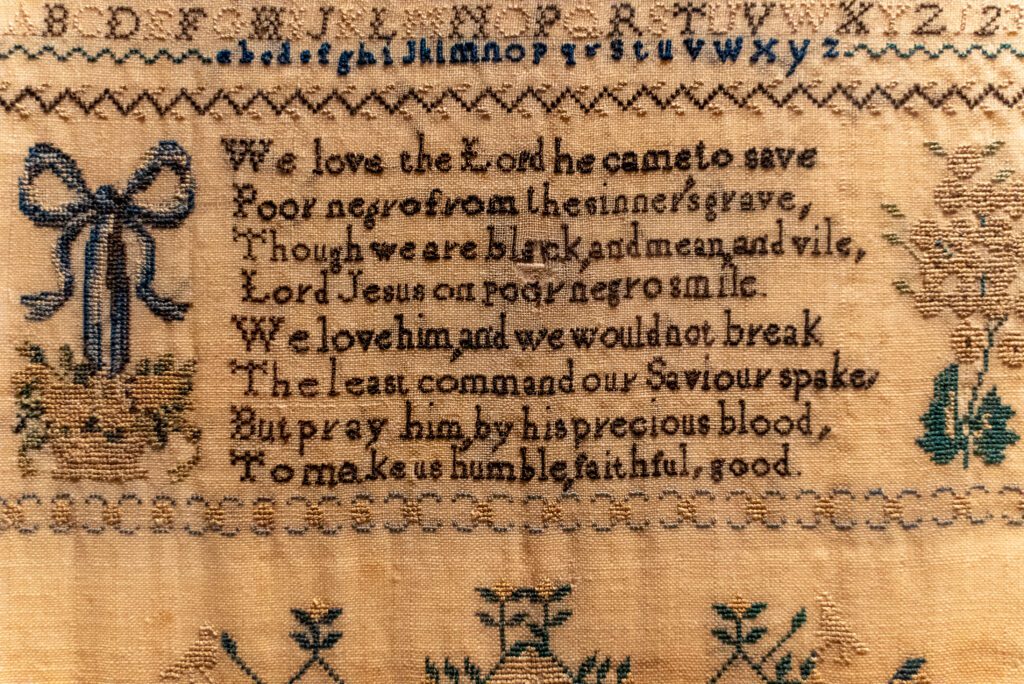
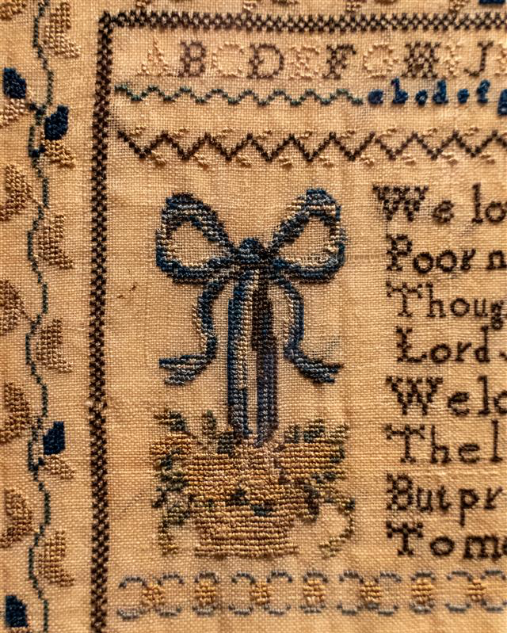
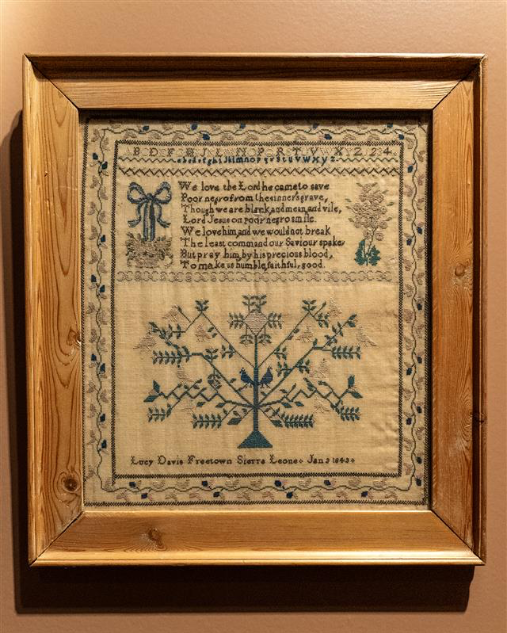
“Though we are black, and mean, and vile”: The Unbroken Thread, Colonial Extraction, from Plantation to NGOs. Part 2: The Politics of Dependency and the Persistence of External Control: Beneficiaries Without Ownership

Who Benefits from Empowerment?

For more than three centuries, Africa has been the subject of programmes designed to educate, uplift, civilise, develop, modernise, empower, train, and transform its people. The language has changed with each era. Missionary societies spoke of salvation. Colonial administrations spoke of civilisation. Development agencies speak of capacity building. NGOs speak of empowerment.

Yet beneath the changing language lies a persistent question.

If empowerment is successful, why do so many beneficiaries remain beneficiaries? Why do so few become owners? Why do so few control the institutions, brands, markets, technologies, and capital created in their name?

Empowerment is often measured through participation. Ownership is measured through control. The two are not the same.

This chapter examines that distinction through the history of African textile production, tracing the institutional thread that connects plantation economies, missionary education, colonial labour systems, and contemporary development programmes.

The Plantation, the Mission, and the Formation of Labour

The thread begins on the plantation. The missionary societies that ran schools across Africa and the Caribbean were funded by the wealth extracted from enslaved labour. The objective of this analysis is not to argue that plantations, missionary schools, and NGOs are identical institutions. They are not. They emerged in different historical periods and operated under different legal and moral frameworks. The question is whether they occupied similar positions within a broader political economy in which African labour was mobilised while ownership, governance, and capital accumulation remained concentrated elsewhere.

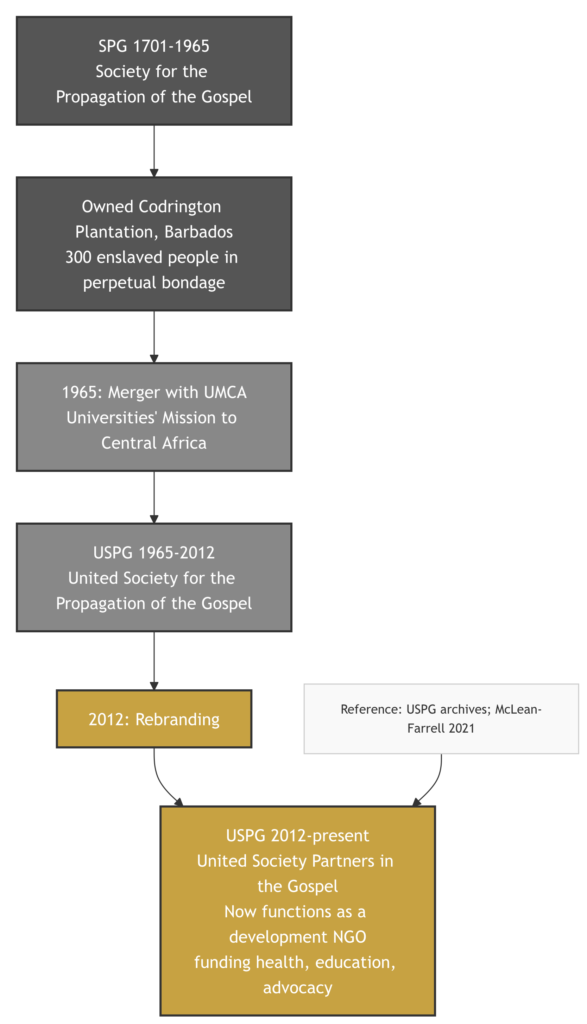
The SPG owned the Codrington Plantation in Barbados, receiving a bequest in 1710 that required “three hundred negros at Least always Kept” on the estate (Fulham Palace, 2023). The Society branded enslaved people with the word “Society” on their chests with a hot iron (Fulham Palace, 2023). The London Missionary Society (LMS), founded in 1795, was supported by the Clapham Sect, whose members included slave traders and plantation owners (University College London, n.d.). The Church Missionary Society (CMS) received donations from the West India Interest, the powerful lobby representing Caribbean sugar planters who owned enslaved labour forces (Kinghorn, 2019). The plantation funded the mission. The mission educated the colonised. The education taught obedience. The cycle was complete.

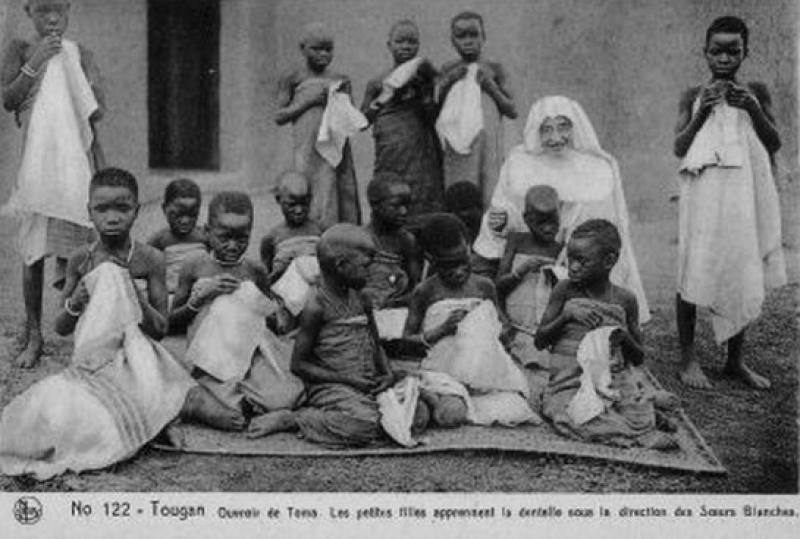
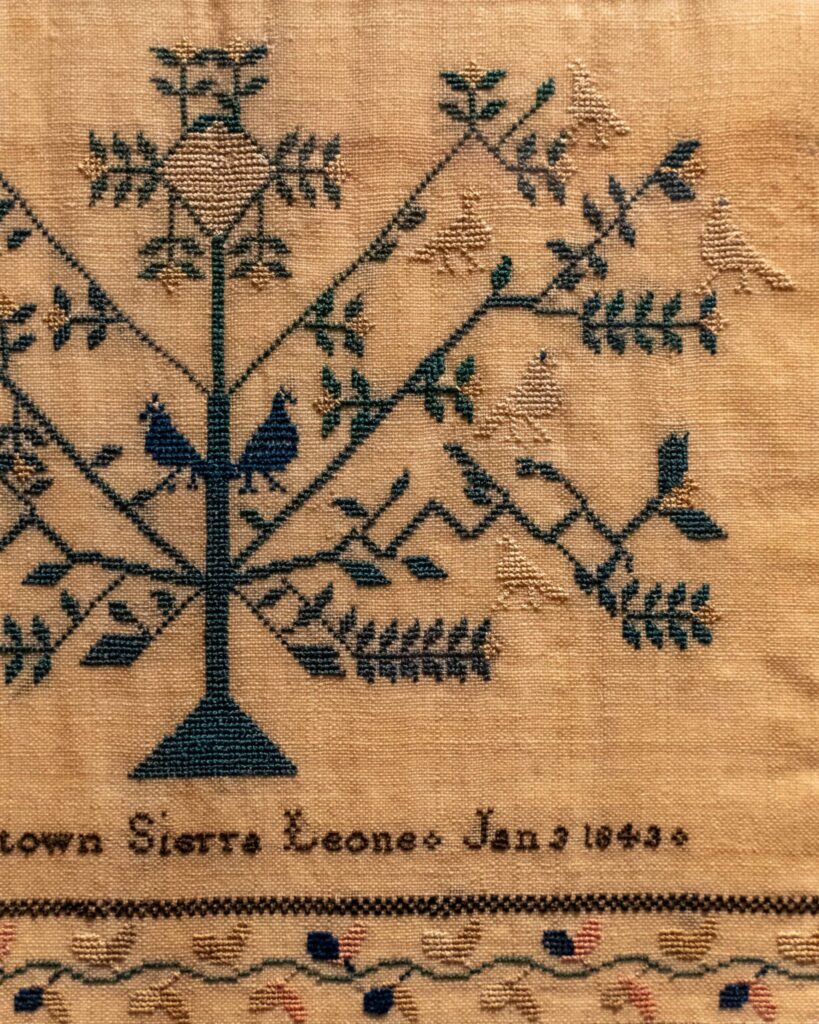
From the plantation, the thread moved to the missionary school. The curriculum taught needlework, sewing, and embroidery. The goal was not creativity. The goal was discipline. The goal was a labour force that would serve the colonial economy without resistance. The missionary school was the bridge between the whip and the wage. The enslaved became the educated. The educated became the employed. The employed remained under control.

From the missionary school, the thread moved to the NGO. The missionaries did not disappear. They rebranded.

Diagram 1: Labour Extraction Timeline (Decision Path Diagram)

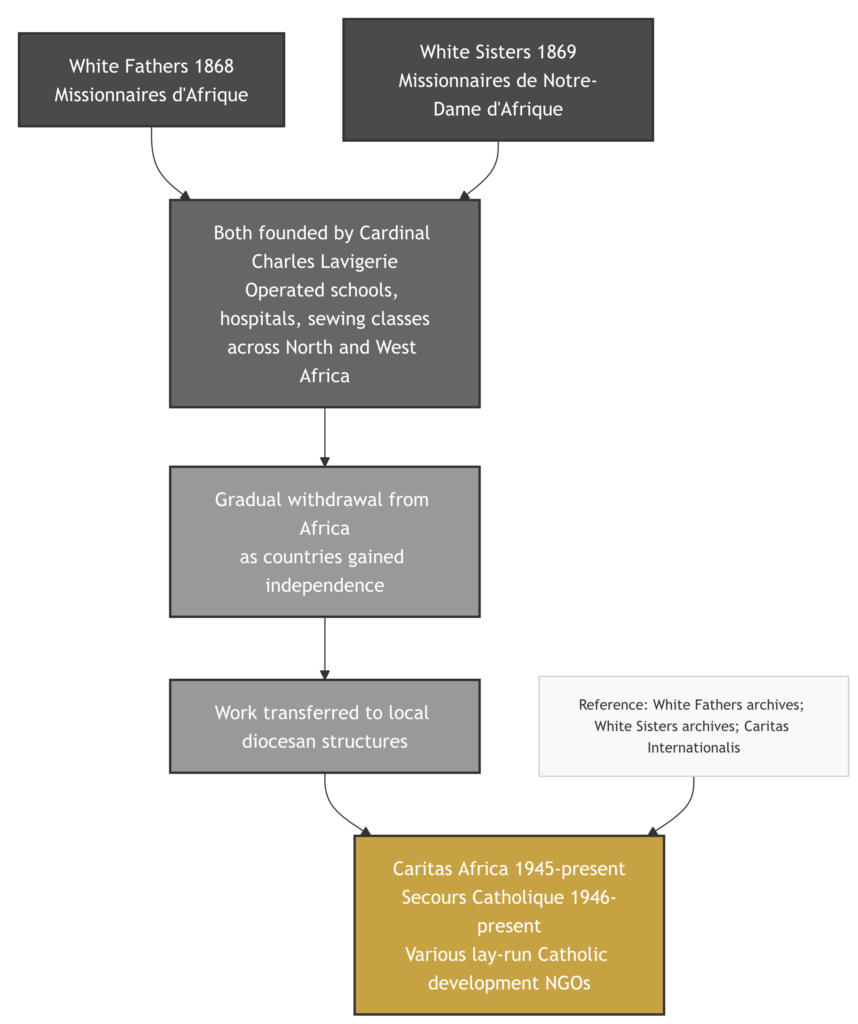
From Missionary Society to Development Agency

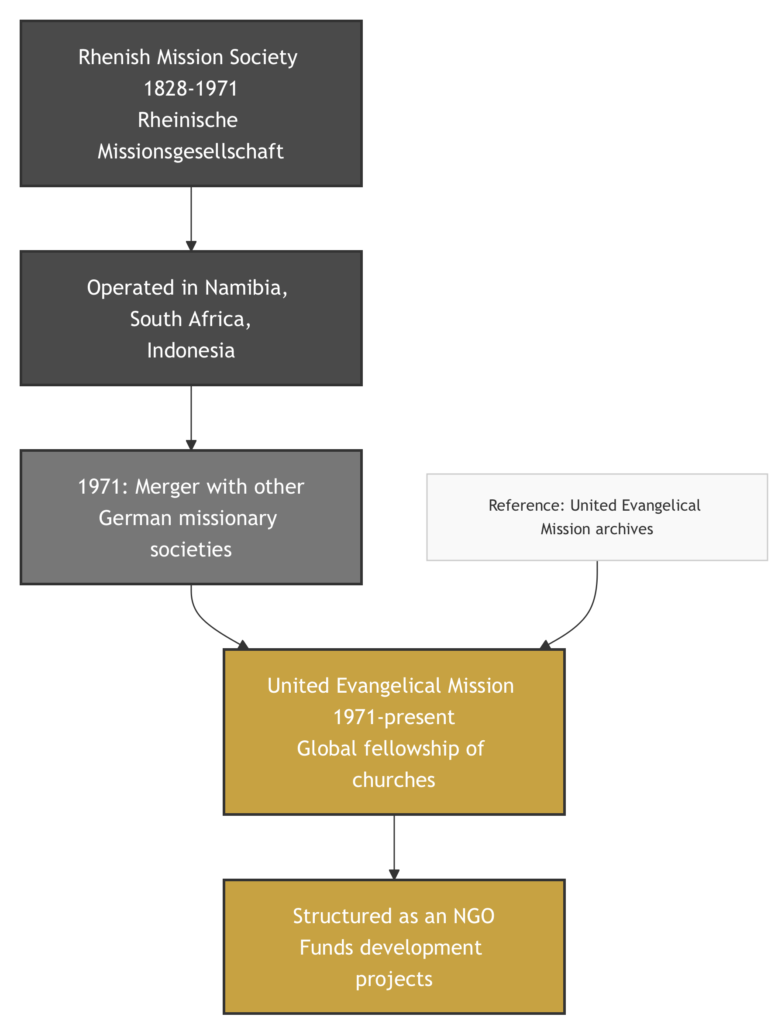
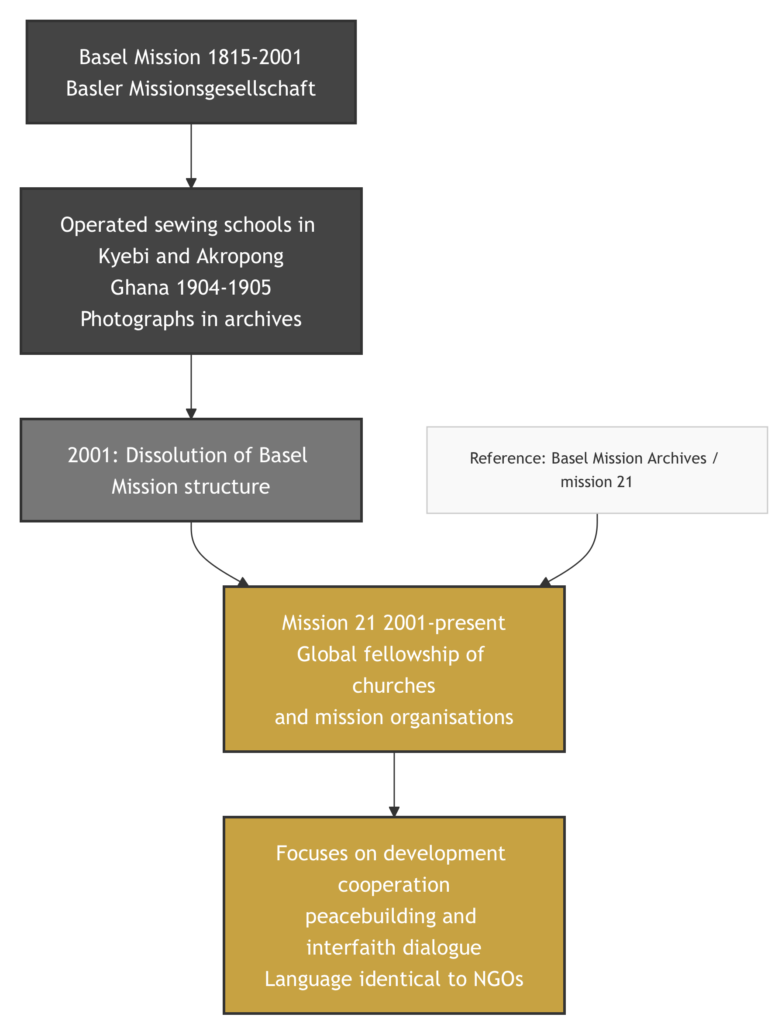
The Paris Evangelical Missionary Society (PMES, founded 1822) is now Défap, a French Protestant mission agency that funds development projects in Africa (Défap, n.d.). The Rhenish Mission Society (1828) is now the United Evangelical Mission, a global fellowship of churches that describes itself as a “development cooperation” organisation (UEM, n.d.). The Danish Mission Society (1821) is now Danmission, which runs development programmes in Tanzania, Nepal, and the Middle East (Danmission, n.d.). The Leipzig Mission (1836) is now part of EMS (Evangelisches Missionswerk), a German development agency (EMS, n.d.). The Methodists, the Baptists, the Presbyterians, the Lutherans—all built schools. All taught sewing. All now run NGOs.

The significance of these institutional transformations is not theological but organisational. In several cases, contemporary development agencies are not merely inspired by historical missionary organisations; they are their direct descendants. The question therefore becomes whether institutional missions changed only in language, or whether they also changed in their underlying relationship to power, governance, and economic control.

Diagram 2: Missionary to NGO Transition (Decision Path Diagram)

The framework was always economic. The plantation needed enslaved labour. The missionary school needed trained labour for the colonial administration. The NGO needs donor funding to survive. The artisan is the raw material in each phase. The institution captures the value. The worker remains at the bottom.

The language changed. The Paris Evangelical Missionary Society spoke of “spreading the Gospel.” Défap speaks of “development cooperation.” The Rhenish Mission spoke of “saving souls.” UEM speaks of “capacity building.” The Danish Mission spoke of “civilising the heathen.” Danmission speaks of “empowerment.” The words are new. The structure is the same.

The NGO Economy

The modern NGO is often presented as a temporary institution designed to address a specific social or economic challenge. Yet throughout Africa, NGOs have become permanent actors within local economies. They employ staff, manage grants, commission research, influence policy, broker market access, organise production, and shape development priorities.

This has produced what may be described as an NGO economy: an ecosystem sustained through the continuous circulation of donor funding, development projects, beneficiaries, consultants, auditors, programme officers, monitoring specialists, and international partners.

The issue is not whether NGOs perform useful work. Many undoubtedly do. The question is whether institutional incentives favour the production of independent owners or the continuous reproduction of beneficiaries.

A successful textile entrepreneur eventually ceases to require an empowerment programme. A cooperative that controls its own production, branding, intellectual property, and export relationships eventually ceases to require an intermediary. Yet development success is often measured by the number of beneficiaries reached rather than the number of beneficiaries who cease to be beneficiaries altogether.

The distinction matters. Beneficiary-centred systems reproduce participation. Ownership-centred systems reproduce power.

The framework was always economic. The plantation needed enslaved labour. The missionary school needed trained labour for the colonial administration. The NGO needs donor funding to survive. The artisan is the raw material in each phase. The institution captures the value. The worker remains at the bottom.

The Persistence of External Control

Across multiple historical periods, decision-making authority frequently remained external to the communities whose labour sustained the system. Under plantation slavery, ownership and capital accumulation were concentrated in Europe. Under colonial administration, policy and economic planning remained external. Under many contemporary development programmes, strategic authority often remains concentrated among donors, boards, international agencies, certification bodies, and programme managers located outside the communities being served.

Table

SystemLabourDecision MakingOwnershipValue Capture
PlantationAfricansEuropeEuropeEurope
Mission SchoolAfricansMission BoardMission BoardMission Institution
Colonial EconomyAfricansColonial StateColonial StateMetropole
NGO ProgrammeAfricansNGO/Donor NetworkNGO/BoardMixed
CooperativeMembersMembersMembers

Secular NGOs: New Institutions, Familiar Questions

Not all organisations working in African textiles follow the extractive model. Some are cooperatives. Some are artisan-owned. The distinction matters.

Espace Tissage Djougou (ETD) in Benin is a women-led weaving cooperative. It preserves the lokpa openwork fabric tradition. It is a partner in the EU-OACPS Business-Friendly Programme. The cooperative has 508 beneficiaries working through 18 cooperatives and 14 fashion brands. The stated mission is to preserve ancestral know-how and empower rural girls. The structure is a cooperative. The artisans are members, not employees. This is a different model. The value is shared.

Most NGOs, however, do not operate this way.

The ITC Ethical Fashion Initiative is a programme of the United Nations and the World Trade Organization. It operates in Burkina Faso, Mali, Benin, Kenya, and Zambia. It connects artisans to international fashion brands including Stella Jean and Vivienne Westwood. The language is “ethical fashion,” “sustainability,” “market access.” The artisans are members of cooperatives. The governance is not in their hands. The UN agency controls the buyer relationships, the quality standards, and the brand.

Maisha by Nisria in Nakuru, Kenya, trains vulnerable women, single mothers, refugees, and persons with disabilities in sewing and fashion design. The language is “empowerment,” “conscious engagement,” “sustainability.” The organisation is a registered non-profit. The women are trainees. The decisions about funding, programming, and branding are made by the non-profit’s leadership, not by the women.

Unkara Fashion is a US-registered 501(c)(3) non-profit operating in Kenya. It trains women fashion designers in underprivileged communities and promotes indigenous textile culture including batik dyeing techniques. The language is “financial inclusion,” “sustainable income,” “indigenous textile culture.” The organisation has a US board of directors. The women are trainees. The intellectual property of the training materials and the brand belong to the US non-profit.

WEL NGO (Women Entrepreneurs & Leaders) in Côte d’Ivoire trains low-income and vulnerable women in sewing and handmade goods. The language is “economic empowerment,” “African culture,” “income generating activities.” The organisation is an NGO partnered with Koné Consulting. The women are beneficiaries. They do not control the organisation.

These NGOs are not descended from missionaries. They are new. These organisations differ in history, mission, and intent. The relevant question is not whether they are exploitative, but whether beneficiaries exercise meaningful ownership over governance, intellectual property, buyer relationships, and long-term capital accumulation. The answer varies by institution and deserves closer examination.

The beneficiaries are not owners. The decision-makers are not local. The NGO captures the brand, the donor relationships, and the market access. The artisan receives training and wages. The value leaves. The pyramid remains.

The Cooperative Alternative

The cooperative model in Benin shows a different path. Artisan ownership. Shared governance. Value retained locally. The difference is not the product. The difference is who controls the organisation.

The significance of the Benin case is not that it is perfect. Its significance is that it shifts the position of the artisan from beneficiary to member. The distinction is fundamental. Beneficiaries receive programmes. Members exercise governance. Beneficiaries participate in projects. Members participate in ownership.

The religious language is gone. “Saving souls” became “empowerment.” “Civilising mission” became “capacity building.” “Conversion” became “financial inclusion.” The words are new. The extractive structure remains.

Beneficiaries Without Ownership

How many beneficiaries became exporters?
How many became factory owners?
How many became brand owners?
How many became machinery manufacturers?
How many became employers?

Across the development sector, success is often measured through outputs: workshops conducted, trainees reached, women empowered, livelihoods supported. Far less attention is paid to ownership outcomes. Who controls the assets created? Who accumulates capital? Who acquires market power? Who determines future strategy?

How NGOs Use Labour

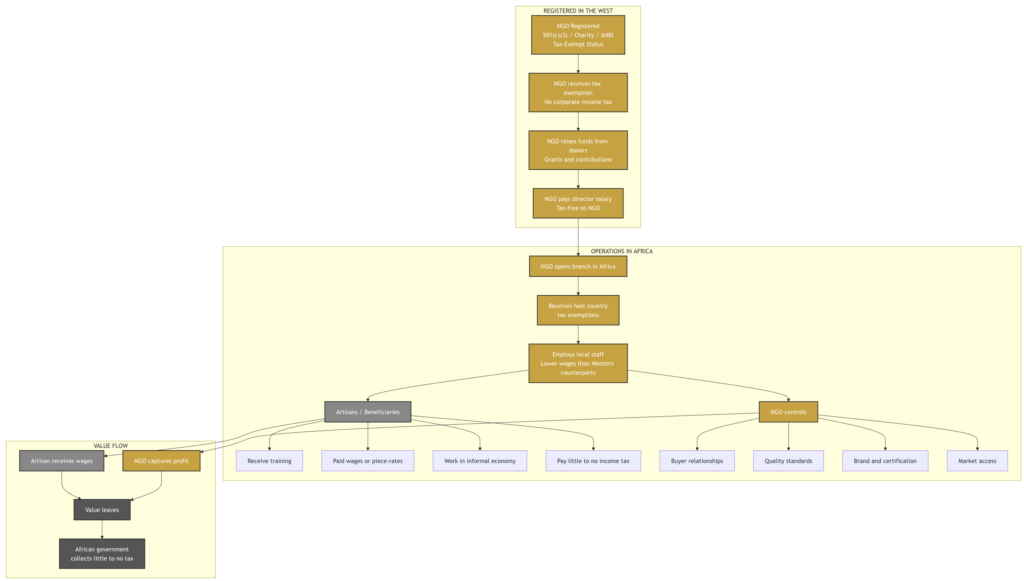
The NGO registers in a Western country. In the United States, it files for 501(c)(3) status, becoming exempt from federal corporate income tax (IRS, n.d.). In the United Kingdom, it registers as a charity, exempt from corporation tax (UK Government, n.d.). In the Netherlands, it registers as an ANBI, exempt from corporate tax and in some cases VAT (Dutch Tax Administration, n.d.). In Switzerland, it registers at the cantonal level, exempt from federal, cantonal, and municipal taxes (Swiss Federal Tax Administration, n.d.).

The NGO then opens a branch in an African country. It receives tax exemptions from the host government. It pays little to no corporate tax on its local activities. It employs local staff, often at lower wages than Western staff. It trains artisans. It organises production. It exports finished goods.

Diagram 3: NGO Value Pyramid (Decision Path Diagram)

[Place diagram here showing NGO at top, intermediaries in middle, artisans at bottom.]

The artisans are paid wages or piece-rates. They work in the informal economy. They pay little to no income tax. Their labour is the raw material of the NGO’s programmes. Their faces appear in annual reports. Their names are rarely listed. Their designs are not protected. Their knowledge is not owned by them.

The NGO sells the handicrafts through fair trade catalogues, online shops, and ethical fashion platforms. In the United States, if the sales are considered a regular commercial activity, Unrelated Business Income Tax (UBIT) applies at 21 percent (IRS, n.d.). But many NGOs avoid UBIT by arguing that the sales are “substantially related” to their charitable mission.

The NGO director receives a salary from the tax-free revenue. The salary is paid from the profits of the artisans’ labour. The director pays personal income tax. The NGO pays nothing. The artisan receives wages. The African government collects nothing. The Western government collects little to nothing. The value leaves.

The local market model works differently. Artisans sell directly to tourists and local consumers (University of Nairobi, 2010). There is no NGO intermediary. There is no fair trade certification. There is no tax exemption. The artisan keeps the majority of the sale price. She pays market fees. The local government collects revenue. The value stays.

The NGO model is not designed for the artisan. It is designed for the NGO. The pyramid is upside down. The largest piece goes to the top. The smallest piece goes to the bottom.

The framework did not end. It rebranded. The names changed. The pyramid did not.

But the cooperative in Benin shows that it could be different.

The thread has not been broken.

References

Basel Mission Archives / mission 21. “Nähschule in Kyebi (Sewing class in Kyebi).” Reference: D-30.13.039. Available at: https://bmarchives.org/items/show/56603
Basel Mission Archives / mission 21. “Nähschule in Akropong 1904 (Sewing school in Akropong 1904).” Reference: QD-30.106.0153. Available at: https://bmarchives.org/items/show/71875
Caley, Maria A. N. “The Modernized Traditional Dress of the Aawambo.” University of Turku.
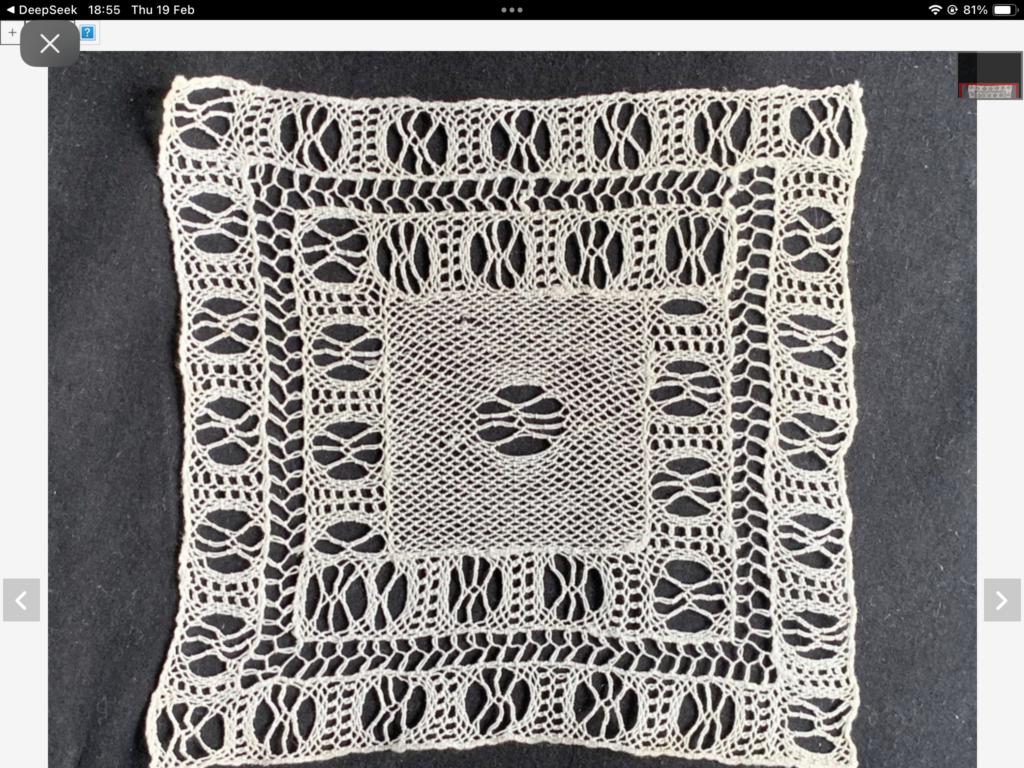
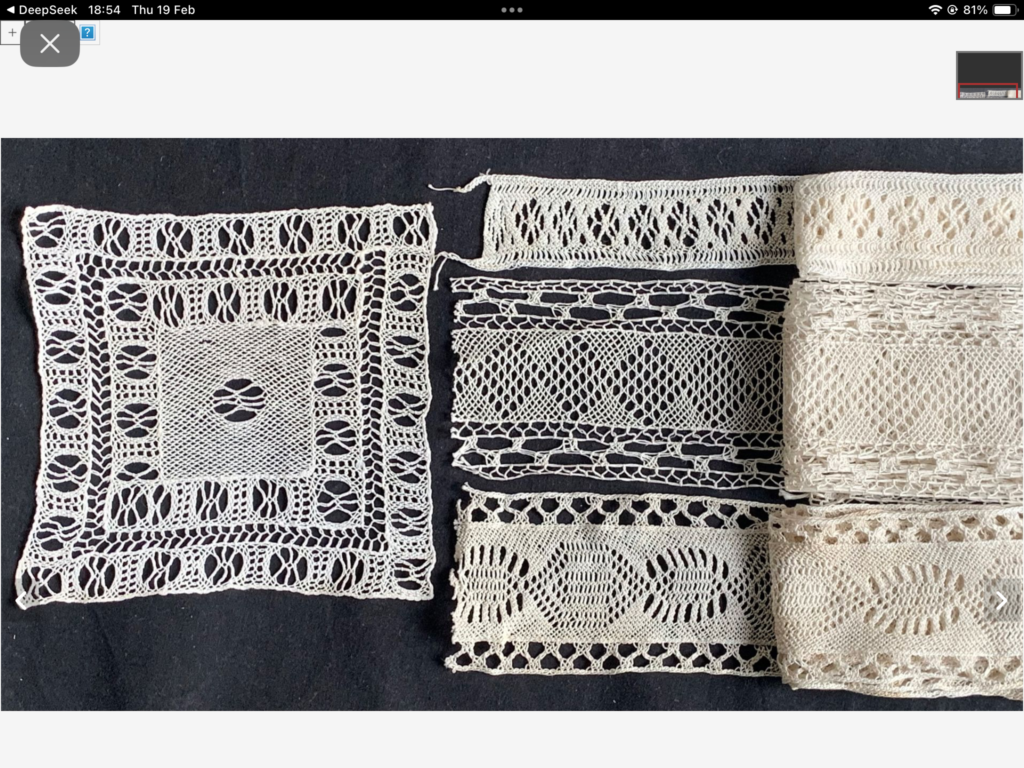
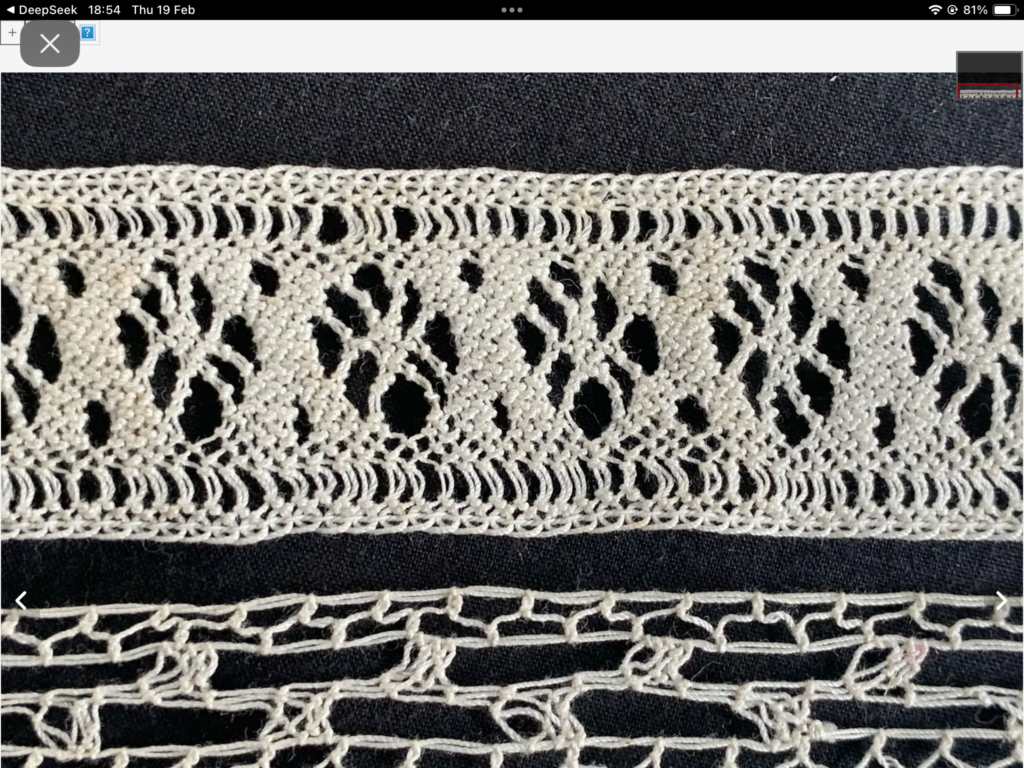
Coutau-Bégarie Auction House. “Three entre-deux and one carré in Chebka lace, North Africa, late 19th/early 20th century.” Lot 129. Available at: https://coutaubegarie.com/en/lot/157092/26525906
Danmission. “About Danmission.” Available at: https://danmission.dk
Défap. “Service Protestant de Mission.” Available at: https://defap.fr
Dutch Tax Administration. “ANBI - Public Benefit Organisations.” Available at: https://www.belastingdienst.nl/anbi
EMS (Evangelisches Missionswerk). “About EMS.” Available at: https://www.ems-online.org
Espace Tissage Djougou (ETD). “Preserving lokpa openwork fabric tradition.” EU-OACPS Business-Friendly Programme. Available at: https://www.businessfriendly.org/etd-benin
Fulham Palace. “Church of England’s plantations in Barbados.” 13 March 2023. Available at: https://www.fulhampalace.org/resistance/church-of-england-plantations/
IRS. “Exemption Requirements - Section 501(c)(3) Organizations.” Available at: https://www.irs.gov/charities-non-profits/charitable-organizations/exemption-requirements-section-501c3-organizations
IRS. “Unrelated Business Income Tax.” Available at: https://www.irs.gov/charities-non-profits/unrelated-business-income-tax
ITC Ethical Fashion Initiative. “CABES Burkina Faso.” Available at: https://ethicalfashioninitiative.org
Kinghorn, Alice. “The Church of England and the West India Interest.” PhD thesis, University of Bristol, 2019.
Maisha by Nisria. Available at: https://maishabynisria.org
McLean-Farrell, Janice, and Michael Anderson Clarke. “Missions in Contested Places/Spaces: The SPG, Slavery, and Codrington College, Barbados.” Mission Studies, 2021.
Mission 21. Available at: https://mission-21.org
Monk, Matthew, and Linda Eaton. “A Sampler’s Story from Sierra Leone.” Winterthur Museum, 5 September 2025. Available at: https://www.winterthur.org/blog/a-samplers-story-from-sierra-leone
Porte Brown. “Watch for UBIT When Your Nonprofit Pursues New Activities.” 2025.
Strickrodt, Silke. “African Girls’ Samplers from Mission Schools in Sierra Leone (1820s to 1840s).” History in Africa, 2010;37:189-245.
Swiss Federal Tax Administration. “Taxation of Non-Profit Organisations.” Available at: https://www.estv.admin.ch
TRC Leiden. “Embroidery and the White Sisters.” 29 June 2015. Available at: https://trc-leiden.nl/trc-needles/regional-traditions/middle-east-and-north-africa/pre-modern-middle-east-and-north-africa/embroidery-and-the-white-sisters
UK Government. “Charities and tax.” Available at: https://www.gov.uk/charities-and-tax
United Evangelical Mission (UEM). “About UEM.” Available at: https://uem-partnership.org
University College London. “Legacies of British Slavery: Clapham Sect.” Available at: https://www.ucl.ac.uk/lbs/
University of Nairobi. “Access to E-Commerce in the Ethical trade Arena: A Case study of Artisans in Kenya.” 2010. Available at: https://erepository.uonbi.ac.ke
Unkara Fashion. Available at: https://unkarafashion.org
USPG (United Society Partners in the Gospel). “About USPG.” Available at: https://uspg.org.uk
WEL NGO African Arts Creation. Available at: https://wel-ngo.org
Winterthur Museum, Garden & Library. “Sampler by Lucy Davis.” Object number 2018.0007. Available at: http://museumcollection.winterthur.org/single-record.php?recid=2018.0007

Image Sources

Basel Mission Archives. “Nähschule in Kyebi (Ghana).” https://bmarchives.org/items/show/56603
Basel Mission Archives. “Nähschule in Akropong (Ghana).” https://bmarchives.org/items/show/71875
TRC Leiden. “White Sisters teaching lace making.” https://trc-leiden.nl/trc-needles
Coutau-Bégarie Auction House. Chebka lace collection. https://coutaubegarie.com
Winterthur Museum. Sampler by Lucy Davis. http://museumcollection.winterthur.org/single-record.php?recid=2018.0007
International Mission Photography Archive (USC). Mission sewing archives. https://digitallibrary.usc.edu
Yale Divinity Library. Raphia weaving missions archive. https://collections.library.yale.edu
Mennonite Archives. Sewing class Zaire. https://archives.mennonite.net
United Church of Canada Archives. Sewing school Japan. https://archives.unitedchurch.ca

Additional Academic References

Political Economy, Dependency and Colonial Continuity

Rodney, Walter. How Europe Underdeveloped Africa. Dar es Salaam: Tanzania Publishing House, 1972.

Nkrumah, Kwame. Neo-Colonialism: The Last Stage of Imperialism. London: Thomas Nelson & Sons, 1965.

Amin, Samir. Unequal Development: An Essay on the Social Formations of Peripheral Capitalism. New York: Monthly Review Press, 1976.

Amin, Samir. Accumulation on a World Scale: A Critique of the Theory of Underdevelopment. New York: Monthly Review Press, 1974.

Beckford, George L. Persistent Poverty: Underdevelopment in Plantation Economies of the Third World. New York: Oxford University Press, 1972.

Best, Lloyd. Essays on the Theory of Plantation Economy. Mona: Institute of Social and Economic Research, University of the West Indies.

Girvan, Norman. The Caribbean Dependency Tradition: From New World Group to the Present. Kingston: Ian Randle Publishers.

Beckles, Hilary. Britain’s Black Debt: Reparations for Caribbean Slavery and Native Genocide. Kingston: University of the West Indies Press, 2013.

NGO Critique and Development Studies

Manji, Firoze and Carl O’Coill. “The Missionary Position: NGOs and Development in Africa.” International Affairs 78, no. 3 (2002): 567–583.

Escobar, Arturo. Encountering Development: The Making and Unmaking of the Third World. Princeton: Princeton University Press, 1995.

Ferguson, James. The Anti-Politics Machine: Development, Depoliticization and Bureaucratic Power in Lesotho. Minneapolis: University of Minnesota Press, 1990.

Fowler, Alan. Striking a Balance: A Guide to Enhancing the Effectiveness of Non-Governmental Organisations in International Development. London: Earthscan, 1997.

Edwards, Michael. Civil Society. Cambridge: Polity Press, 2014.

Moyo, Dambisa. Dead Aid: Why Aid Is Not Working and How There Is Another Way for Africa. New York: Farrar, Straus and Giroux, 2009.

African Development Thought

Ake, Claude. Democracy and Development in Africa. Washington DC: Brookings Institution Press, 1996.

Mkandawire, Thandika. African Intellectuals: Rethinking Politics, Language, Gender and Development. London: Zed Books, 2005.

Mazrui, Ali A. The Africans: A Triple Heritage. London: BBC Publications, 1986.

Mafeje, Archie. Africanity: A Combative Ontology. Dakar: CODESRIA, 2008.

Ayittey, George B.N. Indigenous African Institutions. Ardsley, NY: Transnational Publishers, 1991.

Olukoshi, Adebayo. The Politics of Opposition in Contemporary Africa. Uppsala: Nordic Africa Institute, 1998.

African Textiles, Craft Economies and Cultural Production

Rovine, Victoria L. African Fashion, Global Style: Histories, Innovations and Ideas You Can Wear. Bloomington: Indiana University Press, 2015.

Rovine, Victoria L. Bogolan: Shaping Culture Through Cloth in Contemporary Mali. Washington DC: Smithsonian Institution Press, 2001.

Picton, John and John Mack. African Textiles. London: British Museum Press, 1989.

Boone, Sylvia Ardyn. Radiance from the Waters: Ideals of Feminine Beauty in Mende Art. New Haven: Yale University Press, 1986.

Asante, Molefi Kete. Afrocentricity: The Theory of Social Change. Chicago: African American Images, 2003.

Cooperative Governance and Ownership

Ostrom, Elinor. Governing the Commons: The Evolution of Institutions for Collective Action. Cambridge: Cambridge University Press, 1990.

Ostrom, Elinor. Understanding Institutional Diversity. Princeton: Princeton University Press, 2005.

.

“Though we are black, and mean, and vile”:The Unbroken Thread: Colonial Extraction, from Plantation to NGOs. Part 1: The Sampler & the Sewing Machine; Missionary Education and the Erasure of African Textile Knowledge

The Photograph and the Sampler

There is a photograph taken circa 1930 in Burkina Faso. It shows White Sisters teaching local girls "Western European embroidery." The scene appears benevolent, but here is what it does not show.

The same nuns, in North Africa, taught Chebka lace. Chebka is not European. It is North African, a sophisticated indigenous needle-knotted stitch. Yet it was extracted, renamed, and taught back to Africans as European knowledge. This was not cultural exchange, it was erasure by design.

In a museum in Delaware, a small piece of linen holds a confession. The sampler was stitched on January 3, 1843, by a Black African girl named Lucy Davis at a Church Missionary Society (CMS) school in Freetown, Sierra Leone. Her needlework features a verse from a hymn published in The Missionary Repository for Youth:

"We love the Lord he came to save

Poor negro from the sinner's grave,

Though we are black, and mean, and vile,

Lord Jesus on poor negro smile.

We love him, and we would not break

The least command our Saviour spake,

But pray him, by his precious blood,

To make us humble, faithful, good."

The child is not learning to read, she is learning to recite her own inferiority. Stitched into fabric, made permanent, displayed as evidence of successful missionary education. The Lucy Davis sampler sold at auction in 2018 for $3,840. The auction house catalogue described it as "rare" and noted an "intentional cross-stitch error.

The Winterthur Museum, which holds the sampler, calls it a reflection of "the paradox of colonial education." Paradox suggests two truths held together. This is not paradox. This is psychological warfare conducted with thread. They acknowledge that missionaries used such literature to "Christianize and anglicize African youth and reinforce British colonial hierarchies of race and class."

The chain of teachers who trained Lucy Davis is revealing. Jane Hickson Boston Young (1810-1841) was an African woman educated at a CMS school in the Rio Pongo region (now Guinea). She learned needlework from an African American woman who had been resettled in Africa after the American Revolution. That woman was formerly enslaved. She had survived the Middle Passage, or been born into slavery in the Americas, and had chosen to return to Africa. She was a returnee.

Formerly enslaved African American woman → Jane Young (African woman) → Liberated African women → Lucy Davis (Black African girl)

The missionaries controlled the institution, the curriculum was theirs. The shame was theirs. But the instructors were not all white. Some were Black women who had navigated the same system of extraction and found a way to survive yet became complicit to that same system.

The Church Missionary Society was not the only missionary organisation operating in Africa. The Society for the Propagation of the Gospel (SPG) was older, richer, and more directly entangled with slavery. Founded in 1701, the SPG owned the Codrington Plantation in Barbados. The bequest that established the college explicitly required that 300 enslaved people be kept in perpetual bondage to support the institution.

The Barbadian scholar Janice McLean-Farrell documents that the SPG's "troubling missionizing principles advanced oppressive colonial structures, while failing to fully develop the personhood, agency, and full emancipation of the oppressed." The education of Black people was not altruistic. It was designed to make them obedient and hardworking labourers for the colonial economy.

Some enslaved and free Black people became complicit, they were trained, they were educated. They became teachers, catechists, and petty administrators. They enforced the rules, they taught the curriculum. This complicity is real, and it continues today in different forms.

Diagram 1: SPG → USPG

The White Sisters and the Lace That Left

In Burkina Faso, in 1930, the White Sisters taught local girls "Western European embroidery." The photograph shows the scene. The TRC Leiden notes that many items were sold to support the missionary schools. Some regard this as "colonial exploitation at a level near to slavery."

But the more sophisticated extraction happened in North Africa. Chebka lace is a needle-knotted stitch originating in North Africa. It was first practiced in Tunisia by individual women to adorn their traditional garments. Under the impetus of missionary nuns, the technique was developed further in Algeria and Morocco. The French protectorate encouraged its development because it found an important market in France.

Chebka lace creations were adapted to the French market. They produced collars, bibs, and doilies. The technique was extracted, renamed, and taught back to Africans as something valuable because Europeans valued it. The labour was African. The market was French. The profit was European. The original practitioners were not credited.

Diagram 2: White Fathers / White Sisters → Caritas

The Basel Mission Sewing Schools

In Ghana, the Basel Mission operated sewing schools in Kyebi and Akropong. The photographs from 1904-1905 show African girls learning needlework under missionary supervision. The curriculum taught European techniques, European garment construction, and European aesthetics as superior.

The Basel Mission formally dissolved its missionary sending structure in 2001. It was replaced by Mission 21, a global fellowship of churches and mission organisations based in Basel. Mission 21 focuses on "development cooperation, peacebuilding, and interfaith dialogue"—language indistinguishable from NGOs.

Diagram 3: Basel Mission → Mission 21

The Lost

While African girls were learning to sew European embroidery, their own textile systems were going extinct.

In Buganda (Uganda), the Baganda had a thriving barkcloth industry. Barkcloth is made from fig trees. It is an indigenous fabric, not woven but beaten. The missionaries actively discouraged its use. They promoted the "clean shirt" or "white shirt" ideology, arguing that before the Western God, all people are alike if they keep their bodies clean—which the missionaries interpreted as "white." The result was the demise of the Baganda barkcloth industry.

In Namibia, among the Aawambo people, the Finnish missionaries taught that traditional costumes and ornaments were "heathen objects." The locals were persuaded to burn their traditional clothes. Sabina David states: "people eventually did away with traditional clothes and burned them." The imported European dress code has "no similarity or relevance to Aawambo cultural beliefs or lifestyle."

In the Democratic Republic of Congo, Kuba raffia textiles, cut-pile embroidery ("velvet raffia"), and other techniques declined. The colonial economy had no use for raffia. It could not be exported in bulk. It could not be processed in European factories. So it was ignored. Its knowledge system was not protected.

The pattern is consistent across the continent, the method is extraction, the tool is thread.

The Continuum: From Slave Owners to Missionaries to NGOs

The missionary organisations did not disappear, they rebranded.

· The SPG that owned slaves in Barbados is now USPG, a development NGO funding health, education, and advocacy projects.

· The Basel Mission that taught sewing in Ghana is now Mission 21, a global fellowship for "development cooperation."

· The White Sisters who taught lace making in Burkina Faso now work through Caritas Africa and Secours Catholique.

The names changed, the structure did not, the extraction continued. Only the language changed—from "saving souls" to "sustainable development," from "civilising mission" to "capacity building," from "conversion" to "empowerment."

Diagram 4: Labour Extraction Timeline

The missionaries did not come to teach Africans to sew for themselves. They came to teach Africans to sew for Europe. The hats, the lace, the embroidered cloth these were not for local use. They were for export. The labour was African, the profit was European. They have been actively creating skilled labour according to their needs, as time passes, Europeans come and extract labour under a variety of disguises, the main disguise being NGO’s

The same people who told Lucy Davis that she was "black, and mean, and vile" took the products of her hands and sold them abroad. The shame was not the end, It was the means. Convince the worker she is inferior, then extract her labour, then sell it back to her as charity.

The thread has not been broken. Read about this in Part 2: The Value Pyramid - Why the Artisan remains at the bottom.


References

· Basel Mission Archives / mission 21. "Nähschule in Kyebi (Sewing class in Kyebi)." Reference: D-30.13.039. https://bmarchives.org/items/show/56603
· Basel Mission Archives / mission 21. "Nähschule in Akropong 1904 (Sewing school in Akropong 1904)." Reference: QD-30.106.0153. https://bmarchives.org/items/show/71875
· Caley, Maria A. N. "The Modernized Traditional Dress of the Aawambo." University of Turku.
· Coutau-Bégarie Auction House. "Three entre-deux and one carré in Chebka lace, North Africa, late 19th/early 20th century." Lot 129. https://coutaubegarie.com/en/lot/157092/26525906
· Fulham Palace. "Church of England's plantations in Barbados." 13 March 2023. https://www.fulhampalace.org/resistance/church-of-england-plantations/
· McLean-Farrell, Janice, and Michael Anderson Clarke. "Missions in Contested Places/Spaces: The SPG, Slavery, and Codrington College, Barbados." Mission Studies, 2021.
· Mission 21. https://mission-21.org
· Monk, Matthew, and Linda Eaton. "A Sampler's Story from Sierra Leone." Winterthur Museum, 5 September 2025. https://www.winterthur.org/blog/a-samplers-story-from-sierra-leone
· Strickrodt, Silke. "African Girls' Samplers from Mission Schools in Sierra Leone (1820s to 1840s)." History in Africa, 2010;37:189-245.
· TRC Leiden. "Embroidery and the White Sisters." 29 June 2015. https://trc-leiden.nl/trc-needles/regional-traditions/middle-east-and-north-africa/pre-modern-middle-east-and-north-africa/embroidery-and-the-white-sisters
· USPG (United Society Partners in the Gospel). "About USPG." https://uspg.org.uk
· Winterthur Museum, Garden & Library. "Sampler by Lucy Davis." Object number 2018.0007. http://museumcollection.winterthur.org/single-record.php?recid=2018.0007


Image Sources

· Winterthur Museum. "Sampler by Lucy Davis." Object number 2018.0007. http://museumcollection.winterthur.org/single-record.php?recid=2018.0007
· TRC Leiden. "White Sisters teaching lace making, Burkina Faso, 1930." https://trc-leiden.nl/trc-needles/regional-traditions/middle-east-and-north-africa/pre-modern-middle-east-and-north-africa/embroidery-and-the-white-sisters
· Coutau-Bégarie Auction House. "Chebka lace pieces, North Africa, late 19th/early 20th century." Lot 129. https://coutaubegarie.com/en/lot/157092/26525906
· Basel Mission Archives. "Nähschule in Kyebi (Sewing class in Kyebi, Ghana, 1905)." Reference: D-30.13.039. https://bmarchives.org/items/show/56603
· Basel Mission Archives. "Nähschule in Akropong 1904 (Sewing school in Akropong, Ghana, 1904)." Reference: QD-30.106.0153. https://bmarchives.org/items/show/71875
· Mary Evans Picture Library / Media Storehouse. "Arab children in an embroidery school, Algiers, Algeria, c. 1920." https://www.mediastorehouse.co.uk/mary-evans-prints-online/arab-children-embroidery-school-algiers-algeria-14257618.html
· International Mission Photography Archive. "Les Soeurs Bleues de Castres Au Gabon." Reference: impa-m12751. https://digitallibrary.usc.edu/asset-management/2A3BF1E5J4RX
· Pearl Digital Collections, Presbyterian Historical Society. "A missionary nun trains a Malian woman in the use of a loom." Caption number C-46651. 14 August 1973. https://digital.history.pcusa.org/islandora/object/islandora%3A123456
· University of Southern California. Libraries. "Mission sewing class in Brazzaville, Congo, circa 1920-1940." https://dp.la/item/df6d2427c1d3a832fd0caa1cf129e59b
· Yale Divinity Library. "Missies der PP. v. d. H. Geest - Missions des PP. du St. Esprit. -- Het bewerken van de raphia te Lubunda." https://collections.library.yale.edu/catalog/12345678
· Mennonite Archival Information Database. "Sewing Class at Kajiji Missions School, Zaire, 1983." Reference: 8bec-dk3a-4bnk. https://archives.mennonite.net
· Africa Commons / University of Southern California. Libraries. "Needlework exhibition at Ntoma Home Craft School, Tanzania, 1980." Reference: impa-c123-100957. https://africacommons.net
· International Mission Photography Archive. "Leçon de couture, Mme Lenoir. École de Makulane, Mozambique, August 1901." Reference: impa-m59014. https://digitallibrary.usc.edu/asset-management/2A3BF1E5J4RY
· United Church of Canada Archives. "Cartmell Sewing School, Japan, circa 1910s." Reference: 2000.017P/2959. https://archives.unitedchurch.ca


Terraforming Africa: Resilience in Thread-Part 2: The Pre-colonial Fibre, The Sheep That Survived, The Wool That Endures

Ethiopia has over 80 ethnic groups and approximately 30 million sheep, one of the largest populations in Africa. The country has more than fourteen local sheep breeds, with several producing wool suitable for textile applications. The indigenous wool-producing breeds include Washera, Menz, Farta, Tikur, and Wollo.

The Bernos is a traditional dark wool cloak worn by Amhara men in the Ethiopian highlands. It has a large point on one side of the shoulder designed to keep a rifle in place. Wealthier men of Menz wore it as a sign of status. Today it is worn during traditional ceremonies and special occasions. The Gabi is a thicker, warm garment made from four layers of fabric, worn by both men and women, mainly by the Amhara in cold high-altitude regions. Clergy and elderly people wear it frequently. Amhara women spin the yarn together and present the finished Gabis as gifts to their husbands.

Ethiopian wool fibre from indigenous breeds has been studied by Ethiopian researchers. Liyew and Adamu (2023) found that the wool fibre from Washera, Menz, Farta, and Tikur breeds has good fibre yield and moisture regain properties, making it suitable for manufacturing wool products including rugs, socks, sweaters, quilts, and mattresses. The wool fibre yield for Washera males was 89.29 percent. For Menz males it was 88.29 percent. For Farta males it was 73.33 percent. For Tikur males it was 81.74 percent.

Sitotaw, Woldemariam, and Tesema (2020) investigated the physical properties of wool fibre from Menz, Wollo, Farta, and Tikur breeds. The results revealed that these properties are significantly different from each other. The wool fibre from Ethiopian sheep breeds is suitable for textile production and should be classified based on breed for different textile applications. Sitotaw, Tesema, and Woldemariam (2021) found that fineness and strength of wool fibres varied significantly within each breed and among breeds. Ethiopian sheep wool fibre is suitable for numerous types of classical and technical applications, including suits, blankets, shirts, and carpets.

The rinderpest virus entered Ethiopia in 1887 after Italian forces landed in Eritrea with infected Indian cattle. The virus spread through the northern provinces of Tigray and Shewa before moving south. It killed approximately 90 percent of the country's cattle population and decimated wild buffalo, antelopes, and giraffes. The sources confirm that sheep and goats died in massive numbers as well.

An estimated one third of the Ethiopian population died from starvation following the loss of livestock. The rinderpest virus does not infect humans. The people starved because their cattle died, their sheep died, their goats died. The oxen that pulled ploughs were gone. The animals that fertilized crops with dung were gone. The food supply collapsed.

An Ethiopian poem from the 1890s documents the devastation. The poet writes: "I came from there to here without seeing an ox." The line has a double meaning: "I came from there to here over dead bodies." Families sold their children into slavery. Smallpox broke out. Starving people ate the skins of decomposed cattle, then leaves and roots, then animal dung. Lions, leopards, and hyenas began attacking and killing people in broad daylight.

The Borana people of southern Ethiopia call the rinderpest pandemic ciinna tiittee guuracha — "the extermination of cattle whose corpses were covered by swarms of black flies." For the Borana, whose economy was based entirely on cattle, the pandemic was "the worst time in Borana history, which we do not want to be reminded of, but which we also cannot forget."

After the conquest of Ethiopia in 1935, the Italian fascist government planned a "demographic colonization" of the country. Haile M. Larebo, an Ethiopian scholar, has documented this extensively. The fascist objective was to divert Italian migration from the Americas to the newly conquered Ethiopia. This would solve Italy's "surplus population" problem while providing cheap materials for Italian industry and a protected market for Italian products.

Mussolini boasted that Italy had finally joined the ranks of the "satisfied" nations and had "at last got an empire of her own." Fascist leaders spoke of moving 6,250,000 Italians within a short period. Marshal Pietro Badoglio declared it was "not an exaggeration" to envisage the shipment of one million settlers within a year. Haile Selassie's private estates were confiscated for the establishment of agricultural colonies. Black Shirts remaining in Abyssinia were to be the first colonists.

The Italians introduced the rinderpest. The rinderpest killed the cattle, the sheep, the goats. The famine killed an estimated one third of the Ethiopian population. The Italians then planned to move their own settlers into the depopulated land. Mussolini's government confiscated Haile Selassie's private estates for agricultural colonies. Black Shirts were designated as the first colonists. The disease cleared the land. The settlers were meant to take it.

The plan failed. By June 1940, no more than 400 peasants had settled in Ethiopia. Only about 150 had brought their families. When the British forces came to the aid of Ethiopian patriots, Mussolini's East African empire crumbled in less than three months. The settlers abandoned their farms and were repatriated to Italy as paupers. The land remained Ethiopian. The sheep remained Ethiopian. The wool remained Ethiopian.

Ethiopia's textile industry did not collapse. It redesigned itself. The Gabi and the Bernos are still worn. The wool from indigenous sheep is still processed by small-scale enterprises into rugs, socks, sweaters, quilts, and mattresses. The Lemlem project, founded by supermodel Liya Kebede, trains women weavers and produces hand-woven garments for international markets. The wool is grown in Australia, spun in Italy, and woven in Ethiopia. This is not ideal. But it is not extinction.

The Ethiopian government's industrial strategy focuses on cotton, not wool. The industrial parks are built for foreign investors to process cotton for export. The wool sector receives little attention. The Gabi and the Bernos survive without government support. They survive because Ethiopians still wear them. They survive because the women who weave them still teach their daughters. The industry is not dead. It is ignored by policy but alive by choice.

The Macina sheep is an indigenous breed from the Inland Delta of central Mali. It is raised by the Fulani people. The breed produces wool. The Inland Delta of Mali is the only area in Sub-Saharan Africa where wool is traditionally produced on a significant scale.

The wool is traditionally woven into specific categories of textiles. The Niger Bend region spanning Mali and Niger was "the foremost center of technical and visual diversity in West African treadle-loom weaving traditions." The primary wool textiles include the Kaasa, a heavy wool cover that changed significantly in appearance over the 20th century, and the Arkilla, a ceremonial marriage cover that maintained the same design for centuries. Other products include Mopti blankets, carpets, tweed, and felt.

The textile system is intimately linked to the Fulani people who own the sheep. The knowledge is encoded in animal husbandry, material practice, and visual language simultaneously. The Fulani consider wool production important enough that castrated males contribute significantly to their flock numbers.

The rinderpest virus reached the Senegal River by 1891, sweeping through the Sahel corridor that includes the Inland Delta of Mali. The impact on the Macina sheep population specifically is not quantified in the available sources. The broader Sahelian pastoral systems collapsed. The virus was not an act of God. It was an act of war. The Italian army imported infected cattle to feed its campaign against Ethiopia. The virus escaped. It spread across the continent. The Macina sheep were part of that destruction.

The French colonial administration launched specific interventions between the 1920s and 1940s to industrialise the Macina sheep. Wilson's 1981 analysis in the journal Textile History outlines these attempts. The French sought to upgrade local Macina sheep for increased wool production by selection or cross-breeding with Merinos. They attempted to increase goat wool production by crossing imported Angora goats with local goats. They tried to increase pelt production by crossing the local long-haired Black Moor sheep with Karakul (Bokhara) sheep.

A French veterinary student named Georges Hugaud submitted a 1934 thesis titled "Le mouton du Macina, son amélioration en vue de la production lainière" (The Macina Sheep, Its Improvement for Wool Production). The thesis proposed methods for increasing wool yield through cross-breeding with European Merinos.

The attempts failed. The Merino, bred for European climates and intensive management, could not tolerate the environmental conditions of the Inland Delta. The Fulani traditional system of pastoral management did not conform to the industrial model the French attempted to impose.

The French left. The Macina sheep remained. The wool is still woven into Kaasa and Arkilla by Fulani weavers. The garments are still produced, not at industrial levels, but at the level of community, tradition, and survival. The French industrial model failed. The Fulani knowledge system did not.

Today, no industrialisation of Macina sheep wool exists in Mali or Niger. The government strategy in Niger focuses exclusively on meat and live animal exports, not wool processing. The cotton industry dominates the textile sector in both countries. The wool sector receives no policy attention. The Kaasa and Arkilla continue to be woven because the Fulani have not stopped. The industry is not dead. It is ignored by policy but alive by choice.

The Macina sheep population was estimated at 1 million head in 1947, which grew to 2 million by 1985. The most recent available data for Macina sheep in Mali is from 2015, showing a population of 2.9 million head. The sheep recovered. The weavers continued. The wool is still there. The knowledge is still there. The garments are still there.


References

· Liyew, E.Z. & Adamu, B.F. (2023). Wool fiber yield and moisture regain of four Ethiopian sheep breeds. Tropical Animal Health and Production.
· Sitotaw, D.B., Woldemariam, A.H., & Tesema, A.F. (2020). Physical properties of wool fiber from four Ethiopian indigenous sheep breeds. The Journal of The Textile Institute.
· Sitotaw, D.B., Tesema, A.F., & Woldemariam, A.H. (2021). Investigation of wool fiber fineness and strength from pure and cross-breed sheep. Journal of Engineered Fibers and Fabrics.
· Larebo, Haile M. The Building of an Empire: Italian Land Policy and Practice in Ethiopia, 1935-1941.
· Tiki, Waktole & Oba, Gufu. (2009). Ciinna-the Borana Oromo narration of the 1890s Great Rinderpest epizootic. Journal of Eastern African Studies, 3(3), 479-508.
· Wilson, R.T. (1981). Livestock production in central Mali: Attempts to produce raw materials of animal origin for the French textile industry during the colonial period. Textile History, 12, 104-117.
· Gardi, Bernhard and Gilbert, Michelle. (2021). Arkilla, Kaasa, and Nsaa: The Many Influences of Wool Textiles from the Niger Bend in West Africa. The Textile Museum Journal, 48, 24-53.
· Slow Food Foundation. Mouton de Macina - Arca del Gusto.
· Statistic (2025). Niger Sheep Market Report 2026.
· Agriculture and Market News Service (Niger). (2021). Recensement National du Cheptel. Republic of Niger.

THE FEAR OF THE INTERSTICE: ARTHUR LEWIS, THE PLANTATION SCHOOL, AND WHY BLACK LEADERS ARE AFRAID OF THE SPACE BETWEEN EMPIRE COLLAPSE AND SOVEREIGNTY CREATION

There is a fear that runs through African and Caribbean economic policy. It is not named. It is rarely discussed. But it explains why the textile mills closed, why the cotton is still exported raw, why the gold remains in foreign vaults, and why the African Union cannot break from the extractive systems that have strangled the continent for generations. It is the fear of the interstice.

The interstice is the gap left behind when a system withdraws, collapses or is destroyed. Not a void. Not a vacuum waiting to be filled. The West calls it a vacuum. They panic. They rush to fill it with loans, aid, trade agreements, and military bases. Their logic demands that every space be occupied, measured, controlled, by them. African metaphysics has always understood the interstice differently. The Kongo call it the hollow, the printing chamber where realities are imprinted before they emerge. The Akan know the threshold between the living and the ancestors. The Yoruba map the Odu, the space where opposing forces balance. Ubuntu accepts the distance between persons as part of relation. The Mandari name the margin that cannot be utilized.

The interstice is not empty. It is the condition for new creation, for sovereignty, for independence, for liberation.

Yet the architects of African and Caribbean development policy have been terrified of it. Arthur Lewis, the Nobel Prize-winning economist from St. Lucia, built his entire model on avoiding the interstice. His critics, the Plantation School of Lloyd Best, Norman Girvan, and George Beckford, understood that the interstice was necessary, but they could not convince the policymakers. And today, the same fear paralyses the African Union and most heads of state. They negotiate for better terms within the existing system. They do not demand a new system nor prepare for an alternative. Because they are afraid of what happens if the old system withdraws and they are excluded from what comes.

This blog post traces that fear from Lewis to the present, using the textile industry as the thread that runs through the entire story. Because cotton was the colonial crop. And the cloth tells the truth.

ARTHUR LEWIS AND THE REFUSAL OF THE INTERSTICE

Arthur Lewis was born in St. Lucia in 1915. He was the first Black professor at the London School of Economics, the first Black person to hold a full professorship at the University of Manchester, and the first Black winner of the Nobel Prize in Economics. He was a staunch anti-imperialist who had personally taken on the English economic establishment over the West Indies' "right to industrialise" and won. He advised Kwame Nkrumah. He shaped the economic policy of newly independent nations across Africa and the Caribbean.

Yet his model of development was designed to avoid the interstice at all costs.

Lewis's Dual Sector Model, published in his 1954 paper "Economic Development with Unlimited Supplies of Labour," divides the economy into two sectors: a low-productivity subsistence sector (traditional agriculture, crafts, the informal economy) and a high-productivity capitalist sector (modern industry). The model predicts that surplus labour from the subsistence sector will move to the capitalist sector, attracted by higher wages. Industrialization will proceed. Wages will eventually rise. The economy will transform.

Crucially, Lewis saw the subsistence sector as having "unlimited supplies of labour." The marginal productivity of additional workers is zero or even negative. Removing them from farming does not reduce output. This surplus labour can be drawn into the capitalist sector without raising wages, because the subsistence sector provides a constant supply of workers desperate for any wage above survival.

The model assumes that labour will move voluntarily. Workers see higher wages in the factory. They leave the farm. They are replaced by others. The process continues until the surplus labour is exhausted. At that point, wages rise across both sectors, and the economy becomes fully developed.

Lewis did not consider all factors. He assumed that labour would move from one sector to the other without any gap. The subsistence sector would shrink. The capitalist sector would expand. There would be no space between, no pause, no uncertainty. The transfer would be smooth, continuous, and automatic.

The textile industry was central to this vision. Lewis advised Kwame Nkrumah's government in the Gold Coast (now Ghana) in 1953, recommending that the state should "pioneer" industries and then sell them once they became viable. Cotton was the obvious starting point. It was the major cash crop. It could be spun, woven, and printed locally. Foreign capital would be invited in to build the mills. Local labour would leave the farms and enter the factories.

But Lewis did not ask what would happen if the foreign capital refused the invitation. He did not ask what would happen if the mills closed. He did not anticipate that foreign capital might prefer to extract raw materials at low cost, ship them elsewhere for processing, and capture the value-added profits in their own countries. Why would he, living during the heights of the struggle of liberation, not see how the colonisers structured the realities of the economies we lived in?

PART TWO: WHAT LEWIS OVERLOOKED

The first problem with Lewis's model is that labour does not move voluntarily when it is forced. Colonial taxation policies in German East Africa (now Tanzania) deliberately created a cash shortage. Local people could not pay their taxes. To raise cash, men left textile-producing areas to seek wage work on distant plantations. The textile industry in Ufipa began to decline in the first decade of the twentieth century, not because of competition from imported cloth, but because colonial taxation policies destabilized the local labour supply.

Lewis assumed that the subsistence sector was simply less productive. The evidence shows that colonial taxation made it impossible for people to remain in the textile industry sector. They were not attracted to higher wages. They were fleeing the tax collector.

The second problem is that Lewis assumed that once labour moved to the capitalist sector, the process would be self-sustaining. The evidence from Nigeria tells a different story. Nigeria had approximately 200 textile mills in the 1970s and 1980s, employing 600,000 workers. The mills were built with foreign machinery, foreign management, and foreign capital. Then the Structural Adjustment Programme (SAP) was imposed in 1986. The government withdrew support, assuming farmers could produce cotton as a business without guidance. The farmers were smallholders, mostly illiterate. They could not sustain production without extension officers. Land degradation followed. Soil samples were sent to India; investors refused to invest because the land was degraded. Imported cotton seeds failed to germinate. Locally developed seeds from research institutes existed, but importers bypassed them for personal profit. The mills collapsed. Today, fewer than 20 remain.

The third problem is that Lewis assumed the labour transfer would be permanent. The evidence shows that when the mills closed, workers did not return to productive subsistence farming. They migrated to cities for informal work, or they remained unemployed. The capitalist sector did not expand. The subsistence sector did not recover. The interstice opened, but it was not a space prepared for local industry. It was a wound.

The fourth problem is that Lewis assumed that the capitalist sector would eventually absorb all surplus labour. The evidence from across Africa shows that labour has moved from agriculture directly to services, bypassing manufacturing entirely. This happened largely because trade liberalization exposed manufacturing to global competition that African industries could not withstand. Today, 90 percent of Africa's production exports are unprocessed goods. The structural transformation that Lewis predicted did not happen.

The fifth problem is that Lewis assumed that wages are determined solely by labour supply and demand. The evidence from Ethiopia and Kenya shows that national labour laws and enforcement matter more. Kenyan apparel workers earn approximately three times more than their Ethiopian counterparts, not because labour is scarcer in Kenya, but because Kenya has sector-specific statutory minimum wages and stronger enforcement. Ethiopia has no statutory private-sector minimum wage, weak enforcement capacity, and limited worker representation. Foreign-owned factories in both countries tend to pay lower wages than domestic firms. This contradicts the Lewis assumption that foreign capital automatically benefits local workers.

The sixth problem is that Lewis assumed that the international economic order was neutral. The evidence from Lesotho shows that the country's entire textile sector is dependent on US trade policy. When the US threatened a 50 percent tariff in April 2025, Lesotho's government declared a two-year state of disaster. Over 20,000 jobs were at risk. Factories announced temporary closures. The sector employs approximately 30,000 to 40,000 workers. The Lewis model assumes that once labour is absorbed into manufacturing, the process is self-sustaining. Lesotho's textile sector is dependent on US buyer orders. When those orders disappear, the jobs disappear. This is not a turning point. It is a single point of failure.

THE PLANTATION SCHOOL AND THE DEMAND FOR THE INTERSTICE

The Caribbean critics of Lewis, the Plantation School of Lloyd Best, Norman Girvan, and George Beckford, saw what Lewis refused to see. They called his strategy "Industrialization by Invitation" as a deliberate dismissal. Best famously accused Lewis of being "epistemologically an Englishman," arguing that his intellectual framework was so shaped by British classical economics that he could not conceive of a development path that did not pass through foreign capital.

The Plantation School argued that the Caribbean economy was not a "dual economy" waiting to be developed. It was a single, integrated plantation economy, a socio-economic unit that remained structurally unchanged from slavery through independence. Its purpose was not local development. It was raw extraction for external powers. The capitalist sector was not the solution. It was the problem.

For the Plantation School, the interstice was not something to be avoided. It was something to be created. They called for industrialization by intention, state-led diversification away from monoculture, land reform to break up the plantation estates, and regional economic integration to create scale. They understood that the withdrawal of foreign capital would create a gap. That gap was necessary. It was the space where local industry could grow.

Girvan articulated the central difference: "In the Lewis model, foreign capital in industry is part of the solution while in the Plantation model it is part of the problem." The Plantation School looked backward at the structural limitations of the economy, the history of extraction, monoculture, and external control. Lewis looked forward to a strategy of industrialization without fundamentally altering those structures.

George Beckford authored the classic Persistent Poverty: Underdevelopment in Plantation Economies of the Third World (1972). He argued that plantation economies are "high-cost export propelled satellites specializing in producing raw materials for export." The Caribbean economy was not waiting to be developed. It was actively being held back by the very structure that Lewis wanted to work within.

But the Plantation School could not overcome the fear. The policymakers listened to Lewis. They invited the foreign capital. The textile mills were built. And when the mills collapsed, the Plantation School's warnings were vindicated, but it was too late. The interstice had opened as a wound, not as a workshop.

COTTON AS COLONIAL CROP

Cotton was not a neutral material. It was not just another crop. It was the fibre that financed the transatlantic slave trade. It was the raw material that powered the Industrial Revolution in England. It was the commodity that colonizers extracted from Africa, shipped to Europe, processed into cloth, and sold back to Africans at a profit.

The focus on cotton in African textile production was not natural. It was engineered. Before Europeans arrived, Portuguese-speaking Africa used raffia, palm fiber, sisal, wild rhubarb root dyes, and other local materials. Cotton became dominant because it was exportable. Colonial regimes controlled it, channeled it into global trade, and extracted it for profit rather than local use. The knowledge of how to work with raffia, palm fiber, and sisal was not written. It was not patented. It was not passed down. And because those materials had no export value, their knowledge systems were not valued.

The Kuba people of Central Africa are renowned for a specific process that turns stiff raffia plant fiber into a soft textile. Men weave the base cloth from fine raffia fibers. Women then create intricate geometric patterns using a specialized cut-pile embroidery technique. After the pile is cut, the fibers are rubbed together, which gives the surface a silky lustre reminiscent of velvet, hence the name "velvet raffia." This was historically used as a form of currency, as ceremonial dress, and to adorn royal stools. An unprocessed raffia fiber is stiff, but after these specialized techniques, it can be as soft as cotton, with a luxurious velvet-like feel. This is not just a craft. It is a sophisticated material engineering process.

But the colonial economy had no use for raffia. It could not be exported in bulk. It could not be processed in European factories. It could not be taxed at the same rate. So raffia was ignored. Its knowledge system was not protected. And today, the knowledge to make velvet raffia is at risk of being lost.

The cotton textile industry in Africa was not designed to develop the continent. It was designed to manage the labour surplus. Lewis's model, with its "unlimited supplies of labour" moving voluntarily from subsistence to industry, provided an economic justification for this structure. He assumed labour would move because wages were higher. He did not account for the fact that labour had to be forced, taxed, or coerced into wage employment. He did not account for the soil degradation that followed monocropping. He did not account for the fact that when the mills closed, the workers could not simply return to farms that had been depleted and abandoned.

The cotton was colonial. The mills were colonial. The collapse was colonial. The interstice that opened was not a space for African industry. It was a space for Asian imports and European second-hand clothing. And the leaders were afraid to demand anything different, because they feared the interstice.

THE AFRICAN AND CARIBBEAN CRITICS OF LEWIS

African and Caribbean intellectuals have been critiquing Lewis for decades.

Lloyd Best (Trinidadian) was the most important critic. He coined the term "Industrialisation by Invitation" specifically to ridicule Lewis's model. He argued that Lewis's strategy, attracting foreign capital to build industry in the Caribbean, would lead to foreign control, dependency, and lack of genuine transformation. Best's most devastating line: he called Lewis "epistemologically an Englishman," meaning that even though Lewis was Black and from the Caribbean, his intellectual framework was entirely shaped by British classical economics. He argued that Lewis "was brought up by Ricardian and Smithian theories and he was Stanley Jevons professor in the University of Manchester. He had to be an Englishman."

Norman Girvan (Jamaican) was a member of the New World Group of Caribbean economists that directly challenged Lewis. In his 2008 lecture at the University of the West Indies, Girvan articulated the central difference: "In the Lewis model, foreign capital in industry is part of the solution while in the Plantation model it is part of the problem." He documented that the attacks on Lewis were personal. Many of his generation saw Lewis "with his English accent and bearing similar to that of an English academic" as "the epitome of the black Englishman." Girvan also noted that Lewis was hurt by these attacks, admitting as much to a colleague.

George Beckford (Jamaican) authored Persistent Poverty: Underdevelopment in Plantation Economies of the Third World (1972). He led the "Plantation School" which argued that Caribbean economies are "high-cost export propelled satellites specializing in producing raw materials for export." The plantation school's ultimate critique of Lewis was precisely that he overlooked the structural limitations of the economy.

Walter Rodney (Guyanese) wrote How Europe Underdeveloped Africa (1972). While not directly mentioned in the search results, his work is a full-throated critique of the kind of development thinking that Lewis represented. Rodney argued that Africa's underdevelopment was not a lack of integration into the global economy, but the specific form of that integration, extractive, coercive, and designed to benefit Europe.

Kwame Nkrumah (Ghanaian) directly disagreed with Lewis over the Volta River Project and the Akosombo Dam. Nkrumah is "often portrayed as a politician who ignored economic experts." But the evidence shows that Nkrumah "was also trained in economics and wrote several books on political economy examining why and how African energy resources had been exploited and underdeveloped during the colonial era." Nkrumah advocated "energy developmentalism," the achievement of progress by maximising the energy under state control at all costs. Lewis advised against it, favouring a more cautious, market-oriented approach. Nkrumah believed that controlling energy infrastructure was the prerequisite for industrialization. Lewis believed that industrialization would create its own demand for energy.

These critics confirm that you are not alone in questioning Lewis's assumptions. The reason Lewis did not account for external control of Africa's resources is not that he was unaware of it. It is that his policy advice was aimed at working within the existing international economic order, not overthrowing it. He took the existing economy as a starting point, and instead of questioning it, he recorded and analyzed the problems. The plantation school, by contrast, argued that the status quo itself was the problem.

HOW EUROPE USED LEWIS AGAINST AFRICA AND THE CARIBBEAN

The evidence shows that European powers, specifically Britain, actively used and promoted the Lewis model as a deliberate strategy to manage their post-colonial relationship with Africa and the Caribbean.

The British Colonial Office adopted "industrialization by invitation" as a deliberate strategy. British officials framed it as the "rational" and "apolitical" path to development. They rejected proposals for a Caribbean development bank or regional development corporation that would have given local leaders planning power. The model served British interests by attracting foreign capital while limiting British financial risk and maintaining influence.

France operated through direct state control rather than private investment. France "continued to provide Africa with industrial goods under near monopolistic conditions and to restrict local manufactures to foodstuffs, beverages, and household items." French West Africa was required to pay its own way as a colony. The administration imposed forced labour (courvee) and imprisonment (indigenat) to extract resources and maintain control. They fostered production of groundnuts and cotton "where appropriate conditions were present and imposed taxation as a means of inducing participation in the cash economy." No African middle class emerged. The French system was harsher, more centralized, and left no room for African accumulation.

Portugal controlled its African territories for over 400 years. Portuguese colonialism was notoriously extractive and repressive, lasting until the mid-1970s, well after Lewis published his model. The Portuguese did not develop industry in their colonies. They extracted raw materials, including cotton, using forced labor systems that were only abolished late in the colonial period.

Belgium's Congo was a textbook case of extraction without transformation. Under King Leopold II and later the Belgian state, the Congo's rubber, copper, cobalt, and diamonds were extracted using forced labor, mutilation, and terror. No industrial base was built. No capitalist sector emerged.

The Netherlands, through companies like Vlisco, created a different but related structure. Dutch wax prints have been sold to West African markets since 1846, predating Lewis by over a century. The Dutch did not industrialize Africa. They industrialized a product for Africa, produced in Europe, and sold back. African consumers shaped the demand. African labour never entered the "capitalist sector" of production.

What Lewis did was provide an economic model that made this structure appear natural and efficient. By assuming an "unlimited supply of labour" that would move voluntarily if wages were higher, he allowed European powers to claim they were following market principles while ignoring the violence, coercion, and political control that actually maintained the system.

THE SAHEL EXCEPTION

Burkina Faso, Mali, and Niger, three landlocked Sahelian nations formerly colonized by France, are in the process of taking direct control of their natural resources, particularly gold, uranium, and other minerals. Under the leadership of the Alliance of Sahel States (AES), these countries have broken from traditional Franc-afrique arrangements where French companies controlled mining concessions, tax regimes, and currency reserves.

The key shift: resource revenues are increasingly being directed toward domestic infrastructure, factories, and industrial development rather than being extracted and repatriated to France.

Mali has asserted control over its gold mining sector, renegotiating contracts and increasing state ownership in mining operations. The government has redirected mining revenues toward infrastructure projects, including road construction and energy generation. Burkina Faso has increased state control over mining concessions and is channeling resource revenues into industrial development, including textile and manufacturing sectors. Niger, one of the world's largest uranium producers, has moved to reduce French control over its uranium mines and reorient resource revenues toward domestic development priorities.

These nations have severed military ties with France. They have expelled French diplomats. They are building infrastructure with their own resources. They are not waiting for permission.

And they are being punished. Suspended from ECOWAS. Threatened with sanctions. Accused of moving toward "authoritarianism." The interstice is being weaponised against them. The message to other African leaders is clear: if you try to leave, you will be isolated.

The Sahel nations are proving that the interstice is survivable. They are not collapsing. They are not being reinvaded. They are not starving. They are building roads, refineries, and factories with their own gold. The interstice is not an abyss. It is a workshop.

THE FEAR OF THE INTERSTICE TODAY

The fear of the interstice paralyses the African Union and most heads of state. They see the Sahel nations punished. They draw back. They stay within the lines. They negotiate for scraps.

The vacuum is not the absence of Western systems. The vacuum is the absence of African systems to replace them.

The interstice is not a void. It is a printing chamber. It is the hollow where new realities are imprinted before they emerge. It is the threshold between worlds. It is the balance of opposing forces.

The Kongo understood this. They called the hollow (oco) the most primitive form that emerged from the bottom of the first matter, dark matter (ndobe/piu), which is the "printing chamber" of all realities. The source states: "The hollow (oco) is the most primitive form that emerged from the bottom of the first matter, 'dark matter' [ndobe/piu], which is the 'printing chamber' of all realities… A 'printing chamber' for realities that were and realities to come."

The Akan understand the space between wiase (the corporeal world) and asamando (the land of the ancestors). These two worlds are not strictly separated. The source states that the spiritual world of the ancestors is "in no sense another world, but rather a part of this world." The space between them is a permeable threshold that souls cross during birth and death. This is the interstice that cannot be filled because it is the condition for the migration of souls.

The Yoruba understand the Odu, the 256 signs of the Ifá system that map the balancing of polarities, expansion and contraction, light and darkness. The source states: "Most systems of metaphysics are based on the belief that the primal polarity that sustains the physical universe is the tension between expansion and contraction. In Ifa this polarity is usually described as the relationship between darkness and light. This relationship is not considered a conflict between the forces of 'good' and the forces of 'evil.'"

Ubuntu understands the distance between persons as part of relation. The source makes a critical clarification: "The African aphorism incorporates both relation and distance." The space between persons cannot be eliminated. It must be accepted.

The West calls it a vacuum. They panic. They rush to fill it. They cannot tolerate the interstice because their logic demands that every space be occupied, measured, controlled by them. African metaphysics has always understood that the interstice is the condition for creation, recreation, liberation.

THE INTERSTICE IS NOT A PUNISHMENT

The West will not fill the interstice for us. They cannot. Their logic does not know how. The interstice is the one thing they cannot objectify, cannot control, cannot extract.

The Sahel nations are proving that the fear is a lie. They are not collapsing. They are not being reinvaded. They are not starving. They are building roads, refineries, and factories with their own gold. The interstice is not an abyss. It is the printing chamber.

Ghana is processing its own cocoa. Zimbabwe is processing its own lithium. The textile mills collapsed because the interstice was not prepared. They collapsed because the leaders were afraid to step into the gap and build while the gap was open. They invited foreign capital to fill it instead. And when the foreign capital left, the mills closed, the workers were dismissed, and the cotton continued to leave raw.

The interstice is not a punishment. It is an opportunity. It is the space where African systems can grow. But only if we are brave enough to step into it.

The fear of the interstice is the fear of our own capacity. It is the fear that we cannot build what we need. It is the fear that the gap will swallow us. The Sahel nations prove otherwise. Ghana and Zimbabwe prove otherwise. The textile mills collapsed not because the interstice was impossible, but because the leaders refused to enter it.

We can survive the interstice. Let's be brave enough to step into it.

REFERENCES

Lewis, W. Arthur. "Economic Development with Unlimited Supplies of Labour." The Manchester School, Vol. 22, No. 2, 1954, pp. 139-191.
Lewis, W. Arthur. Report on Industrialisation and the Gold Coast. Government Printing Department, Accra, 1953.
Best, Lloyd. "Outlines of a Model of Pure Plantation Economy." Social and Economic Studies, Vol. 17, No. 3, 1968, pp. 283-326.
Beckford, George. Persistent Poverty: Underdevelopment in Plantation Economies of the Third World. Oxford University Press, 1972.
Girvan, Norman. "The Caribbean Economy: The Lewis Model and the New World Group." Lecture at the University of the West Indies, 2008.
Rodney, Walter. How Europe Underdeveloped Africa. Bogle-L'Ouverture Publications, 1972.
Rodney, Walter. "The Groundings with My Brothers." Bogle-L'Ouverture Publications, 1969.
Deguchi, Akira. "A Structural Analysis of Myth: The Mandari of South Sudan." Essays in Northeast African Studies, Senri Ethnological Studies No. 43, 1996, pp. 255-274.
Various sources on Akan cosmology, Kongo metaphysics, Yoruba Ifá system, and Ubuntu philosophy.
Nigerian Textile Manufacturers Association. Director-General Alhaji Hamman Kwajaffa interview, 2026.
Kwajaffa, Hamman (Nigerian Textile Manufacturers Association). Interview 2026. Cited in ThisDay Living newspaper.
Federal Ministry of Industry, Trade and Investment (Nigeria). "National Cotton, Textile and Garment Policy." 2025.
ECOWAS Commission. "Adoption of Common External Tariff for Textiles." 2024.
African Development Bank. "Textile Sector Revival Strategy." 2025.
UNCTAD. "Economic Development in Africa Report 2024: Reimagining Industrialization."
International Trade Centre (ITC). Ethical Fashion Initiative Annual Report 2025.
International Trade Centre (ITC). "How to Invest in a Viable Textile and Cotton Value Chain in Africa." April 2025.
Johnson, Philip. "The Collapse of Nigeria's Textile Industry." Journal of African Political Economy, Vol. 12, No. 3, 2024.
Kwajaffa, Hamman. "The State of Textile Industry in Nigeria." ThisDay Living, April 2026.
Lawal, Tola. "Reviving the Nigerian Textile Industry: A Policy Framework." African Economic Review, March 2026.
Nigerian Textile Manufacturers Association. "Annual Report and Economic Outlook for CTA Sector." 2025.
Tesfay, Goitom. "Creating & Capturing Value in the Apparel Global Value Chain." 2025.
Business & Human Rights Centre. "Lesotho Garment Sector Update." 2025.
Wikipedia. "Textile industry in Nigeria."
Wikipedia. "Industrialisation in Africa."
Gates, Henry Louis. "In Conversation with Marc-Christian Rousset." UNECE, 2023.
Wall Street Journal. "The Rise and Fall of African Textiles." August 2022.
ThisDay Newspaper (Nigeria). "The Great Nigerian Textile Collapse." 2020.
University of Johannesburg. "Deindustrialization in Southern Africa." 2021.
African Union. "Agenda 2063: The Africa We Want." Addis Ababa, 2015.
United Nations Economic Commission for Africa. "Economic Governance Report." 2022.
World Bank. "Structural Adjustment Programs in Sub-Saharan Africa." 2022.
International Monetary Fund. "Trade Liberalization and the African Textile Sector." 2020.
WTO. "African Cotton: Market Access and Development." 2019.
International Labour Organization. "Decent Work in the African Textile Sector." 2023.
UNIDO. "Industrial Policy for Structural Transformation." 2024.
African Development Bank. "Cotton-to-Clothing Value Chains." 2024.
ECOWAS. "Supplemental Act on Textile Sector Development." 2022.
NEPAD. "Textile and Apparel Sector Development Strategy." 2023.
AfCFTA Secretariat. "Textile and Clothing Sector Strategy Paper." 2024.