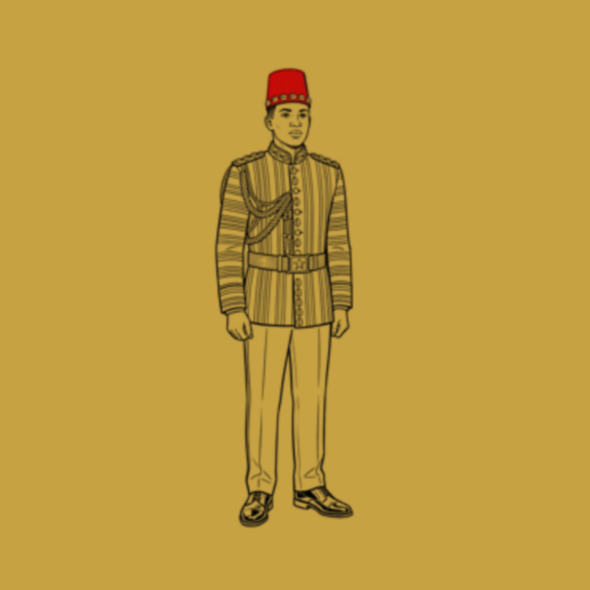
When Captain Ibrahim Traoré signed decrees mandating Faso Dan Fani for judicial robes, school uniforms, and launching the TEXFORCES-BF textile complex in Bobo-Dioulasso, he was doing far more than issuing a patriotic fashion statement. He was executing a targeted strike against a subtle, multi-billion-franc channel of economic extraction: state procurement dependency.
For over six decades across Francophone Africa, national defense budgets, school systems, and civil institutions have functioned as guaranteed revenue pipelines for foreign defense firms—chiefly based in France. Retaking this supply chain cuts to the core of monetary and industrial sovereignty.
1. Ground Zero: The Economic Transformation of Women’s Weaving Cooperatives
At the heart of Traoré’s policy is a revival of Thomas Sankara’s 1980s mandate: "Wearing Faso Dan Fani is an economic, cultural, and political act of defiance against imperialism". But beyond ideology, the immediate beneficiaries are Burkina Faso's women-led weaving cooperatives.
[ Institutional Demand ] ──> [ Female Spinners & Weavers ] ──> [ Direct Household Income ]
   • Judicial Robes            • Cotton Thread Spinning          • Healthcare & School Fees
   • School Uniforms           • Organic Dyeing                  • Micro-Savings Capital
• Civic Ceremonies • Traditional Handweaving • Bankable Cooperatives- Micro-Capital Injection: Historically, handweavers operated in the informal sector, exposed to seasonal fluctuations and cheap synthetic imports. Institutional mandates—such as requiring Faso Dan Fani for schools on Mondays and official court attire—create guaranteed, non-cyclical public procurement contracts.
- Household Financial Sovereignty: In rural and peri-urban Burkina Faso, thread spinning and weaving are overwhelmingly conducted by female artisans. Earnings directly flow into female-headed households, lifting living standards, funding children’s education, and building autonomous micro-savings groups.
- Formalization of Artisanal Guilds: Umbrella organizations (such as CABES and the GIEs) can now convert seasonal handcraft into bankable, structured cooperative enterprises capable of securing credit and scaling loom capacity.
2. The Raw Paradox: West African Cotton Production vs. Domestic Processing
West Africa is a global giant in cotton farming, yet it suffers from one of the most severe industrial value-addition gaps in the world.
The Structural Discrepancy
- Global Export Weight: West African nations (Benin, Burkina Faso, Mali, Côte d'Ivoire) collectively produce millions of bales annually, accounting for over 10–12% of global raw cotton exports.
- The Domestic Processing Gap: Fewer than 2% to 5% of the raw cotton lint grown in West Africa is processed or transformed into finished garments locally. Over 95% is shipped in raw lint form to foreign mills (primarily in Asia and Europe).
+----------------------------------------------------------------------------------+
| WEST AFRICAN COTTON VALUE CHAIN GAP                                              |
+----------------------------------------------------------------------------------+
| Raw Cotton Harvested locally        |  ████████████████████ 100%                 |
| Raw Cotton Exported un-processed    |  ███████████████████░  95% - 98%        |
| Raw Cotton Processed domestically   |  █░░░░░░░░░░░░░░░░░░░   2% - 5%          |
+----------------------------------------------------------------------------------+
When raw cotton is exported at approximately $1.50 to $2.00 per kilogram and bought back as finished military fatigues or court robes at $50 to $300 per unit, the region surrenders tens of thousands of manufacturing jobs and millions of dollars in industrial value-addition.
3. Calculating the Capital Flight: The CFA Franc Uniform Leakage
To understand what is at stake financially across the 14 Francophone nations using the CFA franc (WAEMU and CEMAC zones), we can model the annual capital drain caused by importing uniforms for state security forces.
Capital Flight Calculation Model
Let:
- N = \text{Total active security personnel across 14 Francophone African states (Military, Gendarmerie, Police, Customs, Firefighters)} \approx 480,000 \text{ personnel}.
- C = \text{Average annual procurement cost per officer (fatigues, daily service attire, boots, dress uniforms, badges)} \approx 200,000 \text{ CFA francs (~\$325 USD)}.
\text{Annual Capital Flight} = N \times C
\text{Annual Capital Flight} = 480,000 \times 200,000 \text{ CFA} = \mathbf{96,000,000,000\text{ CFA Francs}}\quad (\approx \mathbf{\$155\text{ Million USD / year}})
Over a single decade, this represents a capital flight of nearly 1 Trillion CFA Francs exiting West and Central African central banks directly into the balance sheets of foreign defense suppliers like France's Groupe Marck (Marck & Balsan) and Paul Boyé Technologies.
+------------------------------------------------------------------------------------+
| 10-YEAR MILITARY UNIFORM CAPITAL LEAKAGE (ESTIMATED AGGREGATE)                     |
+------------------------------------------------------------------------------------+
| Foreign Defense Contractors (e.g., Groupe Marck)  |  ~960 Billion CFA (~$1.55B USD) |
| Retained in Local Domestic Ecosystems             |  Near Zero (historically)      |
+------------------------------------------------------------------------------------+
4. Expanding the Lens: New Crucial Angles of Research
To capture the complete geopolitical picture, four critical dimensions must be examined:
A. The AES (Alliance of Sahel States) Regional Security Industrialization
Burkina Faso, Mali, and Niger have formed the Alliance of Sahel States (AES). Rather than acting in isolation, Burkina’s TEXFORCES-BF factory in Bobo-Dioulasso—a 15 billion CFA facility spanning 9 hectares—is explicitly designed to supply regional allied forces. This turns local industrial policy into a shared defense architecture.
B. The Dual-Production Strategy: Technical vs. Cultural Fabrics
A key operational distinction is how Traoré’s administration handles high-tech requirements versus formal attire:
- Frontline Tactical Gear (TEXFORCES-BF): Ripstop, camouflage, and high-durability cotton-poly blends for combat zones are produced industrially at the Bobo-Dioulasso plant.
- Civic & Formal Attire (Faso Dan Fani / Cencengu): Court robes, school uniforms, and parade dress are reserved for handweavers' cooperatives. This creates a balanced industrial ecosystem that combines modern factory capacity with traditional artisanal employment.
C. The Hypocrisy of Outsourced Foreign Manufacturing
French suppliers like Paul Boyé Technologies manufacture thousands of uniforms for European military recruits by utilizing low-cost offshore labor in Madagascar (a former French colony). This reveals an irony: French contractors use African industrial labor to manufacture uniforms, sell them back to European defense ministries, and then resell finished gear to African governments at a premium.
D. Judicial De-colonization as a Symbol of Sovereignty
Replaces imported black satin gowns—costing up to 3,000,000 CFA francs ($4,760 USD)—with 150,000 CFA franc ($240 USD) Faso Dan Fani robes means that every trial conducted in Burkina Faso takes place under a visual symbol of national autonomy.
Conclusion
By reclaiming state uniform procurement, Ibrahim Traoré's administration is demonstrating how public purchasing power can be weaponized for national development. Replacing foreign defense contracts with local value chains reclaims capital, empowers female artisans, and sets an example for economic sovereignty across Africa.