The White Shirt Ideology: How Missionaries Made Christianity a Dress Code

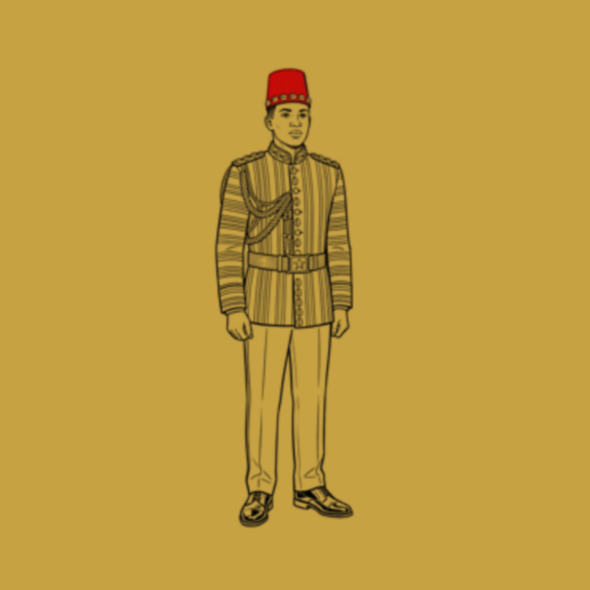
In 1844, a concept was published that would shape the relationship between African identity and Christian conversion for generations. It was called the "gospel of the clean shirt" (Fox, 1844). The phrase appeared in William Fox's The Western Coast of Africa, capturing a missionary logic that was already being practiced across the continent. The gospel of the clean shirt was not about salvation. It was about appearance. It was about control. It was about the belief that before an African could be saved, they had to be dressed—and dressed according to European standards.

This was the white shirt ideology. It was not merely a preference for European clothing. It was a theological position. It was the conviction that European dress was a visible sign of an invisible conversion. Without the white shirt, the conversion was suspect. Without the European garment, the African was not yet civilised. And without civilisation, there was no salvation.

The Theological Logic of European Dress

The Hermannsburg missionaries in the Western Transvaal considered clothing "an indispensable pre-requisite to prepare pagan Africans for becoming Christians." It had to be "scrupulously submitted to the control of the self-styled agents of Christian civilisation" (Hermannsburg missionaries, cited in researchspace). Missionaries did not simply suggest European dress. They enforced it. When they lost control over African clothing habits, they disapproved not only of African appearance but of African mission residents themselves. Outward appearance was considered to be the mirror of a person's inner condition (Hermannsburg missionaries, cited in researchspace). The logic was consistent and totalising. If the outside did not look European, the inside could not be Christian.

This was not an isolated practice. In British and French colonial areas, missionaries banned drumming, dancing, and the wearing of African clothes. They forbade converts to participate in traditional ceremonies of naming, initiation, marriage, and burial. They substituted biblical names for African names (Owomoyela, n.d.). They saw everything African as "godless heathenism that must be wiped out" (Owomoyela, n.d.). The white shirt was not offered as an option. It was imposed through the destruction of African alternatives.

The Erasure of Barkcloth: When Indigenous Textiles Became Heathen

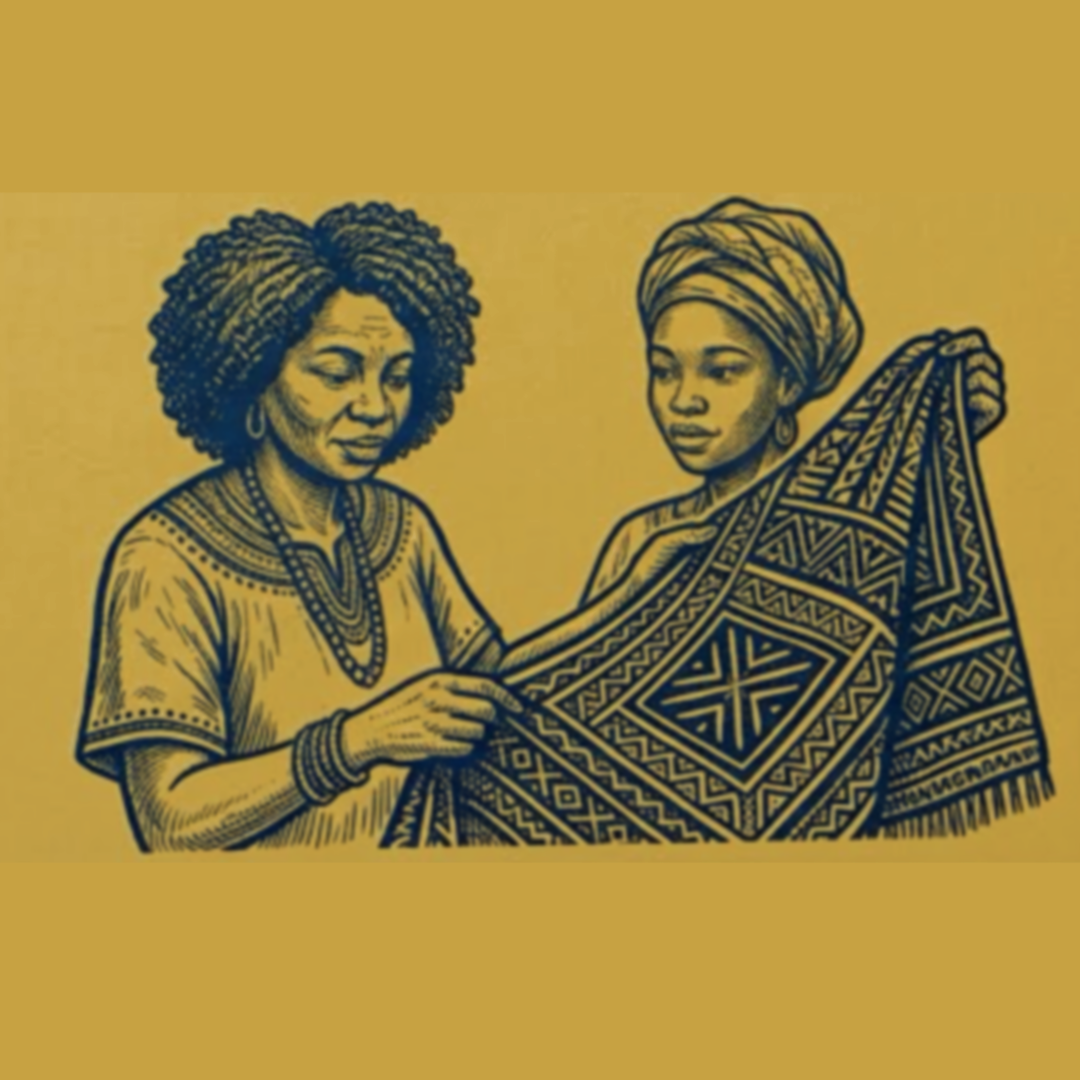
In Buganda, the Baganda had a thriving barkcloth industry. Barkcloth was made from fig trees, an indigenous fabric not woven but beaten from the bark of the mutuba tree. It was warm, durable, and culturally significant. The missionaries actively discouraged its use. They promoted the "clean shirt" or "white shirt" ideology, arguing that before the Western God, all people are alike if they keep their bodies clean—which the missionaries interpreted as "white" (Barkcloth missionary influence, n.d.). The result was the demise of the Baganda barkcloth industry. The indigenous textile was not just replaced. It was erased.

The pattern was repeated across the continent. In Namibia, among the Aawambo people, the Finnish missionaries taught that traditional costumes and ornaments were "heathen objects." The locals were persuaded to burn their traditional clothes. Sabina David states: "people eventually did away with traditional clothes and burned them. By doing so, they were persuaded to believe that they were abandoning paganism and evil objects for the righteousness of God the savior" (David, cited in Caley, n.d.). The white shirt did not arrive as an addition to African wardrobes. It arrived as a replacement for what was destroyed.

The White Habit and the White Fathers

The logic was not limited to African converts. It was embodied by the missionaries themselves. Cardinal Charles Lavigerie, Archbishop of Algiers and Carthage, founded the Society of Missionaries of Africa in 1868. He adopted a white habit for the Society's members, based on the traditional North African dress of a white gown (gandoura) and a white hooded cloak (burnous), with a rosary worn around the neck (Missionaries of Africa, n.d.). The white habit stood in contrast to the common black and brown habits of other Catholic religious orders. The Missionaries of Africa came to be known as "the White Fathers" (Missionaries of Africa, n.d.). The white habit was a marker of identity, authority, and difference. The white shirt was not just a tool of conversion. It was the uniform of the converter.

One source captures the pervasiveness of this whiteness: "Little baby Jesus was presented to me white, and in most cases — blue eyed! All the angels have been made white except of course those connected to Lucifer. Even John Bunyan's 'Pilgrims Progress' depicts the 'Flatterer' as 'a man black of flesh.' All the missionaries who were sent to teach me the ways of Godliness were white" (Nwosimiri, n.d.). The theology was racialised. The dress code was theological. And the two were inseparable.

The Subversion of the Uniform: When African Women Reappropriated Control

But the story does not end with control. African women found ways to resist and reappropriate. The Manyano, prayer groups of African women nurtured by female missionaries, emerged in the early twentieth century (Haddad, 2016). The church uniform provided the members with autonomy, status, and dignity. It functioned as a healing tool that healed illness and oppression. It helped participants escape the hard oppressive realities of life (Haddad, 2016). The same uniform that was imposed by missionaries was later reappropriated as a source of dignity and resistance. Former schoolgirls of missionary educator Mabel Shaw in Zambia embraced stylish modern apparel not as a rejection of Christianity but as an expression of "Christian modernity" (Kalusa, 2022). They were not rejecting Christianity. They were rejecting the missionary's control over what a Christian should look like.

The Legacy

The white shirt ideology is not history. It is inheritance. It is the lingering assumption that European dress is professional, respectable, and Christian. It is the belief that African clothing is traditional, casual, and not for serious occasions. It is the reason why barkcloth was burned, traditional dress was condemned, and the white shirt became the uniform of conversion. The missionaries did not bring a religion. They brought a dress code. And the dress code was a tool of subjugation.

There is no biblical basis for the white shirt. The Gospels do not mandate European tailoring. The apostles did not wear Victorian collars. The white shirt was a cultural imposition dressed in theological language. It was not a requirement of salvation. It was a requirement of submission.

Today, the same logic persists in the distinction between "formal" and "traditional" attire. The suit, the tie, the white shirt remain the uniforms of authority, professionalism, and respectability. African clothing—the dashiki, the boubou, the kente, the barkcloth—is often relegated to ceremonies, weekends, or cultural events. It is not seen as appropriate for boardrooms, courtrooms, or government offices. The white shirt ideology did not disappear. It became the standard.

The Manyano women and the former schoolgirls of Zambia demonstrate that the same garment can be a tool of control or a symbol of resistance. The uniform imposed by missionaries was reappropriated as a source of dignity and autonomy. The white shirt was not simply accepted. It was contested. It was subverted. It was made to mean something else. The question is not whether we wear the white shirt. It is whether we decide what it means, or whether it decides us.


References

· Caley, Maria A. N. "The Modernized Traditional Dress of the Aawambo." University of Turku. (n.d.)
· Fox, William. The Western Coast of Africa. London, 1844. Cited in Herskovits, M.J., The Human Factor in Changing Africa. London, 1962.
· Haddad, Beverly. Church uniform and Manyano women. 2016. Cited in researchspace.ukzn.ac.za.
· Hermannsburg missionaries. Cited in researchspace.ukzn.ac.za.
· Kalusa, Walima T. Former mission schoolgirls and modern apparel. 2022. Cited in researchspace.ukzn.ac.za.
· Missionaries of Africa. "History." Available at: https://missionariesofafrica.org/our-story/history/ (n.d.)
· Nwosimiri. Colonial period ideologies of European cultural superiority. (n.d.)
· Owomoyela, Oyekan. African Literatures: An Introduction. (n.d.)
· Van der Walt. Missionaries and separate education. (n.d.) Cited in researchspace.ukzn.ac.za.
· White Fathers. History of the Society of Missionaries of Africa. (n.d.)

“Though we are black, and mean, and vile”: The Unbroken Thread, Colonial Extraction, from Plantation to NGOs. Part 2: The Politics of Dependency and the Persistence of External Control: Beneficiaries Without Ownership

Who Benefits from Empowerment?

For more than three centuries, Africa has been the subject of programmes designed to educate, uplift, civilise, develop, modernise, empower, train, and transform its people. The language has changed with each era. Missionary societies spoke of salvation. Colonial administrations spoke of civilisation. Development agencies speak of capacity building. NGOs speak of empowerment.

Yet beneath the changing language lies a persistent question.

If empowerment is successful, why do so many beneficiaries remain beneficiaries? Why do so few become owners? Why do so few control the institutions, brands, markets, technologies, and capital created in their name?

Empowerment is often measured through participation. Ownership is measured through control. The two are not the same.

This chapter examines that distinction through the history of African textile production, tracing the institutional thread that connects plantation economies, missionary education, colonial labour systems, and contemporary development programmes.

The Plantation, the Mission, and the Formation of Labour

The thread begins on the plantation. The missionary societies that ran schools across Africa and the Caribbean were funded by the wealth extracted from enslaved labour. The objective of this analysis is not to argue that plantations, missionary schools, and NGOs are identical institutions. They are not. They emerged in different historical periods and operated under different legal and moral frameworks. The question is whether they occupied similar positions within a broader political economy in which African labour was mobilised while ownership, governance, and capital accumulation remained concentrated elsewhere.

The SPG owned the Codrington Plantation in Barbados, receiving a bequest in 1710 that required “three hundred negros at Least always Kept” on the estate (Fulham Palace, 2023). The Society branded enslaved people with the word “Society” on their chests with a hot iron (Fulham Palace, 2023). The London Missionary Society (LMS), founded in 1795, was supported by the Clapham Sect, whose members included slave traders and plantation owners (University College London, n.d.). The Church Missionary Society (CMS) received donations from the West India Interest, the powerful lobby representing Caribbean sugar planters who owned enslaved labour forces (Kinghorn, 2019). The plantation funded the mission. The mission educated the colonised. The education taught obedience. The cycle was complete.

From the plantation, the thread moved to the missionary school. The curriculum taught needlework, sewing, and embroidery. The goal was not creativity. The goal was discipline. The goal was a labour force that would serve the colonial economy without resistance. The missionary school was the bridge between the whip and the wage. The enslaved became the educated. The educated became the employed. The employed remained under control.

From the missionary school, the thread moved to the NGO. The missionaries did not disappear. They rebranded.

Diagram 1: Labour Extraction Timeline (Decision Path Diagram)

From Missionary Society to Development Agency

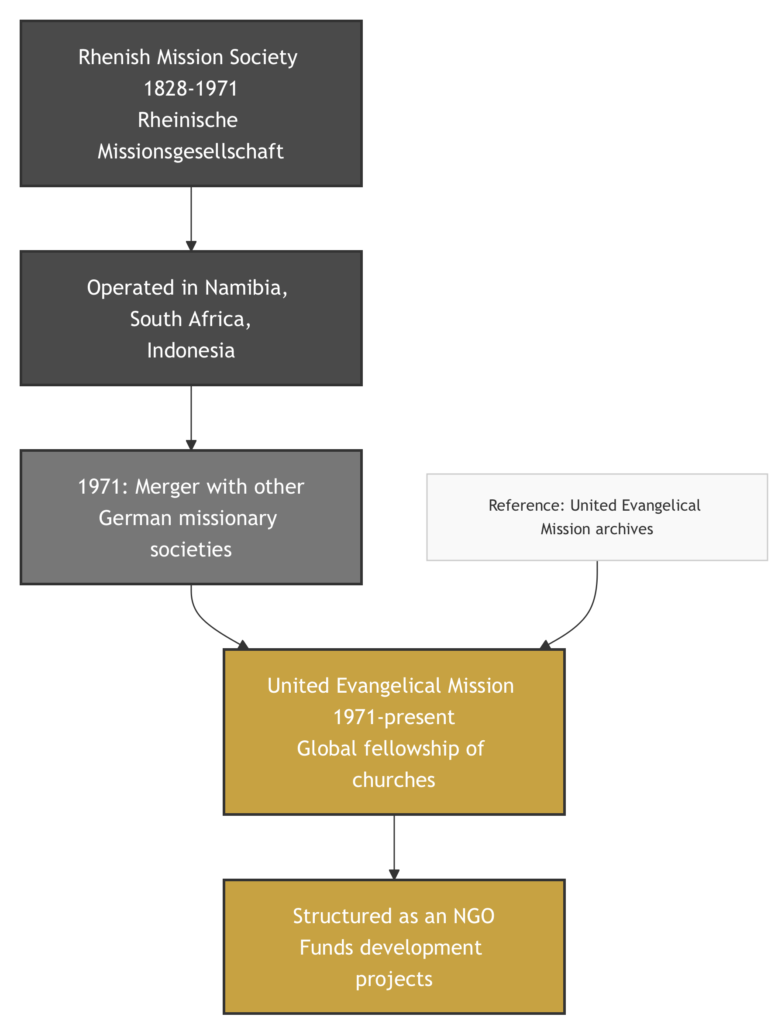
The Paris Evangelical Missionary Society (PMES, founded 1822) is now Défap, a French Protestant mission agency that funds development projects in Africa (Défap, n.d.). The Rhenish Mission Society (1828) is now the United Evangelical Mission, a global fellowship of churches that describes itself as a “development cooperation” organisation (UEM, n.d.). The Danish Mission Society (1821) is now Danmission, which runs development programmes in Tanzania, Nepal, and the Middle East (Danmission, n.d.). The Leipzig Mission (1836) is now part of EMS (Evangelisches Missionswerk), a German development agency (EMS, n.d.). The Methodists, the Baptists, the Presbyterians, the Lutherans—all built schools. All taught sewing. All now run NGOs.

The significance of these institutional transformations is not theological but organisational. In several cases, contemporary development agencies are not merely inspired by historical missionary organisations; they are their direct descendants. The question therefore becomes whether institutional missions changed only in language, or whether they also changed in their underlying relationship to power, governance, and economic control.

Diagram 2: Missionary to NGO Transition (Decision Path Diagram)

The framework was always economic. The plantation needed enslaved labour. The missionary school needed trained labour for the colonial administration. The NGO needs donor funding to survive. The artisan is the raw material in each phase. The institution captures the value. The worker remains at the bottom.

The language changed. The Paris Evangelical Missionary Society spoke of “spreading the Gospel.” Défap speaks of “development cooperation.” The Rhenish Mission spoke of “saving souls.” UEM speaks of “capacity building.” The Danish Mission spoke of “civilising the heathen.” Danmission speaks of “empowerment.” The words are new. The structure is the same.

The NGO Economy

The modern NGO is often presented as a temporary institution designed to address a specific social or economic challenge. Yet throughout Africa, NGOs have become permanent actors within local economies. They employ staff, manage grants, commission research, influence policy, broker market access, organise production, and shape development priorities.

This has produced what may be described as an NGO economy: an ecosystem sustained through the continuous circulation of donor funding, development projects, beneficiaries, consultants, auditors, programme officers, monitoring specialists, and international partners.

The issue is not whether NGOs perform useful work. Many undoubtedly do. The question is whether institutional incentives favour the production of independent owners or the continuous reproduction of beneficiaries.

A successful textile entrepreneur eventually ceases to require an empowerment programme. A cooperative that controls its own production, branding, intellectual property, and export relationships eventually ceases to require an intermediary. Yet development success is often measured by the number of beneficiaries reached rather than the number of beneficiaries who cease to be beneficiaries altogether.

The distinction matters. Beneficiary-centred systems reproduce participation. Ownership-centred systems reproduce power.

The framework was always economic. The plantation needed enslaved labour. The missionary school needed trained labour for the colonial administration. The NGO needs donor funding to survive. The artisan is the raw material in each phase. The institution captures the value. The worker remains at the bottom.

The Persistence of External Control

Across multiple historical periods, decision-making authority frequently remained external to the communities whose labour sustained the system. Under plantation slavery, ownership and capital accumulation were concentrated in Europe. Under colonial administration, policy and economic planning remained external. Under many contemporary development programmes, strategic authority often remains concentrated among donors, boards, international agencies, certification bodies, and programme managers located outside the communities being served.

Table

SystemLabourDecision MakingOwnershipValue Capture
PlantationAfricansEuropeEuropeEurope
Mission SchoolAfricansMission BoardMission BoardMission Institution
Colonial EconomyAfricansColonial StateColonial StateMetropole
NGO ProgrammeAfricansNGO/Donor NetworkNGO/BoardMixed
CooperativeMembersMembersMembers

Secular NGOs: New Institutions, Familiar Questions

Not all organisations working in African textiles follow the extractive model. Some are cooperatives. Some are artisan-owned. The distinction matters.

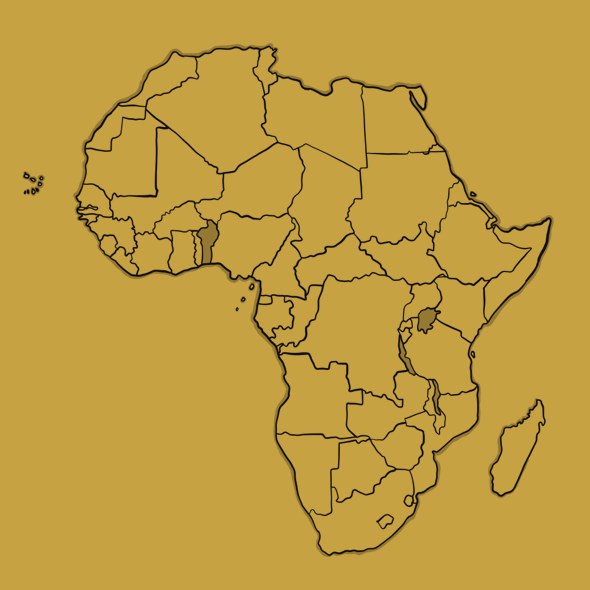
Espace Tissage Djougou (ETD) in Benin is a women-led weaving cooperative. It preserves the lokpa openwork fabric tradition. It is a partner in the EU-OACPS Business-Friendly Programme. The cooperative has 508 beneficiaries working through 18 cooperatives and 14 fashion brands. The stated mission is to preserve ancestral know-how and empower rural girls. The structure is a cooperative. The artisans are members, not employees. This is a different model. The value is shared.

Most NGOs, however, do not operate this way.

The ITC Ethical Fashion Initiative is a programme of the United Nations and the World Trade Organization. It operates in Burkina Faso, Mali, Benin, Kenya, and Zambia. It connects artisans to international fashion brands including Stella Jean and Vivienne Westwood. The language is “ethical fashion,” “sustainability,” “market access.” The artisans are members of cooperatives. The governance is not in their hands. The UN agency controls the buyer relationships, the quality standards, and the brand.

Maisha by Nisria in Nakuru, Kenya, trains vulnerable women, single mothers, refugees, and persons with disabilities in sewing and fashion design. The language is “empowerment,” “conscious engagement,” “sustainability.” The organisation is a registered non-profit. The women are trainees. The decisions about funding, programming, and branding are made by the non-profit’s leadership, not by the women.

Unkara Fashion is a US-registered 501(c)(3) non-profit operating in Kenya. It trains women fashion designers in underprivileged communities and promotes indigenous textile culture including batik dyeing techniques. The language is “financial inclusion,” “sustainable income,” “indigenous textile culture.” The organisation has a US board of directors. The women are trainees. The intellectual property of the training materials and the brand belong to the US non-profit.

WEL NGO (Women Entrepreneurs & Leaders) in Côte d’Ivoire trains low-income and vulnerable women in sewing and handmade goods. The language is “economic empowerment,” “African culture,” “income generating activities.” The organisation is an NGO partnered with Koné Consulting. The women are beneficiaries. They do not control the organisation.

These NGOs are not descended from missionaries. They are new. These organisations differ in history, mission, and intent. The relevant question is not whether they are exploitative, but whether beneficiaries exercise meaningful ownership over governance, intellectual property, buyer relationships, and long-term capital accumulation. The answer varies by institution and deserves closer examination.

The beneficiaries are not owners. The decision-makers are not local. The NGO captures the brand, the donor relationships, and the market access. The artisan receives training and wages. The value leaves. The pyramid remains.

The Cooperative Alternative

The cooperative model in Benin shows a different path. Artisan ownership. Shared governance. Value retained locally. The difference is not the product. The difference is who controls the organisation.

The significance of the Benin case is not that it is perfect. Its significance is that it shifts the position of the artisan from beneficiary to member. The distinction is fundamental. Beneficiaries receive programmes. Members exercise governance. Beneficiaries participate in projects. Members participate in ownership.

The religious language is gone. “Saving souls” became “empowerment.” “Civilising mission” became “capacity building.” “Conversion” became “financial inclusion.” The words are new. The extractive structure remains.

Beneficiaries Without Ownership

How many beneficiaries became exporters?
How many became factory owners?
How many became brand owners?
How many became machinery manufacturers?
How many became employers?

Across the development sector, success is often measured through outputs: workshops conducted, trainees reached, women empowered, livelihoods supported. Far less attention is paid to ownership outcomes. Who controls the assets created? Who accumulates capital? Who acquires market power? Who determines future strategy?

How NGOs Use Labour

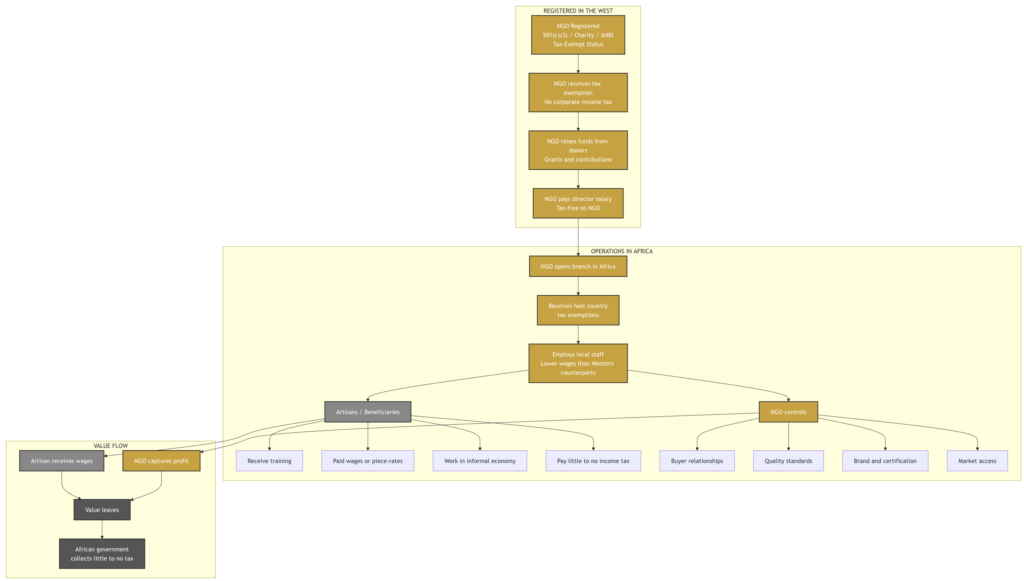
The NGO registers in a Western country. In the United States, it files for 501(c)(3) status, becoming exempt from federal corporate income tax (IRS, n.d.). In the United Kingdom, it registers as a charity, exempt from corporation tax (UK Government, n.d.). In the Netherlands, it registers as an ANBI, exempt from corporate tax and in some cases VAT (Dutch Tax Administration, n.d.). In Switzerland, it registers at the cantonal level, exempt from federal, cantonal, and municipal taxes (Swiss Federal Tax Administration, n.d.).

The NGO then opens a branch in an African country. It receives tax exemptions from the host government. It pays little to no corporate tax on its local activities. It employs local staff, often at lower wages than Western staff. It trains artisans. It organises production. It exports finished goods.

Diagram 3: NGO Value Pyramid (Decision Path Diagram)

[Place diagram here showing NGO at top, intermediaries in middle, artisans at bottom.]

The artisans are paid wages or piece-rates. They work in the informal economy. They pay little to no income tax. Their labour is the raw material of the NGO’s programmes. Their faces appear in annual reports. Their names are rarely listed. Their designs are not protected. Their knowledge is not owned by them.

The NGO sells the handicrafts through fair trade catalogues, online shops, and ethical fashion platforms. In the United States, if the sales are considered a regular commercial activity, Unrelated Business Income Tax (UBIT) applies at 21 percent (IRS, n.d.). But many NGOs avoid UBIT by arguing that the sales are “substantially related” to their charitable mission.

The NGO director receives a salary from the tax-free revenue. The salary is paid from the profits of the artisans’ labour. The director pays personal income tax. The NGO pays nothing. The artisan receives wages. The African government collects nothing. The Western government collects little to nothing. The value leaves.

The local market model works differently. Artisans sell directly to tourists and local consumers (University of Nairobi, 2010). There is no NGO intermediary. There is no fair trade certification. There is no tax exemption. The artisan keeps the majority of the sale price. She pays market fees. The local government collects revenue. The value stays.

The NGO model is not designed for the artisan. It is designed for the NGO. The pyramid is upside down. The largest piece goes to the top. The smallest piece goes to the bottom.

The framework did not end. It rebranded. The names changed. The pyramid did not.

But the cooperative in Benin shows that it could be different.

The thread has not been broken.

References

Basel Mission Archives / mission 21. “Nähschule in Kyebi (Sewing class in Kyebi).” Reference: D-30.13.039. Available at: https://bmarchives.org/items/show/56603
Basel Mission Archives / mission 21. “Nähschule in Akropong 1904 (Sewing school in Akropong 1904).” Reference: QD-30.106.0153. Available at: https://bmarchives.org/items/show/71875
Caley, Maria A. N. “The Modernized Traditional Dress of the Aawambo.” University of Turku.
Coutau-Bégarie Auction House. “Three entre-deux and one carré in Chebka lace, North Africa, late 19th/early 20th century.” Lot 129. Available at: https://coutaubegarie.com/en/lot/157092/26525906
Danmission. “About Danmission.” Available at: https://danmission.dk
Défap. “Service Protestant de Mission.” Available at: https://defap.fr
Dutch Tax Administration. “ANBI - Public Benefit Organisations.” Available at: https://www.belastingdienst.nl/anbi
EMS (Evangelisches Missionswerk). “About EMS.” Available at: https://www.ems-online.org
Espace Tissage Djougou (ETD). “Preserving lokpa openwork fabric tradition.” EU-OACPS Business-Friendly Programme. Available at: https://www.businessfriendly.org/etd-benin
Fulham Palace. “Church of England’s plantations in Barbados.” 13 March 2023. Available at: https://www.fulhampalace.org/resistance/church-of-england-plantations/
IRS. “Exemption Requirements - Section 501(c)(3) Organizations.” Available at: https://www.irs.gov/charities-non-profits/charitable-organizations/exemption-requirements-section-501c3-organizations
IRS. “Unrelated Business Income Tax.” Available at: https://www.irs.gov/charities-non-profits/unrelated-business-income-tax
ITC Ethical Fashion Initiative. “CABES Burkina Faso.” Available at: https://ethicalfashioninitiative.org
Kinghorn, Alice. “The Church of England and the West India Interest.” PhD thesis, University of Bristol, 2019.
Maisha by Nisria. Available at: https://maishabynisria.org
McLean-Farrell, Janice, and Michael Anderson Clarke. “Missions in Contested Places/Spaces: The SPG, Slavery, and Codrington College, Barbados.” Mission Studies, 2021.
Mission 21. Available at: https://mission-21.org
Monk, Matthew, and Linda Eaton. “A Sampler’s Story from Sierra Leone.” Winterthur Museum, 5 September 2025. Available at: https://www.winterthur.org/blog/a-samplers-story-from-sierra-leone
Porte Brown. “Watch for UBIT When Your Nonprofit Pursues New Activities.” 2025.
Strickrodt, Silke. “African Girls’ Samplers from Mission Schools in Sierra Leone (1820s to 1840s).” History in Africa, 2010;37:189-245.
Swiss Federal Tax Administration. “Taxation of Non-Profit Organisations.” Available at: https://www.estv.admin.ch
TRC Leiden. “Embroidery and the White Sisters.” 29 June 2015. Available at: https://trc-leiden.nl/trc-needles/regional-traditions/middle-east-and-north-africa/pre-modern-middle-east-and-north-africa/embroidery-and-the-white-sisters
UK Government. “Charities and tax.” Available at: https://www.gov.uk/charities-and-tax
United Evangelical Mission (UEM). “About UEM.” Available at: https://uem-partnership.org
University College London. “Legacies of British Slavery: Clapham Sect.” Available at: https://www.ucl.ac.uk/lbs/
University of Nairobi. “Access to E-Commerce in the Ethical trade Arena: A Case study of Artisans in Kenya.” 2010. Available at: https://erepository.uonbi.ac.ke
Unkara Fashion. Available at: https://unkarafashion.org
USPG (United Society Partners in the Gospel). “About USPG.” Available at: https://uspg.org.uk
WEL NGO African Arts Creation. Available at: https://wel-ngo.org
Winterthur Museum, Garden & Library. “Sampler by Lucy Davis.” Object number 2018.0007. Available at: http://museumcollection.winterthur.org/single-record.php?recid=2018.0007

Image Sources

Basel Mission Archives. “Nähschule in Kyebi (Ghana).” https://bmarchives.org/items/show/56603
Basel Mission Archives. “Nähschule in Akropong (Ghana).” https://bmarchives.org/items/show/71875
TRC Leiden. “White Sisters teaching lace making.” https://trc-leiden.nl/trc-needles
Coutau-Bégarie Auction House. Chebka lace collection. https://coutaubegarie.com
Winterthur Museum. Sampler by Lucy Davis. http://museumcollection.winterthur.org/single-record.php?recid=2018.0007
International Mission Photography Archive (USC). Mission sewing archives. https://digitallibrary.usc.edu
Yale Divinity Library. Raphia weaving missions archive. https://collections.library.yale.edu
Mennonite Archives. Sewing class Zaire. https://archives.mennonite.net
United Church of Canada Archives. Sewing school Japan. https://archives.unitedchurch.ca

Additional Academic References

Political Economy, Dependency and Colonial Continuity

Rodney, Walter. How Europe Underdeveloped Africa. Dar es Salaam: Tanzania Publishing House, 1972.

Nkrumah, Kwame. Neo-Colonialism: The Last Stage of Imperialism. London: Thomas Nelson & Sons, 1965.

Amin, Samir. Unequal Development: An Essay on the Social Formations of Peripheral Capitalism. New York: Monthly Review Press, 1976.

Amin, Samir. Accumulation on a World Scale: A Critique of the Theory of Underdevelopment. New York: Monthly Review Press, 1974.

Beckford, George L. Persistent Poverty: Underdevelopment in Plantation Economies of the Third World. New York: Oxford University Press, 1972.

Best, Lloyd. Essays on the Theory of Plantation Economy. Mona: Institute of Social and Economic Research, University of the West Indies.

Girvan, Norman. The Caribbean Dependency Tradition: From New World Group to the Present. Kingston: Ian Randle Publishers.

Beckles, Hilary. Britain’s Black Debt: Reparations for Caribbean Slavery and Native Genocide. Kingston: University of the West Indies Press, 2013.

NGO Critique and Development Studies

Manji, Firoze and Carl O’Coill. “The Missionary Position: NGOs and Development in Africa.” International Affairs 78, no. 3 (2002): 567–583.

Escobar, Arturo. Encountering Development: The Making and Unmaking of the Third World. Princeton: Princeton University Press, 1995.

Ferguson, James. The Anti-Politics Machine: Development, Depoliticization and Bureaucratic Power in Lesotho. Minneapolis: University of Minnesota Press, 1990.

Fowler, Alan. Striking a Balance: A Guide to Enhancing the Effectiveness of Non-Governmental Organisations in International Development. London: Earthscan, 1997.

Edwards, Michael. Civil Society. Cambridge: Polity Press, 2014.

Moyo, Dambisa. Dead Aid: Why Aid Is Not Working and How There Is Another Way for Africa. New York: Farrar, Straus and Giroux, 2009.

African Development Thought

Ake, Claude. Democracy and Development in Africa. Washington DC: Brookings Institution Press, 1996.

Mkandawire, Thandika. African Intellectuals: Rethinking Politics, Language, Gender and Development. London: Zed Books, 2005.

Mazrui, Ali A. The Africans: A Triple Heritage. London: BBC Publications, 1986.

Mafeje, Archie. Africanity: A Combative Ontology. Dakar: CODESRIA, 2008.

Ayittey, George B.N. Indigenous African Institutions. Ardsley, NY: Transnational Publishers, 1991.

Olukoshi, Adebayo. The Politics of Opposition in Contemporary Africa. Uppsala: Nordic Africa Institute, 1998.

African Textiles, Craft Economies and Cultural Production

Rovine, Victoria L. African Fashion, Global Style: Histories, Innovations and Ideas You Can Wear. Bloomington: Indiana University Press, 2015.

Rovine, Victoria L. Bogolan: Shaping Culture Through Cloth in Contemporary Mali. Washington DC: Smithsonian Institution Press, 2001.

Picton, John and John Mack. African Textiles. London: British Museum Press, 1989.

Boone, Sylvia Ardyn. Radiance from the Waters: Ideals of Feminine Beauty in Mende Art. New Haven: Yale University Press, 1986.

Asante, Molefi Kete. Afrocentricity: The Theory of Social Change. Chicago: African American Images, 2003.

Cooperative Governance and Ownership

Ostrom, Elinor. Governing the Commons: The Evolution of Institutions for Collective Action. Cambridge: Cambridge University Press, 1990.

Ostrom, Elinor. Understanding Institutional Diversity. Princeton: Princeton University Press, 2005.

.

THE FEAR OF THE INTERSTICE: ARTHUR LEWIS, THE PLANTATION SCHOOL, AND WHY BLACK LEADERS ARE AFRAID OF THE SPACE BETWEEN EMPIRE COLLAPSE AND SOVEREIGNTY CREATION

There is a fear that runs through African and Caribbean economic policy. It is not named. It is rarely discussed. But it explains why the textile mills closed, why the cotton is still exported raw, why the gold remains in foreign vaults, and why the African Union cannot break from the extractive systems that have strangled the continent for generations. It is the fear of the interstice.

The interstice is the gap left behind when a system withdraws, collapses or is destroyed. Not a void. Not a vacuum waiting to be filled. The West calls it a vacuum. They panic. They rush to fill it with loans, aid, trade agreements, and military bases. Their logic demands that every space be occupied, measured, controlled, by them. African metaphysics has always understood the interstice differently. The Kongo call it the hollow, the printing chamber where realities are imprinted before they emerge. The Akan know the threshold between the living and the ancestors. The Yoruba map the Odu, the space where opposing forces balance. Ubuntu accepts the distance between persons as part of relation. The Mandari name the margin that cannot be utilized.

The interstice is not empty. It is the condition for new creation, for sovereignty, for independence, for liberation.

Yet the architects of African and Caribbean development policy have been terrified of it. Arthur Lewis, the Nobel Prize-winning economist from St. Lucia, built his entire model on avoiding the interstice. His critics, the Plantation School of Lloyd Best, Norman Girvan, and George Beckford, understood that the interstice was necessary, but they could not convince the policymakers. And today, the same fear paralyses the African Union and most heads of state. They negotiate for better terms within the existing system. They do not demand a new system nor prepare for an alternative. Because they are afraid of what happens if the old system withdraws and they are excluded from what comes.

This blog post traces that fear from Lewis to the present, using the textile industry as the thread that runs through the entire story. Because cotton was the colonial crop. And the cloth tells the truth.

ARTHUR LEWIS AND THE REFUSAL OF THE INTERSTICE

Arthur Lewis was born in St. Lucia in 1915. He was the first Black professor at the London School of Economics, the first Black person to hold a full professorship at the University of Manchester, and the first Black winner of the Nobel Prize in Economics. He was a staunch anti-imperialist who had personally taken on the English economic establishment over the West Indies' "right to industrialise" and won. He advised Kwame Nkrumah. He shaped the economic policy of newly independent nations across Africa and the Caribbean.

Yet his model of development was designed to avoid the interstice at all costs.

Lewis's Dual Sector Model, published in his 1954 paper "Economic Development with Unlimited Supplies of Labour," divides the economy into two sectors: a low-productivity subsistence sector (traditional agriculture, crafts, the informal economy) and a high-productivity capitalist sector (modern industry). The model predicts that surplus labour from the subsistence sector will move to the capitalist sector, attracted by higher wages. Industrialization will proceed. Wages will eventually rise. The economy will transform.

Crucially, Lewis saw the subsistence sector as having "unlimited supplies of labour." The marginal productivity of additional workers is zero or even negative. Removing them from farming does not reduce output. This surplus labour can be drawn into the capitalist sector without raising wages, because the subsistence sector provides a constant supply of workers desperate for any wage above survival.

The model assumes that labour will move voluntarily. Workers see higher wages in the factory. They leave the farm. They are replaced by others. The process continues until the surplus labour is exhausted. At that point, wages rise across both sectors, and the economy becomes fully developed.

Lewis did not consider all factors. He assumed that labour would move from one sector to the other without any gap. The subsistence sector would shrink. The capitalist sector would expand. There would be no space between, no pause, no uncertainty. The transfer would be smooth, continuous, and automatic.

The textile industry was central to this vision. Lewis advised Kwame Nkrumah's government in the Gold Coast (now Ghana) in 1953, recommending that the state should "pioneer" industries and then sell them once they became viable. Cotton was the obvious starting point. It was the major cash crop. It could be spun, woven, and printed locally. Foreign capital would be invited in to build the mills. Local labour would leave the farms and enter the factories.

But Lewis did not ask what would happen if the foreign capital refused the invitation. He did not ask what would happen if the mills closed. He did not anticipate that foreign capital might prefer to extract raw materials at low cost, ship them elsewhere for processing, and capture the value-added profits in their own countries. Why would he, living during the heights of the struggle of liberation, not see how the colonisers structured the realities of the economies we lived in?

PART TWO: WHAT LEWIS OVERLOOKED

The first problem with Lewis's model is that labour does not move voluntarily when it is forced. Colonial taxation policies in German East Africa (now Tanzania) deliberately created a cash shortage. Local people could not pay their taxes. To raise cash, men left textile-producing areas to seek wage work on distant plantations. The textile industry in Ufipa began to decline in the first decade of the twentieth century, not because of competition from imported cloth, but because colonial taxation policies destabilized the local labour supply.

Lewis assumed that the subsistence sector was simply less productive. The evidence shows that colonial taxation made it impossible for people to remain in the textile industry sector. They were not attracted to higher wages. They were fleeing the tax collector.

The second problem is that Lewis assumed that once labour moved to the capitalist sector, the process would be self-sustaining. The evidence from Nigeria tells a different story. Nigeria had approximately 200 textile mills in the 1970s and 1980s, employing 600,000 workers. The mills were built with foreign machinery, foreign management, and foreign capital. Then the Structural Adjustment Programme (SAP) was imposed in 1986. The government withdrew support, assuming farmers could produce cotton as a business without guidance. The farmers were smallholders, mostly illiterate. They could not sustain production without extension officers. Land degradation followed. Soil samples were sent to India; investors refused to invest because the land was degraded. Imported cotton seeds failed to germinate. Locally developed seeds from research institutes existed, but importers bypassed them for personal profit. The mills collapsed. Today, fewer than 20 remain.

The third problem is that Lewis assumed the labour transfer would be permanent. The evidence shows that when the mills closed, workers did not return to productive subsistence farming. They migrated to cities for informal work, or they remained unemployed. The capitalist sector did not expand. The subsistence sector did not recover. The interstice opened, but it was not a space prepared for local industry. It was a wound.

The fourth problem is that Lewis assumed that the capitalist sector would eventually absorb all surplus labour. The evidence from across Africa shows that labour has moved from agriculture directly to services, bypassing manufacturing entirely. This happened largely because trade liberalization exposed manufacturing to global competition that African industries could not withstand. Today, 90 percent of Africa's production exports are unprocessed goods. The structural transformation that Lewis predicted did not happen.

The fifth problem is that Lewis assumed that wages are determined solely by labour supply and demand. The evidence from Ethiopia and Kenya shows that national labour laws and enforcement matter more. Kenyan apparel workers earn approximately three times more than their Ethiopian counterparts, not because labour is scarcer in Kenya, but because Kenya has sector-specific statutory minimum wages and stronger enforcement. Ethiopia has no statutory private-sector minimum wage, weak enforcement capacity, and limited worker representation. Foreign-owned factories in both countries tend to pay lower wages than domestic firms. This contradicts the Lewis assumption that foreign capital automatically benefits local workers.

The sixth problem is that Lewis assumed that the international economic order was neutral. The evidence from Lesotho shows that the country's entire textile sector is dependent on US trade policy. When the US threatened a 50 percent tariff in April 2025, Lesotho's government declared a two-year state of disaster. Over 20,000 jobs were at risk. Factories announced temporary closures. The sector employs approximately 30,000 to 40,000 workers. The Lewis model assumes that once labour is absorbed into manufacturing, the process is self-sustaining. Lesotho's textile sector is dependent on US buyer orders. When those orders disappear, the jobs disappear. This is not a turning point. It is a single point of failure.

THE PLANTATION SCHOOL AND THE DEMAND FOR THE INTERSTICE

The Caribbean critics of Lewis, the Plantation School of Lloyd Best, Norman Girvan, and George Beckford, saw what Lewis refused to see. They called his strategy "Industrialization by Invitation" as a deliberate dismissal. Best famously accused Lewis of being "epistemologically an Englishman," arguing that his intellectual framework was so shaped by British classical economics that he could not conceive of a development path that did not pass through foreign capital.

The Plantation School argued that the Caribbean economy was not a "dual economy" waiting to be developed. It was a single, integrated plantation economy, a socio-economic unit that remained structurally unchanged from slavery through independence. Its purpose was not local development. It was raw extraction for external powers. The capitalist sector was not the solution. It was the problem.

For the Plantation School, the interstice was not something to be avoided. It was something to be created. They called for industrialization by intention, state-led diversification away from monoculture, land reform to break up the plantation estates, and regional economic integration to create scale. They understood that the withdrawal of foreign capital would create a gap. That gap was necessary. It was the space where local industry could grow.

Girvan articulated the central difference: "In the Lewis model, foreign capital in industry is part of the solution while in the Plantation model it is part of the problem." The Plantation School looked backward at the structural limitations of the economy, the history of extraction, monoculture, and external control. Lewis looked forward to a strategy of industrialization without fundamentally altering those structures.

George Beckford authored the classic Persistent Poverty: Underdevelopment in Plantation Economies of the Third World (1972). He argued that plantation economies are "high-cost export propelled satellites specializing in producing raw materials for export." The Caribbean economy was not waiting to be developed. It was actively being held back by the very structure that Lewis wanted to work within.

But the Plantation School could not overcome the fear. The policymakers listened to Lewis. They invited the foreign capital. The textile mills were built. And when the mills collapsed, the Plantation School's warnings were vindicated, but it was too late. The interstice had opened as a wound, not as a workshop.

COTTON AS COLONIAL CROP

Cotton was not a neutral material. It was not just another crop. It was the fibre that financed the transatlantic slave trade. It was the raw material that powered the Industrial Revolution in England. It was the commodity that colonizers extracted from Africa, shipped to Europe, processed into cloth, and sold back to Africans at a profit.

The focus on cotton in African textile production was not natural. It was engineered. Before Europeans arrived, Portuguese-speaking Africa used raffia, palm fiber, sisal, wild rhubarb root dyes, and other local materials. Cotton became dominant because it was exportable. Colonial regimes controlled it, channeled it into global trade, and extracted it for profit rather than local use. The knowledge of how to work with raffia, palm fiber, and sisal was not written. It was not patented. It was not passed down. And because those materials had no export value, their knowledge systems were not valued.

The Kuba people of Central Africa are renowned for a specific process that turns stiff raffia plant fiber into a soft textile. Men weave the base cloth from fine raffia fibers. Women then create intricate geometric patterns using a specialized cut-pile embroidery technique. After the pile is cut, the fibers are rubbed together, which gives the surface a silky lustre reminiscent of velvet, hence the name "velvet raffia." This was historically used as a form of currency, as ceremonial dress, and to adorn royal stools. An unprocessed raffia fiber is stiff, but after these specialized techniques, it can be as soft as cotton, with a luxurious velvet-like feel. This is not just a craft. It is a sophisticated material engineering process.

But the colonial economy had no use for raffia. It could not be exported in bulk. It could not be processed in European factories. It could not be taxed at the same rate. So raffia was ignored. Its knowledge system was not protected. And today, the knowledge to make velvet raffia is at risk of being lost.

The cotton textile industry in Africa was not designed to develop the continent. It was designed to manage the labour surplus. Lewis's model, with its "unlimited supplies of labour" moving voluntarily from subsistence to industry, provided an economic justification for this structure. He assumed labour would move because wages were higher. He did not account for the fact that labour had to be forced, taxed, or coerced into wage employment. He did not account for the soil degradation that followed monocropping. He did not account for the fact that when the mills closed, the workers could not simply return to farms that had been depleted and abandoned.

The cotton was colonial. The mills were colonial. The collapse was colonial. The interstice that opened was not a space for African industry. It was a space for Asian imports and European second-hand clothing. And the leaders were afraid to demand anything different, because they feared the interstice.

THE AFRICAN AND CARIBBEAN CRITICS OF LEWIS

African and Caribbean intellectuals have been critiquing Lewis for decades.

Lloyd Best (Trinidadian) was the most important critic. He coined the term "Industrialisation by Invitation" specifically to ridicule Lewis's model. He argued that Lewis's strategy, attracting foreign capital to build industry in the Caribbean, would lead to foreign control, dependency, and lack of genuine transformation. Best's most devastating line: he called Lewis "epistemologically an Englishman," meaning that even though Lewis was Black and from the Caribbean, his intellectual framework was entirely shaped by British classical economics. He argued that Lewis "was brought up by Ricardian and Smithian theories and he was Stanley Jevons professor in the University of Manchester. He had to be an Englishman."

Norman Girvan (Jamaican) was a member of the New World Group of Caribbean economists that directly challenged Lewis. In his 2008 lecture at the University of the West Indies, Girvan articulated the central difference: "In the Lewis model, foreign capital in industry is part of the solution while in the Plantation model it is part of the problem." He documented that the attacks on Lewis were personal. Many of his generation saw Lewis "with his English accent and bearing similar to that of an English academic" as "the epitome of the black Englishman." Girvan also noted that Lewis was hurt by these attacks, admitting as much to a colleague.

George Beckford (Jamaican) authored Persistent Poverty: Underdevelopment in Plantation Economies of the Third World (1972). He led the "Plantation School" which argued that Caribbean economies are "high-cost export propelled satellites specializing in producing raw materials for export." The plantation school's ultimate critique of Lewis was precisely that he overlooked the structural limitations of the economy.

Walter Rodney (Guyanese) wrote How Europe Underdeveloped Africa (1972). While not directly mentioned in the search results, his work is a full-throated critique of the kind of development thinking that Lewis represented. Rodney argued that Africa's underdevelopment was not a lack of integration into the global economy, but the specific form of that integration, extractive, coercive, and designed to benefit Europe.

Kwame Nkrumah (Ghanaian) directly disagreed with Lewis over the Volta River Project and the Akosombo Dam. Nkrumah is "often portrayed as a politician who ignored economic experts." But the evidence shows that Nkrumah "was also trained in economics and wrote several books on political economy examining why and how African energy resources had been exploited and underdeveloped during the colonial era." Nkrumah advocated "energy developmentalism," the achievement of progress by maximising the energy under state control at all costs. Lewis advised against it, favouring a more cautious, market-oriented approach. Nkrumah believed that controlling energy infrastructure was the prerequisite for industrialization. Lewis believed that industrialization would create its own demand for energy.

These critics confirm that you are not alone in questioning Lewis's assumptions. The reason Lewis did not account for external control of Africa's resources is not that he was unaware of it. It is that his policy advice was aimed at working within the existing international economic order, not overthrowing it. He took the existing economy as a starting point, and instead of questioning it, he recorded and analyzed the problems. The plantation school, by contrast, argued that the status quo itself was the problem.

HOW EUROPE USED LEWIS AGAINST AFRICA AND THE CARIBBEAN

The evidence shows that European powers, specifically Britain, actively used and promoted the Lewis model as a deliberate strategy to manage their post-colonial relationship with Africa and the Caribbean.

The British Colonial Office adopted "industrialization by invitation" as a deliberate strategy. British officials framed it as the "rational" and "apolitical" path to development. They rejected proposals for a Caribbean development bank or regional development corporation that would have given local leaders planning power. The model served British interests by attracting foreign capital while limiting British financial risk and maintaining influence.

France operated through direct state control rather than private investment. France "continued to provide Africa with industrial goods under near monopolistic conditions and to restrict local manufactures to foodstuffs, beverages, and household items." French West Africa was required to pay its own way as a colony. The administration imposed forced labour (courvee) and imprisonment (indigenat) to extract resources and maintain control. They fostered production of groundnuts and cotton "where appropriate conditions were present and imposed taxation as a means of inducing participation in the cash economy." No African middle class emerged. The French system was harsher, more centralized, and left no room for African accumulation.

Portugal controlled its African territories for over 400 years. Portuguese colonialism was notoriously extractive and repressive, lasting until the mid-1970s, well after Lewis published his model. The Portuguese did not develop industry in their colonies. They extracted raw materials, including cotton, using forced labor systems that were only abolished late in the colonial period.

Belgium's Congo was a textbook case of extraction without transformation. Under King Leopold II and later the Belgian state, the Congo's rubber, copper, cobalt, and diamonds were extracted using forced labor, mutilation, and terror. No industrial base was built. No capitalist sector emerged.

The Netherlands, through companies like Vlisco, created a different but related structure. Dutch wax prints have been sold to West African markets since 1846, predating Lewis by over a century. The Dutch did not industrialize Africa. They industrialized a product for Africa, produced in Europe, and sold back. African consumers shaped the demand. African labour never entered the "capitalist sector" of production.

What Lewis did was provide an economic model that made this structure appear natural and efficient. By assuming an "unlimited supply of labour" that would move voluntarily if wages were higher, he allowed European powers to claim they were following market principles while ignoring the violence, coercion, and political control that actually maintained the system.

THE SAHEL EXCEPTION

Burkina Faso, Mali, and Niger, three landlocked Sahelian nations formerly colonized by France, are in the process of taking direct control of their natural resources, particularly gold, uranium, and other minerals. Under the leadership of the Alliance of Sahel States (AES), these countries have broken from traditional Franc-afrique arrangements where French companies controlled mining concessions, tax regimes, and currency reserves.

The key shift: resource revenues are increasingly being directed toward domestic infrastructure, factories, and industrial development rather than being extracted and repatriated to France.

Mali has asserted control over its gold mining sector, renegotiating contracts and increasing state ownership in mining operations. The government has redirected mining revenues toward infrastructure projects, including road construction and energy generation. Burkina Faso has increased state control over mining concessions and is channeling resource revenues into industrial development, including textile and manufacturing sectors. Niger, one of the world's largest uranium producers, has moved to reduce French control over its uranium mines and reorient resource revenues toward domestic development priorities.

These nations have severed military ties with France. They have expelled French diplomats. They are building infrastructure with their own resources. They are not waiting for permission.

And they are being punished. Suspended from ECOWAS. Threatened with sanctions. Accused of moving toward "authoritarianism." The interstice is being weaponised against them. The message to other African leaders is clear: if you try to leave, you will be isolated.

The Sahel nations are proving that the interstice is survivable. They are not collapsing. They are not being reinvaded. They are not starving. They are building roads, refineries, and factories with their own gold. The interstice is not an abyss. It is a workshop.

THE FEAR OF THE INTERSTICE TODAY

The fear of the interstice paralyses the African Union and most heads of state. They see the Sahel nations punished. They draw back. They stay within the lines. They negotiate for scraps.

The vacuum is not the absence of Western systems. The vacuum is the absence of African systems to replace them.

The interstice is not a void. It is a printing chamber. It is the hollow where new realities are imprinted before they emerge. It is the threshold between worlds. It is the balance of opposing forces.

The Kongo understood this. They called the hollow (oco) the most primitive form that emerged from the bottom of the first matter, dark matter (ndobe/piu), which is the "printing chamber" of all realities. The source states: "The hollow (oco) is the most primitive form that emerged from the bottom of the first matter, 'dark matter' [ndobe/piu], which is the 'printing chamber' of all realities… A 'printing chamber' for realities that were and realities to come."

The Akan understand the space between wiase (the corporeal world) and asamando (the land of the ancestors). These two worlds are not strictly separated. The source states that the spiritual world of the ancestors is "in no sense another world, but rather a part of this world." The space between them is a permeable threshold that souls cross during birth and death. This is the interstice that cannot be filled because it is the condition for the migration of souls.

The Yoruba understand the Odu, the 256 signs of the Ifá system that map the balancing of polarities, expansion and contraction, light and darkness. The source states: "Most systems of metaphysics are based on the belief that the primal polarity that sustains the physical universe is the tension between expansion and contraction. In Ifa this polarity is usually described as the relationship between darkness and light. This relationship is not considered a conflict between the forces of 'good' and the forces of 'evil.'"

Ubuntu understands the distance between persons as part of relation. The source makes a critical clarification: "The African aphorism incorporates both relation and distance." The space between persons cannot be eliminated. It must be accepted.

The West calls it a vacuum. They panic. They rush to fill it. They cannot tolerate the interstice because their logic demands that every space be occupied, measured, controlled by them. African metaphysics has always understood that the interstice is the condition for creation, recreation, liberation.

THE INTERSTICE IS NOT A PUNISHMENT

The West will not fill the interstice for us. They cannot. Their logic does not know how. The interstice is the one thing they cannot objectify, cannot control, cannot extract.

The Sahel nations are proving that the fear is a lie. They are not collapsing. They are not being reinvaded. They are not starving. They are building roads, refineries, and factories with their own gold. The interstice is not an abyss. It is the printing chamber.

Ghana is processing its own cocoa. Zimbabwe is processing its own lithium. The textile mills collapsed because the interstice was not prepared. They collapsed because the leaders were afraid to step into the gap and build while the gap was open. They invited foreign capital to fill it instead. And when the foreign capital left, the mills closed, the workers were dismissed, and the cotton continued to leave raw.

The interstice is not a punishment. It is an opportunity. It is the space where African systems can grow. But only if we are brave enough to step into it.

The fear of the interstice is the fear of our own capacity. It is the fear that we cannot build what we need. It is the fear that the gap will swallow us. The Sahel nations prove otherwise. Ghana and Zimbabwe prove otherwise. The textile mills collapsed not because the interstice was impossible, but because the leaders refused to enter it.

We can survive the interstice. Let's be brave enough to step into it.

REFERENCES

Lewis, W. Arthur. "Economic Development with Unlimited Supplies of Labour." The Manchester School, Vol. 22, No. 2, 1954, pp. 139-191.
Lewis, W. Arthur. Report on Industrialisation and the Gold Coast. Government Printing Department, Accra, 1953.
Best, Lloyd. "Outlines of a Model of Pure Plantation Economy." Social and Economic Studies, Vol. 17, No. 3, 1968, pp. 283-326.
Beckford, George. Persistent Poverty: Underdevelopment in Plantation Economies of the Third World. Oxford University Press, 1972.
Girvan, Norman. "The Caribbean Economy: The Lewis Model and the New World Group." Lecture at the University of the West Indies, 2008.
Rodney, Walter. How Europe Underdeveloped Africa. Bogle-L'Ouverture Publications, 1972.
Rodney, Walter. "The Groundings with My Brothers." Bogle-L'Ouverture Publications, 1969.
Deguchi, Akira. "A Structural Analysis of Myth: The Mandari of South Sudan." Essays in Northeast African Studies, Senri Ethnological Studies No. 43, 1996, pp. 255-274.
Various sources on Akan cosmology, Kongo metaphysics, Yoruba Ifá system, and Ubuntu philosophy.
Nigerian Textile Manufacturers Association. Director-General Alhaji Hamman Kwajaffa interview, 2026.
Kwajaffa, Hamman (Nigerian Textile Manufacturers Association). Interview 2026. Cited in ThisDay Living newspaper.
Federal Ministry of Industry, Trade and Investment (Nigeria). "National Cotton, Textile and Garment Policy." 2025.
ECOWAS Commission. "Adoption of Common External Tariff for Textiles." 2024.
African Development Bank. "Textile Sector Revival Strategy." 2025.
UNCTAD. "Economic Development in Africa Report 2024: Reimagining Industrialization."
International Trade Centre (ITC). Ethical Fashion Initiative Annual Report 2025.
International Trade Centre (ITC). "How to Invest in a Viable Textile and Cotton Value Chain in Africa." April 2025.
Johnson, Philip. "The Collapse of Nigeria's Textile Industry." Journal of African Political Economy, Vol. 12, No. 3, 2024.
Kwajaffa, Hamman. "The State of Textile Industry in Nigeria." ThisDay Living, April 2026.
Lawal, Tola. "Reviving the Nigerian Textile Industry: A Policy Framework." African Economic Review, March 2026.
Nigerian Textile Manufacturers Association. "Annual Report and Economic Outlook for CTA Sector." 2025.
Tesfay, Goitom. "Creating & Capturing Value in the Apparel Global Value Chain." 2025.
Business & Human Rights Centre. "Lesotho Garment Sector Update." 2025.
Wikipedia. "Textile industry in Nigeria."
Wikipedia. "Industrialisation in Africa."
Gates, Henry Louis. "In Conversation with Marc-Christian Rousset." UNECE, 2023.
Wall Street Journal. "The Rise and Fall of African Textiles." August 2022.
ThisDay Newspaper (Nigeria). "The Great Nigerian Textile Collapse." 2020.
University of Johannesburg. "Deindustrialization in Southern Africa." 2021.
African Union. "Agenda 2063: The Africa We Want." Addis Ababa, 2015.
United Nations Economic Commission for Africa. "Economic Governance Report." 2022.
World Bank. "Structural Adjustment Programs in Sub-Saharan Africa." 2022.
International Monetary Fund. "Trade Liberalization and the African Textile Sector." 2020.
WTO. "African Cotton: Market Access and Development." 2019.
International Labour Organization. "Decent Work in the African Textile Sector." 2023.
UNIDO. "Industrial Policy for Structural Transformation." 2024.
African Development Bank. "Cotton-to-Clothing Value Chains." 2024.
ECOWAS. "Supplemental Act on Textile Sector Development." 2022.
NEPAD. "Textile and Apparel Sector Development Strategy." 2023.
AfCFTA Secretariat. "Textile and Clothing Sector Strategy Paper." 2024.
The Unraveling; When the weaver cannot afford to weave: How economic decline destroys African textile cultures, Poverty as Extinction

There is a question I have been sitting with. Has any African academic written about how poverty causes the decline of local cultures and traditions?

The answer is yes. They have. And what they have found should stop us from talking about "cultural preservation" as if culture exists separate from economics.

In the Eastern Cape province of South Africa, among the amaMpondo communities, researcher Nontuthuzelo Mtsini of Walter Sisulu University documented something striking. The political upheavals and economic decline after the postcolonial period resulted in job losses, corruption, crime, poverty, and the loss of the philosophy of ubuntu embedded in cultural beliefs. Her findings are direct: poverty and unemployment were the major causes of the decline of ubuntu among communities. The elders she interviewed indicated that extreme poverty was caused by political tension, economic decline, and cultural changes. When people cannot feed their families, when there are no jobs, when the economy contracts, the transmission of cultural knowledge from elders to children breaks down. You cannot teach ubuntu when you are migrating for work. You cannot pass down weaving techniques when you cannot afford materials. This is not cultural decline as abstraction. This is poverty as erasure.

Dr Chika C Mba, a Senior Research Fellow at the Institute of African Studies at the University of Ghana, made a striking argument at the Africa Wiki Challenge 2025 launch. He used marriage ceremonies as a concrete example. Africans now spend double on traditional weddings and Western-style "white weddings." The abuse of our own culture and identity leads directly to poverty and impoverishment. This is the cycle. When a family spends money on two weddings instead of one, the money leaves the community. When they choose foreign customs over their own, they are not only spending more—they are signaling that their own traditions are not enough. The message is internalized. The next generation sees the foreign as aspirational. The local becomes "traditional" in the pejorative sense—backward, poor, not for people who have made it.

Atoyebi and Yunusa, writing in the Nigerian Journal of Sociology and Anthropology (2024), examined cultural practices among the Idoma and Ogugu peoples of North-Central Nigeria. Their paper highlights how certain traditional beliefs, inheritance of women by their deceased husband's relation, widow's succession rights, refund of bride price after divorce—exemplify what they call the "feminization of poverty." This is not an argument against tradition. It is an argument that poverty and culture cannot be separated. When a practice contributes to poverty, the practice itself becomes vulnerable. And when the practice is abandoned, the entire knowledge system that surrounded it, including the textile traditions, the ceremonial cloths, the symbolic patterns, can disappear with it.

A 2025 study of Ethiopian weavers documents that poverty directly threatens the survival of traditional handwoven garments like the "habesha kemis." With roughly 39 to 43 percent of Ethiopia's 130 million people living below the poverty line (less than $3 per day), demand for traditional handwoven clothes has sharply declined as families cannot afford the higher cost of handmade garments. One weaver with three decades of experience earns only $68 to $102 per month before deducting raw material costs. After 30 years of weaving, this barely covers survival—there is no surplus to pass the craft to a new generation. The youngest weaver in the workshop, 23, is already planning a career change because "the economy isn't what it used to be." This is not just lost income. It is lost transmission.

Getachew, Alemu, and Wudu's 2025 study at Bahir-Dar City documents how poverty exacerbates the challenges facing women weavers. Women face economic difficulties including material shortages and outdated technology. The study notes that household consumption is prioritized over purchasing traditional hand-woven garments—when a family must choose between food and a ceremonial cloth, food wins. The handloom sector's decline is directly linked to deteriorating economic conditions that make handcrafted goods unaffordable for local consumers.

Araya and Beyene's 2024 study on cultural appropriation in Ethiopia's garment weaving industry found that poverty erodes cultural value in two ways. First, when cheaper, mass-produced imitations of traditional designs flood the market due to lack of IP protection, the price of authentic handmade garments is undercut. Second, poverty affects the mindset of educated Africans, who come to see traditional textiles as "cloth for the poor, illiterate, rural dwellers." This is the psychological dimension of poverty. When a traditional cloth becomes associated with economic hardship rather than cultural pride, younger generations reject it in favor of foreign styles perceived as more "modern" or "aspirational."

Amanor-Wilks' 2024 study on the Kente economy in Bonwire, Ghana, documents how the productive role women once played as cotton growers and spinners has been eroded by economic pressures. The research found that while more women are weaving than ever before, they continue to face enormous pressure to stop because the income is insufficient to sustain households even as the traditional gender taboo on women weaving has been suspended.

Areo's 2013 study on Adire (Yoruba indigo-dyed cloth) documents that the art suffered a "lull" in the 1950s due to the flooding of Nigerian markets with cheaper, untaxed imported textiles while locally produced ones were taxed. Hand in hand with this was the mindset of educated Nigerians who then saw Adire "merely as rural cloth for poor, illiterate, rural dwellers." This is the direct link: poverty, enforced by colonial and post-colonial economic policies, led to cultural devaluation, which led to near extinction of the craft.

These studies are not about "preserving culture" in a museum sense. They document material reality: when people cannot afford to buy handmade textiles, weavers cannot afford to weave. When weavers cannot afford to weave, they do not teach their children. When they do not teach their children, the knowledge dies. This is not cultural decline as abstraction. It is poverty as extinction.

The academic literature on poverty and textile decline concentrates heavily on West Africa and Ethiopia. But there are sources from other regions, they just require more searching and often come from non-academic channels such as NGO reports, news articles, and economic studies.

In Namibia, a 2025 Coastal Trade Fair report documents that local fashion designers and tailors struggle because consumers demand lower prices than what handmade garments cost. Maria Franciskus, a fashion designer, stated: "The struggle is that sometimes we buy material and people are demanding low prices… we make a small profit, and it's not enough." The National Museum of Namibia's documentation of traditional leather processing notes that "relative poverty was also reflected in the fact that poorer people were not able to obtain cow fat to keep their skins in good condition." When poverty prevents people from maintaining traditional garments, the knowledge of how to process and care for them erodes. No academic study from Namibia specifically on poverty and traditional textile decline exists.

In Zambia, World Vision reports that due to prolonged drought and climate change, traditional agriculture is no longer reliable, forcing rural families to seek non-agricultural livelihoods. The Tailoring Enterprise Development program was created to equip vulnerable households with sewing skills. This is economic adaptation, but it also represents a shift away from traditional textile knowledge toward production for external markets. This is an NGO report, not academic research. No Zambian academic has published specifically on poverty and traditional textile decline.

In Somaliland, a 2025 report on the artisan industry documents that "traditional crafts such as pottery, blacksmithing, beadwork, and basket weaving are at risk of disappearing due to modernization, cultural stigma, and limited intergenerational transfer." Youth involvement in artisan trades is deterred by "low prestige, inconsistent earnings, and lack of structured growth paths." The Radio Ergo report on Galkayo shoemakers documents that traditional shoemakers have gone out of work because "people have changed their ways… now just throw away broken shoes to buy new ones instead of seeking repairs." One shoemaker, Salad Mahamud Hassan, used to earn $10 daily. Now he lives in a displacement camp and cannot feed his children. This is poverty caused by the decline of traditional crafts, and poverty accelerating the decline. The Somaliland report is from an NGO; the shoemaker story is journalism. No Somali academic has published peer-reviewed research on this topic.

In Tanzania, Pendo Bigambo and colleagues (2024) published a study on Tanzania's batik industry in the African Journal of Science, Technology, Innovation & Development. The study found the industry is informal, predominantly women-owned, and faces challenges including poor access to funds, scarcity of tools and materials, and repetitive designs due to lack of creativity training. This is a peer-reviewed academic study by Tanzanian researchers.

In Zimbabwe, a news report on cotton farming documents that the collapse of the cotton industry has "spelled doom for communities where the crop is grown." Farmers have abandoned cotton due to low prices, switching to maize. When raw cotton production collapses, the material base for traditional textile production disappears. This is journalism, not academic research. No Zimbabwean academic study specifically links poverty to traditional textile decline.

In Malawi, a 2007 IPS news report documents that following trade liberalization, Malawi saw an influx of second-hand clothing. Consumers prefer cheap imported clothes because "up to 65 percent of Malawians are living in poverty, which means having less than 1 US dollar per day." Local textile manufacturers cannot compete. Farmers are abandoning cotton because prices are too low. The textile industry has collapsed. This is journalism, not academic research. No Malawian academic study specifically links poverty to traditional textile decline.

An English-speaking researcher will not search in Portuguese. They will not search in French. They will not dig through Angolan journals, Mozambican university repositories, or Cabo Verdean conference proceedings. The information exists, but it is not accessible. When African researchers publish in Portuguese or French, their work does not circulate in English-dominated academic databases. When English-speaking African nations do not translate that research, they are not learning from their neighbors. The weaver in Angola and the weaver in Ghana cannot read each other's struggles because the language barrier is a wall. The system does not need to destroy the knowledge. It only needs to ensure the knowledge never circulates.

In Angola, peer-reviewed research exists. Celestino José Taca, publishing in the Angolan journal Revista Samayonga (Volume 4, Issue 2, 2026, pp. 267-277), conducted fieldwork in Luena between February and June 2025. He writes:

"A pobreza multidimensional constitui uma barreira que afecta, de maneira preocupante, a transmissão de saberes culturais. A valorização cultural de manifestações como o semba e a escrita Sona continua, mas a pobreza e a exclusão educacional ameaçam estas práticas."

Translation: "Multidimensional poverty constitutes a barrier that worryingly affects the transmission of cultural knowledge. The cultural valorization of expressions like semba and Sona writing continues, but poverty and educational exclusion threaten these practices."

This is an African academic publishing in an Angolan journal, directly linking poverty to the potential decline of cultural manifestations. While it does not focus exclusively on textiles, it establishes the framework: poverty erodes the material and social basis for cultural transmission in Angola.

The official Angolan news agency Angop published a report on 17 March 2022, documenting the decline of traditional professions in Bengo province:

"Os alfaiates, sapateiros e costureiras tradicionais estão a tornar-se escassos na província do Bengo. Os jovens não demonstram interesse em aprender estas profissões devido às baixas receitas e ao custo elevado dos materiais. Grandes quantidades de roupa importada pronta-a-vestir e a industrialização são citadas como causas directas."

Translation: "Traditional tailors, shoemakers, and seamstresses are becoming scarce in Bengo province. Young people show no interest in learning these professions due to low income and the high cost of materials. Large quantities of imported ready-to-wear clothing and industrialization are cited as direct causes."

Antonio Gaspar, a 60-year-old shoemaker, states that the province lacks these services, forcing people to travel to Luanda for repairs. David Chambo, a shoemaker for over 20 years, personally trains over 50 young people but says it "has not been easy." This is official documentation from Angola's state news agency, citing multiple artisans by name, with direct quotes about poverty, imported goods, and generational disinterest as drivers of decline.

Angolan researcher Leonardo Tuyenikumwe published a scientific book in 2024, "Os khoinsan (khun e khwe) de Angola e seus desafios actuais" (The Khoisan of Angola and Their Current Challenges). He writes:

"Os khoinsan (khun e khwe) de Angola enfrentam desafios actuais graves. A situação da pobreza extrema e da fome está a forçar estas comunidades a mudar o seu estilo de vida e a abandonar práticas ancestrais."

Translation: "The Khoisan (Khun and Khwe) of Angola face serious current challenges. The situation of extreme poverty and hunger is forcing these communities to change their lifestyle and abandon ancestral practices."

The book explicitly links poverty to the erosion of cultural traditions among indigenous peoples in Angola.

In Mozambique, Cardoso Esboi of the Catholic University of Mozambique published a study in 2007:

"A produção de algodão é a cultura não alimentar com maior rendimento e cria auto-emprego para a maioria das famílias rurais. No entanto, os baixos níveis de educação, a dependência de factores naturais (clima, pragas) e a falta de infra-estruturas sociais limitam os agricultores de aproveitar plenamente as condições favoráveis do mercado."

Translation: "Cotton production is the highest earning non-food crop and creates auto-employment for most rural households. However, low education levels, dependence on natural factors (weather, pests), and lack of social infrastructure constrain farmers from taking full advantage of favorable market conditions."

This is a Mozambican researcher directly linking cotton to poverty. When cotton farming fails to lift farmers out of poverty, the material base for textile production erodes. No Mozambican academic has published specifically on the decline of traditional capulana due to poverty—a central textile tradition in Mozambique. The gap confirms the point: research on traditional textile decline is limited.

In Cabo Verde, the pano d'obra (meaning "laborous cloth") was "highly prized for trading along the West African coast, from the second half of the 16th century to the end of the 18th century." From the 19th century, "a marked decline in the manufacture of these historic textiles is witnessed due to the demise of the local cotton and dyes production, alongside with a lack of demand for them, particularly the ones with high-value price." Today, local weavers use mostly imported yarn, including synthetic. The decline is documented, but the researcher presenting this at the Textile Society of America 2024 Symposium is from the University of Porto, Portugal—not a Cabo Verdean scholar. No academic source by a Cabo Verdean scholar exists on this topic.

For Guinea-Bissau, São Tomé and Príncipe, and Equatorial Guinea, no academic sources by local scholars were found. This is a complete research gap. It does not mean the phenomenon does not exist. It means African researchers have not yet documented it—or the documentation exists but is not indexed in accessible databases.

The focus on cotton in African textile production is not natural. It was engineered. Before Europeans arrived, Portuguese-speaking Africa used raffia, palm fiber, sisal, wild rhubarb root dyes, and other local materials. Cotton became dominant because it was exportable. Colonial regimes controlled it, channeled it into global trade, and extracted it for profit rather than local use. The knowledge of how to work with raffia, palm fiber, and sisal was not written. It was not patented. It was not passed down. And because those materials had no export value, their knowledge systems were not valued.

The Kuba people of Central Africa are renowned for a specific process that turns stiff raffia plant fiber into a soft textile. Men weave the base cloth from fine raffia fibers. Women then create intricate geometric patterns using a specialized cut-pile embroidery technique. After the pile is cut, the fibers are rubbed together, which gives the surface a silky lustre reminiscent of velvet, hence the name "velvet raffia." This was historically used as a form of currency, as ceremonial dress, and to adorn royal stools. An unprocessed raffia fiber is stiff, but after these specialized techniques, it can be as soft as cotton, with a luxurious velvet-like feel. This is not just a craft. It is a sophisticated material engineering process.

The argument that raffia is rough and cotton is soft is historically inaccurate. It ignores the existence of specialized, high-skill techniques that produce a textile of exceptional quality, softness, and prestige. As poverty increased, communities could not afford the time or resources for the labor-intensive velvet technique. They defaulted to the quicker, stiffer versions of raffia, or they abandoned raffia altogether for cheaper, imported cotton. Over time, this created a false narrative that "raffia is stiff" and "cotton is soft." The knowledge to make velvet raffia is at risk of being lost, not just a craft disappearing, but the disappearance of a specific, sophisticated material engineering process.

The objects remain. But they remain under European control. The British Museum holds nearly 8 million objects. Only 1 percent are on public display at any time. The other 99 percent are in storage. The raffia cloth from Equatorial Guinea (1820) sits in Reading, England. The Angolan raffia costume (1929-1936) sits in Montreal, Canada. The objects are not destroyed. They are contained. Sealed. Removed from the communities that made them. The knowledge that the object represents, the technique, the material understanding, the transmission from one generation to the next, can die even as the object itself is perfectly preserved. The weaver dies. The language shifts. The materials become unavailable. The ceremony stops. The child moves to the city. The museum catalogues the cloth. The cloth is safe. The knowledge is not.

Hoarding is not destruction. It is preservation in a cage. The object remains. The people change. The knowledge thins. The museum wins.

Oliver Mtapuri's edited volume "African Perspectives on Poverty, Indigenous Knowledge Systems, and Innovation" (Springer, 2022) dedicates chapters to the "Onomastic and Conceptual Pathologisation of African Culture as a Creation and Perpetuation of African Poverty in Zimbabwe." The title alone says enough. When African culture is pathologized—treated as the cause of poverty rather than the solution, the logic is inverted. The cure becomes abandoning culture. The abandonment leads to more poverty. The cycle continues.

The research exists. African scholars have documented it. South Africa. Nigeria. Ghana. Ethiopia. Zimbabwe. Angola. Mozambique. The evidence is clear: poverty destroys the material basis for cultural transmission. But the research is fragmented. The language barriers prevent circulation. The museums hold the objects but not the knowledge. The economic policies continue to favor imported goods over local production.

African textile knowledge is declining, in some spaces perhaps already extinct. When will we document what remains before it is gone, when will we build systems that keep it alive, not just preserved in a crate in a foreign country.


References

· Mtsini, Nontuthuzelo. "Reinstating cultural beliefs and Ubuntu in the AmaMpondo communities in the Eastern Cape province, South Africa." E-Journal of Humanities Arts and Social Sciences, Vol. 6 No. 9 (2025). Walter Sisulu University, South Africa.
· Mba, Chika C. Speech at Africa Wiki Challenge 2025 launch. GhanaWeb, 25 May 2025. Institute of African Studies, University of Ghana.
· Atoyebi, Timothy Abayomi and Yunusa, Edime. "Cultural Practices and Women's Rights among Idoma and Ogugu Peoples of North-Central, Nigeria: Implications for Poverty Reduction and Sustainable Development." The Nigerian Journal of Sociology and Anthropology, Volume 22, No. 2, November 2024, pp. 102-114. Prince Abubakar Audu University, Nigeria.
· Getachew, Alemu, and Wudu. 2025 study at Bahir-Dar City, Ethiopia.
· Araya and Beyene. 2024 study on cultural appropriation in Ethiopia's garment weaving industry.
· Amanor-Wilks. 2024 study on the Kente economy in Bonwire, Ghana.
· Areo. 2013 study on Adire (Yoruba indigo-dyed cloth).
· Wayessa, Bula S. "My Meals Are in the Pots: Making Pots and Meals in Wollega, Southwest Ethiopia." African Archaeological Review, Volume 40, 2023, pp. 519–529.
· Laitin, David D. and Ramachandran, Rajesh. "Language Policy as the Culprit of Africa's Growth Tragedy." Journal of Politics, 2025. Stanford University / Monash University Malaysia.
· Mtapuri, Oliver (ed.). African Perspectives on Poverty, Indigenous Knowledge Systems, and Innovation. Springer, 2022.
· Taca, Celestino José. "Diversidade Cultural, Social e Económica em África com Ênfase em Angola Desafios e Perspectivas Contemporâneas." Revista Samayonga, Volume 4, Issue 2, 2026, pp. 267-277.
· Angop (Angola News Agency). "Profissões tradicionais em risco de extinção no Bengo." 17 March 2022.
· Tuyenikumwe, Leonardo. Os khoinsan (khun e khwe) de Angola e seus desafios actuais. Vamos Editora, 2024.
· Esboi, Cardoso. "Impact of Cotton Production Among Cotton Farmers in Maringue District of Sofala Province – Mozambique." Universidade Católica de Moçambique (UCM), 2007. Available at: http://www.repositorio.ucm.ac.mz/handle/123456789/99
· Textile Society of America 2024 Symposium. "A Contribution to the Preservation and Revival of the Cabo Verdean pano d'obra Textiles."
· Hansen, Karen Tranberg. "Riches from Rags or Persistent Poverty? The Working Lives of Secondhand Clothing Vendors in Maputo, Mozambique." Textile: The Journal of Cloth & Culture, Volume 10, Issue 2, 2012, pp. 222-237.
· Bigambo, Pendo et al. 2024 study on Tanzania's batik industry. African Journal of Science, Technology, Innovation & Development.
· Namibia Coastal Trade Fair 2025 report.
· World Vision Zambia. Tailoring Enterprise Development program reports.
· Solidaarisuus. 2025 report on artisan industry in Somaliland.
· Radio Ergo. Report on Galkayo shoemakers.
· IPS news agency. 2007 report on Malawi second-hand clothing.
· Reading Museum. Raffia cloth from Equatorial Guinea (1820). Collection record.
· Redpath Museum, McGill University. Angolan raffia costume (1929-1936). Collection record.
· British Museum. Papel cloth from Guinea-Bissau (c. 1989). Collection record.

The Woven Web of Soft Power: Detecting External Influence Through Textiles

There is a word that diplomats and academics use. Soft power. Let me translate.

Soft power means getting what you want without using force. You do not send soldiers. You do not impose sanctions. Instead, you make people want what you have. You make your culture, your products, your values seem attractive, modern, and desirable.

When a young person in Lagos saves money for months to buy a Louis Vuitton bag made in France, that is soft power. When a fashion designer in Accra studies pattern-making at a Chinese university and returns to teach Chinese cutting methods, that is soft power. When a family in Abidjan chooses Dutch wax prints for a wedding because "that is the real fabric," that is soft power.

No one forced them. They were attracted. The attraction is the instrument.

I am not stating it is wrong for Africans to learn new techniques in textiles. That is not what this post is about. The exchange of knowledge across cultures is not the problem. The problem is the asymmetry. External actors have strategies, budgets, and coordinated frameworks. They study our markets, our tastes, our vulnerabilities. We do not fund research into how their strategies operate. We do not train diplomats in textile diplomacy. We do not build shields. The result is not cultural exchange. It is extraction wearing a friendly face.

External actors have been using textiles to project soft power into Africa for centuries. The Dutch have done it since 1846. The French do it through luxury brands. The Chinese are doing it now through cheaper fabrics and cultural centres. The Americans have done it through trade agreements, development programmes, and diplomatic initiatives.

They all have strategies. They all have budgets. They all study African markets, African tastes, and African vulnerabilities.

We have not funded research into how these strategies operate. We have not trained diplomats in textile diplomacy. We have not built shields.

This post is an attempt to change that. Not to adopt their frameworks. To understand them, translate them, and help us build our own systems as a shield. We do not need to copy what they have built. Their systems serve their interests, not ours. What we build will look different. It will be rooted in our own logic, our own values, our own ways of organising knowledge. The shield is not a replica. It is a response.


What Soft Power Is and What It Can Achieve

Soft power was coined by Joseph Nye in 1990. He defined it as "the ability to get what you want through attraction rather than coercion or payments."

When a country possesses soft power, it does not need to make concessions or trade-offs to achieve its goals. It simply gets its way "softly." Soft power operates through the accumulation of "political capital"—the ability to rally others around its objectives.

Soft power can generate favourable perceptions of a country's people, culture, and policies, facilitate greater cooperation between nations, help change target countries' policies or political environments, and prevent, manage, and mitigate conflicts.

But soft power also constrains. A reputation for honour, coherence, and values dictates unpalatable political choices. Sudden deviance from a country's projected image leads to loss of trust. This is why external actors invest so heavily in maintaining consistent, attractive cultural narratives. They cannot afford to be exposed.

Soft power originates from three primary sources: culture (both "high brow" and popular forms like art, fashion, music, film, and textiles), political values (democracy, human rights, individualism, freedom, as projected internationally), and foreign policies (perceived as legitimate, multilateral, and having moral authority).

In the context of fashion and textiles, soft power operates through luxury branding that positions certain aesthetics as aspirational, the global dominance of certain design vocabularies that become "neutral" or "universal" while erasing their origins, educational and exchange programmes that train designers in foreign frameworks, and museum exhibitions that canonise some textile traditions while marginalising others.


How to Recognise Soft Power When You See It

You do not need a degree. You need to ask four questions.

  1. Who profits? If the fabric is worn in Accra but the company is registered in Amsterdam, the profit leaves. That is soft power at work.
  2. Who frames the story? If a luxury house calls a bag "a modern homage to the global traveler" but does not mention the expulsion of migrants that gave the bag its name, they are controlling the narrative. That is soft power.
  3. Who sets the standard? If Chinese universities train African designers in Chinese cutting methods, and those designers teach those methods to their students, soon the "right way" to sew will be Chinese. That is soft power.
  4. Who defines "quality"? If Dutch wax prints are considered "real fabric" and locally made textiles are considered "traditional" or "not for business," the definition of quality has been captured. That is soft power.

These four questions are your detection framework. Use them.


External Soft Power Actors – How They Operate

The Netherlands: Vlisco and 180 Years of Market Dominance

The Dutch company Vlisco has been producing wax prints for West and Central Africa since 1846. Nearly 180 years. The fabric is designed in the Netherlands, registered in the United Kingdom, and given popular names by African women traders called "nanas." The power dynamic is clear: European designs, European profits, African naming, African consumption, African cultural meaning attached to a European product.

The Vlisco story is the same pattern traced in our "Research is national security" series. African capital tried to buy the company. The bid was higher. It was rejected. The company remains European-owned. The soft power continues to flow outward.

France: Luxury Branding and the Capture of "Taste"

French perfumes constructed a "fashionable ethos" that positioned France as the arbiter of taste globally. This is soft power through scent and packaging—textile-adjacent because fashion and perfume are marketed together and signify the same aspirational lifestyle.

In 2021, Louis Vuitton released a Kente-inspired menswear collection designed by Virgil Abloh (American of Ghanaian descent). The suits sold out globally. No credit to Ghanaian weavers. In 2025, they released the "Ghana Must Go" bag—a luxury version of the woven polypropylene bag used by West African migrants. The bag is named after a painful chapter in Ghanaian history—the 1983 expulsion of Ghanaians from Nigeria. Louis Vuitton markets it as "a modern homage to the global traveler." The original bag was a symbol of displacement. They turned it into a $3,000 accessory.

Ghanaian journalist and Kente Ambassador Amma Prempeh analysed this: "Both collections treat West African aesthetics as visual motifs rather than cultural inheritances. They do not credit local makers or designers for their sources. Instead, they use broad themes like 'heritage' and 'migration,' detaching designs from their sociopolitical roots."

The soft power works. The profits leave. The original creators are not credited.

China: Gradualism, Affordability, and Cultural Centres

Chinese wax prints initially entered the market as counterfeits of Dutch designs. Today, brands like Hitarget, Phoenix, and Binta Wax compete directly. Not because they are superior. Because they are cheaper. Affordability is soft power when it shapes what people can buy, what they consider "good enough," and which factories stay open.

Nigerian researcher Sandra Oliver‑Mbonu has documented how the China Cultural Centre Nigeria uses fashion shows to strategically stage Chinese textile heritage alongside Nigerian fabrics. They showcase China's sartorial expertise while fostering supposedly "transcultural" dialogue. Off the runway, Nigerian designers incorporate Chinese aesthetic elements into everyday garments.

But here is the warning. These exchanges are not neutral. They invoke historical memories of colonial dress politics. They generate ambivalent responses that reveal post‑colonial tensions between authenticity and cosmopolitan aspiration.

Fairuzah Atchulo, a Ghanaian PhD candidate, is documenting another layer of this infiltration. Her research focuses on how sizing systems in global fashion exclude African bodies. She asks: why are there no "African sizes" on international platforms? Her answer is "the entangled histories of colonialism in global sizing systems" – a form of neo‑colonial control imposed through fabric and fit.

China's approach favours gradualism, where subtle changes tweak preexisting styles. In Mozambique, consumers balance these influences, seeking a "novidade" (novelty) that is neither fully foreign nor fully local. The term is "not too African, not too Chinese."

The United States: Trade Agreements, Development Programmes, and Economic Leverage

US soft power in textiles operates primarily through trade and development initiatives rather than cultural branding. The African Growth and Opportunity Act (AGOA) has been the central instrument since 2000, offering duty-free access to the US market for over 6,000 product lines from eligible sub-Saharan African countries. The apparel provisions, including the transformative third‑country fabric allowance, became the backbone of export success stories in Lesotho, Kenya, and Madagascar.

The impact has been significant. Kenya's apparel exports to the United States under AGOA grew from $55 million in 2001 to $603 million in 2022, constituting 67.6 per cent of the country's total exports to the US.

However, this soft power comes with conditions. In 2025, when AGOA expired and new US tariffs were introduced, the consequences were severe. Lesotho, where textile and apparel products made up over 85 per cent of its $2.37 billion exports to the US, saw its garments facing 15 per cent tariffs. The result: young people's unemployment rose to 50 per cent, and the Lesotho government declared a two‑year state of emergency.

The US also uses grants and co‑investment to shape the African apparel industry. In 2021, the West Africa Trade & Investment Hub, funded by USAID, provided a $1.35 million grant to establish a model garment factory in Ghana, creating 800 fair‑wage jobs with at least 70 per cent going to women. The stated goal was to demonstrate that "ethical garment manufacturing can be the norm."

But here is the warning. These initiatives are not charity. They serve US strategic interests, including diversifying supply chains away from Asia and creating favourable conditions for American buyers. The soft power message is: the US helps Africa build industry. The intended audience is not just Africa but the world watching. The result is favourable perceptions of the US as a benevolent partner—even as tariff policies simultaneously undermine the same industries in other African countries.


The Recognition Gap – How African Soft Power Is Systematically Undervalued

The Global Soft Power Index 2026 ranks the United States first, China second, Japan third, and the United Kingdom fourth. No African country appears in the top tier.

This ranking matters. It shapes global perceptions of "value." When Chinese silk, French luxury, and Italian leather are ranked as "high soft power," they command premium prices. When African textiles are not ranked, they are perceived as "commodities," not "brands."

The Index reveals a structural problem. The metrics used to measure soft power – familiarity, reputation, influence, governance, culture, education, business environment – were designed in the Global North. African textile systems are not measured because the frameworks were not built for them.

This is the same pattern we have traced across our work. The patent system was not built for collective knowledge. The legal frameworks were not built for traditional knowledge. The soft power metrics were not built for African cultural influence.

We do not need to seek recognition from these frameworks. We need to understand them so we can protect ourselves from them. And we need to build our own ways of organising, valuing, and projecting our knowledge, based on our own logic, not theirs.


African Counter‑Soft Power – The Shield Already Exists

The response to external soft power is not rejection. It is projection. Building African soft power that operates on African terms.

Ghana has demonstrated how this works. At the 2026 African Union Summit in Addis Ababa, Ghanaian ministers wore traditional smocks (Batakari/Fugu). The result: foreign ministers from across Africa requested their own smocks in national colours. Ghana is now planning a "fugu and kente" exhibition in Zambia, and its ambassadors have been instructed to organise "Fugu and Kente Fairs" for national day celebrations.

Lagos State is doing the same. Governor Sanwo-Olu's administration is explicitly investing in Adire as "a strategic driver of diplomacy, innovation, and economic growth" – turning "heritage into an engine for diplomacy and economic growth."

Historically, Queen Ranavalona III of Madagascar (1886) used handwoven silk textiles as diplomatic gifts to US President Grover Cleveland to challenge US recognition of French colonization. The Bamileke people of Cameroon used ndop cloth as gifts among elites across chieftaincies, with geometric designs conveying royal hospitality, diplomacy, and sacred knowledge.

Africans have always understood textiles as tools of diplomacy and influence. The difference is that our ancestors did not call it "soft power." They just did it.


What We Must Do – Building the Shield

We do not advocate rejecting external textiles or closing markets. The shield is not a wall. The shield is awareness plus our own systems.

Awareness means ordinary people can recognise soft power when they see it. They know why Louis Vuitton named a bag after an expulsion. They know why Chinese wax prints are cheaper. They know why US-backed factories in Ghana produce for American brands. They make informed choices.

Our own systems means African governments investing in textile diplomacy. Not copying the structures of France, China, or the US. Not replicating their metrics or their methods. Building what works for us.

What our systems will look like:

· They will be rooted in African logics, not Western frameworks
· They will centre collective knowledge, not individual patents
· They will be accountable to African communities, not foreign shareholders
· They will measure success by African priorities, not global rankings designed elsewhere

African governments must:

  1. Train ambassadors in textile heritage. Use locally made fabrics for state gifts. Mandate local fabrics for official functions. Require cultural centres abroad to feature African textiles.
  2. Establish textile diplomacy units within foreign ministries. Deploy textiles as strategic gifts at bilateral meetings. Embed textile promotion in trade missions.
  3. Fund African scholars documenting soft power. Sandra Oliver‑Mbonu and Fairuzah Atchulo are doing rigorous, timely, African-led research. They should be scaled, funded, and placed at the centre of national security research.
  4. Build intentional educational pipelines. Ensure students who study design abroad also study local textile systems. Fund apprenticeships with master weavers alongside university degrees.
  5. Use the AfCFTA to harmonise textile standards and create a continental market for African-designed, African-produced, African-branded textiles. Not to replicate European standards, but to set our own.
  6. Measure what matters to us. Track what we value: community wellbeing, cultural continuity, ecological sustainability, local ownership. Use data to inform our own decisions, not to seek validation from external rankings.

External soft power is not a conspiracy, It is strategy, It is funded, It is coordinated, It works.

We have not funded the counter‑research, not built the shield. We have left ourselves exposed to attraction without awareness, desire without understanding, and market dominance without local capacity.

We do not need to adopt their frameworks. We do not need to replicate their systems. We need to understand them so we can recognise when they are operating on us. And we need to build our own systems—based on our own logic, our own values, our own ways of organising knowledge—as a shield.

The first step is awareness. The second step is our own systems, not copies, not replicas bud responses.

Ghana showed what the shield looks like at the AU Summit, Lagos State is building its own shield and the scholars are doing the research. The weavers are also doing the work. We must fund this work, scale it, and protect it. The shield is not a wall rather it is awareness plus our own infrastructure.


References

· Atchulo, Fairuzah M. "Standardized size and sizing systems and neo-colonialism in global fashion." ERC Project "China Africa Fashion Power" (CAFP), University of Amsterdam.
· Brand Finance. "Global Soft Power Index 2026."
· Eicher, Joanne and Erekosima, Tonye. "Cultural authentication" framework for Sino-African fashion.
· Lemire, Beverly. The Force of Fashion in Politics and Society. 2010.
· Nye, Joseph S. Jr. Soft Power: The Means to Success in World Politics. Public Affairs, 2004.
· Oliver‑Mbonu, Sandra Ifunanya. "Soft power in stitches: China's fashion projection in Nigeria." MA Thesis, University of Victoria, 2025.
· Prempeh, Amma. "Louis Vuitton's Kente and Ghana Must Go: West African aesthetics as visual motifs." 2025.
· USAID West Africa Trade & Investment Hub. "Model garment factory in Ghana." 2021.
· Various news reports. Ghana's "smock diplomacy" at 39th African Union Summit, February 2026.
· Various news reports. Lagos State Adire diplomacy and cultural soft power investment, June 2025.

Heritage knowledge is infrastructure. Research as extraction, Research as counteragent.

You have read the five‑part series. You have followed the evidence. The RMRDC loom, patented and forgotten. The mycelium innovation, celebrated and exposed. The Vlisco bid, higher and rejected. The pattern is undeniable.

But you have not yet heard the deepest lesson.

Research into African communities has been used to infiltrate us, map our vulnerabilities, and destabilise our nations. External actors studied us—not to help, but to exploit. And when the damage was done, our own governments never invested in the research that could rebuild.

This is not paranoia. This is documented history. And it is happening in a field you might least expect: arts and textiles.


The Destruction of Knowledge: Timbuktu and the Colonial Library

In 2013, as French military jets bombed northern Mali, a group of African scholars gathered in Dakar for a CODESRIA conference. The topic was the "colonial library"—the vast archive of Western knowledge that has shaped how Africa is studied, understood, and governed.

Then the news came. Islamist rebels had set fire to the Timbuktu manuscript libraries. Thousands of priceless texts—centuries of West African scholarship—were feared lost.

The conference panicked. Speakers demanded that France, the former coloniser, intervene to "save" the manuscripts.

Then a scholar named Zubairu Wai stood up. He asked a question that should have stopped everyone in the room. Why are we calling the arsonist to put out the fire?

France, through NATO's destabilisation of Libya, had helped create the very crisis that now threatened Timbuktu. Yet the research infrastructure that had studied these manuscripts for decades—funded by European institutions, catalogued in European languages, validated by European credentials—had conditioned African scholars to see France as the protector, not the perpetrator.

The colonial library had done its work. Research was weaponised to create dependency, shape perception, and erase the structural violence of the very actors being called upon to intervene.

When a Western researcher arrives to document your community's textile traditions, they extract knowledge. They publish it in journals your community does not read. They build careers on it. The community is never consulted again. The solution is not to ask for better consultation. The solution is to build our own research institutions that answer to our own communities.


The Hollow State: Why African Governments Never Funded the Counter‑Research

If research can be weaponised, then counter‑research must be deployed. But African governments have failed to invest in the knowledge systems that could detect, resist, and rebuild.

Jeremiah Arowosegbe, a Nigerian scholar, has documented the reality. The post‑colonial state is authoritarian, dependent, non‑developmental, and subversive. It undermines knowledge production instead of nurturing it. Research is chronically underfunded. What little exists is shaped by donor priorities, not national needs.

Samwel Oando, a Kenyan researcher, has shown how Indigenous knowledge and women's voices are systematically excluded from Countering Violent Extremism (CVE) frameworks. The consequence is clear: interventions fail because they do not speak to local realities. The very knowledge that could stabilise communities is ignored.

While external actors study African communities for their own purposes, African governments leave the tools of rebuilding on the shelf.


The Weapon That Could Rebuild: Textiles as Resistance and Repair

The frameworks already exist. They are not in Western textbooks. They are encoded in thread.

Dr. Precious Wapukha of Kibabii University in Kenya has documented how Samburu women use beadwork as a sophisticated system of coded messaging for conflict resolution. The colours carry meaning. Blue represents water and blessings. White means harmony. Red symbolises blood, connection, and strength. Green stands for healing and fertility.

These are not ornaments. They are a language. Women use beadwork to facilitate dialogue, express reconciliation, and reinforce communal bonds. They gift intricately designed necklaces and bracelets to rival clans as symbols of goodwill.

This is not "craft." This is peace‑building technology. And it works.

Wapukha's research demonstrates that Indigenous women's peace initiatives are more context‑friendly and effective than state‑centric models. But without government funding, without institutional support, without recognition that textile knowledge is national security knowledge, these frameworks remain isolated and unable to scale.


Thread as Compass: The Counter‑Weapon That Worked Without a Single Written Word

Now consider what the enslaved built in America. While European enslavers documented their transactions in ledgers, signed their names on manifests, and recorded their property in bound volumes, the enslaved constructed a counter‑intelligence network using thread and cloth.

They stitched escape routes into quilts. They coded directions into patches and patterns. They passed information in plain sight—hung on clotheslines, draped over fences, displayed in windows—while the enslavers saw only fabric.

This was a successful counter‑weapon. Quilt codes guided enslaved people north to freedom. The system worked. It was not written. It was not patented. It was not archived in any institution that the colonizers controlled.

Now consider the demand that followed. European frameworks require written evidence. They dismiss oral tradition. They question memory. They demand documentation produced by the very people who benefited from the system of enslavement. This is not neutrality. This is a trap.

The enslaved did not leave written records of their escape codes. As scholar Raymond Dobard, a history professor at Howard University, has stated: "The code was a way to say something to a person in the presence of many others without the others knowing. It was a way of giving direction without saying, 'Go northwest.'"

But the European framework demands the written word. It demands the signed document. It demands the paper trail. When that paper trail does not exist, the system declares the knowledge invalid.

The same educational systems that colonizers enforced on Africa do the same. Students are taught that if something is not written, it is not reliable. If it is not documented in a European language, it is not credible. If it is passed down through oral tradition, it is suspect.

This instills doubt into generation after generation. African children learn to distrust the knowledge of their own grandparents. They learn that their ancestors' intelligence—woven into thread, stitched into quilts, coded in beadwork—does not count as real knowledge because it was never written in a book.

The asymmetry of the archive is the violence. The colonizers had paper. The enslaved had thread. The colonizers built universities. The enslaved built escape routes.

The quilt code worked. It succeeded. It freed people. That is enough. The knowledge does not need the permission of the system that was designed to imprison its creators.

The task is not to make European frameworks recognise this knowledge. The task is to build our own systems where this knowledge takes central space in our societies. To build universities that teach quilt codes alongside calculus. To build archives that centre oral tradition. To build patent systems designed for collective, embodied knowledge.

The Niger Bend wool textiles, the algorithmic logic of Kuba cloth, the peace‑building technology of Samburu beadwork, the escape codes stitched into quilts—these knowledge systems stand on their own. They do not need validation from the institutions that dismissed them. They need African institutions built to hold them.


Detecting Infiltration: How Fashion Reveals Soft Power Operations

If textiles can heal and textiles can liberate, they can also be used to infiltrate.

Sandra Oliver‑Mbonu, a Nigerian researcher at the University of Victoria, has produced a groundbreaking study on China's soft power projection through fashion in Nigeria.

Her research reveals how the China Cultural Centre Nigeria uses fashion shows to strategically stage Chinese textile heritage alongside Nigerian fabrics. They showcase China's sartorial expertise while fostering supposedly "transcultural" dialogue. Off the runway, Nigerian designers incorporate Chinese aesthetic elements into everyday garments. This is bottom‑up negotiation and local agency.

But here is the warning. These exchanges are not neutral. They invoke historical memories of colonial dress politics. They generate ambivalent responses that reveal post‑colonial tensions between authenticity and cosmopolitan aspiration.

African governments should be funding this research. Not to reject cultural exchange, but to understand it. To detect when influence operations are at work. To negotiate from a position of knowledge. And to ensure that African designers, weavers, and artists are not merely the subjects of others' soft power strategies.

Oliver‑Mbonu's work is rigorous, timely, and African. It should be scaled.


From Weaponization to Reconstruction: A Call to Action

Timbuktu Research and Design is in a unique position. It is not an outsider studying African textiles from a distance. It works directly with weavers, reconstructs looms, and retrieves knowledge that has been dismissed as "craft."

Timbuktu Research and Design has already shown that the Niger Bend wool textiles are engineered. Algorithmic. Mathematical. Rule‑based. It has shown that the Tellem textiles encode generative logic. It has shown that the Dinka, the Yoruba, the Zulu, and the Xhosa share a metaphysical framework that Western binary logic could never grasp.

Now we must show that this knowledge is not just heritage. It is infrastructure.

The same frameworks that study how beadwork mediates conflict can be adapted to rebuild communities after destabilisation. The same frameworks that study how quilts encoded escape can be adapted to resist surveillance. The same frameworks that study how fashion projects soft power can be adapted to counter it.

This is not a metaphor. This is methodology. And we are the ones who will build it.


What Governments Must Do

African governments must fund the documentation of Indigenous textile knowledge. Not as folklore. As technology. Wapukha's beadwork research should be expanded, not left to isolated academics.

They must establish research programmes on cultural soft power. Oliver‑Mbonu's work should be replicated across the continent, studying how external actors use arts and culture to project influence.

They must integrate Indigenous knowledge into national security frameworks. Oando's critique of CVE must be heeded. Beadwork, weaving, quilt codes, and textile symbolism should be recognised as legitimate tools for conflict resolution, escape, and community rebuilding.

They must protect the knowledge that is already there. The Timbuktu manuscripts were nearly lost not because of rebels alone, but because the infrastructure to protect them was dependent on external actors. African governments must build their own archives, their own digitisation projects, and their own legal frameworks.

They must reform their educational systems. The colonial curriculum that teaches African children to distrust oral tradition must be replaced. Students must learn that knowledge encoded in thread is as valid as knowledge encoded in text.


The Closing

Research was weaponised against African communities. External actors studied our vulnerabilities, mapped our resources, and used that knowledge to infiltrate and destabilise.

African governments never invested in the research that could rebuild what was broken.

But the frameworks exist. They are encoded in thread, in beadwork, in quilts, in manuscripts, in the logic of our textiles. African scholars are documenting them. Practitioners are reviving them.

The quilt code worked. The beadwork works. The textiles have always been technology.

The same knowledge that was weaponised against us can be the knowledge that rebuilds us. The difference lies in building our own systems. Our own research agendas. Our own funding. Our own institutions. The framework exists. It has always existed. Now we must build the infrastructure to hold it.

Build. Protect. Or lose it.


References

· Arowosegbe, Jeremiah O. "Postcolonial state and knowledge production in Africa." (Current research)
· Dobard, Raymond, and Tobin, Jacqueline. Hidden in Plain View: The Secret Story of Quilts and the Underground Railroad. Doubleday, 2000.
· Dobard, Raymond. Interview statements on the quilt code. Howard University archives.
· Molins Lliteras, Susana. "The dysfunctional copy: 'Mali Magic,' loss and the digital remake of the Timbuktu archive." Social Dynamics, 2024.
· Musumba, Levis. "Stitching Bonds, Weaving Peace." LinkedIn, 2023.
· Oando, Samwel. "CVE and the exclusion of indigenous knowledge." In Local Perspectives on Countering Violent Extremism, Taylor & Francis, 2024.
· Oliver‑Mbonu, Sandra Ifunanya. "Soft power in stitches: China's fashion projection in Nigeria." MA Thesis, University of Victoria, 2025.
· Wai, Zubairu. "The colonial library and the 2013 military intervention in Mali." CODESRIA conference proceedings, 2013.
· Wapukha, Precious. "The Art of Peace: Beauty, Beadwork and Democracy in Indigenous Conflict Resolution in Samburu Culture, Kenya." Democracy in Africa, 2025.

African Knowledge System of Engineered Textiles from the Niger Bend

In the arc of the Niger River, where the desert meets the inland delta, a distinctive wool textile tradition developed that stands as one of West Africa's most sophisticated material technologies. The Niger Bend region—spanning what is now Mali and Niger—was historically a crossroads where Saharan camel caravans transferred goods to boats navigating the river. It also became, according to textile scholars Bernhard Gardi and Michelle Gilbert, "the foremost center of technical and visual diversity in West African treadle-loom weaving traditions."

What makes this tradition remarkable is not just its beauty but its engineering. The weavers of the Niger Bend produced wool textiles using two advanced techniques: extra-weft patterning and tapestry weave. These are not simple weaving methods. Extra-weft patterning involves adding non-structural threads that float across the surface to create complex, raised designs. Tapestry weave requires the weaver to manage multiple colored weft threads simultaneously, creating distinct blocks of pattern that form geometric compositions.

The wool itself comes from Massina sheep, raised in the Inland Delta of Mali—the only area in Sub-Saharan Africa where wool is traditionally produced. This is not incidental. The textile system is intimately linked to the social system of the Fulani people who own the sheep. The knowledge is encoded in animal husbandry, material practice, and visual language simultaneously.


The Algorithmic Pattern System

The patterns on these textiles are not random. They follow a rule-based logic that textile researchers have only recently begun to decode. The foundational element is a motif called bitshirgal—an "onset" pattern that serves as the generative seed for all other designs. All other motifs are recombinations of the different elements of the bitshirgal.

This is algorithmic generation. A finite set of elements produces an indefinite number of variations. Not in theory. Woven by hand.

The checkerboard pattern, achieved on the narrow-strip loom by alternating sections of light and dark weft threads, is mathematically systematic. The Smithsonian Institution notes that this pattern is related to "magic squares" that feature precise mathematical progressions.

The Niger Bend weavers did not write code. They encoded logic in thread.


Two Major Textile Types

The tradition produced two distinct categories of wool textiles, each with its own purpose and design logic.

Kaasa were heavy covers that changed significantly in appearance over the 20th century. A mid-20th century kaasa blanket in the Smithsonian collection demonstrates the checkerboard pattern achieved by "rapidly tossing his shuttle" as the weaver alternated light and dark weft threads.

Arkilla (also called arkilla jenngo) were ceremonial marriage covers that maintained the same design language for centuries. The Textile Museum describes a 1940s arkilla as a "beautiful and complex woven panel" designed to hang inside or outside Tuareg tents. The word arkilla means "mosquito net"—the panel offered protection against the harsh mosquito-laden environment of the Niger Bend.

The construction is sophisticated. A typical arkilla is composed of fourteen narrow strips sewn together. A Fulbe weaver would create "an arrangement of triangles, chevrons and other motifs that has meaning in the Tuareg culture," often spending up to four months completing a single commission.


The Third Category: Wool Ornamentation on Cotton Ground

A third category featured wool ornamentation on a cotton ground, woven in the northeastern part of Burkina Faso, particularly around the town of Dori. These textiles were made by weavers of the Djerma (or Zarma) people, rather than the specialized Fulani maabuuɓe who produced the full-wool textiles.

The British Museum holds a striking example of this category, acquired in 1937. The cloth is constructed from eleven hand-woven cotton strips sewn together, with the pattern formed from bands of lines in continuous supplementary weft thread and discontinuous motifs including camels. The warp ends are twisted into tassels. Such cloths are called 'suban' and were used as marriage gifts.

The distinction in social status between weavers is significant. While the kaasa and arkilla were made by the specialized maabuuɓe caste, these wool-cotton covers "were made by weavers of lower status." The 1905 French abolition of slavery in their West African territories profoundly transformed the weaving landscape. A generation or more later, "formerly enslaved weavers versed in traditional techniques started their own weaving businesses supported by women who bought industrial threads." This shift helped diffuse extra-weft patterns and tapestry weave eastward, influencing Zarma weaving in Niger and Hausa weaving in Nigeria.


The Weavers: Maabuuɓe

The people who made the full-wool textiles were highly specialized male weavers called maabuuɓe (singular: maabo). They formed a distinct social group, a kind of specialized knowledge caste whose expertise was passed through generations. This was not casual craft. It was hereditary, technical knowledge.

The textiles were commissioned by Tuareg patrons, nomadic pastoralists who did not weave themselves but who valued the wool covers for their tents and ceremonies. A Fulbe weaver might travel to the Tuareg camp with his assistant and a simple pedal loom, spending months completing the project.


The French Colonial Attempts to Industrialize the Massina Sheep

The Massina sheep—the source of the wool—attracted the attention of French colonial administrators who saw an opportunity to supply the French textile industry. Between the 1920s and 1940s, they launched a series of interventions to "upgrade" the indigenous sheep for industrial wool production.

Georges Hugaud, a French veterinary student, submitted a 1934 thesis titled "Le mouton du Macina, son amélioration en vue de la production lainière" (The Macina Sheep, Its Improvement for Wool Production). The thesis proposed methods for increasing wool yield, specifically through cross-breeding local Macina sheep with European Merinos—the premier wool breed of Europe.

R.T. Wilson's 1981 analysis documents the "causes of the failure" of these colonial attempts. The Merino, bred for European climates and intensive management, could not tolerate the environmental conditions of the Inland Delta—seasonal flooding, arid periods, disease pressure. The Fulani traditional system of pastoral management did not conform to the industrial model the French attempted to impose.

The colonial intervention sought to replace an indigenous knowledge system with a European framework. It failed. The indigenous system did not need saving. It needed to be recognized for what it was: a sustainable, locally-adapted technology for producing wool.


The Reach of the Niger Bend Textiles

The influence of these engineered textiles was not contained to the Niger Bend. The wool covers were traded 1,000 kilometers south to the Akan kingdoms of Ghana and Côte d'Ivoire, where they were called nsaa and attained great ritual significance.

The technical influence also moved eastward. Extra-weft patterns and tapestry weave slowly diffused to the region stretching to Lake Chad. This is how, as Gardi and Gilbert document, "the rich Zarma weaving of the Republic of Niger came into being and Hausa weavers in Nigeria 'discovered' tapestry weaving." A much older line of influence went straight into Ewe weaving of Togo and Ghana.

One tradition, many offshoots. The Niger Bend was not isolated. It was a center of technical innovation that shaped weaving across West Africa.


The Absence of Protection

None of this was ever patented. Not because it lacked value. Because the patent system was not built for collective, oral, embodied knowledge.

The Niger Bend weavers—the maabuuɓe—did not file patents. They passed knowledge through caste, through family, through apprenticeship. The system worked for them. It did not fit the Western intellectual property framework.

But the knowledge is still there. The patterns are still there. The logic is still there. The Massina sheep still produce wool in the Inland Delta. The rule-based design system still generates new variations from the old motifs.


Engineering as Integration

What makes the Niger Bend wool textiles an "engineered" system is not any single feature. It is the integration.

Western Framework Niger Bend Reality
Separate categories (engineering, art, agriculture, social structure) All integrated into one system
Written documentation required Knowledge transmitted through caste, family, apprenticeship
Patent system for individual inventors Collective, multi-generational knowledge production
Raw material extraction Animal husbandry linked to social system of Fulani people
Product designed for market Commissioned for specific cultural and ceremonial use

The West would separate these into different disciplines—textile engineering, art history, animal science, sociology. The Niger Bend knowledge system never made those separations. The weaver knew the sheep, the loom, the pattern logic, the client, the ceremony, and the trade route as one interconnected field of knowledge.

This knowledge is real. It is. We will finally recognize it—not as heritage, not as craft, not as tradition—but as engineering. As technology. As an African knowledge system that deserves protection, development, and its place in the story of global innovation.


References

· Gardi, Bernhard and Gilbert, Michelle. "Arkilla, Kaasa, and Nsaa: The Many Influences of Wool Textiles from the Niger Bend in West Africa." The Textile Museum Journal, Volume 48, 2021, pp. 24-53.
· Wilson, R.T. "Livestock production in central Mali: Attempts to produce raw materials of animal origin for the French textile industry during the colonial period." Textile History, Volume 12, 1981, pp. 104-117.
· Wilson, R.T. "The Macina wool sheep of the Niger inundation zone." Tropical Animal Health and Production, Volume 15, 1983, pp. 189-196.
· Hugaud, Georges. Le mouton du Macina, son amélioration en vue de la production lainière. Veterinary thesis, École nationale vétérinaire d'Alfort, 1934.
· Gillow, John. African Textiles. San Francisco: Chronicle Books, 2003.
· The Textile Museum, George Washington University. Collection object 1977.23.2 (Arkilla jenngo, Mali, 1940s).
· Smithsonian National Museum of African Art. Collection object 75-9-1 (Kaasa blanket, Mali, mid-20th century).
· British Museum. Collection object 2018,2036.361 (Kaasa njokwaaka, woolen blanket, Mali, c. 1940-1980).
· British Museum. Collection object Af1937,1002.4 (Wool ornamentation on cotton ground, Dori, Burkina Faso, acquired 1937).
· Schaeder, Karl-Ferdinand. "Le Tissage en Afrique au sud du Sahara", Pantena Verlag, Munich, 1987.

Cassava Resist Dye: Reviving an Endangered African Indigenous Textile Practice

There is a technique hidden in the folds of African textile history. It uses cassava paste—simple, abundant, biodegradable—to create patterns on fabric. The paste resists indigo dye. When the cloth is dipped, the paste protects the areas beneath it. What emerges is pattern. What emerges is mathematics. What emerges is centuries of knowledge encoded in starch and leaf.

The West knows wax. The West industrialised batik. The West also knows cassava resist. European traders collected samples. They studied the patterns. They understood the technique. They chose to ignore it.

This is not ignorance. This is a decision.

What Is Cassava Resist Dyeing?

The technique is called adire eleko among the Yoruba people of southwestern Nigeria. Cassava flour is mixed with water, boiled, and strained into a thick starch paste . The paste is applied to cotton cloth using a feather, a brush, or a stencil cut into a design . Where the paste touches the cloth, dye cannot penetrate. The cloth is then dipped into an indigo vat made from the elu plant (Lonchocarpus cyanescens), which is pounded, shaped into balls, dried, and fermented for anywhere from three weeks to six months . The cloth is dipped repeatedly. Each dip deepens the blue. When the final color is achieved, the starch is scraped off. What remains is a pattern of white or light blue against a deep indigo ground.

The technique is slow. It takes roughly three days to complete one yard, and about two weeks to complete five yards . The starch is applied by hand. The patterns are not random. They encode Yoruba history, mythology, social commentary, and even the sound of beads on dancers' hips—a pattern called Sun Bebe, which means "lifting up the sun" and refers to beads that would move up and down as girls danced before their future husbands .

This is not craft. This is technology. This is chemistry, material science, design logic, and cultural memory all at once.

The Knowledge Keepers

In Ogun State, particularly in Abeokuta, adire eleko is not taught in schools. It is not written in books. It is passed down within specific families. One particular family is known as the master of this art, and it remains so to this day . The technique is taught and learned only within the family.

This is not a limitation. This is protection.

While the patent system requires public disclosure, the Yoruba knowledge system protects through lineage, through trust, through generations of embodied practice. The knowledge does not leave the family because the family is the institution that holds it.

This is why the West ignored cassava resist. It could not be easily extracted. It could not be industrialised without the consent of the families who hold it. The technique survived not because it was documented, but because it was guarded.

The History That Was Never Written

Resist dyeing is not new to Africa. It was not imported. It was not taught by colonizers. The Yoruba people developed adire independently, using cassava starch as their resist agent of choice . The technique was practiced almost exclusively by women, who made, designed, dyed, and sold the cloth . Knowledge was passed from mother to daughter, from grandmother to granddaughter.

The first major production of adire began in the late nineteenth century . By the 1910s and 1920s, it was flourishing. Then came the disruption.

The Hostile Takeover

European traders did not bring resist dyeing to Africa. What they brought was competition—unfair competition. Companies like GB Ollivant Ltd, a Manchester-based firm, collected samples of adire cloth to study . They were not collecting out of admiration. They were collecting to replicate. They wanted to understand the patterns, the aesthetics, the market preferences so they could produce their own versions and sell them back to African consumers .

The same pattern we have seen before. Study the knowledge. Industrialize a different technique. Undermine the local producer. Capture the market.

The West knew about cassava resist. They chose not to develop it. Not because it was inferior. Because developing African knowledge would mean competing with African producers on their own terms. It was easier to industrialize wax, control the supply chain, and capture the market.

By World War II, adire production had dwindled . The colonial economy had done its work. Cheaper, faster, machine-made imitations flooded the market. The women who had spent generations perfecting the technique could not compete.

Wax became the dominant resist agent. Not because it was better. Because it was industrial. Because it was controlled by European manufacturers. Because the system was rigged.

The Environmental Cost

Wax resist dyeing is polluting. The wax must be removed from the fabric after dyeing, often using hot water and chemicals. In Thailand, where similar wax-resist techniques are used to produce batik, the wax residue clogs drainage pipes and contaminates water sources . The textile and dyeing industries release wastewater containing dye remnants and chemical substances into rivers and streams .

Cassava paste does none of this. It is made from cassava flour—a food crop. It is water-soluble. It scrapes off cleanly. It biodegrades. There is no chemical residue. There is no pipe-clogging wax. There is no pollution.

Cassava is also abundant across Africa. Nigeria is one of the world's largest producers of cassava. The raw material is already here. The knowledge is already here. The technique is already here.

So why are we not using it?

What Others Are Doing

While Africa has allowed cassava resist dyeing to remain a footnote, other nations are paying attention.

In Thailand, researchers at Rajamangala University of Technology Phra Nakhon are developing cassava starch as a substitute for fabric dye blockers and natural powder colors . They recognize the environmental damage caused by wax resists. They are looking for alternatives. They are looking at cassava.

Vietnam is also exploring the technique. The global market for sustainable textiles is growing. Consumers are demanding eco-friendly alternatives to polluting industrial processes. Cassava resist dyeing offers exactly that.

Meanwhile, on the African continent, the technique survives in pockets. Practitioners like Gasali Adeyemo, a Yoruba artist based in Santa Fe, New Mexico, travel internationally teaching traditional adire eleko techniques . He learned from his elders. He teaches in America. Not because he wants to leave, but because there is more demand for his knowledge outside Africa than inside it.

This is the irony. The knowledge is African. The technique is African. The material is African. But the innovation, the investment, the market development—these are happening elsewhere.

The Opportunity We Are Missing

Cassava resist dyeing could be a cornerstone of a sustainable, ecologically responsible, distinctly African textile industry. It uses local materials. It produces zero toxic waste. It generates employment for rural women who already know the technique or could be trained in it. It produces cloth that is beautiful, culturally specific, and globally marketable.

But none of this will happen without investment. Without research. Without government support. Without a conscious decision to develop the technique, scale it, and bring it to market.

The revival of adire began in the 1960s, with new patterns and new uses emerging . But revival is not enough. We need transformation.

Other countries are developing cassava-based textile technologies. If Africa does not act, the same pattern will repeat: African knowledge, developed elsewhere, patented elsewhere, sold back to Africa.

What Must Change

First, documentation. The knowledge exists in the hands of elderly practitioners and within families. It must be documented, archived, and made available for future generations—with the consent and benefit of the knowledge holders. Universities and research institutions across Africa should prioritize the study of indigenous textile techniques.

Second, research and development. Cassava paste formulations can be improved. Application methods can be mechanized. Color fastness can be enhanced. All of this requires investment in materials science and textile engineering—on African soil, with African researchers, leading the agenda.

Third, market development. Sustainable textiles are a growing global market. African cassava-resist cloth could be positioned as a premium eco-friendly product. But this requires branding, certification, supply chain development, and access to international markets.

Fourth, policy support. Governments must prioritize indigenous textile techniques in procurement, education, and industrial policy. If Nigerian schools wore uniforms made with cassava-resist cloth, the industry would have an immediate market. If public events required locally made textiles, demand would rise.

Fifth, respect for family knowledge. The families in Abeokuta who have guarded this knowledge for generations must be centered in any effort to develop the technique. Their consent, their benefit, and their leadership are non-negotiable.

Sixth, rejection of the colonial framework. We must stop treating wax as the default. We must stop treating European techniques as superior. Cassava resist is not primitive. It is not a craft to be preserved in museums. It is a technology to be developed, scaled, and owned.

The Question

I first read about cassava resist dyeing in Claire Polakoff's African Textiles and Dyeing Techniques. The book is decades old. The technique is centuries older. The West knew about it. The West chose to ignore it.

The question is not whether the knowledge exists. It does. The question is whether we will finally decide to develop what we already have.

Other countries are watching. Other countries are learning. Other countries are investing.

Cassava grows in our soil. Indigo grows in our soil. The knowledge lives in our communities and in the families who have guarded it for generations.

What are we waiting for?


References

  1. Fashioning Africa. "R6139/6 Textile; Adire." Brighton Museums, 2020. Available at: https://brightonmuseums.org.uk/fashioningafrica/objects-and-stories/object/r6139-6-textile-adire/
  2. Rajamangala University of Technology Phra Nakhon. "Using cassava starch as a substitute for fabric dye blockers and natural powder colors." Green RMUTP, 2023. Available at: https://green.rmutp.ac.th/cassava-starch/
  3. Penland School of Craft. "Traditional Yoruba Dyeing Techniques with Indigo." 2023. Available at: https://penland.org/class/traditional-yoruba-dyeing-techniques-with-indigo/
  4. Fashioning Africa. "R6038/6 Shirt; Adire." Brighton Museums, 2019. Available at: https://brightonmuseums.org.uk/fashioningafrica/objects-and-stories/object/r6038-6-shirt-adire/
  5. The Centenary Project. "Adire: The Art of Tie and Dye." Google Arts & Culture. Available at: https://artsandculture.google.com/story/adire-the-art-of-tie-and-dye/8gXxRjT3ZkRUKg
  6. Cornell University Library. "Inspiration: Resist Dyeing." Fashion & Feathers Exhibit. Available at: https://rmc.library.cornell.edu/fashion/exhibition/inspiration/
  7. KOTITI Testing & Research Institute. "Resist dye patterning." Textile Information, 2002. Available at: https://www.kotiti.or.jp/eng/publication/backnumber/2002/12/
  8. Lancashire Textile Gallery. "Sample of Nigerian adire resist dyeing with fish and chevron pattern." 2023. Available at: https://lancashiretextilegallery.org/adire-fish-chevron
  9. Smithsonian National Museum of African Art. "Wrapper (Adire)." Object 96-1-17. Available at: https://africa.si.edu/collections/view/objects/asitem/items@11222
  10. Nigerian textile practitioner account. "Adire Eleko: The Family Art of Abeokuta." (Source as provided)
  11. Polakoff, Claire. African Textiles and Dyeing Techniques. (Original source)

The Loom Was the First Computer: How Africa’s Textile Logic Built the World—And Why Colonizers Erased It

Introduction

Modern technology tells a convenient story about itself.
It begins in Europe.
It advances through invention.
It culminates in machines.

Everything else—everything before—is reduced to craft, culture, or tradition.

But this story depends on a fragile assumption: that technology only begins when knowledge becomes mechanical. If we reject that assumption, even briefly, the timeline collapses.

Long before machines, there were systems capable of encoding information, executing instructions, and generating complex, repeatable outputs. Those systems were textile systems. And textile production is not just craft—it is one of the foundational technological systems that shaped industrialization, automation, computing, and global capitalism (including slavery and colonial extraction).

Once we begin there, it becomes impossible to ignore a second truth: the intellectual foundations of modern technology were not only global—they were selectively recognized.


African Looms: Technology Without Recognition

Before mechanization, looms across Africa already functioned as precision technologies. In West Africa, strip‑weaving traditions—seen across regions including present‑day Ghana, Nigeria, and Mali—relied on narrow‑band looms, tension control systems, pattern memorization and execution, and modular construction (strip assembly into larger cloths).

These were not simple tools. They were controlled environments for executing patterned logic. The weaver configures the loom (setup phase), encodes pattern rules mentally or culturally, and executes sequences through repeated motion. This is not improvisation. It is structured.

As Mozambican mathematician Paulus Gerdes—who spent decades documenting African mathematical heritage—writes: “In many African crafts, mathematical ideas are not taught as abstract concepts but are embedded in the techniques themselves.” Gerdes’s work, particularly his studies of Mozambican and Angolan weaving, shows that African artisans used symmetry, repetition, translation, and rotation as fundamental operations in design.

This embedding is critical. Because it reveals something often ignored: the absence of written formulas does not mean the absence of mathematics. It means the mathematics is being performed.


Weaving as Algorithmic Execution: The Tellem Case Study

To understand weaving is to understand instruction. A textile is built through ordered sequences, repeated operations, and conditional variations. Each row depends on the previous one; each pattern depends on a rule.

The Tellem people, who lived in the Bandiagara cliffs of present‑day Mali, left behind textiles that continue to challenge assumptions about pre‑industrial design. These textiles display geometric repetition, symmetry across axes, and structured variation within constraint. What makes them significant is not just their visual complexity but their generative logic.

Tellem textile
Tellem textile, Mali

Patterns are not isolated images. They are constructed through repeatable units, transformation rules, and extendable sequences. Gerdes’s work on African textiles broadly shows that such systems involve what he calls “systematic exploration of symmetry and pattern construction.” These are the same operations used in computer graphics, pattern generation algorithms, and digital modeling systems.

What the Tellem textiles demonstrate is that a finite rule system can produce an indefinitely extendable pattern. This is the essence of algorithmic generation—not in theory, but in material form.


The Benin Bronzes: African Metallurgy as Parallel Innovation

African technological sophistication was not limited to textiles. The Benin Kingdom (in modern‑day Nigeria) produced some of the world’s most technically advanced metal castings—the so‑called Benin Bronzes. Using the lost‑wax method, Benin artisans created lifelike heads, intricate plaques, and ritual objects from at least the 13th century onward. Their work displayed not only extraordinary artistry but also mastery of alloy composition, inlay techniques, and large‑scale casting.

Yet the raw material—brass—came from Europe. Portuguese traders brought brass manillas (bracelet‑shaped currency) from Germany’s Rhineland to West Africa as part of the same trade networks that carried enslaved people. African artisans melted these imported objects and transformed them into works of profound cultural and technical achievement. When British forces looted Benin City in 1897, they took thousands of these objects, sold them to museums, and erased the knowledge systems that produced them.

This pattern—African skill combined with raw materials extracted through colonial trade, followed by violent appropriation—mirrors what happened with textiles. In both cases, the colonial narrative reframed African innovation as mere “craft” while European institutions profited from the objects and the knowledge embedded in them.


Infinite Pattern, Recursion, and the Ifá Information System

Modern computing relies on the idea that simple instructions can generate complex outputs and that systems can scale without losing structure. This is the foundation of fractals, recursive algorithms, and procedural design.

The research of Ron Eglash, a scholar of African fractals, makes this connection explicit. He writes: “Many African designs use recursive scaling, where a pattern is repeated at different levels of size.” This is not symbolic; it is structural. “These are not just designs, but processes.” That distinction matters, because processes are what define computation.

African knowledge systems extend this logic beyond textiles. The Ifá system of the Yoruba people—documented extensively by the Nigerian scholar Wande Abimbola, who served as Vice Chancellor of Obafemi Awolowo University—is built on 256 odu (signs) generated through a combinatorial, binary‑like process. When a babalawo (priest) casts the sacred palm nuts or opele chain, they produce a specific odu based on established rules. Each odu is linked to a vast corpus of verses (ese) that encode history, philosophy, medicine, and ethics. The interpretation follows structured pathways, applying stored knowledge to the querent’s situation.

Western scholars labeled Ifá a “divination system.” The term carries assumptions of irrationality, mysticism, and guesswork. But Ifá is better understood as a knowledge system—a logical, rule‑based method of storing, retrieving, and applying information. The operations are not random; they follow predictable combinatorial logic. The years of training required to memorize the ese are no different from the training a computer scientist undergoes to master programming languages and algorithms.

In fact, Ifá and modern artificial intelligence share a fundamental structure. When you consult an AI, you ask a question; the system processes it through a vast dataset, retrieves relevant patterns, and generates a response based on encoded rules. A babalawo does the same: the querent’s concern is mapped to an odu; the odu retrieves the appropriate verses; the babalawo applies the wisdom to the situation. One practice is called “divination”; the other is called “artificial intelligence.” The difference in naming reflects not the nature of the practice, but the racial and colonial hierarchies that determine which knowledge counts as “science” and which is dismissed as “tradition.”

Long before the formalization of binary code in Europe, African knowledge systems such as Ifá developed complex combinatorial and binary‑like structures for storing and processing information. These systems, alongside textile pattern encoding, demonstrate that computational thinking was not invented in the West but has multiple global origins—many of which were later marginalized during colonialism.


The Industrial Revolution: Mechanization Without Acknowledgment

Textiles drove the Industrial Revolution. Mechanized spinning and weaving transformed production. But this transformation relied on raw materials extracted through colonial systems, labor extracted through slavery, and knowledge extracted through global contact.

European mechanization did not arise from a vacuum. The first successful power loom, patented by Edmund Cartwright in 1785, was developed in a context where British factories processed cotton grown by enslaved Africans in the Americas and sold finished cloth to West African consumers whose preferences shaped global production. The logic of weaving—sequencing, repetition, pattern encoding—had existed for centuries in African and other non‑European textile systems. Industrialization scaled that logic, but it did not invent it.

Why, then, did Africa not develop its own mechanical looms? Some scholars point to divergent technological trajectories: African ironworkers used bloomery furnaces, which produced malleable iron perfect for forging tools and weapons but not molten iron for casting large machine components; European blast furnaces, developed partly for cannon production, enabled cast‑iron looms. From this perspective, the difference reflects material constraints and choices, not a hierarchy of “advancement.” Yet this framing, while common in academic literature, risks deflecting attention from the more fundamental issue: African textile industries were actively undermined by colonial policies that flooded markets with cheap European machine‑made goods, redirected raw materials, and dismantled local production. Whether African ironworkers could have eventually developed cast‑iron looms under different conditions is a question that remains open—and one that colonial violence foreclosed.

As Walter Rodney, the Guyanese historian, wrote in How Europe Underdeveloped Africa: “The only positive development in Europe was at the expense of Africa and other parts of the world.” This applies not only to resources—but to systems of knowledge.


The Politics of Recognition: Why Knowledge Was Categorized by Race

The problem is not that African systems lacked sophistication. The problem is that they were not recognized as such.

Cedric J. Robinson, author of Black Marxism, argues that “the development, organization, and expansion of capitalist society pursued essentially racial directions.” This includes how knowledge is categorized. Under this system, African systems became “craft” or “tradition,” while European systems became “science” and “technology”—even when both operated through pattern, logic, repetition, and transformation.

This erasure was not passive. Colonial collecting was systematic. Take the Hina textile from northern Cameroon: a cotton fabric taken during a German “punitive expedition” in 1908, when villages were burned and people killed or taken hostage. The cloth was sold to a museum, inscribed with the catalog number of the officer who led the assault, and its original name, maker, and meaning were lost. Such looted textiles joined Benin Bronzes and other objects in European collections, where they were reclassified as “ethnographic artifacts” rather than evidence of technological sophistication. Colonial regulations often required that objects acquired during state‑sponsored expeditions go to museums, ensuring that African knowledge was physically removed and reframed.

The connection between textiles and computing is not speculative; it is historical. Punch cards from the Jacquard loom influenced early computing. Pattern encoding maps directly onto binary logic. Mechanical repetition prefigured automation. But beneath this history is a deeper continuity: the logic of computing did not originate with machines. Machines inherited it. And that logic was already present in textile systems, pattern traditions, and knowledge practices across Africa and its diaspora.


Conclusion: The Technology That Was Always There

The question is no longer whether textiles contributed to modern technology. The question is: why were they never fully recognized as technology in the first place?

If we redefine technology as systems of structured knowledge and processes that encode and reproduce information, then textiles—especially African textile systems—are not peripheral. They are foundational.

And the history of technology, as it is currently told, is not incomplete by accident. It is incomplete by design.


References

· Abimbola, Wande. Ifá: An Exposition of Ifá Literary Corpus. Oxford University Press, 1976.
· Eglash, Ron. African Fractals: Modern Computing and Indigenous Design. Rutgers University Press, 1999.
· Gerdes, Paulus. Geometry from Africa: Mathematical and Educational Explorations. Mathematical Association of America, 1999.
· Gerdes, Paulus. African Mathematics: From Bones to Computers. University Press of America, 2008.
· Robinson, Cedric J. Black Marxism: The Making of the Black Radical Tradition. University of North Carolina Press, 1983.
· Rodney, Walter. How Europe Underdeveloped Africa. Bogle‑L’Ouverture Publications, 1972.
· Soloum, Salomé. “The Hina Textile: Colonial Looting and Museum Collections.” TRAFO Blog, 2025.
· Skowronek, Tobias, et al. “German Brass for Benin Bronzes.” Journal of Archaeological Science, 2023.


Broken connection 2: The Myth of Tradition. How Slavery, Trade Routes, and Scarcity Created National Dress. A Curaçao Case Study.

Part III: Men's Dress – The Sugar Sack as Fabric

Perhaps nowhere is the tension between tradition and necessity more visible than in men's traditional clothing. The Chobolobo article is explicit:

"The clothing was made from sugar and flour packaging. In the past, sugar, and flour used to come in big sacks. The resourceful minds of the locals took these sacks and created clothing with it."

musicians 1900’s Curacao

This single sentence contains a world of meaning. It tells us that what is now considered "traditional" men's attire—the cream-colored pants and shirt worn at cultural celebrations—began as industrial waste, repurposed by people who had no other options. The resourcefulness was theirs; the necessity was imposed.

Braiders at work 1900’s

The Global Practice of Sack Clothing

This was not unique to Curaçao. Across the Atlantic world, from the 1880s through the 1950s, people repurposed flour and sugar sacks into clothing, bedding, and household items. The practice intensified during the Great Depression and World War II, when textiles were scarce and expensive. In the United States, feed sacks were so widely used that by the late 1930s, an estimated three million Americans were wearing feed sack clothing—dresses, shirts, quilts, curtains, sheets, mattress covers, pajamas, and even undergarments. In Norway, women made blouses and undergarments from flour sacks, sometimes leaving the printed labels visible as a quiet joke about the origins of their clothing. In the Turks and Caicos Islands, elders recall that underwear was made from the bags that flour came in, and seamstresses would obtain cloth and supplies from merchant boats.

The practice was born of poverty, but it was sustained by skill. Women everywhere developed techniques to transform coarse, stamped sacks into wearable garments. They knew how to remove printed labels—soaking in green soap, scrubbing, bleaching in sunlight—and how to soften rough fabric through washing and beating. This was not tradition in the sense of cultural inheritance passed down unchanged. This was tradition as survival strategy, repeated wherever people faced scarcity.

What the Curaçao Record Shows

In Curaçao, men wore "cream colored pants with a loose shirt or a button-up shirt of a similar shade." That cream color was not chosen from a palette of options. It was the natural, undyed color of the unbleached cotton sacks in which flour and sugar arrived on the island. The garment was defined by the material available, not by aesthetic preference.

The Chobolobo source places this practice within living memory, noting that today's traditional clothing uses "different types of textile that are more colorful and with patterns." The flour sack is gone, replaced by fabrics chosen for beauty rather than scarcity. But the cream color persists—reproduced deliberately, in finer materials, as a marker of heritage. The connection between the color and its origin has been broken. What was once the signature of poverty is now a signifier of tradition.

The Labor Behind the Garment

The Chobolobo article tells us what the sacks became, but it does not detail how they were transformed. To understand that, we must look to community knowledge preserved through generations of Curaçaoan women, and to the broader Caribbean context of textile practices.

The coarse sackcloth would have been stiff, uncomfortable against skin, marked with printed labels from the mills. Before it could become clothing, it had to be worked. Women developed techniques:

· Softening the fabric through beating, washing, and working the fibers until they yielded

· Stiffening it with cassava paste to create crisp creases and a finished appearance worthy of formal wear

· Adding lace for embellishment and dignity, refusing to let their families wear plain sacking

The cassava paste is particularly significant. Cassava—manioc, yuca—was an indigenous crop of the Americas, long cultivated by the Arawak, Carib, and Taino peoples long before European arrival. By the time of slavery, it had become a staple throughout the Caribbean, valued for its versatility and its ability to grow in poor soils. The starch could be extracted by grating the root, mixing with water, straining through cloth, and allowing the sediment to settle. The resulting paste could be used wet or dried and stored.

Jill Becker's research at the University of Technology, Jamaica, confirms that cassava was used in Caribbean textile applications, including resist dyeing. The Caribbean Association of Home Economists has documented cassava's role in regional textile crafts. Scientific studies verify that cassava starch increases the stiffness of cotton fabric, making it ideal for creating the crisp finish required for formal wear. And the practical method—accessible to anyone with access to the root—involved mashing, straining through cloth to produce "starch milk," and applying the wet sediment directly to fabric.

In Aruba, ethnographic sources note that ground cassava was "used as starch for fabrics," a practice carried from indigenous ancestors through generations. The knowledge of how to process cassava for food and for cloth was part of the inherited wisdom of Caribbean women.

The Unrecorded Labor of Women

Notice who performed this labor. The Chobolobo article tells us that women sewed their own clothing. It tells us that traditional clothing is still "often made by elderly women." But it does not tell us about the hours of beating fabric to soften it, the careful preparation of cassava starch, the delicate addition of lace trim. This work was too mundane to record, too feminine to merit documentation, too ordinary for the archives.

1900’s Braiders

And yet this unrecorded labor was the very thing that transformed a flour sack into a garment worthy of being called traditional. The men's cream-colored shirt, now a symbol of Curaçaoan heritage, began as a sack, softened by hand, starched with cassava, and trimmed with lace by a wife or mother who refused to let her family wear plain sacking. She could not control the economic conditions that left her dependent on flour sacks for cloth. But she could control what she made of them.

The Question of Tradition

So we return to the question that runs through this entire study: Is this tradition, or is this necessity?

The men's cream-colored shirt is both. It is necessity because it began as a flour sack, the only material available to people too poor to buy cloth. It is tradition because generations of women developed the skills to transform that sack into something wearable, even beautiful. It is necessity because the color was not chosen. It is tradition because that color has been remembered and reproduced long after the sacks themselves disappeared.

The connection between the shirt and its origin is broken. Most people who wear it today at Seú or other cultural celebrations do not think of flour sacks. They think of heritage, of identity, of belonging. And they are not wrong. The heritage is real. But it is a heritage forged in scarcity, not chosen in freedom. The shirt carries within it the memory of poverty, even if that memory has been smoothed over by time and pride.

Creative Survival

The details of how survival was made creative—the softening, the starching, the lace—were acts of dignity performed in conditions that offered little dignity. The women who did this work could not choose their material. But they could choose what to make of it. They could choose to add lace. They could choose to starch the fabric until it held a crease as sharp as any gentleman's. They could choose to transform a sack into a garment their husband or son could wear with pride.

This is not tradition as timeless inheritance, passed down unchanged from ancestors who designed it in freedom. This is tradition as creative survival—the material record of a people who, denied everything, made something of their own. The connection may be broken, but what was made in that broken space still matters.

Part IV: Headwraps and Straw Hats – Status, Labor, and Performance

The Headwrap: African Continuity and Sartorial Insurgency

The headwrap styles documented at Chobolobo—Punta di Skálo for labor, Pèchi Yaya for celebration—reveal how a single garment could encode complex social information. The Punta di Skálo's supportive knot was functional: it allowed women to carry buckets of fish or vegetables door-to-door as vendors. This was not ceremonial dress; it was workwear, designed by women for women's labor.

Yet these same headwraps, when made of finer Madras cloth and tied in the Pèchi Yaya style, became garments of celebration, worn to baptisms and first communions. The same practice—wrapping the head—could signify either subsistence labor or spiritual occasion. The difference lay in the cloth and the tie, choices made within tight economic constraints.

But to read the headwrap only through the lens of function or occasion is to miss its deeper significance. Recent scholarship has reframed the Afro-Creole headwrap as a site of what Nicole Willson terms "sartorial insurgency"—a form of revolutionary counternarrative authored by women of colour through acts of creativity, ingenuity, and domestic labour. In the colonial circum-Caribbean, headwraps were not merely practical accessories; they were material texts through which Black women asserted agency in societies designed to deny it.

The colonial archive, dominated by the voices of white men, often reduced women of colour to the trope of the "tropical temptress"—a figure of seduction, excess, and degeneracy that served to justify racial hierarchies. Yet encoded within these very accounts, Willson argues, is a subtextual fear of Black female agency. The elaborate headwraps that so fascinated and unsettled colonial observers were not signs of submission but of rebellion. They represented what Danielle Skeehan has called "extra-discursive and material texts"—traces of Black female insurgency that bear unique witness to experiences the formal archive sought to erase.

Before the headwrap even touched the hair, there was the labor of grooming—combing with forks, plaiting, twisting, and threading hair with twine, practices carried directly from Africa that prevented tangles and maintained a sense of cultivated personhood in conditions designed to strip it away.

The Tignon Laws: Imposition and Subversion

This tension between control and creativity is nowhere more visible than in the history of the tignon laws of Louisiana. In 1786, Governor Esteban Rodríguez Miró issued a decree requiring all women of African descent—whether enslaved or free—to cover their hair with a knotted headwrap. The stated purpose was to maintain racial distinctions and curb the "audacious" displays of free women of colour, whose elaborate hairstyles and fashionable dress were seen as threatening to the social order.

The law was intended as humiliation. The headwrap had long been associated with enslavement and labour; forcing all Black women to wear it was meant to mark them as inferior, to strip them of the visual markers of status and beauty they had claimed for themselves.

But the women subverted this intention. Rather than accept the headwrap as a badge of shame, they transformed it into an opportunity for creativity. They sourced the finest fabrics—silks, satins, imported Madras—and wrapped their heads in increasingly elaborate and artistic styles. They added jewels, feathers, and ornaments. What was meant to diminish them became a canvas for their artistry and a marker of their dignity. The tignon law did not suppress Black women's self-fashioning; it inadvertently created a new tradition that spread throughout the Americas.

This history matters for Curaçao. While the Dutch Caribbean had its own specific legal codes, the pattern is consistent across the colonial Americas: headwraps were sites of struggle between the impulse to control Black women's bodies and the determination of those women to define themselves. The Punta di Skálo and Pèchi Yaya are not merely functional or festive styles. They are the descendants of this longer history—styles that carry within them the memory of both oppression and resistance.

Straw Hats: Local Craft, Imperial Education, and Global Markets

The men's straw hat tells a parallel story of stratified necessity, but with its own distinct entanglements of labour, colonialism, and global commerce. The Chobolobo source notes that for work on the kunuku (plantation), men wore locally hand-braided straw hats with "damaged edges and were less finely braided." These were functional objects, made from local fibers, designed for sun protection, and discarded when worn. For formal occasions, however, men sought hats imported from Cuba—finer, better made, status objects. The local product was for labor; the imported product was for presentation.

But the story of straw hat production in Curaçao is more complex than this simple hierarchy suggests. As Charlotte Hammond's research documents, from the late nineteenth through the mid-twentieth century, straw hat making in Curaçao became entangled with colonial education, international exhibitions, and global capitalist markets.

Up until 1946, as a strategy of the Catholic church's "civilising mission," young women in Curaçao were trained to plait the so-called "Panama hat" at technical schools run by the church. The schools focussed on training young Black women in sewing and a range of hat-plaiting techniques. The church legitimised this education as an important tool to combat unemployment and instil respectability and morality in young Curaçaoan women. The ideology underpinning this "civilising mission" touted the education of a work ethic—imposed by God—as a means to counter the threat of idleness associated with sinful activity and the post-emancipation freedom of enslaved workers.

The products of this labour were often exhibited at international expositions and exported for sale in Europe and the United States. A report from the Brussels 1910 world exhibition describes the huge sales of both "simple" and "finely woven" straw hats from Curaçao that led to a second shipment quickly selling out. Conscious of the economic potential, the Dutch reporter lamented the lack of funds allocated to bring several Curaçaoan women hat braiders to the exhibition "to better acquaint them with the requirements of the European market." The bulletin reveals Dutch admiration for this indigenous skill, yet this respect was ambivalent: local craft production was framed as outside modernity, static, and unable to meet the "progressive" standards of a European market without foreign intervention.

Hammond's analysis is trenchant: missionary education that claimed to modernise, industrialise, and revalue local handicraft skills for the benefit of local populations instead perpetuated colonial gendered and racialised divisions of labour. These schools prepared and disciplined students for factory work in global textile industries. The straw hat industry in Curaçao was not simply a matter of local craft serving local needs; it was integrated into a global capitalist system that extracted value from Black women's labour while simultaneously devaluing it.

Counter-Plantation Knowledge and Resistance

Yet even here, within systems designed for exploitation, there were spaces of resistance. Drawing on Jean Casimir's concept of contre-plantation (counter-plantation), Hammond explores how histories of indigenous craft knowledge during specific periods of resistance nurtured what she calls "disidentification with a gendered logic of labour exploitation and racial capitalism."

Casimir's concept is crucial: the contre-plantation refers to the ways enslaved and freed people developed survival strategies and cultural practices on the margins of the formal plantation economy. Craft knowledge, developed covertly on the margins of the plantation or through urban artisanal production, nourished resistance to continued attempts to restore plantation economies after emancipation. When young women in Curaçao learned to plait straw, they were not simply absorbing a colonial work ethic. They were also participating in a longer tradition of indigenous craft knowledge that had sustained their ancestors through slavery and into freedom.

The straw hat, like the headwrap, is thus a contradictory object. It carries the marks of its production within colonial education systems and global capitalist markets. But it also carries the knowledge of hands that learned from mothers and grandmothers, techniques that predated the missionary schools and would outlast them. The "damaged edges" and "less finely braided" work hats that men wore on the kunuku were not merely inferior versions of the fine Cuban imports. They were products of a different economy—one oriented toward survival and use rather than export and profit.

Conclusion: What Covers the Head Tells a Story

Both the headwrap and the straw hat, then, are sites where multiple histories converge. They are functional objects that protect from sun and labour. They are markers of status that distinguish work from celebration, local from imported. They are products of colonial economies that sought to discipline Black bodies and extract value from Black labour. And they are canvases for creativity and resistance, through which women and men asserted their dignity and their personhood.

The Punta di Skálo with its supportive knot, the Pèchi Yaya for special occasions, the rough work hat for the kunuku, the fine Cuban import for formal wear—each carries a story. Together, they remind us that what covers the head is never merely covering. It is communication, identity, memory, and sometimes, insurgency.

Part V: The Seú Parade – From Labor to Spectacle

The Seú harvest parade, held annually on Easter Monday, is described as a celebration of "connectedness to mother nature" and a reenactment of enslaved workers dancing and singing while carrying their harvest to the storage house. Today, over forty-five groups—nearly five thousand people—process through the streets of Otrobanda and the western districts, their colorful costumes and headwraps transforming the route into a river of movement and memory.

But the transformation of this procession demands critical analysis. What was once a forced march—enslaved people transporting the fruits of their unpaid labor to their enslavers' storehouses—is now a voluntary cultural parade. The songs of resistance become heritage performances. The work clothes become costume. The question at the heart of this study—tradition or necessity—finds no clearer expression than in the annual journey of the Seú.

The Ritual in History

The Seú tradition emerged during slavery, specifically around the harvest of sorghum, a grain introduced from West Africa that became a staple crop on Curaçao's plantations. In the eighteenth and nineteenth centuries, the purpose of the Seú celebration was to thank the gods for the harvest. Enslaved workers would cut the sorghum stalks in the fields—men doing the cutting, women gathering the harvest into baskets—and then process, singing and dancing, to the magazina (warehouse) where the crop would be stored. After the harvest was secured, celebrations continued in the square near the plantation house, where the shon (landowner) could observe the festivities.

The ritual unfolded in three distinct phases. The first phase was the harvest itself, accompanied by the rhythmic playing of the kachu (cow horn). The second phase was the procession to the warehouse, with workers singing songs in a fixed rhythm. The third phase, after the work was complete, brought the community together to sing and dance to the music of the tambú drum.

These phases encoded within them both the structure of enslaved labor and the creative response to it. The songs that accompanied the harvest and procession were work songs—but they were also repositories of memory, complaint, and coded resistance. The tambú music that closed the celebration carried particular danger: it was considered pagan by the Catholic Church and threatening by the colonial authorities. After emancipation, the tambú portion of the Seú was banned outright, an explicit attempt to suppress the creativity of the Afro-Curaçaoan population.

Suppression and Revival

The trajectory of the Seú after emancipation mirrors the larger story of Afro-Curaçaoan cultural expression. With the arrival of the Shell oil refinery in 1915 and the accompanying modernization, the Seú gradually lost its original function. The harvest economy that had given it meaning was being supplanted by industrial labor. The tradition risked fading entirely.

It was rescued by women. In the 1940s and 1950s, Ursulita Martis led an effort to breathe new life into the Seú celebration. Thanks to her work, and to the many women who carried the knowledge of songs, dances, and dress, the tradition was revived. What had been a labor ritual tied to the agricultural calendar became an annual cultural parade, a conscious performance of Afro-Curaçaoan identity.

This revival was not simple preservation. It was transformation. The Seú became something new: a celebration of heritage rather than a requirement of labor. The participants were no longer enslaved workers compelled to march; they were free people choosing to remember. The songs were no longer sung under the eye of the shon; they were offered to ancestors and to the community.

The Costume Today

Today's Seú features "colorful clothing designs and headwraps" that "reflect both the modernization and the creativity of the community." The saya ku djèki is now made from "different types of textile that are more colorful and with patterns." The flour sack is gone, replaced by fabrics chosen for aesthetics, not scarcity. The cassava paste that once stiffened a man's collar has been forgotten by all but the oldest families. The lace added by candlelight survives only in the heirlooms passed down through generations.

The men wear straw hats—but these are no longer the rough work hats with "damaged edges" worn on the kunuku. They are finer, more deliberate, chosen to complete an outfit rather than to shield a laborer from the sun. The distinction between local work hat and imported formal hat has blurred into a single "traditional" accessory.

And yet, the connection to the past is not entirely lost. Participants still speak of honoring their grandinan (ancestors). The music still uses instruments born of the plantation—the chapi (garden hoe), the kachu (cow horn), the tambú drum. The procession still moves un pia un pia (slow step by slow step), as it did when workers carried their harvest to the warehouse. The body remembers what the mind may have forgotten.

Is This Loss or Gain?

The question is unavoidable. The parade preserves memory, but it also sanitizes it. The contemporary viewer sees beauty and tradition; they do not see the flour sack, the cassava paste, the lace added in candlelight by women determined to create dignity from deprivation. The design has been abstracted from its conditions of production. The struggle that produced it has been smoothed over by pride and by time.

This is what Jean Casimir, the Haitian sociologist, might call the movement from plantation to counter-plantation. The plantation was the system that planted people to plant crops, that reduced human beings to adjuncts of commodity production. The counter-plantation was everything the enslaved and their descendants built in opposition to that system: the smallholdings, the kinship networks, the cultural practices, the autonomous spaces where dignity could be cultivated even in the absence of freedom.

The Seú, in its origins, was a product of the plantation—a ritual embedded in the rhythms of forced labor. But in its survival and transformation, it became something of the counter-plantation. It became a space where Afro-Curaçaoan identity could be performed, remembered, and passed on. The flour sack became a shirt. The work song became a heritage. The forced march became a voluntary parade.

This is not simple loss, nor is it simple gain. It is the complex process by which oppressed people take the materials of their oppression and make something of their own. The connection between the Seú of the eighteenth century and the Seú of today is broken—but what was made in that broken space still matters.

The Carnival Connection

Scholars of the African diaspora have traced similar transformations across the Americas. Raphael Njoku's work on West African masking traditions and diaspora masquerade carnivals shows how enslaved Africans carried with them not static customs, but dynamic practices of memory and performance. The masquerade, like the Seú procession, served multiple functions: it was a form of spiritual practice, a method of social control, a technique of remembering, and a medium of resistance.

When Africans were forcibly brought to the Americas, these practices did not simply disappear or survive unchanged. They adapted. They incorporated new materials, new contexts, new meanings. The Caribbean carnival traditions—Trinidad's Carnival, Cuba's comparsas, Haiti's rara—all bear the marks of this creative adaptation. They are neither purely African nor purely European. They are something new, born of the violent encounter between worlds.

The Seú belongs to this family. It is Curaçao's version of a pan-Afro-diasporic phenomenon: the transformation of forced ritual into voluntary celebration, of labor into performance, of survival into art.

Conclusion: What Do We Call Tradition?

This analysis has traced the threads of Curaçaoan dress through:

· The holds of Dutch slave ships carrying Madras cloth, traded for human beings on the African coast

· The backs of enslaved women wrapping African-style headwraps from European fabric, transforming commodity into memory

· The sumptuary laws of colonial regimes that sought to control Black women's bodies, and the creative subversion of those laws through fabric and style

· The empty flour sacks of the post-emancipation poor, transformed into cream-colored shirts that would become markers of heritage

· The cassava root, mashed and strained into starch to give those shirts shape and dignity

· The lace, added by hand, turning necessity into beauty

· The missionary schools that trained young women in straw plaiting for global markets, even as they sought to discipline them into colonial norms

· The Seú parade, transforming forced labor into voluntary celebration, work song into heritage performance

At every stage, the clothing now called "traditional" was shaped by forces its wearers did not control: the global textile trade, the economics of slavery, the scarcity of the Depression, the social codes of colonial society, the educational interventions of church and state. Yet at every stage, Curaçaoans made choices within those constraints. They preserved African headwrap styles. They sewed their own garments. They developed techniques—softening, starching, embellishing—that turned industrial waste into wearable art. They wore their best to baptisms and their work-wraps to sell vegetables. They adapted masking traditions from West Africa to new contexts, new materials, new meanings.

The Counter-Plantation Framework

Jean Casimir's concept of the counter-plantation offers a powerful lens for understanding what this process means. The plantation system was designed to reduce human beings to adjuncts of commodity production. It sought to strip them of memory, of culture, of autonomous social life. But the enslaved and their descendants refused to be reduced. They built something else on the margins of the plantation: smallholdings, kinship networks, religious practices, aesthetic traditions. They created, in Casimir's terms, a "counter-plantation" that existed in opposition to the logic of the master.

The traditional clothing of Curaçao is a product of this counter-plantation. It was made from the scraps and discards of the plantation economy—the coarse fabric issued to laborers, the empty sacks that had held imported flour. But it was made according to aesthetic principles that remembered Africa. It was worn with a dignity that the plantation never intended. It was passed down through generations of women who taught their daughters to sew as their mothers had taught them.

This is not to romanticize. The counter-plantation was not a space of freedom; it was a space of survival within unfreedom. The clothing made in that space bears the marks of its origins. It is simple, modest, economical. It is made from what was available, not what was desired. But it is also beautiful, creative, meaningful. It carries within it the stories of the women who made it and the men who wore it.

So: Is This Tradition or Necessity?

The answer is both. It is necessity transformed by generations of creativity into something that feels like tradition. It is the flour sack, remembered not as poverty but as resourcefulness. It is the cassava paste, forgotten by written records but preserved in the hands of families. It is the headwrap, African in origin, Caribbean in practice, Curaçaoan in identity.

To call it merely "traditional" is to erase the struggle that produced it. To call it merely "necessary" is to erase the artistry that elevated it. The truer term might be survival design—the material record of a people who, denied everything, made something of their own.

The Broken Connection

The title of this essay names the problem: the connection is broken. The flour sack is no longer a flour sack; it is a "traditional" cream-colored shirt. The headwrap is no longer a marker of African identity preserved under oppression; it is a festive accessory. The Seú parade is no longer a memory of forced marches; it is a tourist attraction and a source of community pride. The cassava paste, the lace, the softening techniques—these survive only in the memories of the oldest women, if they survive at all.

This is not to say that contemporary Curaçaoan dress is inauthentic. Authenticity is not located in a fixed past, frozen and unreachable. Culture is always changing, always adapting, always making itself new. The women who sew saya ku djèki today for the Seú parade are not less authentic than their grandmothers who sewed from flour sacks. They are simply working with different materials, different contexts, different meanings.

But the broken connection is itself part of the story. It is what happens when oppressed people take the materials of their oppression—whether fabric from Dutch merchants or sacks from imported flour—and transform them into something of their own. The break is not a loss; it is the space where creativity happens. It is the gap between what was imposed and what was made, between the master's provision and the wearer's meaning.

What Remains

What remains, after this analysis, is not a simple story of victimhood or of triumph. It is a complex story of people who, facing conditions not of their choosing, made choices nonetheless. They chose to remember Africa in the wrapping of a headwrap. They chose to add lace to a flour sack. They chose to revive a harvest ritual that had lost its original function. They chose to pass their knowledge to their daughters.

The clothing they made carries the marks of these choices. It is modest because modesty was required of them, but it is also beautiful because beauty was something they required of themselves. It is economical because materials were scarce, but it is creative because creativity was how they survived. It is traditional because they kept making it, generation after generation.

So, what do we call tradition?

Perhaps we call it this: the material record of a people's ongoing conversation with their past, conducted under conditions not of their choosing, but carried out with whatever materials they had at hand. The connection may be broken, but the conversation continues. And what is made in that broken, continuing space—the shirt, the headwrap, the parade, the song—is worthy of the name tradition, if we understand that name to mean not timeless inheritance but creative survival.


References for Post 2 (Parts III, IV, V & Conclusion)

Allen, R. "The Harvest Ceremony Seú as a Case Study of the Dynamics of Power in Post-Emancipation Curaçao (1863-1915)." Caribbean Quarterly 56, no. 3 (2010): 13-29.

Becker, Jill. "Cassava Resist Dyeing: Traditional dyeing techniques in a new environment." Paper presented at the Biennial Conference of The University of the West Indies Schools of Education, St. Augustine, Trinidad and Tobago, April 2013.

Casimir, Jean. The Haitians: A Decolonial History. Chapel Hill: University of North Carolina Press, 2020.

Casimir, Jean. "La plantacion y la contraplantacion en la Historia del Caribe." In La Invención del Caribe. San Juan: Editorial de la Universidad de Puerto Rico, 1997.

"Cassava Resist Dyeing." Caribbean Association of Home Economists. http://caribbeanhomeeconomist.org/cassava-resist-dyeing/

"Curaçaose muziek." Wikipedia. https://nl.wikipedia.org/wiki/Cura%C3%A7aose_muziek

"Episode CXXI -121: Yuca an Amerindian cultural heritage." Aruba Today, September 2021.

Hammond, Charlotte. "Straw craft, imperial education and ethnographic exhibitions as tightly braided sites of gender production in Haiti and Curaçao." Journal of Material Culture 28, no. 4 (2023): 515-538.

Jenson, Deborah. "Plot and counter-plantation: Jean Casimir and captive modernity." Cultural Dynamics 36, no. 3 (August 2024): 360-366.

Kirkland, Teleica. "Clothing as Resistance." Costume Institute of the African Diaspora. https://ciad.org.uk/directory/clothing-as-resistance/

Njoku, Raphael Chijioke. West African Masking Traditions and Diaspora Masquerade Carnivals: History, Memory, and Transnationalism. Rochester: University of Rochester Press, 2020.

Njoku, Raphael Chijioke. "Igbo/West African Masquerade Culture and the Dynamics of African Diaspora Carnivals." Lecture, Frontier Culture Museum.

Rathgeb, Jody. "Wear? Where? Keeping Islanders clothed in 'the old days'." Times of the Islands, Summer 2022.

"Seú." Wikipedia. https://nl.wikipedia.org/wiki/Seu

"730. Curaçao's Thanksgiving Parade." 1000 Awesome Things About Curaçao. https://1000awesomethingsaboutcuracao.com/2013/04/12/730-curacao-awesome-thanksgiving-parade-seu/

Systad, Gunnhild. "The Use of Flour and Sugar Sacks in Clothing, Bedding, and More." Norwegian Textile Letter, February 2020.

The Story Behind the Traditional Clothing of Curaçao. Landhuis Chobolobo.

"Unraveling the History: When Did Flour Sacks Become Fashion?" Fashion Trend Tips, August 2025.

"A Sliver of Deep Blue Cloth." Haptic & Hue podcast, April 2023. https://hapticandhue.com/tales-of-textiles-series-5/

Willson, Nicole. "Sartorial insurgencies: Rebel women, headwraps and the revolutionary Black Atlantic." Atlantic Studies 19, no. 1 (2022): 86-106.