Introduction: The Tyranny of the Imported Trope and the Erasure of the Sovereign Adult
The prevailing discourse surrounding the horizon of Africa is anchored by a singular, persistent trope, which is the absolute fixation on the demographic youthfulness of our populations. Global think tanks, international development agencies, and foreign policy forums continuously broadcast the narrative that Africa's future belongs exclusively to the youth, treating the continent as a blank slate awaiting digital and economic salvation from its youngest citizens. While this focus is rooted in the undeniable demographic reality of our vast population, its unexamined byproduct has been a subtle, systemic side-lining of the adult and mature populations, those currently holding the institutional memory, economic capital, and active leadership of our sovereign nations. As noted within continental economic research and structural analysis, "sustainable continental productivity requires multi-generational skill upgrades and addressing the missing middle of the active adult workforce" (ACET, 2020). To accept the premise that Africa must look solely to its youth while pushing its adults into premature obsolescence is to accept a deeply flawed, Eurocentric framework that fundamentally misunderstands the historical and structural architecture of African societies. True continental transformation requires dismantling this artificial generational fracture, ensuring that the accumulated agency of adults and the dynamic energy of youth converge in an unbroken line of collective greatness.
The Neo-Colonial Fracture: Dissecting the Foreign Import of the "Youth-Only" Future
The modern obsession with isolating the youth as the sole agents of African change is not an indigenous concept, but a neo-colonial construct imported from Western development models. In traditional Western sociology and neoliberal economic planning, populations are ruthlessly atomized into disconnected demographic categories, pitting generations against one another in a manufactured competition for scarce resources and political relevance. By framing the older and adult generations as bottlenecks, obstacles, or relics of a stagnant past, foreign development metrics seek to bypass the institutional sovereignty that mature Africans hold. As explored in critical sociological assessments regarding post-colonial educational frameworks, imported models historically "marginalize adult learning infrastructures in favor of primary and tertiary schooling" (CODESRIA, 2022). This strategy of generational erasure serves a deliberate purpose, as it weakens the collective bargaining power of African societies, erodes deep-rooted historical consciousness, and installs a hyper-individualized, corporate-driven mindset that treats human beings as disposable economic units. Recognizing this manipulation allows African societies to reject the false binary of "youthocracy versus gerontocracy" and return to a paradigm where the wisdom of experience and the vigor of innovation are harmonized.
Ontological Continuity: How African Societies Have Historically Thrived Through Intergenerational Complementarity
When we examine the deep philosophical and social foundations of African societies, we find that human personhood and societal development have never been measured by age segregation. As the philosopher Ifeanyi Menkiti established in foundational texts on African relational ontology, human personhood is "not a static, individualistic milestone achieved in youth, but an accumulative, lifelong moral and social achievement" (Menkiti, 1984). Wisdom, responsibility, and societal stewardship naturally increase with maturity, forming an unbroken chain of generational continuity. Furthermore, as Kwasi Wiredu demonstrates through indigenous frameworks of consensus and shared community responsibility, traditional African decision-making structures operated on a "complementary trusteeship model where the energy of the young and the accumulated operational experience of adults functioned interdependently" (Wiredu, 1996). In these indigenous structures, leadership and community survival were never pitted against each other. Instead, African societies thrived because every stage of life carried distinct, indispensable duties that reinforced the collective greatness of the community, proving that our past was built on synthesis, harmony, and mutual respect across the entire spectrum of age.
The Economic Cost of Discontinuity: Preserving the "Missing Middle" for Continental Sovereignty
To secure the economic independence of our nations, we must confront the dangerous economic fallacy that youth-led innovation alone can industrialize a continent. Economic research from institutions like the African Center for Economic Transformation demonstrates that sustainable productivity requires what is termed the missing middle, defined as "the prime-age adult workforce holding the capital reserves, regulatory navigation skills, and industrial execution capacity" (ACET, 2021). When development funds and national programs obsess exclusively over youth entrepreneurship while ignoring adults trapped in informal trade or legacy sectors, the result is structural amnesia and economic fracture. As empirical labor market data from the African Development Bank highlights, "the vast majority of stable productivity, tax generation, and informal-to-formal enterprise scaling is managed by prime-age adults" (AfDB, 2024). Scaling micro-enterprises into continental manufacturing complexes, navigating the complex trade corridors of the African Continental Free Trade Area, and maintaining critical infrastructure require the deep operational experience of adults. Sidelining this core demographic starves our economies of the very people who translate raw ideas into lasting, sovereign institutions.
Conscientization and Re-tooling: The Blueprint for Adult Education in Decolonized Societies
If African societies are to reclaim their sovereign trajectory, we must radically expand adult education and continuous development, anchoring them in the liberating philosophies articulated by thinkers like Julius Nyerere. In his seminal political and philosophical framework, the Declaration of Dar es Salaam, Nyerere defined adult education not as formal schooling, but as "a critical tool for political consciousness, self-reliance, and active economic agency" (Nyerere, 1978). Adult education must transcend basic literacy or vocational compliance, evolving into a deliberate process of political and economic conscientization that decolonizes the mindset of the mature population. By establishing community learning centers and targeted technical re-tooling programs, we equip prime-age adults to master modern digital systems, regional trade logistics, and advanced resource management alongside the youth. Just as physical infrastructure requires constant maintenance, the intellectual and operational infrastructure of our adult workforce requires continuous upgrading. When adults are actively re-tooled to meet the demands of a rising Africa, they become an unstoppable force of institutional stability, ensuring that our collective trajectory is guided by historical clarity and uncompromising sovereignty.
Conclusion: Forging a Grand Future Through the Unbroken Power of All Generations
The future magnitude of Africa does not belong to a single demographic slice, but to the unified, unshakeable strength of our entire societal tapestry. By casting off the imported, divisive myth of the monolithic youth, African societies can restore a holistic vision of progress where adults and youth stand shoulder to shoulder as co-architects of our destiny. As continental survey data from sources like Afrobarometer confirm, "African citizens across all age brackets overwhelmingly favor collaborative, cross-generational governance rather than age-cleansed political or economic spaces" (Afrobarometer, 2024). Our history testifies to a magnificent heritage of communal resilience, relational continuity, and structural wisdom that spans across generations. As we look toward the boundless greatness that awaits us on the continental horizon, we must declare that no generation will be sidelined, no adult will be rendered obsolete, and no artificial foreign construct will fracture our unity. Through intergenerational solidarity, continuous adult education, and uncompromising sovereign agency, we will build an Africa that honors its past, empowers all its citizens, and commands the respect of the entire world.
Bibliography
Adegbindin, O. (2011). Indigenous Knowledge Systems and the Crisis of Development in Africa. Journal of Pan African Studies.
African Center for Economic Transformation (ACET). (2020). African Transformation Report: Growth with Depth. ACET Publications, Accra, Ghana.
African Center for Economic Transformation (ACET). (2021). The Quest for Growth with Depth: Transforming African Economies. Palgrave Macmillan, Accra/London.
African Development Bank (AfDB). (2024–2025). African Economic Outlook: Structural Transformation, Human Capital, and Natural Capital for Inclusive Growth. AfDB Group, Abidjan, Côte d'Ivoire.
Afrobarometer. (2024). Democracy, Governance, and Citizen Participation Across Generations in Africa. Afrobarometer Dispatch Series.
Amoako, K. Y. (Ed.). (2021). The Quest for Growth with Depth: Transforming African Economies. Palgrave Macmillan / ACET.
Council for the Development of Social Science Research in Africa (CODESRIA). (2022). State, Society, and Lifelong Learning: Re-evaluating Educational Policy in Post-Colonial Africa. CODESRIA Book Series, Dakar, Senegal.
Gboku, M., & Lekoko, R. N. (2007). Developing Programmes for Adult Learners in Africa. Pearson Education / University of Botswana Publications.
Mastercard Foundation. (2025–2026). Africa Youth Employment Outlook: Navigating Labour Market Transitions and Adult-Youth Synergy. Mastercard Foundation Research Series.
Menkiti, I. (1984). Person and Community in African Traditional Thought. In E. A. Ruch & K. C. Anyanwu (Eds.), African Philosophy: An Introduction. Catholic Book Agency.
Murove, M. R. (2009). African Ethics: An Anthology of Comparative and Applied Ethics. University of KwaZulu-Natal Press.
Nyerere, J. K. (1978). Adult Education and Development / The Declaration of Dar es Salaam. International Council for Adult Education (ICAE).
Wiredu, K. (1996). Cultural Universals and Particulars: An African Philosophy of the First Order. Indiana University Press.
There is a fear that runs through African and Caribbean economic policy. It is not named. It is rarely discussed. But it explains why the textile mills closed, why the cotton is still exported raw, why the gold remains in foreign vaults, and why the African Union cannot break from the extractive systems that have strangled the continent for generations. It is the fear of the interstice.
The interstice is the gap left behind when a system withdraws, collapses or is destroyed. Not a void. Not a vacuum waiting to be filled. The West calls it a vacuum. They panic. They rush to fill it with loans, aid, trade agreements, and military bases. Their logic demands that every space be occupied, measured, controlled, by them. African metaphysics has always understood the interstice differently. The Kongo call it the hollow, the printing chamber where realities are imprinted before they emerge. The Akan know the threshold between the living and the ancestors. The Yoruba map the Odu, the space where opposing forces balance. Ubuntu accepts the distance between persons as part of relation. The Mandari name the margin that cannot be utilized.
The interstice is not empty. It is the condition for new creation, for sovereignty, for independence, for liberation.
Yet the architects of African and Caribbean development policy have been terrified of it. Arthur Lewis, the Nobel Prize-winning economist from St. Lucia, built his entire model on avoiding the interstice. His critics, the Plantation School of Lloyd Best, Norman Girvan, and George Beckford, understood that the interstice was necessary, but they could not convince the policymakers. And today, the same fear paralyses the African Union and most heads of state. They negotiate for better terms within the existing system. They do not demand a new system nor prepare for an alternative. Because they are afraid of what happens if the old system withdraws and they are excluded from what comes.
This blog post traces that fear from Lewis to the present, using the textile industry as the thread that runs through the entire story. Because cotton was the colonial crop. And the cloth tells the truth.
ARTHUR LEWIS AND THE REFUSAL OF THE INTERSTICE
Arthur Lewis was born in St. Lucia in 1915. He was the first Black professor at the London School of Economics, the first Black person to hold a full professorship at the University of Manchester, and the first Black winner of the Nobel Prize in Economics. He was a staunch anti-imperialist who had personally taken on the English economic establishment over the West Indies' "right to industrialise" and won. He advised Kwame Nkrumah. He shaped the economic policy of newly independent nations across Africa and the Caribbean.
Yet his model of development was designed to avoid the interstice at all costs.
Lewis's Dual Sector Model, published in his 1954 paper "Economic Development with Unlimited Supplies of Labour," divides the economy into two sectors: a low-productivity subsistence sector (traditional agriculture, crafts, the informal economy) and a high-productivity capitalist sector (modern industry). The model predicts that surplus labour from the subsistence sector will move to the capitalist sector, attracted by higher wages. Industrialization will proceed. Wages will eventually rise. The economy will transform.
Crucially, Lewis saw the subsistence sector as having "unlimited supplies of labour." The marginal productivity of additional workers is zero or even negative. Removing them from farming does not reduce output. This surplus labour can be drawn into the capitalist sector without raising wages, because the subsistence sector provides a constant supply of workers desperate for any wage above survival.
The model assumes that labour will move voluntarily. Workers see higher wages in the factory. They leave the farm. They are replaced by others. The process continues until the surplus labour is exhausted. At that point, wages rise across both sectors, and the economy becomes fully developed.
Lewis did not consider all factors. He assumed that labour would move from one sector to the other without any gap. The subsistence sector would shrink. The capitalist sector would expand. There would be no space between, no pause, no uncertainty. The transfer would be smooth, continuous, and automatic.
The textile industry was central to this vision. Lewis advised Kwame Nkrumah's government in the Gold Coast (now Ghana) in 1953, recommending that the state should "pioneer" industries and then sell them once they became viable. Cotton was the obvious starting point. It was the major cash crop. It could be spun, woven, and printed locally. Foreign capital would be invited in to build the mills. Local labour would leave the farms and enter the factories.
But Lewis did not ask what would happen if the foreign capital refused the invitation. He did not ask what would happen if the mills closed. He did not anticipate that foreign capital might prefer to extract raw materials at low cost, ship them elsewhere for processing, and capture the value-added profits in their own countries. Why would he, living during the heights of the struggle of liberation, not see how the colonisers structured the realities of the economies we lived in?
PART TWO: WHAT LEWIS OVERLOOKED
The first problem with Lewis's model is that labour does not move voluntarily when it is forced. Colonial taxation policies in German East Africa (now Tanzania) deliberately created a cash shortage. Local people could not pay their taxes. To raise cash, men left textile-producing areas to seek wage work on distant plantations. The textile industry in Ufipa began to decline in the first decade of the twentieth century, not because of competition from imported cloth, but because colonial taxation policies destabilized the local labour supply.
Lewis assumed that the subsistence sector was simply less productive. The evidence shows that colonial taxation made it impossible for people to remain in the textile industry sector. They were not attracted to higher wages. They were fleeing the tax collector.
The second problem is that Lewis assumed that once labour moved to the capitalist sector, the process would be self-sustaining. The evidence from Nigeria tells a different story. Nigeria had approximately 200 textile mills in the 1970s and 1980s, employing 600,000 workers. The mills were built with foreign machinery, foreign management, and foreign capital. Then the Structural Adjustment Programme (SAP) was imposed in 1986. The government withdrew support, assuming farmers could produce cotton as a business without guidance. The farmers were smallholders, mostly illiterate. They could not sustain production without extension officers. Land degradation followed. Soil samples were sent to India; investors refused to invest because the land was degraded. Imported cotton seeds failed to germinate. Locally developed seeds from research institutes existed, but importers bypassed them for personal profit. The mills collapsed. Today, fewer than 20 remain.
The third problem is that Lewis assumed the labour transfer would be permanent. The evidence shows that when the mills closed, workers did not return to productive subsistence farming. They migrated to cities for informal work, or they remained unemployed. The capitalist sector did not expand. The subsistence sector did not recover. The interstice opened, but it was not a space prepared for local industry. It was a wound.
The fourth problem is that Lewis assumed that the capitalist sector would eventually absorb all surplus labour. The evidence from across Africa shows that labour has moved from agriculture directly to services, bypassing manufacturing entirely. This happened largely because trade liberalization exposed manufacturing to global competition that African industries could not withstand. Today, 90 percent of Africa's production exports are unprocessed goods. The structural transformation that Lewis predicted did not happen.
The fifth problem is that Lewis assumed that wages are determined solely by labour supply and demand. The evidence from Ethiopia and Kenya shows that national labour laws and enforcement matter more. Kenyan apparel workers earn approximately three times more than their Ethiopian counterparts, not because labour is scarcer in Kenya, but because Kenya has sector-specific statutory minimum wages and stronger enforcement. Ethiopia has no statutory private-sector minimum wage, weak enforcement capacity, and limited worker representation. Foreign-owned factories in both countries tend to pay lower wages than domestic firms. This contradicts the Lewis assumption that foreign capital automatically benefits local workers.
The sixth problem is that Lewis assumed that the international economic order was neutral. The evidence from Lesotho shows that the country's entire textile sector is dependent on US trade policy. When the US threatened a 50 percent tariff in April 2025, Lesotho's government declared a two-year state of disaster. Over 20,000 jobs were at risk. Factories announced temporary closures. The sector employs approximately 30,000 to 40,000 workers. The Lewis model assumes that once labour is absorbed into manufacturing, the process is self-sustaining. Lesotho's textile sector is dependent on US buyer orders. When those orders disappear, the jobs disappear. This is not a turning point. It is a single point of failure.
THE PLANTATION SCHOOL AND THE DEMAND FOR THE INTERSTICE
The Caribbean critics of Lewis, the Plantation School of Lloyd Best, Norman Girvan, and George Beckford, saw what Lewis refused to see. They called his strategy "Industrialization by Invitation" as a deliberate dismissal. Best famously accused Lewis of being "epistemologically an Englishman," arguing that his intellectual framework was so shaped by British classical economics that he could not conceive of a development path that did not pass through foreign capital.
The Plantation School argued that the Caribbean economy was not a "dual economy" waiting to be developed. It was a single, integrated plantation economy, a socio-economic unit that remained structurally unchanged from slavery through independence. Its purpose was not local development. It was raw extraction for external powers. The capitalist sector was not the solution. It was the problem.
For the Plantation School, the interstice was not something to be avoided. It was something to be created. They called for industrialization by intention, state-led diversification away from monoculture, land reform to break up the plantation estates, and regional economic integration to create scale. They understood that the withdrawal of foreign capital would create a gap. That gap was necessary. It was the space where local industry could grow.
Girvan articulated the central difference: "In the Lewis model, foreign capital in industry is part of the solution while in the Plantation model it is part of the problem." The Plantation School looked backward at the structural limitations of the economy, the history of extraction, monoculture, and external control. Lewis looked forward to a strategy of industrialization without fundamentally altering those structures.
George Beckford authored the classic Persistent Poverty: Underdevelopment in Plantation Economies of the Third World (1972). He argued that plantation economies are "high-cost export propelled satellites specializing in producing raw materials for export." The Caribbean economy was not waiting to be developed. It was actively being held back by the very structure that Lewis wanted to work within.
But the Plantation School could not overcome the fear. The policymakers listened to Lewis. They invited the foreign capital. The textile mills were built. And when the mills collapsed, the Plantation School's warnings were vindicated, but it was too late. The interstice had opened as a wound, not as a workshop.
COTTON AS COLONIAL CROP
Cotton was not a neutral material. It was not just another crop. It was the fibre that financed the transatlantic slave trade. It was the raw material that powered the Industrial Revolution in England. It was the commodity that colonizers extracted from Africa, shipped to Europe, processed into cloth, and sold back to Africans at a profit.
The focus on cotton in African textile production was not natural. It was engineered. Before Europeans arrived, Portuguese-speaking Africa used raffia, palm fiber, sisal, wild rhubarb root dyes, and other local materials. Cotton became dominant because it was exportable. Colonial regimes controlled it, channeled it into global trade, and extracted it for profit rather than local use. The knowledge of how to work with raffia, palm fiber, and sisal was not written. It was not patented. It was not passed down. And because those materials had no export value, their knowledge systems were not valued.
The Kuba people of Central Africa are renowned for a specific process that turns stiff raffia plant fiber into a soft textile. Men weave the base cloth from fine raffia fibers. Women then create intricate geometric patterns using a specialized cut-pile embroidery technique. After the pile is cut, the fibers are rubbed together, which gives the surface a silky lustre reminiscent of velvet, hence the name "velvet raffia." This was historically used as a form of currency, as ceremonial dress, and to adorn royal stools. An unprocessed raffia fiber is stiff, but after these specialized techniques, it can be as soft as cotton, with a luxurious velvet-like feel. This is not just a craft. It is a sophisticated material engineering process.
But the colonial economy had no use for raffia. It could not be exported in bulk. It could not be processed in European factories. It could not be taxed at the same rate. So raffia was ignored. Its knowledge system was not protected. And today, the knowledge to make velvet raffia is at risk of being lost.
The cotton textile industry in Africa was not designed to develop the continent. It was designed to manage the labour surplus. Lewis's model, with its "unlimited supplies of labour" moving voluntarily from subsistence to industry, provided an economic justification for this structure. He assumed labour would move because wages were higher. He did not account for the fact that labour had to be forced, taxed, or coerced into wage employment. He did not account for the soil degradation that followed monocropping. He did not account for the fact that when the mills closed, the workers could not simply return to farms that had been depleted and abandoned.
The cotton was colonial. The mills were colonial. The collapse was colonial. The interstice that opened was not a space for African industry. It was a space for Asian imports and European second-hand clothing. And the leaders were afraid to demand anything different, because they feared the interstice.
THE AFRICAN AND CARIBBEAN CRITICS OF LEWIS
African and Caribbean intellectuals have been critiquing Lewis for decades.
Lloyd Best (Trinidadian) was the most important critic. He coined the term "Industrialisation by Invitation" specifically to ridicule Lewis's model. He argued that Lewis's strategy, attracting foreign capital to build industry in the Caribbean, would lead to foreign control, dependency, and lack of genuine transformation. Best's most devastating line: he called Lewis "epistemologically an Englishman," meaning that even though Lewis was Black and from the Caribbean, his intellectual framework was entirely shaped by British classical economics. He argued that Lewis "was brought up by Ricardian and Smithian theories and he was Stanley Jevons professor in the University of Manchester. He had to be an Englishman."
Norman Girvan (Jamaican) was a member of the New World Group of Caribbean economists that directly challenged Lewis. In his 2008 lecture at the University of the West Indies, Girvan articulated the central difference: "In the Lewis model, foreign capital in industry is part of the solution while in the Plantation model it is part of the problem." He documented that the attacks on Lewis were personal. Many of his generation saw Lewis "with his English accent and bearing similar to that of an English academic" as "the epitome of the black Englishman." Girvan also noted that Lewis was hurt by these attacks, admitting as much to a colleague.
George Beckford (Jamaican) authored Persistent Poverty: Underdevelopment in Plantation Economies of the Third World (1972). He led the "Plantation School" which argued that Caribbean economies are "high-cost export propelled satellites specializing in producing raw materials for export." The plantation school's ultimate critique of Lewis was precisely that he overlooked the structural limitations of the economy.
Walter Rodney (Guyanese) wrote How Europe Underdeveloped Africa (1972). While not directly mentioned in the search results, his work is a full-throated critique of the kind of development thinking that Lewis represented. Rodney argued that Africa's underdevelopment was not a lack of integration into the global economy, but the specific form of that integration, extractive, coercive, and designed to benefit Europe.
Kwame Nkrumah (Ghanaian) directly disagreed with Lewis over the Volta River Project and the Akosombo Dam. Nkrumah is "often portrayed as a politician who ignored economic experts." But the evidence shows that Nkrumah "was also trained in economics and wrote several books on political economy examining why and how African energy resources had been exploited and underdeveloped during the colonial era." Nkrumah advocated "energy developmentalism," the achievement of progress by maximising the energy under state control at all costs. Lewis advised against it, favouring a more cautious, market-oriented approach. Nkrumah believed that controlling energy infrastructure was the prerequisite for industrialization. Lewis believed that industrialization would create its own demand for energy.
These critics confirm that you are not alone in questioning Lewis's assumptions. The reason Lewis did not account for external control of Africa's resources is not that he was unaware of it. It is that his policy advice was aimed at working within the existing international economic order, not overthrowing it. He took the existing economy as a starting point, and instead of questioning it, he recorded and analyzed the problems. The plantation school, by contrast, argued that the status quo itself was the problem.
HOW EUROPE USED LEWIS AGAINST AFRICA AND THE CARIBBEAN
The evidence shows that European powers, specifically Britain, actively used and promoted the Lewis model as a deliberate strategy to manage their post-colonial relationship with Africa and the Caribbean.
The British Colonial Office adopted "industrialization by invitation" as a deliberate strategy. British officials framed it as the "rational" and "apolitical" path to development. They rejected proposals for a Caribbean development bank or regional development corporation that would have given local leaders planning power. The model served British interests by attracting foreign capital while limiting British financial risk and maintaining influence.
France operated through direct state control rather than private investment. France "continued to provide Africa with industrial goods under near monopolistic conditions and to restrict local manufactures to foodstuffs, beverages, and household items." French West Africa was required to pay its own way as a colony. The administration imposed forced labour (courvee) and imprisonment (indigenat) to extract resources and maintain control. They fostered production of groundnuts and cotton "where appropriate conditions were present and imposed taxation as a means of inducing participation in the cash economy." No African middle class emerged. The French system was harsher, more centralized, and left no room for African accumulation.
Portugal controlled its African territories for over 400 years. Portuguese colonialism was notoriously extractive and repressive, lasting until the mid-1970s, well after Lewis published his model. The Portuguese did not develop industry in their colonies. They extracted raw materials, including cotton, using forced labor systems that were only abolished late in the colonial period.
Belgium's Congo was a textbook case of extraction without transformation. Under King Leopold II and later the Belgian state, the Congo's rubber, copper, cobalt, and diamonds were extracted using forced labor, mutilation, and terror. No industrial base was built. No capitalist sector emerged.
The Netherlands, through companies like Vlisco, created a different but related structure. Dutch wax prints have been sold to West African markets since 1846, predating Lewis by over a century. The Dutch did not industrialize Africa. They industrialized a product for Africa, produced in Europe, and sold back. African consumers shaped the demand. African labour never entered the "capitalist sector" of production.
What Lewis did was provide an economic model that made this structure appear natural and efficient. By assuming an "unlimited supply of labour" that would move voluntarily if wages were higher, he allowed European powers to claim they were following market principles while ignoring the violence, coercion, and political control that actually maintained the system.
THE SAHEL EXCEPTION
Burkina Faso, Mali, and Niger, three landlocked Sahelian nations formerly colonized by France, are in the process of taking direct control of their natural resources, particularly gold, uranium, and other minerals. Under the leadership of the Alliance of Sahel States (AES), these countries have broken from traditional Franc-afrique arrangements where French companies controlled mining concessions, tax regimes, and currency reserves.
The key shift: resource revenues are increasingly being directed toward domestic infrastructure, factories, and industrial development rather than being extracted and repatriated to France.
Mali has asserted control over its gold mining sector, renegotiating contracts and increasing state ownership in mining operations. The government has redirected mining revenues toward infrastructure projects, including road construction and energy generation. Burkina Faso has increased state control over mining concessions and is channeling resource revenues into industrial development, including textile and manufacturing sectors. Niger, one of the world's largest uranium producers, has moved to reduce French control over its uranium mines and reorient resource revenues toward domestic development priorities.
These nations have severed military ties with France. They have expelled French diplomats. They are building infrastructure with their own resources. They are not waiting for permission.
And they are being punished. Suspended from ECOWAS. Threatened with sanctions. Accused of moving toward "authoritarianism." The interstice is being weaponised against them. The message to other African leaders is clear: if you try to leave, you will be isolated.
The Sahel nations are proving that the interstice is survivable. They are not collapsing. They are not being reinvaded. They are not starving. They are building roads, refineries, and factories with their own gold. The interstice is not an abyss. It is a workshop.
THE FEAR OF THE INTERSTICE TODAY
The fear of the interstice paralyses the African Union and most heads of state. They see the Sahel nations punished. They draw back. They stay within the lines. They negotiate for scraps.
The vacuum is not the absence of Western systems. The vacuum is the absence of African systems to replace them.
The interstice is not a void. It is a printing chamber. It is the hollow where new realities are imprinted before they emerge. It is the threshold between worlds. It is the balance of opposing forces.
The Kongo understood this. They called the hollow (oco) the most primitive form that emerged from the bottom of the first matter, dark matter (ndobe/piu), which is the "printing chamber" of all realities. The source states: "The hollow (oco) is the most primitive form that emerged from the bottom of the first matter, 'dark matter' [ndobe/piu], which is the 'printing chamber' of all realities… A 'printing chamber' for realities that were and realities to come."
The Akan understand the space between wiase (the corporeal world) and asamando (the land of the ancestors). These two worlds are not strictly separated. The source states that the spiritual world of the ancestors is "in no sense another world, but rather a part of this world." The space between them is a permeable threshold that souls cross during birth and death. This is the interstice that cannot be filled because it is the condition for the migration of souls.
The Yoruba understand the Odu, the 256 signs of the Ifá system that map the balancing of polarities, expansion and contraction, light and darkness. The source states: "Most systems of metaphysics are based on the belief that the primal polarity that sustains the physical universe is the tension between expansion and contraction. In Ifa this polarity is usually described as the relationship between darkness and light. This relationship is not considered a conflict between the forces of 'good' and the forces of 'evil.'"
Ubuntu understands the distance between persons as part of relation. The source makes a critical clarification: "The African aphorism incorporates both relation and distance." The space between persons cannot be eliminated. It must be accepted.
The West calls it a vacuum. They panic. They rush to fill it. They cannot tolerate the interstice because their logic demands that every space be occupied, measured, controlled by them. African metaphysics has always understood that the interstice is the condition for creation, recreation, liberation.
THE INTERSTICE IS NOT A PUNISHMENT
The West will not fill the interstice for us. They cannot. Their logic does not know how. The interstice is the one thing they cannot objectify, cannot control, cannot extract.
The Sahel nations are proving that the fear is a lie. They are not collapsing. They are not being reinvaded. They are not starving. They are building roads, refineries, and factories with their own gold. The interstice is not an abyss. It is the printing chamber.
Ghana is processing its own cocoa. Zimbabwe is processing its own lithium. The textile mills collapsed because the interstice was not prepared. They collapsed because the leaders were afraid to step into the gap and build while the gap was open. They invited foreign capital to fill it instead. And when the foreign capital left, the mills closed, the workers were dismissed, and the cotton continued to leave raw.
The interstice is not a punishment. It is an opportunity. It is the space where African systems can grow. But only if we are brave enough to step into it.
The fear of the interstice is the fear of our own capacity. It is the fear that we cannot build what we need. It is the fear that the gap will swallow us. The Sahel nations prove otherwise. Ghana and Zimbabwe prove otherwise. The textile mills collapsed not because the interstice was impossible, but because the leaders refused to enter it.
We can survive the interstice. Let's be brave enough to step into it.
REFERENCES
Lewis, W. Arthur. "Economic Development with Unlimited Supplies of Labour." The Manchester School, Vol. 22, No. 2, 1954, pp. 139-191. Lewis, W. Arthur. Report on Industrialisation and the Gold Coast. Government Printing Department, Accra, 1953. Best, Lloyd. "Outlines of a Model of Pure Plantation Economy." Social and Economic Studies, Vol. 17, No. 3, 1968, pp. 283-326. Beckford, George. Persistent Poverty: Underdevelopment in Plantation Economies of the Third World. Oxford University Press, 1972. Girvan, Norman. "The Caribbean Economy: The Lewis Model and the New World Group." Lecture at the University of the West Indies, 2008. Rodney, Walter. How Europe Underdeveloped Africa. Bogle-L'Ouverture Publications, 1972. Rodney, Walter. "The Groundings with My Brothers." Bogle-L'Ouverture Publications, 1969. Deguchi, Akira. "A Structural Analysis of Myth: The Mandari of South Sudan." Essays in Northeast African Studies, Senri Ethnological Studies No. 43, 1996, pp. 255-274. Various sources on Akan cosmology, Kongo metaphysics, Yoruba Ifá system, and Ubuntu philosophy. Nigerian Textile Manufacturers Association. Director-General Alhaji Hamman Kwajaffa interview, 2026. Kwajaffa, Hamman (Nigerian Textile Manufacturers Association). Interview 2026. Cited in ThisDay Living newspaper. Federal Ministry of Industry, Trade and Investment (Nigeria). "National Cotton, Textile and Garment Policy." 2025. ECOWAS Commission. "Adoption of Common External Tariff for Textiles." 2024. African Development Bank. "Textile Sector Revival Strategy." 2025. UNCTAD. "Economic Development in Africa Report 2024: Reimagining Industrialization." International Trade Centre (ITC). Ethical Fashion Initiative Annual Report 2025. International Trade Centre (ITC). "How to Invest in a Viable Textile and Cotton Value Chain in Africa." April 2025. Johnson, Philip. "The Collapse of Nigeria's Textile Industry." Journal of African Political Economy, Vol. 12, No. 3, 2024. Kwajaffa, Hamman. "The State of Textile Industry in Nigeria." ThisDay Living, April 2026. Lawal, Tola. "Reviving the Nigerian Textile Industry: A Policy Framework." African Economic Review, March 2026. Nigerian Textile Manufacturers Association. "Annual Report and Economic Outlook for CTA Sector." 2025. Tesfay, Goitom. "Creating & Capturing Value in the Apparel Global Value Chain." 2025. Business & Human Rights Centre. "Lesotho Garment Sector Update." 2025. Wikipedia. "Textile industry in Nigeria." Wikipedia. "Industrialisation in Africa." Gates, Henry Louis. "In Conversation with Marc-Christian Rousset." UNECE, 2023. Wall Street Journal. "The Rise and Fall of African Textiles." August 2022. ThisDay Newspaper (Nigeria). "The Great Nigerian Textile Collapse." 2020. University of Johannesburg. "Deindustrialization in Southern Africa." 2021. African Union. "Agenda 2063: The Africa We Want." Addis Ababa, 2015. United Nations Economic Commission for Africa. "Economic Governance Report." 2022. World Bank. "Structural Adjustment Programs in Sub-Saharan Africa." 2022. International Monetary Fund. "Trade Liberalization and the African Textile Sector." 2020. WTO. "African Cotton: Market Access and Development." 2019. International Labour Organization. "Decent Work in the African Textile Sector." 2023. UNIDO. "Industrial Policy for Structural Transformation." 2024. African Development Bank. "Cotton-to-Clothing Value Chains." 2024. ECOWAS. "Supplemental Act on Textile Sector Development." 2022. NEPAD. "Textile and Apparel Sector Development Strategy." 2023. AfCFTA Secretariat. "Textile and Clothing Sector Strategy Paper." 2024.
Perhaps nowhere is the tension between tradition and necessity more visible than in men's traditional clothing. The Chobolobo article is explicit:
"The clothing was made from sugar and flour packaging. In the past, sugar, and flour used to come in big sacks. The resourceful minds of the locals took these sacks and created clothing with it."
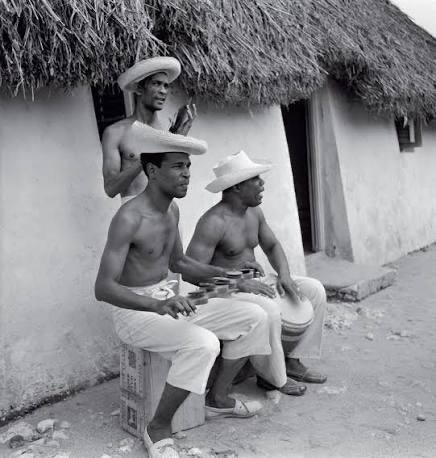
musicians 1900’s Curacao
This single sentence contains a world of meaning. It tells us that what is now considered "traditional" men's attire—the cream-colored pants and shirt worn at cultural celebrations—began as industrial waste, repurposed by people who had no other options. The resourcefulness was theirs; the necessity was imposed.
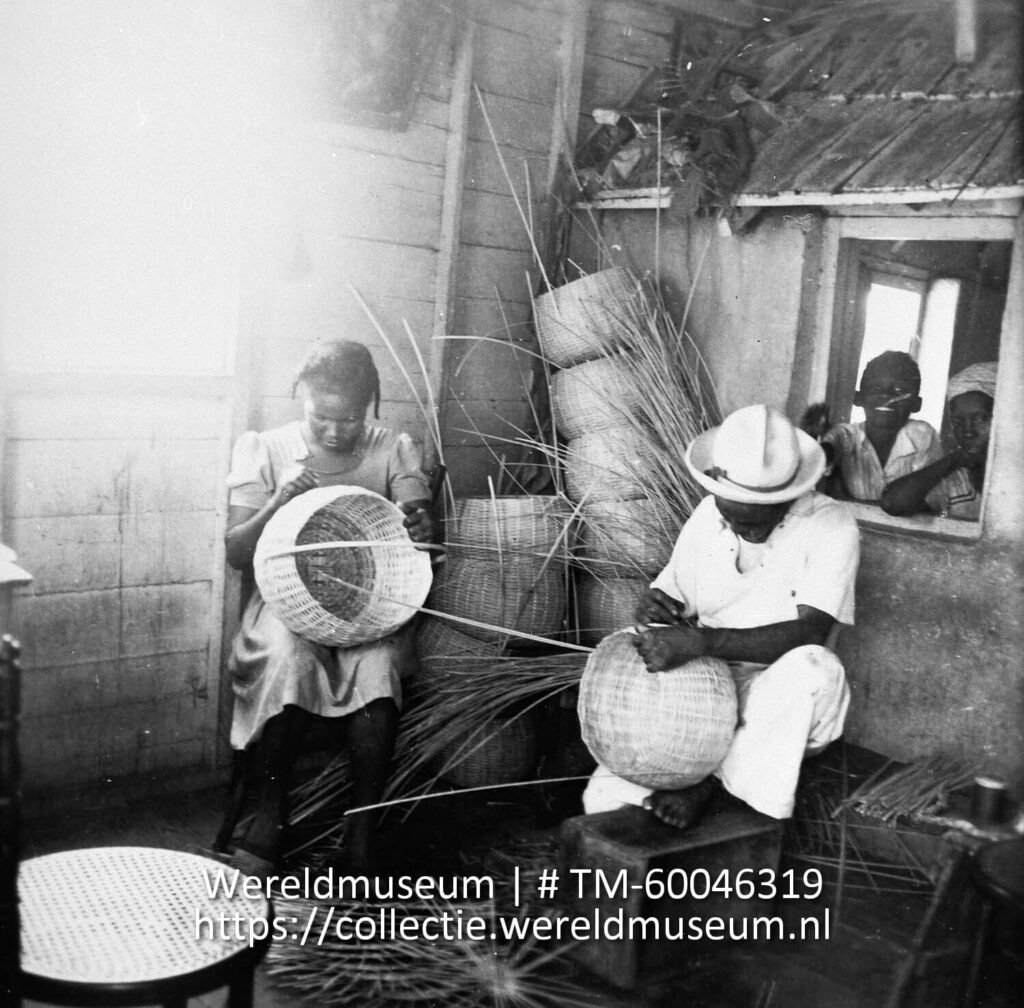
Braiders at work 1900’s
The Global Practice of Sack Clothing
This was not unique to Curaçao. Across the Atlantic world, from the 1880s through the 1950s, people repurposed flour and sugar sacks into clothing, bedding, and household items. The practice intensified during the Great Depression and World War II, when textiles were scarce and expensive. In the United States, feed sacks were so widely used that by the late 1930s, an estimated three million Americans were wearing feed sack clothing—dresses, shirts, quilts, curtains, sheets, mattress covers, pajamas, and even undergarments. In Norway, women made blouses and undergarments from flour sacks, sometimes leaving the printed labels visible as a quiet joke about the origins of their clothing. In the Turks and Caicos Islands, elders recall that underwear was made from the bags that flour came in, and seamstresses would obtain cloth and supplies from merchant boats.
The practice was born of poverty, but it was sustained by skill. Women everywhere developed techniques to transform coarse, stamped sacks into wearable garments. They knew how to remove printed labels—soaking in green soap, scrubbing, bleaching in sunlight—and how to soften rough fabric through washing and beating. This was not tradition in the sense of cultural inheritance passed down unchanged. This was tradition as survival strategy, repeated wherever people faced scarcity.
What the Curaçao Record Shows
In Curaçao, men wore "cream colored pants with a loose shirt or a button-up shirt of a similar shade." That cream color was not chosen from a palette of options. It was the natural, undyed color of the unbleached cotton sacks in which flour and sugar arrived on the island. The garment was defined by the material available, not by aesthetic preference.
The Chobolobo source places this practice within living memory, noting that today's traditional clothing uses "different types of textile that are more colorful and with patterns." The flour sack is gone, replaced by fabrics chosen for beauty rather than scarcity. But the cream color persists—reproduced deliberately, in finer materials, as a marker of heritage. The connection between the color and its origin has been broken. What was once the signature of poverty is now a signifier of tradition.
The Labor Behind the Garment
The Chobolobo article tells us what the sacks became, but it does not detail how they were transformed. To understand that, we must look to community knowledge preserved through generations of Curaçaoan women, and to the broader Caribbean context of textile practices.
The coarse sackcloth would have been stiff, uncomfortable against skin, marked with printed labels from the mills. Before it could become clothing, it had to be worked. Women developed techniques:
· Softening the fabric through beating, washing, and working the fibers until they yielded
· Stiffening it with cassava paste to create crisp creases and a finished appearance worthy of formal wear
· Adding lace for embellishment and dignity, refusing to let their families wear plain sacking
The cassava paste is particularly significant. Cassava—manioc, yuca—was an indigenous crop of the Americas, long cultivated by the Arawak, Carib, and Taino peoples long before European arrival. By the time of slavery, it had become a staple throughout the Caribbean, valued for its versatility and its ability to grow in poor soils. The starch could be extracted by grating the root, mixing with water, straining through cloth, and allowing the sediment to settle. The resulting paste could be used wet or dried and stored.
Jill Becker's research at the University of Technology, Jamaica, confirms that cassava was used in Caribbean textile applications, including resist dyeing. The Caribbean Association of Home Economists has documented cassava's role in regional textile crafts. Scientific studies verify that cassava starch increases the stiffness of cotton fabric, making it ideal for creating the crisp finish required for formal wear. And the practical method—accessible to anyone with access to the root—involved mashing, straining through cloth to produce "starch milk," and applying the wet sediment directly to fabric.
In Aruba, ethnographic sources note that ground cassava was "used as starch for fabrics," a practice carried from indigenous ancestors through generations. The knowledge of how to process cassava for food and for cloth was part of the inherited wisdom of Caribbean women.
The Unrecorded Labor of Women
Notice who performed this labor. The Chobolobo article tells us that women sewed their own clothing. It tells us that traditional clothing is still "often made by elderly women." But it does not tell us about the hours of beating fabric to soften it, the careful preparation of cassava starch, the delicate addition of lace trim. This work was too mundane to record, too feminine to merit documentation, too ordinary for the archives.
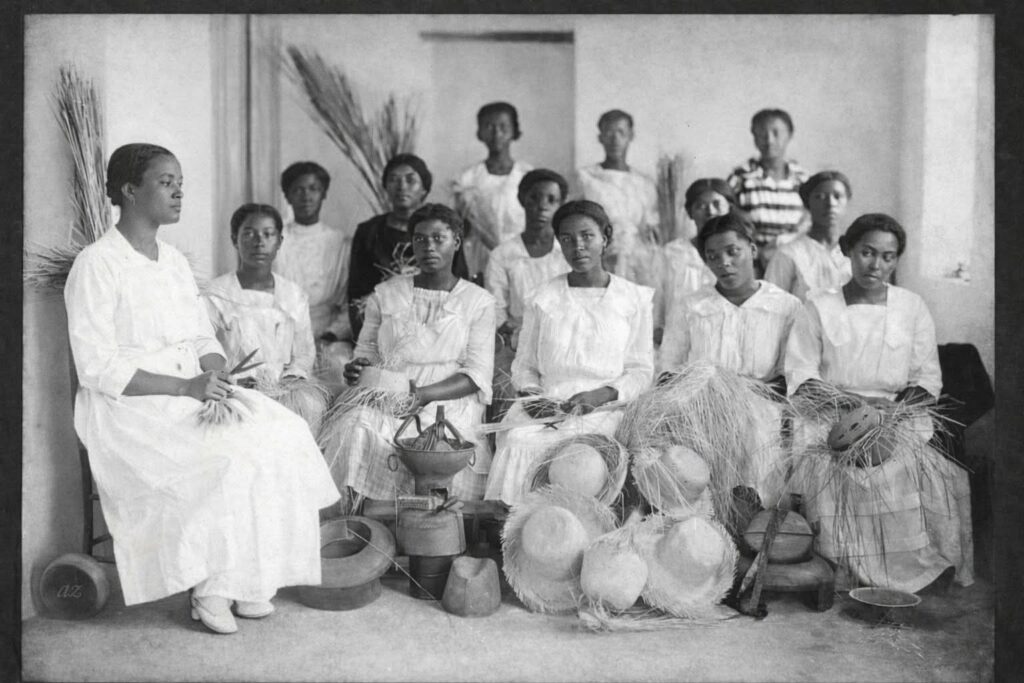
1900’s Braiders
And yet this unrecorded labor was the very thing that transformed a flour sack into a garment worthy of being called traditional. The men's cream-colored shirt, now a symbol of Curaçaoan heritage, began as a sack, softened by hand, starched with cassava, and trimmed with lace by a wife or mother who refused to let her family wear plain sacking. She could not control the economic conditions that left her dependent on flour sacks for cloth. But she could control what she made of them.
The Question of Tradition
So we return to the question that runs through this entire study: Is this tradition, or is this necessity?
The men's cream-colored shirt is both. It is necessity because it began as a flour sack, the only material available to people too poor to buy cloth. It is tradition because generations of women developed the skills to transform that sack into something wearable, even beautiful. It is necessity because the color was not chosen. It is tradition because that color has been remembered and reproduced long after the sacks themselves disappeared.
The connection between the shirt and its origin is broken. Most people who wear it today at Seú or other cultural celebrations do not think of flour sacks. They think of heritage, of identity, of belonging. And they are not wrong. The heritage is real. But it is a heritage forged in scarcity, not chosen in freedom. The shirt carries within it the memory of poverty, even if that memory has been smoothed over by time and pride.
Creative Survival
The details of how survival was made creative—the softening, the starching, the lace—were acts of dignity performed in conditions that offered little dignity. The women who did this work could not choose their material. But they could choose what to make of it. They could choose to add lace. They could choose to starch the fabric until it held a crease as sharp as any gentleman's. They could choose to transform a sack into a garment their husband or son could wear with pride.
This is not tradition as timeless inheritance, passed down unchanged from ancestors who designed it in freedom. This is tradition as creative survival—the material record of a people who, denied everything, made something of their own. The connection may be broken, but what was made in that broken space still matters.
Part IV: Headwraps and Straw Hats – Status, Labor, and Performance
The Headwrap: African Continuity and Sartorial Insurgency
The headwrap styles documented at Chobolobo—Punta di Skálo for labor, Pèchi Yaya for celebration—reveal how a single garment could encode complex social information. The Punta di Skálo's supportive knot was functional: it allowed women to carry buckets of fish or vegetables door-to-door as vendors. This was not ceremonial dress; it was workwear, designed by women for women's labor.
Yet these same headwraps, when made of finer Madras cloth and tied in the Pèchi Yaya style, became garments of celebration, worn to baptisms and first communions. The same practice—wrapping the head—could signify either subsistence labor or spiritual occasion. The difference lay in the cloth and the tie, choices made within tight economic constraints.
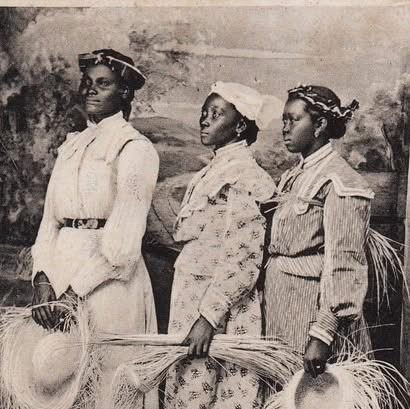
But to read the headwrap only through the lens of function or occasion is to miss its deeper significance. Recent scholarship has reframed the Afro-Creole headwrap as a site of what Nicole Willson terms "sartorial insurgency"—a form of revolutionary counternarrative authored by women of colour through acts of creativity, ingenuity, and domestic labour. In the colonial circum-Caribbean, headwraps were not merely practical accessories; they were material texts through which Black women asserted agency in societies designed to deny it.
The colonial archive, dominated by the voices of white men, often reduced women of colour to the trope of the "tropical temptress"—a figure of seduction, excess, and degeneracy that served to justify racial hierarchies. Yet encoded within these very accounts, Willson argues, is a subtextual fear of Black female agency. The elaborate headwraps that so fascinated and unsettled colonial observers were not signs of submission but of rebellion. They represented what Danielle Skeehan has called "extra-discursive and material texts"—traces of Black female insurgency that bear unique witness to experiences the formal archive sought to erase.
Before the headwrap even touched the hair, there was the labor of grooming—combing with forks, plaiting, twisting, and threading hair with twine, practices carried directly from Africa that prevented tangles and maintained a sense of cultivated personhood in conditions designed to strip it away.
The Tignon Laws: Imposition and Subversion
This tension between control and creativity is nowhere more visible than in the history of the tignon laws of Louisiana. In 1786, Governor Esteban Rodríguez Miró issued a decree requiring all women of African descent—whether enslaved or free—to cover their hair with a knotted headwrap. The stated purpose was to maintain racial distinctions and curb the "audacious" displays of free women of colour, whose elaborate hairstyles and fashionable dress were seen as threatening to the social order.
The law was intended as humiliation. The headwrap had long been associated with enslavement and labour; forcing all Black women to wear it was meant to mark them as inferior, to strip them of the visual markers of status and beauty they had claimed for themselves.
But the women subverted this intention. Rather than accept the headwrap as a badge of shame, they transformed it into an opportunity for creativity. They sourced the finest fabrics—silks, satins, imported Madras—and wrapped their heads in increasingly elaborate and artistic styles. They added jewels, feathers, and ornaments. What was meant to diminish them became a canvas for their artistry and a marker of their dignity. The tignon law did not suppress Black women's self-fashioning; it inadvertently created a new tradition that spread throughout the Americas.
This history matters for Curaçao. While the Dutch Caribbean had its own specific legal codes, the pattern is consistent across the colonial Americas: headwraps were sites of struggle between the impulse to control Black women's bodies and the determination of those women to define themselves. The Punta di Skálo and Pèchi Yaya are not merely functional or festive styles. They are the descendants of this longer history—styles that carry within them the memory of both oppression and resistance.
Straw Hats: Local Craft, Imperial Education, and Global Markets
The men's straw hat tells a parallel story of stratified necessity, but with its own distinct entanglements of labour, colonialism, and global commerce. The Chobolobo source notes that for work on the kunuku (plantation), men wore locally hand-braided straw hats with "damaged edges and were less finely braided." These were functional objects, made from local fibers, designed for sun protection, and discarded when worn. For formal occasions, however, men sought hats imported from Cuba—finer, better made, status objects. The local product was for labor; the imported product was for presentation.
But the story of straw hat production in Curaçao is more complex than this simple hierarchy suggests. As Charlotte Hammond's research documents, from the late nineteenth through the mid-twentieth century, straw hat making in Curaçao became entangled with colonial education, international exhibitions, and global capitalist markets.
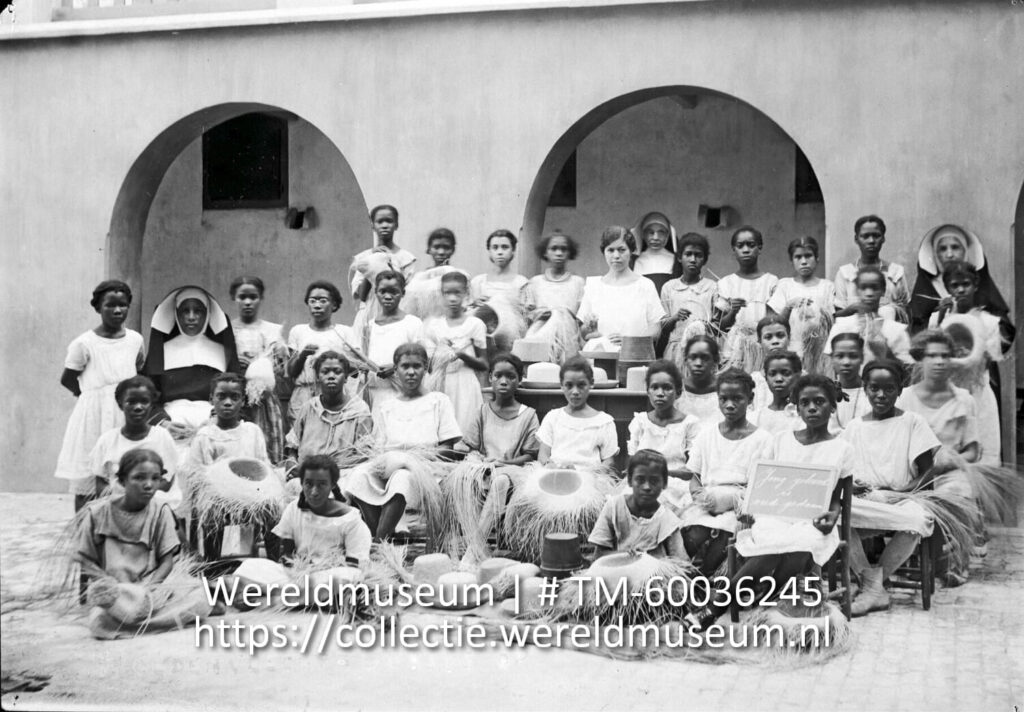
Up until 1946, as a strategy of the Catholic church's "civilising mission," young women in Curaçao were trained to plait the so-called "Panama hat" at technical schools run by the church. The schools focussed on training young Black women in sewing and a range of hat-plaiting techniques. The church legitimised this education as an important tool to combat unemployment and instil respectability and morality in young Curaçaoan women. The ideology underpinning this "civilising mission" touted the education of a work ethic—imposed by God—as a means to counter the threat of idleness associated with sinful activity and the post-emancipation freedom of enslaved workers.
The products of this labour were often exhibited at international expositions and exported for sale in Europe and the United States. A report from the Brussels 1910 world exhibition describes the huge sales of both "simple" and "finely woven" straw hats from Curaçao that led to a second shipment quickly selling out. Conscious of the economic potential, the Dutch reporter lamented the lack of funds allocated to bring several Curaçaoan women hat braiders to the exhibition "to better acquaint them with the requirements of the European market." The bulletin reveals Dutch admiration for this indigenous skill, yet this respect was ambivalent: local craft production was framed as outside modernity, static, and unable to meet the "progressive" standards of a European market without foreign intervention.
Hammond's analysis is trenchant: missionary education that claimed to modernise, industrialise, and revalue local handicraft skills for the benefit of local populations instead perpetuated colonial gendered and racialised divisions of labour. These schools prepared and disciplined students for factory work in global textile industries. The straw hat industry in Curaçao was not simply a matter of local craft serving local needs; it was integrated into a global capitalist system that extracted value from Black women's labour while simultaneously devaluing it.
Counter-Plantation Knowledge and Resistance
Yet even here, within systems designed for exploitation, there were spaces of resistance. Drawing on Jean Casimir's concept of contre-plantation (counter-plantation), Hammond explores how histories of indigenous craft knowledge during specific periods of resistance nurtured what she calls "disidentification with a gendered logic of labour exploitation and racial capitalism."
Casimir's concept is crucial: the contre-plantation refers to the ways enslaved and freed people developed survival strategies and cultural practices on the margins of the formal plantation economy. Craft knowledge, developed covertly on the margins of the plantation or through urban artisanal production, nourished resistance to continued attempts to restore plantation economies after emancipation. When young women in Curaçao learned to plait straw, they were not simply absorbing a colonial work ethic. They were also participating in a longer tradition of indigenous craft knowledge that had sustained their ancestors through slavery and into freedom.
The straw hat, like the headwrap, is thus a contradictory object. It carries the marks of its production within colonial education systems and global capitalist markets. But it also carries the knowledge of hands that learned from mothers and grandmothers, techniques that predated the missionary schools and would outlast them. The "damaged edges" and "less finely braided" work hats that men wore on the kunuku were not merely inferior versions of the fine Cuban imports. They were products of a different economy—one oriented toward survival and use rather than export and profit.
Conclusion: What Covers the Head Tells a Story
Both the headwrap and the straw hat, then, are sites where multiple histories converge. They are functional objects that protect from sun and labour. They are markers of status that distinguish work from celebration, local from imported. They are products of colonial economies that sought to discipline Black bodies and extract value from Black labour. And they are canvases for creativity and resistance, through which women and men asserted their dignity and their personhood.
The Punta di Skálo with its supportive knot, the Pèchi Yaya for special occasions, the rough work hat for the kunuku, the fine Cuban import for formal wear—each carries a story. Together, they remind us that what covers the head is never merely covering. It is communication, identity, memory, and sometimes, insurgency.
Part V: The Seú Parade – From Labor to Spectacle
The Seú harvest parade, held annually on Easter Monday, is described as a celebration of "connectedness to mother nature" and a reenactment of enslaved workers dancing and singing while carrying their harvest to the storage house. Today, over forty-five groups—nearly five thousand people—process through the streets of Otrobanda and the western districts, their colorful costumes and headwraps transforming the route into a river of movement and memory.
But the transformation of this procession demands critical analysis. What was once a forced march—enslaved people transporting the fruits of their unpaid labor to their enslavers' storehouses—is now a voluntary cultural parade. The songs of resistance become heritage performances. The work clothes become costume. The question at the heart of this study—tradition or necessity—finds no clearer expression than in the annual journey of the Seú.
The Ritual in History
The Seú tradition emerged during slavery, specifically around the harvest of sorghum, a grain introduced from West Africa that became a staple crop on Curaçao's plantations. In the eighteenth and nineteenth centuries, the purpose of the Seú celebration was to thank the gods for the harvest. Enslaved workers would cut the sorghum stalks in the fields—men doing the cutting, women gathering the harvest into baskets—and then process, singing and dancing, to the magazina (warehouse) where the crop would be stored. After the harvest was secured, celebrations continued in the square near the plantation house, where the shon (landowner) could observe the festivities.
The ritual unfolded in three distinct phases. The first phase was the harvest itself, accompanied by the rhythmic playing of the kachu (cow horn). The second phase was the procession to the warehouse, with workers singing songs in a fixed rhythm. The third phase, after the work was complete, brought the community together to sing and dance to the music of the tambú drum.
These phases encoded within them both the structure of enslaved labor and the creative response to it. The songs that accompanied the harvest and procession were work songs—but they were also repositories of memory, complaint, and coded resistance. The tambú music that closed the celebration carried particular danger: it was considered pagan by the Catholic Church and threatening by the colonial authorities. After emancipation, the tambú portion of the Seú was banned outright, an explicit attempt to suppress the creativity of the Afro-Curaçaoan population.
Suppression and Revival
The trajectory of the Seú after emancipation mirrors the larger story of Afro-Curaçaoan cultural expression. With the arrival of the Shell oil refinery in 1915 and the accompanying modernization, the Seú gradually lost its original function. The harvest economy that had given it meaning was being supplanted by industrial labor. The tradition risked fading entirely.
It was rescued by women. In the 1940s and 1950s, Ursulita Martis led an effort to breathe new life into the Seú celebration. Thanks to her work, and to the many women who carried the knowledge of songs, dances, and dress, the tradition was revived. What had been a labor ritual tied to the agricultural calendar became an annual cultural parade, a conscious performance of Afro-Curaçaoan identity.
This revival was not simple preservation. It was transformation. The Seú became something new: a celebration of heritage rather than a requirement of labor. The participants were no longer enslaved workers compelled to march; they were free people choosing to remember. The songs were no longer sung under the eye of the shon; they were offered to ancestors and to the community.
The Costume Today
Today's Seú features "colorful clothing designs and headwraps" that "reflect both the modernization and the creativity of the community." The saya ku djèki is now made from "different types of textile that are more colorful and with patterns." The flour sack is gone, replaced by fabrics chosen for aesthetics, not scarcity. The cassava paste that once stiffened a man's collar has been forgotten by all but the oldest families. The lace added by candlelight survives only in the heirlooms passed down through generations.
The men wear straw hats—but these are no longer the rough work hats with "damaged edges" worn on the kunuku. They are finer, more deliberate, chosen to complete an outfit rather than to shield a laborer from the sun. The distinction between local work hat and imported formal hat has blurred into a single "traditional" accessory.
And yet, the connection to the past is not entirely lost. Participants still speak of honoring their grandinan (ancestors). The music still uses instruments born of the plantation—the chapi (garden hoe), the kachu (cow horn), the tambú drum. The procession still moves un pia un pia (slow step by slow step), as it did when workers carried their harvest to the warehouse. The body remembers what the mind may have forgotten.
Is This Loss or Gain?
The question is unavoidable. The parade preserves memory, but it also sanitizes it. The contemporary viewer sees beauty and tradition; they do not see the flour sack, the cassava paste, the lace added in candlelight by women determined to create dignity from deprivation. The design has been abstracted from its conditions of production. The struggle that produced it has been smoothed over by pride and by time.
This is what Jean Casimir, the Haitian sociologist, might call the movement from plantation to counter-plantation. The plantation was the system that planted people to plant crops, that reduced human beings to adjuncts of commodity production. The counter-plantation was everything the enslaved and their descendants built in opposition to that system: the smallholdings, the kinship networks, the cultural practices, the autonomous spaces where dignity could be cultivated even in the absence of freedom.
The Seú, in its origins, was a product of the plantation—a ritual embedded in the rhythms of forced labor. But in its survival and transformation, it became something of the counter-plantation. It became a space where Afro-Curaçaoan identity could be performed, remembered, and passed on. The flour sack became a shirt. The work song became a heritage. The forced march became a voluntary parade.
This is not simple loss, nor is it simple gain. It is the complex process by which oppressed people take the materials of their oppression and make something of their own. The connection between the Seú of the eighteenth century and the Seú of today is broken—but what was made in that broken space still matters.
The Carnival Connection
Scholars of the African diaspora have traced similar transformations across the Americas. Raphael Njoku's work on West African masking traditions and diaspora masquerade carnivals shows how enslaved Africans carried with them not static customs, but dynamic practices of memory and performance. The masquerade, like the Seú procession, served multiple functions: it was a form of spiritual practice, a method of social control, a technique of remembering, and a medium of resistance.
When Africans were forcibly brought to the Americas, these practices did not simply disappear or survive unchanged. They adapted. They incorporated new materials, new contexts, new meanings. The Caribbean carnival traditions—Trinidad's Carnival, Cuba's comparsas, Haiti's rara—all bear the marks of this creative adaptation. They are neither purely African nor purely European. They are something new, born of the violent encounter between worlds.
The Seú belongs to this family. It is Curaçao's version of a pan-Afro-diasporic phenomenon: the transformation of forced ritual into voluntary celebration, of labor into performance, of survival into art.
Conclusion: What Do We Call Tradition?
This analysis has traced the threads of Curaçaoan dress through:
· The holds of Dutch slave ships carrying Madras cloth, traded for human beings on the African coast
· The backs of enslaved women wrapping African-style headwraps from European fabric, transforming commodity into memory
· The sumptuary laws of colonial regimes that sought to control Black women's bodies, and the creative subversion of those laws through fabric and style
· The empty flour sacks of the post-emancipation poor, transformed into cream-colored shirts that would become markers of heritage
· The cassava root, mashed and strained into starch to give those shirts shape and dignity
· The lace, added by hand, turning necessity into beauty
· The missionary schools that trained young women in straw plaiting for global markets, even as they sought to discipline them into colonial norms
· The Seú parade, transforming forced labor into voluntary celebration, work song into heritage performance
At every stage, the clothing now called "traditional" was shaped by forces its wearers did not control: the global textile trade, the economics of slavery, the scarcity of the Depression, the social codes of colonial society, the educational interventions of church and state. Yet at every stage, Curaçaoans made choices within those constraints. They preserved African headwrap styles. They sewed their own garments. They developed techniques—softening, starching, embellishing—that turned industrial waste into wearable art. They wore their best to baptisms and their work-wraps to sell vegetables. They adapted masking traditions from West Africa to new contexts, new materials, new meanings.
The Counter-Plantation Framework
Jean Casimir's concept of the counter-plantation offers a powerful lens for understanding what this process means. The plantation system was designed to reduce human beings to adjuncts of commodity production. It sought to strip them of memory, of culture, of autonomous social life. But the enslaved and their descendants refused to be reduced. They built something else on the margins of the plantation: smallholdings, kinship networks, religious practices, aesthetic traditions. They created, in Casimir's terms, a "counter-plantation" that existed in opposition to the logic of the master.
The traditional clothing of Curaçao is a product of this counter-plantation. It was made from the scraps and discards of the plantation economy—the coarse fabric issued to laborers, the empty sacks that had held imported flour. But it was made according to aesthetic principles that remembered Africa. It was worn with a dignity that the plantation never intended. It was passed down through generations of women who taught their daughters to sew as their mothers had taught them.
This is not to romanticize. The counter-plantation was not a space of freedom; it was a space of survival within unfreedom. The clothing made in that space bears the marks of its origins. It is simple, modest, economical. It is made from what was available, not what was desired. But it is also beautiful, creative, meaningful. It carries within it the stories of the women who made it and the men who wore it.
So: Is This Tradition or Necessity?
The answer is both. It is necessity transformed by generations of creativity into something that feels like tradition. It is the flour sack, remembered not as poverty but as resourcefulness. It is the cassava paste, forgotten by written records but preserved in the hands of families. It is the headwrap, African in origin, Caribbean in practice, Curaçaoan in identity.
To call it merely "traditional" is to erase the struggle that produced it. To call it merely "necessary" is to erase the artistry that elevated it. The truer term might be survival design—the material record of a people who, denied everything, made something of their own.
The Broken Connection
The title of this essay names the problem: the connection is broken. The flour sack is no longer a flour sack; it is a "traditional" cream-colored shirt. The headwrap is no longer a marker of African identity preserved under oppression; it is a festive accessory. The Seú parade is no longer a memory of forced marches; it is a tourist attraction and a source of community pride. The cassava paste, the lace, the softening techniques—these survive only in the memories of the oldest women, if they survive at all.
This is not to say that contemporary Curaçaoan dress is inauthentic. Authenticity is not located in a fixed past, frozen and unreachable. Culture is always changing, always adapting, always making itself new. The women who sew saya ku djèki today for the Seú parade are not less authentic than their grandmothers who sewed from flour sacks. They are simply working with different materials, different contexts, different meanings.
But the broken connection is itself part of the story. It is what happens when oppressed people take the materials of their oppression—whether fabric from Dutch merchants or sacks from imported flour—and transform them into something of their own. The break is not a loss; it is the space where creativity happens. It is the gap between what was imposed and what was made, between the master's provision and the wearer's meaning.
What Remains
What remains, after this analysis, is not a simple story of victimhood or of triumph. It is a complex story of people who, facing conditions not of their choosing, made choices nonetheless. They chose to remember Africa in the wrapping of a headwrap. They chose to add lace to a flour sack. They chose to revive a harvest ritual that had lost its original function. They chose to pass their knowledge to their daughters.
The clothing they made carries the marks of these choices. It is modest because modesty was required of them, but it is also beautiful because beauty was something they required of themselves. It is economical because materials were scarce, but it is creative because creativity was how they survived. It is traditional because they kept making it, generation after generation.
So, what do we call tradition?
Perhaps we call it this: the material record of a people's ongoing conversation with their past, conducted under conditions not of their choosing, but carried out with whatever materials they had at hand. The connection may be broken, but the conversation continues. And what is made in that broken, continuing space—the shirt, the headwrap, the parade, the song—is worthy of the name tradition, if we understand that name to mean not timeless inheritance but creative survival.
References for Post 2 (Parts III, IV, V & Conclusion)
Allen, R. "The Harvest Ceremony Seú as a Case Study of the Dynamics of Power in Post-Emancipation Curaçao (1863-1915)." Caribbean Quarterly 56, no. 3 (2010): 13-29.
Becker, Jill. "Cassava Resist Dyeing: Traditional dyeing techniques in a new environment." Paper presented at the Biennial Conference of The University of the West Indies Schools of Education, St. Augustine, Trinidad and Tobago, April 2013.
Casimir, Jean. The Haitians: A Decolonial History. Chapel Hill: University of North Carolina Press, 2020.
Casimir, Jean. "La plantacion y la contraplantacion en la Historia del Caribe." In La Invención del Caribe. San Juan: Editorial de la Universidad de Puerto Rico, 1997.
"Cassava Resist Dyeing." Caribbean Association of Home Economists. http://caribbeanhomeeconomist.org/cassava-resist-dyeing/
"Episode CXXI -121: Yuca an Amerindian cultural heritage." Aruba Today, September 2021.
Hammond, Charlotte. "Straw craft, imperial education and ethnographic exhibitions as tightly braided sites of gender production in Haiti and Curaçao." Journal of Material Culture 28, no. 4 (2023): 515-538.
Jenson, Deborah. "Plot and counter-plantation: Jean Casimir and captive modernity." Cultural Dynamics 36, no. 3 (August 2024): 360-366.
Kirkland, Teleica. "Clothing as Resistance." Costume Institute of the African Diaspora. https://ciad.org.uk/directory/clothing-as-resistance/
Njoku, Raphael Chijioke. West African Masking Traditions and Diaspora Masquerade Carnivals: History, Memory, and Transnationalism. Rochester: University of Rochester Press, 2020.
Njoku, Raphael Chijioke. "Igbo/West African Masquerade Culture and the Dynamics of African Diaspora Carnivals." Lecture, Frontier Culture Museum.
Rathgeb, Jody. "Wear? Where? Keeping Islanders clothed in 'the old days'." Times of the Islands, Summer 2022.
"730. Curaçao's Thanksgiving Parade." 1000 Awesome Things About Curaçao. https://1000awesomethingsaboutcuracao.com/2013/04/12/730-curacao-awesome-thanksgiving-parade-seu/
Systad, Gunnhild. "The Use of Flour and Sugar Sacks in Clothing, Bedding, and More." Norwegian Textile Letter, February 2020.
The Story Behind the Traditional Clothing of Curaçao. Landhuis Chobolobo.
"Unraveling the History: When Did Flour Sacks Become Fashion?" Fashion Trend Tips, August 2025.
"A Sliver of Deep Blue Cloth." Haptic & Hue podcast, April 2023. https://hapticandhue.com/tales-of-textiles-series-5/
Willson, Nicole. "Sartorial insurgencies: Rebel women, headwraps and the revolutionary Black Atlantic." Atlantic Studies 19, no. 1 (2022): 86-106.
When visitors to Curaçao admire the vibrant saya ku djèki during the Seú parade, or when cultural festivals showcase women in elaborate headwraps and men in cream-colored shirts, these garments are presented as timeless expressions of Curaçaoan identity. They are called "traditional dress."
But this label obscures a more uncomfortable truth. What we celebrate as cultural heritage was born from the bodies of taken African people—men and women torn from their homelands, forced into the holds of Dutch slave ships, and deposited on an island where they would be required to rebuild identity from fragments. This essay interrogates, through a critical design lens, how the experience of enslaved Africans—their trauma, their memory, their creativity—shaped what became Curaçao's traditional clothing. It asks a fundamental question: Is this tradition, or is this necessity—preserved, polished, and rebranded over generations?
The garments now called "traditional" were not designed in freedom. They were assembled from the materials of oppression: the cargo lists of Dutch merchants, the coarse fabric issued to laborers, the empty flour sacks of impoverished families, and the starch of a cassava root grown on land they did not own.
Yet there is something more at work here—something that resists simple explanations of material scarcity. The saya ku djèki—that distinctive combination of wide skirt and fitted top—is not unique to Curaçao. Travel across the Black diaspora, and you will find its echoes everywhere. In Brazil, the baiana dress of Salvador's Carnival carries the same volumetric skirt and elaborate headwrap. In Colombia's Palenque, in the pollera of Panama, in the bata of Cuba's Santería practitioners, in the nagua of Venezuela's Afro-descendant communities, the same silhouette appears and reappears. It emerges in the quadrille dress of Haiti and the douillette of Martinique. The forms are not identical—each carries the imprint of its specific colonial power, its local materials, its particular history—but the family resemblance is undeniable.
What are we to make of this? The connections are not always scientifically traceable. There is no single shipping manifest documenting the movement of a skirt pattern, no colonial decree that mandated this particular silhouette across Dutch, Spanish, Portuguese, and French colonies. And yet the form persists—a deep structure carried in memory, in muscle, in the hands of women who taught their daughters to sew as their mothers had taught them. It suggests that taken African people, dispersed across the Americas, developed similar aesthetic solutions to similar problems: how to dress modestly under the gaze of oppressors, how to preserve dignity through fabric, how to signal identity through silhouette.
This opening observation—that the saya ku djèki belongs to a pan-Afro-diasporic family of dress—points toward research still to be done. If the same form appears in Curaçao and Brazil, in Cuba and Colombia, what does that tell us about the deep connections that survived the Middle Passage? What knowledge traveled not in books but in bodies, not in patterns but in memory? This essay focuses on Curaçao as a case study, but the questions it raises ripple outward, inviting future scholars to trace the threads that bind the Black Americas together.
Part I: The Raw Materials of Oppression – Textiles in the Slave Era
Before there could be a saya ku djèki, there had to be fabric. And in 17th and 18th century Curaçao, fabric arrived not for the comfort of the enslaved, but for the profit of the enslaver. The very fibers that would eventually become "traditional dress" first touched the island as cargo—listed in ledgers, exchanged for human beings, and distributed according to the logic of empire.
The Dutch Textile Machine
The Dutch were master textile traders. Through the Dutch East India Company (VOC), they flooded the Atlantic world with Indian cottons—calicoes, chintzes, and the distinctive plaid Madras cloth. By the 1600s, these fabrics were reaching Curaçao, but their journey tells us everything about the broken connection this essay traces. These textiles arrived not as goods for the enslaved to wear with pride, but as:
· Currency in the slave trade, exchanged for human beings on the African coast
· Cargo to be re-exported to Spanish colonies
· Payment for plantation infrastructure
· Clothing issued to enslaved laborers at the lowest possible cost
Madras cloth, now celebrated as a symbol of Afro-Caribbean identity, arrived as a commodity of empire. Its transformation into a marker of resistance and belonging happened despite its origins, not because of them. The same fabric that wrapped African bodies in the hold of a slave ship would later wrap the heads of their descendants in ceremonies of freedom. The connection between origin and meaning is not just broken—it is violently severed and painstakingly repaired by generations of women who refused to let the cloth carry only the story of their oppression.
The Paradox of Trade Cloth
This paradox deserves attention. The Dutch did not import Madras cloth for enslaved people. They imported it as trade goods—to be sold, bartered, and exchanged along the West African coast for more human cargo. That some of these textiles eventually reached the hands of enslaved people in Curaçao was incidental to their purpose. They were not gifts; they were the loose change of a brutal economy.
And yet, once in those hands, the cloth was transformed. A length of Madras—called injiri or 'George' by the Kalabari people of Nigeria, who had worn it for centuries before the slave trade—might be woven in South India, shipped by Dutch merchants to the West African coast, and exchanged for enslaved human beings. That same cloth, carried across the Middle Passage in memory as much as in baggage, might end its journey as a headwrap in Curaçao—wrapped in a style that remembered Africa, worn with a dignity the Dutch never intended. The cloth carried the violence of its journey, but it also carried possibility. This is the broken connection made visible: the same object can contain both trauma and resilience, both theft and creation.
Clothing the Enslaved: The Bare Minimum
When enslaved people were given clothing—and the word "given" itself is a deception, for nothing was given that their labor did not purchase many times over—it was not an act of kindness but of economic calculation. Coarse, cheap fabrics were imported specifically to outfit laborers at the lowest possible cost. These included:
· Osnaburg: a rough linen named for the German city where it was produced, stiff and uncomfortable against skin
· Low-grade cotton: often unbleached, undyed, and quickly worn thin
· Heavy wool: entirely unsuited to the tropical climate, likely issued because it was cheap, not because it was appropriate
These were the textiles of subsistence. They were designed for durability, not dignity; for covering, not expression. The Dutch were not interested in whether enslaved people felt human in their clothing. They were interested in whether the clothing would last another season before requiring replacement.
And yet—and this is the central tension of this entire study—even these scant materials became sites of meaning. As scholarship on Curaçaoan women documents, enslaved women took the rough fabric they were issued and made something more of it. They did not simply wear what they were given; they transformed it.
The Headwrap: Memory in Cloth
Nowhere is this transformation more evident than in the headwrap. The styles documented at Landhuis Chobolobo—Punta di Skálo with its supportive knot for carrying buckets, Pèchi Yaya for special occasions—are not European inventions. They are direct lines back to the African continent, preserved through the Middle Passage, adapted to new materials and new circumstances.
The headwrap tells us something crucial about how taken African people approached cloth. When they received coarse osnaburg or cheap cotton, they did not see only what the Dutch intended. They saw possibility. They saw memory. They saw a way to continue, in a new land, practices their mothers had taught them. The cloth may have been European, but the meaning was African.
This is an early act of what we might call design resistance: the refusal to let material be merely material, the insistence on imprinting identity onto even the most meager resources. The headwrap is not just a piece of fabric wrapped around hair. It is a repository of memory, a marker of occasion, a tool for labor, and a statement of selfhood—all at once.
The Connection That Was Never Supposed to Survive
The Dutch textile machine was designed to move goods and people as efficiently as possible. It was not designed to preserve African aesthetics or enable cultural continuity. And yet, despite every effort to strip enslaved people of their identities, the knowledge of how to wrap a head, how to style fabric, how to make cloth carry meaning—this knowledge survived.
It survived in the hands of women. It survived in the whispered instructions from mother to daughter. It survived in the muscle memory of fingers folding and tucking fabric. It survived because taken African people refused to let it die.
The connection was broken, yes—violently, deliberately, systematically broken. But it was also repaired, stitch by stitch, wrap by wrap, generation by generation. The saya ku djèki and the headwraps of Curaçao are not simply "traditional dress." They are the material evidence of that repair.
Looking Ahead
This chapter has traced the raw materials of oppression—the fabrics that arrived in Curaçao as cargo and currency. But materials alone do not make clothing. The next chapter examines how taken African people, particularly women, transformed these materials into the garments we now call traditional. It asks: When you are given nothing but coarse cloth and memory, what do you make? The answer is the saya ku djèki.
Part II: The Saya ku Djèki – Whose Design, Whose Modesty?
The saya ku djèki—a long skirt paired with a flared, button-up shirt—is today's iconic Curaçaoan women's outfit. It is described as modest, practical, and beautiful. But a persistent narrative lingers in some histories: that this modesty was imposed upon enslaved and freed women by the wives of slave masters, who, threatened by the presence of Black women in their households, sought to cover them according to European Victorian standards.
This explanation is too simple. More importantly, it is an explanation that erases agency. It assumes that Black women were passive recipients of dress codes rather than active participants in their own self-fashioning. The scholarship on dress in the Caribbean tells a different story—one in which African women retained, nurtured, and adapted their own aesthetic traditions, making conscious choices about when to resist and when to accommodate.
The Narrative We Must Challenge
The claim that slave masters' wives imposed modesty on enslaved women rests on a plausible premise: that white women in colonial households felt threatened by the presence of Black women and sought to control their appearance. This may well have happened. But to conclude from this that the saya ku djèki is simply a hand-me-down of Victorian modesty is to ignore everything we know about how enslaved women actually used dress.
If modesty were purely an imposition, we would expect to find records of enslaved women passively accepting whatever clothing was given to them. Instead, the historical record shows the opposite. Enslaved women exercised significant control over their clothing, using it as a symbol of resistance against European attempts at cultural annihilation. They maintained and nurtured African cultural characteristics in their dress, preserving aesthetic values that had nothing to do with Victorian morality.
What the Scholarship Actually Shows
Steeve Buckridge's foundational work on Jamaican women's dress documents that African cultural features—folklore, music, language, religion, and dress—were retained and nurtured in the Caribbean because they guaranteed the survival of Africans and their descendants. Dress was not a passive accommodation to white expectations; it was an active strategy of survival. Women had some control over their clothing whether as resistors or accommodators. The key word here is control.
When European elements did appear in enslaved women's dress, Buckridge argues, this was not simply imposition. Changes from more African modes to more European-influenced styles accompanied greater possibilities for social mobility. Women made calculated choices: adopting certain European elements could open doors, but this was a strategy, not submission. As Buckridge puts it, resistance and accommodation were not polar opposites, but melded into each other.
The Evidence of Colonial Fear
If slave masters' wives were so successful at imposing modesty, why did colonial authorities feel the need to pass laws controlling what enslaved women wore? Charlotte Hammond's research on the francophone Caribbean documents that dress was so powerful a form of expression that it stirred the colonists to restrain this seemingly dangerous form of slave ascension through legislative prohibition. These ordinances policed the way certain bodies could be attired precisely because enslaved women were dressing in ways the colonizers found threatening, not compliant.
The existence of these laws tells us everything: enslaved women were not passively accepting the dress codes of their oppressors. They were actively using clothing to assert themselves, and the colonial state had to intervene to stop them.
The Evidence of Creativity
Perhaps most powerfully, Danielle Skeehan's work reveals that enslaved women used clothing as a medium of authorship. She documents the case of Coobah, an enslaved seamstress in Jamaica, who embroidered names and messages onto another woman's smock—creating what Skeehan calls a "material epistle" that circulated publicly on the wearer's body. This was not passive acceptance of imposed modesty. This was a woman using needle and thread to "write" her own stories of love and kinship, to assert her own voice in a world that denied her literacy.
As Skeehan argues, these material texts complicate our understanding of who counts as an "author" in the Atlantic world. Enslaved women converted the very tools of her labor as an enslaved seamstress into a medium through which she can tell stories of love and kinship, as well as sexual exploitation and loss.
The Question of African Aesthetics
If the saya ku djèki is not simply an imposed Victorian garment, what are its sources? The scholarship points to African aesthetic values that survived the Middle Passage. Buckridge discusses the aesthetic value of West African women's dress and the African customs that were brought to Jamaica and nurtured across generations. The headwrap traditions documented in Curaçao—Punta di Skálo and Pèchi Yaya—are explicitly linked to African origins. Why would headwraps retain their African connections while the saya ku djèki did not?
The answer is that both retain African aesthetic sensibilities, adapted to new materials and circumstances. The wide skirt and fitted top silhouette that appears across the Black diaspora—from Brazil's baiana to Cuba's bata to Curaçao's saya ku djèki—suggests deep structural continuities that cannot be explained by European influence alone.
Revisiting the Chobolobo Timeline
The Chobolobo source states that traditional clothing started after the slavery times with our ancestors. This timing is significant, but not for the reasons usually given. After 1863, formerly enslaved women were free—but they were also poor. Their clothing had to serve multiple purposes: affordable, durable, appropriate for labor.
Curacao Woman of the braiding industry 1900’s
But this does not mean they simply adopted whatever styles were available. As Buckridge's work shows, even in freedom, women continued to make choices about their dress that reflected both African heritage and strategic accommodation to new social realities. The saya ku djèki was often made from the same fabric or a combination of two or three patterns. This pattern-mixing was not merely economical; it was a continuation of African aesthetic practices that valued pattern and texture.
Conclusion: Whose Modesty?
So, whose modesty does the saya ku djèki represent?
The evidence suggests that the question itself may be wrong. The garment does not represent someone else's modesty imposed upon Black women. It represents the choices of Black women themselves—choices made within constraints, yes, but choices nonetheless. They chose when to retain African modes and when to adopt European elements. They chose how to wrap their heads and how to mix their patterns. They chose, like Coobah, to use needle and thread to tell their own stories.
The modesty of the saya ku djèki may have less to do with Victorian morality and more to do with African values of dignity, self-presentation, and community. It may reflect what it meant for a woman to present herself with respect in a world that denied her respect at every turn.
The question lingers, but the scholarship shifts its terms. It is no longer: "Did white women impose this on Black women?" It becomes: "What did Black women make of the materials they had, and what stories did they tell through the clothes they made?"
📚 References for Post 1 (Introduction, Parts I & II)
Becker, Jill. (2013). Cassava Resist Dyeing: Traditional dyeing techniques in a new environment. Paper presented at the Biennial Conference of The University of the West Indies Schools of Education, St. Augustine, Trinidad and Tobago.
Buckridge, Steeve O. The Language of Dress: Resistance and Accommodation in Jamaica, 1750-1890. Kingston: University of the West Indies Press, 2004.
Buckridge, Steeve O. "Dem caa dress yah!" : dress as resistance and accommodation among Jamaican women from slavery to freedom, 1760-1890. Doctoral dissertation, Ohio State University, 1998.
Buckridge, Steeve O. African Lace-Bark in the Caribbean: The Construction of Race, Class, and Gender. London: Bloomsbury Academic, 2016.
Contiguous Cloth: Textiles and the Slave Trade in New Netherland. The Gotham Center for New York City History.
Curaçaoan Women in the Late 18th and Early 19th Centuries. Brill Publishing.
Design History In Curaçao. Design Encyclopedia.
Hammond, Charlotte. "Costuming Colonial Resistance in the New World." In Entangled Otherness: Cross-gender Fabrications in the Francophone Caribbean, 48-81. Liverpool: Liverpool University Press, 2018.
Indian Cotton Textiles in the 18th-Century Atlantic Economy. LSE Research.
Madras and the Poetics of Sartorial Resistance. Age of Revolutions.
Skeehan, Danielle C. "Materializing the Black Atlantic: African Captives, Caribbean Slaves, and Creole Fashioning." In The Fabric of Empire: Material and Literary Cultures of the Global Atlantic, 1650-1850. Baltimore: Johns Hopkins University Press, 2020.
Systad, Gunnhild. (2020). The Use of Flour and Sugar Sacks in Clothing, Bedding, and More. Norwegian Textile Letter.
Textile Circulation in the Dutch Global Market. Journal of Historians of Netherlandish Art (JHNA).
The Story Behind the Traditional Clothing of Curaçao. Landhuis Chobolobo.
Utilization and Characterization of Cassava Starch as a Natural Thickening Agent for Reactive Dye Printing on Cotton Fabric. ResearchGate.
White Gold: Cassava as an Industrial Base. Scientific Research Publishing.
How to Make Laundry Starch from Cassava. Starch Project Solution / Doing Group.