Having established the theoretical foundations of design sovereignty in Part 1 and spatial justice in Part 2, Part 3 pivots from physical architecture to tactile design, material culture, and textile economies. Material sovereignty asserts that raw fiber ecosystems, heritage processing methods, and artisanal repair engineering are not static artifacts, but sophisticated, high-margin intellectual property. For centuries, continental textile traditions were reduced by colonial trade arrangements to unrefined agricultural commodities. Reclaiming industrial advantage across African and Caribbean corridors requires transforming these material archives into autonomous, sustainable luxury frameworks and high-value sovereign production networks.
1. Textile Heritage as High-Level Luxury and Intellectual Property
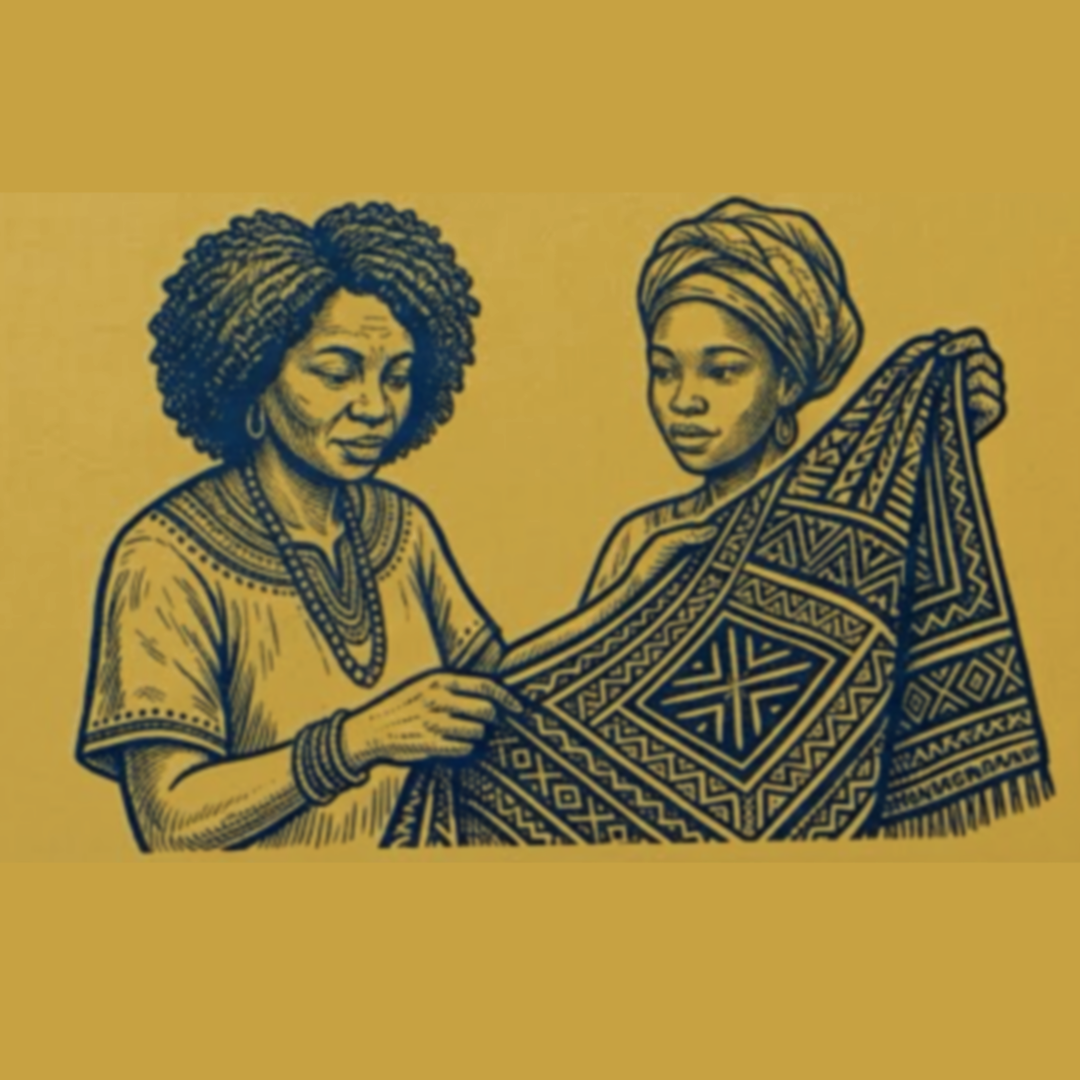
As fashion theorist Ken Kweku Nimo establishes, African textile systems were historically stripped of their intellectual property rights and framed as mere folklore or raw material inputs for foreign mills. In reality, traditions such as Kente, Aṣọ-Òkè, Bògòlanfini, and Ndop represent sophisticated luxury frameworks grounded in rigorous material science, complex geometric algorithms, and elite craftsmanship. Continental industrialization must reassert these textiles as proprietary, high-value visual IP.
2. Slow Design, Indigo Archives, and Material Epistemologies
Dr. Folayemi Foster’s work on West African textile archives highlights the philosophy of slow design and indigo vatting as advanced biochemical and spatial knowledge systems. West African indigo dyeing across the Senegambian basin and Nigeria connects botanical cultivation, fermentation chemistry, and structural resist-dyeing into an integrated archive of resilience. Scaling organic indigo vatting over synthetic petroleum dyes creates an unassailable luxury standard that commands premium global pricing while eliminating toxic environmental run-off.
3. Esthétique de la Récupération: Engineering Street-Level Circularity
Design scholar Kouassi Akpetou introduces the esthétique de la récupération, evaluating informal street-level repair, material upcycling, and artisanal reconstruction as high-level industrial engineering. Rather than viewing informal repair networks as signs of poverty, Akpetou demonstrates that these circular practices form an advanced blueprint for modern zero-waste manufacturing, post-consumer textile management, and decentralized material regeneration.
4. Transatlantic Material Resistance and Diaspora Craft Agency
Material culture across the African diaspora functions as a continuous archive of survival and political resistance. As scholars Malene Barnett, Charmaine Nelson, and Manuel Zapata Olivella articulate, transatlantic craft practices across the Caribbean and Americas carried embedded spatial memory, ancestral technical codes, and economic agency. From plantation-era textile workarounds to contemporary ceramic and woven forms, craft has consistently operated as political self-determination.
Master Bibliography (Curated Project Sources)
Akpetou, K. (2021). L'esthétique de la récupération: Design, recyclage et économie informelle en Afrique de l'Ouest. Éditions de l'Harmattan.
Barnett, M. (2024). Crafted Kinship: Ancestral Memory in Caribbean Craft. Artisan Books.
Bennett, A. G. (2012). Interactive Aesthetics: Digital Design and Culture. Palgrave Macmillan.
Business & Human Rights Resource Centre. (2026). Garment workers protest demanding Tk 30,000 minimum wage increase.
Spatial Infrastructure as an Industrial Imperative
In Part 1, we established that Africa’s textile competitiveness must be built on autonomous design sovereignty, heritage methodologies, and proprietary intellectual property rather than low-wage labor extraction. Moving from design epistemology into the physical realm, Part 2 addresses the spatial foundation of manufacturing: the built environment, factory architecture, and special economic zones (SEZs). True industrial sovereignty requires an architecture of resistance. If African textile corridors are housed within imported, energy-intensive concrete boxes and planned using extractive colonial layouts, they inherit structural vulnerabilities. To build resilient industrial hubs, we must ground our physical infrastructure in indigenous spatial theories, vernacular material tectonics, and spatial justice.
                    +-------------------------------------------------+
                    |       EXTRACTIVE SPATIAL MODEL (OLD PARADIGM)   |
                    | Concrete Boxes  --> Energy Drain --> Enclave SEZ|
                    | (Vulnerable to power outages & climate heat)    |
                    +------------------------+------------------------+
                                             |
                                             v
                    +-------------------------------------------------+
                    |       SOVEREIGN SPATIAL PARADIGM (PART 2)       |
                    | Quilombo Urbanism + Vernacular Tectonics        |
                    | (Passive Cooling, Local Earth, Communal Layouts)|
                    +------------------------+------------------------+
                                             |
                                             v
                    +-------------------------------------------------+
                    |            THE INFRASTRUCTURE ADVANTAGE         |
                    | Low Energy Overhead + High Thermal Regulation   |
                    | (Optimal fiber processing & worker dignity)     |
                    +-------------------------------------------------+
1. Dismantling the Colonial Spatial Legacy
For over a century, urban planning and industrial zone development across the African continent were engineered under colonial blueprints designed exclusively to drain raw materials to coastal ports (Osayimwese, 2017). Modern industrial parks often reproduce this logic: isolating workers in hostile, hyper-fenced enclaves that rely on expensive imported materials and massive air conditioning loads (Wilson, 2021). Decolonial spatial theorists demonstrate that space is never neutral. As Lesley Lokko argues through the African Futures Institute framework, Africa’s built environment must function as a laboratory for future spatial justice rather than a repository for outdated Western architectural templates (Lokko, 2023). Decolonizing the layout of textile parks is direct risk management for manufacturers.
2. Core Methodologies of Spatial Sovereignty
To gain an operational and economic edge, African industrial parks and textile facilities must deploy three key spatial frameworks:
A. Quilombo Spatial Theory and Communal Land Autonomy
Drawing from the groundbreaking historical research of Afro-Brazilian scholar Beatriz Nascimento, quilombo spaces (historic maroon settlements across Brazil) were not merely temporary refuges; they were highly organized, autonomous socio-spatial design models (Nascimento, 1989).
The Industrial Application:Quilombo spatial theory provides a structural model for modern worker-centric manufacturing ecosystems. Instead of alienating sweatshop compounds, quilombo-inspired industrial zones integrate housing, communal land management, shared solar/biomass micro-grids, and family support systems directly into the industrial landscape. This eliminates worker displacement and fosters long-term workforce stability.
B. Afrocentric Vernacular Tectonics and Climate Performance
Architects Mariam Kamara and Nmadili Okwumabua champion the integration of indigenous earth architecture, compressed laterite blocks, and natural micro-climate engineering into modern design (Kamara, 2022; Okwumabua, 2020).
The Industrial Application: Constructing textile spinning, weaving, and dyeing facilities with stabilized earth masonry and passive airflow systems dramatically lowers capital expenditure while replacing high-embodied-carbon concrete. Furthermore, earth masonry naturally regulates ambient indoor humidity and temperature, creating the ideal, stable micro-climate required for high-tension cotton spinning and weaving without draining the local power grid.
+-----------------------------------------------------------------------------------+
|                       WESTERN vs. SOVEREIGN SPATIAL DESIGN                        |
+--------------------------------------------------+--------------------------------+
| Standard Extractive Industrial Park              | Sovereign Vernacular Hub       |
+--------------------------------------------------+--------------------------------+
| • High-carbon concrete & steel frames            | • Compressed earth & laterite  |
| • Heavy reliance on grid HVAC cooling            | • Passive thermal ventilation  |
| • Top-down, alienated worker zones               | • Quilombo communal layouts    |
+--------------------------------------------------+--------------------------------+
| Result: Volatile energy costs & high turnover    | Result: 40-50% power savings   |
+--------------------------------------------------+--------------------------------+
C. Spatial Equity and Intra-African Logistics
Scholarship by Filomena Marona on self-built housing and urban appropriation in Angola highlights how local communities autonomously subvert rigid zoning laws to create functional spatial networks (Marona, 2021).
The Industrial Application: At the macro-level under the AfCFTA, spatial sovereignty ensures that regional textile corridors directly connect agricultural cotton zones in hinterlands to regional processing mills, rather than routing materials solely toward Atlantic shipping lines for raw export.
3. Financial and Operational Dividends of Sovereign Architecture
Energy Cost Reduction: Passive ventilation and thermal mass masonry reduce factory HVAC electricity consumption by up to 50%, protecting operators from power grid instability.
Localized Supply Chains: Sourcing earth, stone, and regional timber for industrial construction retains capital within local construction economies rather than exporting it to foreign material suppliers.
Retention of Human Capital: Facilities built with human-centered ergonomics, natural light, and integrated communal infrastructure reduce worker turnover and foster higher technical precision on the factory floor.
Comprehensive Master Bibliography (All Curated Series Scholars & Research Sources)
Barnett, M. (2024). Crafted Kinship. Artisan Books.
Bennett, A. G. (2012). Interactive Aesthetics: Digital Design and Culture. Palgrave Macmillan.
Business & Human Rights Resource Centre. (2026). Garment workers protest demanding Tk 30,000 minimum wage increase. Available at: https://www.business-humanrights.org
Dhaka Tribune. (2026). Fresh wage protests erupt in Gazipur, police disperse workers. Published November 8, 2026. Available at: https://www.dhakatribune.com
Djibril, A., et al. (2022). Manifeste pour un Design Contextuel Africain. Éditions l'Harmattan.
Eglash, R., & Bennett, A. G. (2014). African Fractals: Computing and Culture. Rutgers University Press.
Eshun, E. (2021). In the Black Fantastic. Hayward Publishing.
Foster, F. (2023). Indigo Geographies: West African Textile Archives and Slow Design Philosophies. Journal of Material Culture, 28(2), 145–168.
Gonzalez, L. (1988). A categoria político-cultural de amefricanidade. Tempo Brasileiro, 92/93, 69–82.
Johnson, C. (1982). Grassroots Organizing: Women in Anti-Colonial Protests in Nigeria. African Studies Review, 25(2/3), 137–157.
Kamara, M. (2022). Vernacular Tectonics and Earth Architecture in the Sahel. Architectural Review, 1489, 72–79.
Lokko, L. (Ed.). (2023). The Laboratory of the Future: Biennale Architettura 2023 Exhibition Catalogue. La Biennale di Venezia.
Marona, F. (2021). Habitação Evolutiva e apropriação do solo urbano em Luanda. Luanda Architectural Press.
Mba, N. E. (1982). Nigerian Women Mobilized: Women's Political Activity in Southern Nigeria, 1900-1965. Institute of International Studies, University of California, Berkeley.
Nascimento, B. (1989). O Quilombo do Palmares: A Modernidade do Quilombo. Revista de História das Ideias.
Nelson, C. (2022). The Visual Life of Legitimate/Illegitimate Slavery: Material Culture of the Transatlantic Plantation. Duke University Press.
Nimo, K. K. (2022). Africa in Fashion: Luxury, Craft and Textile Heritage. Laurence King Publishing.
Ofosu-Asare, Y. (2024). Decolonising Design in Africa: Towards New Theories, Methods, and Practices. Routledge.
Okwumabua, N. (2020). Afrocentric Architecture: Reclaiming Indigenous Spatial Languages. CPDI Africa Global Monograph.
Ortiz, F. (1940). Contrapunteo cubano del tabaco y el azúcar. Editorial de Ciencias Sociales.
Osayimwese, I. (2017). Colonialism and Modern Architecture in West Africa. Yale University Press.
Shah, A. (2026). Bangladesh textile workers strike: Wage crisis, India's edge explained. The Indian Express. Published November 9, 2026. Available at: https://indianexpress.com
The Voice News. (2026). 469 Garment Factories Shut Amid Wage Protests as Tarique Rahman Intervenes. Published November 8, 2026. Available at: https://thevoice.news
WION News. (2026). Bangladesh garment workers defy wage board call, demand 30,000 taka minimum pay. Published November 1, 2026. Available at: https://www.wionews.com
Wilson, M. O. (2021). Black Bodies / White Spaces: Architecture and the Making of Modern America. University of Chicago Press.
Yorùbá Aesthetics & Material Culture Series. (2018). Ọ̀nà: The Philosophy of Form and Character in West African Craft. African Arts Journal, 51(3).
Zapata Olivella, M. (1989). Las Claves Mágicas de América: Raza, Mitos y Cultura. Plaza & Janés.
Introduction: The Tyranny of the Imported Trope and the Erasure of the Sovereign Adult
The prevailing discourse surrounding the horizon of Africa is anchored by a singular, persistent trope, which is the absolute fixation on the demographic youthfulness of our populations. Global think tanks, international development agencies, and foreign policy forums continuously broadcast the narrative that Africa's future belongs exclusively to the youth, treating the continent as a blank slate awaiting digital and economic salvation from its youngest citizens. While this focus is rooted in the undeniable demographic reality of our vast population, its unexamined byproduct has been a subtle, systemic side-lining of the adult and mature populations, those currently holding the institutional memory, economic capital, and active leadership of our sovereign nations. As noted within continental economic research and structural analysis, "sustainable continental productivity requires multi-generational skill upgrades and addressing the missing middle of the active adult workforce" (ACET, 2020). To accept the premise that Africa must look solely to its youth while pushing its adults into premature obsolescence is to accept a deeply flawed, Eurocentric framework that fundamentally misunderstands the historical and structural architecture of African societies. True continental transformation requires dismantling this artificial generational fracture, ensuring that the accumulated agency of adults and the dynamic energy of youth converge in an unbroken line of collective greatness.
The Neo-Colonial Fracture: Dissecting the Foreign Import of the "Youth-Only" Future
The modern obsession with isolating the youth as the sole agents of African change is not an indigenous concept, but a neo-colonial construct imported from Western development models. In traditional Western sociology and neoliberal economic planning, populations are ruthlessly atomized into disconnected demographic categories, pitting generations against one another in a manufactured competition for scarce resources and political relevance. By framing the older and adult generations as bottlenecks, obstacles, or relics of a stagnant past, foreign development metrics seek to bypass the institutional sovereignty that mature Africans hold. As explored in critical sociological assessments regarding post-colonial educational frameworks, imported models historically "marginalize adult learning infrastructures in favor of primary and tertiary schooling" (CODESRIA, 2022). This strategy of generational erasure serves a deliberate purpose, as it weakens the collective bargaining power of African societies, erodes deep-rooted historical consciousness, and installs a hyper-individualized, corporate-driven mindset that treats human beings as disposable economic units. Recognizing this manipulation allows African societies to reject the false binary of "youthocracy versus gerontocracy" and return to a paradigm where the wisdom of experience and the vigor of innovation are harmonized.
Ontological Continuity: How African Societies Have Historically Thrived Through Intergenerational Complementarity
When we examine the deep philosophical and social foundations of African societies, we find that human personhood and societal development have never been measured by age segregation. As the philosopher Ifeanyi Menkiti established in foundational texts on African relational ontology, human personhood is "not a static, individualistic milestone achieved in youth, but an accumulative, lifelong moral and social achievement" (Menkiti, 1984). Wisdom, responsibility, and societal stewardship naturally increase with maturity, forming an unbroken chain of generational continuity. Furthermore, as Kwasi Wiredu demonstrates through indigenous frameworks of consensus and shared community responsibility, traditional African decision-making structures operated on a "complementary trusteeship model where the energy of the young and the accumulated operational experience of adults functioned interdependently" (Wiredu, 1996). In these indigenous structures, leadership and community survival were never pitted against each other. Instead, African societies thrived because every stage of life carried distinct, indispensable duties that reinforced the collective greatness of the community, proving that our past was built on synthesis, harmony, and mutual respect across the entire spectrum of age.
The Economic Cost of Discontinuity: Preserving the "Missing Middle" for Continental Sovereignty
To secure the economic independence of our nations, we must confront the dangerous economic fallacy that youth-led innovation alone can industrialize a continent. Economic research from institutions like the African Center for Economic Transformation demonstrates that sustainable productivity requires what is termed the missing middle, defined as "the prime-age adult workforce holding the capital reserves, regulatory navigation skills, and industrial execution capacity" (ACET, 2021). When development funds and national programs obsess exclusively over youth entrepreneurship while ignoring adults trapped in informal trade or legacy sectors, the result is structural amnesia and economic fracture. As empirical labor market data from the African Development Bank highlights, "the vast majority of stable productivity, tax generation, and informal-to-formal enterprise scaling is managed by prime-age adults" (AfDB, 2024). Scaling micro-enterprises into continental manufacturing complexes, navigating the complex trade corridors of the African Continental Free Trade Area, and maintaining critical infrastructure require the deep operational experience of adults. Sidelining this core demographic starves our economies of the very people who translate raw ideas into lasting, sovereign institutions.
Conscientization and Re-tooling: The Blueprint for Adult Education in Decolonized Societies
If African societies are to reclaim their sovereign trajectory, we must radically expand adult education and continuous development, anchoring them in the liberating philosophies articulated by thinkers like Julius Nyerere. In his seminal political and philosophical framework, the Declaration of Dar es Salaam, Nyerere defined adult education not as formal schooling, but as "a critical tool for political consciousness, self-reliance, and active economic agency" (Nyerere, 1978). Adult education must transcend basic literacy or vocational compliance, evolving into a deliberate process of political and economic conscientization that decolonizes the mindset of the mature population. By establishing community learning centers and targeted technical re-tooling programs, we equip prime-age adults to master modern digital systems, regional trade logistics, and advanced resource management alongside the youth. Just as physical infrastructure requires constant maintenance, the intellectual and operational infrastructure of our adult workforce requires continuous upgrading. When adults are actively re-tooled to meet the demands of a rising Africa, they become an unstoppable force of institutional stability, ensuring that our collective trajectory is guided by historical clarity and uncompromising sovereignty.
Conclusion: Forging a Grand Future Through the Unbroken Power of All Generations
The future magnitude of Africa does not belong to a single demographic slice, but to the unified, unshakeable strength of our entire societal tapestry. By casting off the imported, divisive myth of the monolithic youth, African societies can restore a holistic vision of progress where adults and youth stand shoulder to shoulder as co-architects of our destiny. As continental survey data from sources like Afrobarometer confirm, "African citizens across all age brackets overwhelmingly favor collaborative, cross-generational governance rather than age-cleansed political or economic spaces" (Afrobarometer, 2024). Our history testifies to a magnificent heritage of communal resilience, relational continuity, and structural wisdom that spans across generations. As we look toward the boundless greatness that awaits us on the continental horizon, we must declare that no generation will be sidelined, no adult will be rendered obsolete, and no artificial foreign construct will fracture our unity. Through intergenerational solidarity, continuous adult education, and uncompromising sovereign agency, we will build an Africa that honors its past, empowers all its citizens, and commands the respect of the entire world.
Bibliography
Adegbindin, O. (2011). Indigenous Knowledge Systems and the Crisis of Development in Africa. Journal of Pan African Studies.
African Center for Economic Transformation (ACET). (2020). African Transformation Report: Growth with Depth. ACET Publications, Accra, Ghana.
African Center for Economic Transformation (ACET). (2021). The Quest for Growth with Depth: Transforming African Economies. Palgrave Macmillan, Accra/London.
African Development Bank (AfDB). (2024–2025). African Economic Outlook: Structural Transformation, Human Capital, and Natural Capital for Inclusive Growth. AfDB Group, Abidjan, Côte d'Ivoire.
Afrobarometer. (2024). Democracy, Governance, and Citizen Participation Across Generations in Africa. Afrobarometer Dispatch Series.
Amoako, K. Y. (Ed.). (2021). The Quest for Growth with Depth: Transforming African Economies. Palgrave Macmillan / ACET.
Council for the Development of Social Science Research in Africa (CODESRIA). (2022). State, Society, and Lifelong Learning: Re-evaluating Educational Policy in Post-Colonial Africa. CODESRIA Book Series, Dakar, Senegal.
Gboku, M., & Lekoko, R. N. (2007). Developing Programmes for Adult Learners in Africa. Pearson Education / University of Botswana Publications.
Mastercard Foundation. (2025–2026). Africa Youth Employment Outlook: Navigating Labour Market Transitions and Adult-Youth Synergy. Mastercard Foundation Research Series.
Menkiti, I. (1984). Person and Community in African Traditional Thought. In E. A. Ruch & K. C. Anyanwu (Eds.), African Philosophy: An Introduction. Catholic Book Agency.
Murove, M. R. (2009). African Ethics: An Anthology of Comparative and Applied Ethics. University of KwaZulu-Natal Press.
Nyerere, J. K. (1978). Adult Education and Development / The Declaration of Dar es Salaam. International Council for Adult Education (ICAE).
Wiredu, K. (1996). Cultural Universals and Particulars: An African Philosophy of the First Order. Indiana University Press.
The production of academic knowledge is not a neutral enterprise. It is shaped by geography, institution, language, and power, and nowhere is this more evident than in the stark disparities between who publishes and who is published.
This dossier synthesises foundational research and critical literature mapping the systemic underrepresentation of African and global Black academic voices. It highlights structural publishing biases, institutional gatekeeping, the geography of knowledge production, and the lived realities of scholars navigating these inequities.
What emerges is a portrait of an epistemic siege: Black thought, systematically confined behind white gates.
The Geography of Knowledge: Who Speaks and Who Is Silenced?
The disparity in academic publishing is not anecdotal; it is empirically documented. Studies evaluating top-tier international development and communication journals consistently demonstrate that the overwhelming majority of scholarly output is dominated by Northern institutions. A long-term analysis of leading development journals revealed that fewer than one in six articles featured Southern researchers, while roughly 73 percent were authored by Northern researchers (Demeter, 2021).
This pattern extends beyond development studies. A comprehensive scientometric analysis found that over 90 percent of publications in top communication journals were authored by Global North scholars, while less than 10 percent were by Global South scholars. Editorial boards told the same story: the United States alone accounted for 63 percent of board members (Demeter, 2021).
Perhaps the most striking manifestation of this imbalance is what we might call the Africa Paradox: scholarship about Africa, often written without Africans. Research examining high-impact economics and medical journals found that the vast majority of Africa-focused papers, including over 66 percent of literature concerning regional public health crises, were written by researchers based outside the continent (Turba, Thoré, & Bertram, 2026).
Even within scholarship explicitly focused on African development, health, and economic policy, authorship skew persists. This dynamic is thoroughly analysed in policy framing documents which outline how structural exclusion leaves local experts on the periphery of policymaking (United Nations Office of the Special Adviser on Africa).
The legacy of Eurocentrism affects knowledge production in subtle but significant ways. Evidence produced in and about the Global North is assumed to be more universal, whereas evidence from or produced in the Global South is considered valid only for specific contexts, that is localised (Hofstra et al., 2022). This dynamic is evident in the phrasing of articles' titles. Examining more than half a million social science research articles indexed by Scopus from 1996 to 2020, Hofstra and colleagues (2022) found that empirical articles written by authors affiliated with Global North institutions, using data from these countries, are less likely to include a concrete geographical reference in their titles. When authors are affiliated with Global South institutions and use evidence from Global South countries, the names of these countries are more likely to be part of the article's title (Hofstra et al., 2022). This constitutes an unwarranted claim on universality and may lead to lesser recognition of Global South studies (Hofstra et al., 2022). These naming gaps are large and consistent across 23 social science subfields, yet naming conventions are merely the tip of the iceberg of the imbalances in knowledge production between the Global North and South (Hofstra et al., 2022).
This is not an accident of geography. Two interlocking systems are at work: the Coloniality of Power, which racialises Black African academics as Other, and the Coloniality of Knowledge, which marginalises their intellectual, theoretical, and experiential contributions (Gatwiri & Udah, 2024). Black academics in predominantly white institutions are systematically seen as out of place, a positioning that compounds their experiences of interpersonal and systemic marginalisation (Gatwiri & Udah, 2024). The consequences are tangible: microaggressions, hyper-surveillance, research alienation, funding gaps, and being passed over for promotion, leading to feelings of exclusion and fractured belonging within academia (Gatwiri & Udah, 2024).
The Gatekeeping Apparatus: Editorial Bias, Linguistic Hegemony, and the Cost of Entry
If the geography of knowledge determines who gets to publish, the gatekeeping apparatus determines what gets published, and under what conditions.
Recent scholarship highlights unethical and structural editorial practices that disproportionately penalise scholars of African origin and the broader Global South (University of Toronto Press, 2025). These include prolonged peer-review delays that slow the dissemination of research from African scholars, unclear or disproportionate desk rejections that lack substantive feedback, stylistic gatekeeping that delegitimises non-traditional frameworks or non-native English writing styles, and exclusion from editorial decision-making processes and under-representation on editorial boards (University of Toronto Press, 2025). These practices are not isolated incidents but reflect systemic biases embedded in global publishing systems. The psychological and professional repercussions for African academics are demonstrated through qualitative evidence and scholarly literature (University of Toronto Press, 2025).
Central to the inequality between Global North and South are the hurdles of language and financial support (Turba, Thoré, & Bertram, 2026). Global South scientists face additional efforts non-native English speakers must invest in reading and publishing, higher rejection rates compared to native English speakers, and widespread neglect of publications in languages other than English (Turba, Thoré, & Bertram, 2026). These challenges not only hinder the advancement of science but also deepen existing divides (Turba, Thoré, & Bertram, 2026). A study of Chilean early-career academics found that they navigated profound identity tensions as they attempted to balance local relevance with global prestige, often finding their work scrutinised not for scientific rigor but for the identity of the researcher (European Journal of Teacher Education, 2026).
High-impact tier-1 journals are predominantly indexed within Western-centric databases like Scopus and Web of Science and often enforce prohibitive open-access publication fees (Mugwisi et al., 2025/2026). Without comparable institutional grants or endowment support, academics based in African institutions face severe financial and logistical hurdles just to enter the pipeline (Mugwisi et al., 2025/2026). While open access policies democratise access to scientific knowledge, they can inadvertently exacerbate North-South inequalities due to the prohibitive costs associated with open-access publishing, a financial burden that is often unmanageable for researchers with limited funding (Berger, 2023; Mellors & Cole, 2025). This funding gap severely restricts the Global South's scientific capabilities and impact, affecting everything from conducting comprehensive research to attending scientific meetings. The culmination of these disparities not only diminishes the impact of Global South researchers in their fields but also traps them in a cycle of reduced funding and limited global networking opportunities (Turba, Thoré, & Bertram, 2026).
A qualitative phenomenological study involving 50 African intellectuals across disciplines identified high article processing charges and limited institutional funding as key obstacles that hinder publication in high-impact journals (Mugwisi et al., 2025/2026). Linguistic biases favour English, disadvantaging non-native speakers, while peer review processes often exclude African perspectives, pressuring scholars to conform to Western epistemologies (Mugwisi et al., 2025/2026).
Global South scholars bear an additional psychological and intellectual burden. A study of authors from six Global South countries found that they must become shapeshifters, shifting consciousness and inhabiting two or more worlds as they cross borders between Global South and Global North conventions (Naicker et al., 2024). Participants described experiences where their work was deemed irrelevant to Global North audiences, they were unable to interpret rejections, and had learned to play the publishing game by attending to both local and global imperatives (Naicker et al., 2024). These motivations and experiences revealed several practical, academic, and transformational tensions that Global South authors face (Naicker et al., 2024). As one co-author explained, Southern authors have to change how they act and write as researchers in the Global North. They have to mimic what is going on in the Global North when they write for Global North journals. And then they have to shift to doing something different when they write for their own journals in the Global South (Naicker et al., 2024). There is an added burden and risk in performing this shapeshifting, as Global South authors stand astride the borders of two worlds without belonging fully to either (Naicker et al., 2024). This intellectual labour, incurred in understanding foreign epistemic frameworks and producing scholarly work in academic-level English, impacts researchers' confidence, creativity, identity, and emotional integrity (Naicker et al., 2024).
The Diaspora and the Double Bind: Black Academics in the Americas and Beyond
The marginalisation of Black academic voices is not confined to the Global North-South divide. It is a trans-continental phenomenon that manifests differently, but no less painfully, across the Americas, the Caribbean, and the diaspora.
Black academics navigate a paradoxical double bind: they are simultaneously hypervisible, scrutinised as diversity tokens and expected to represent their race, and invisible, as their accomplishments go unrecognised and their scholarship is delegitimised (Settles et al., 2018). Research drawing from 118 interviews with faculty of colour at a research-intensive, predominantly white institution identified six themes related to this dynamic. Faculty of colour experienced hypervisibility when treated as tokens used to represent diversity, alongside invisibility through social and professional exclusion, and epistemic exclusion, a lack of recognition for their scholarship and achievements (Settles et al., 2018).
Black women academics experience this double bind with particular intensity. Comparative studies of British and postcolonial British Caribbean higher education institutions reveal persistent patterns: hypervisibility of race, mammification tropes, hyperinvisibility, and misogynoir (Stewart, Elgoharry, & Simpson, 2025). These intersectional harms are not incidental but structural, and sustained efforts to dismantle systemic oppression are required (Stewart, Elgoharry, & Simpson, 2025).
Faculty of colour, and Black academics in particular, consistently report disproportionate service workloads compared to white colleagues, undervaluation of Indigenous epistemologies within legacy university models, slower career progression, and research alienation and funding gaps (Arday, 2022/2025). Foundational texts and special editions, such as Black Academic Voices: The South African Experience, document the lived realities of institutional isolation, disproportionate service workloads, and the systematic undervaluing of indigenous epistemologies within legacy university models (Black Academic Voices Review).
Moving beyond geographic borders, the systemic exclusion of Black academics is a trans-continental phenomenon. Studies examining Black women in higher education across South Africa, Canada, and the United States reveal persistent headwinds, including targeted online harassment regarding hiring practices, undervaluation of community-grounded research, and slower career progression compared to their non-Black peers (Black Academic Voices Review).
Within the South: Afro-Descendant Erasure in Latin America and Asia
Less frequently documented, but equally significant, is the marginalisation of Black populations within the Global South, in Latin America and Asia, where local national narratives often erase structural anti-Blackness.
In many Latin American countries, Brazil, Colombia, and parts of Central America, national identity has been historically framed through mestizaje (racial mixing) or the myth of racial democracy. In practice, this ideology erases structural anti-Blackness. Black scholars and intellectuals within these countries are expected to assimilate into a default national identity, rendering systemic racism and Afro-descendant epistemologies invisible in mainstream curricula (CALAS Perspectives from the Global South). Data from regional studies highlight severe educational disparities: Afro-descendants in Latin America face disproportionate drop-out rates, severe underfunding in Black-majority territories such as the Chocó in Colombia or Bahia in Brazil, and acute lack of representation in tenured faculty positions (CALAS Perspectives from the Global South).
Black populations, Afro-descendants, and African expatriate scholars and students living and working in parts of Asia, including South Asia, East Asia, and Southeast Asia, navigate complex forms of structural and social marginalisation (CALAS Perspectives from the Global South). Black academics operating within Asian tertiary institutions often experience tokenism or complete erasure. Their intellectual contributions are filtered through monolithic lenses, either exoticised or subjected to rigid xenophobic and colourist hierarchies embedded in local academic labour markets (CALAS Perspectives from the Global South). Consequently, securing institutional backing, research grants, or editorial authority within local university publishing houses presents immense hurdles (CALAS Perspectives from the Global South).
Scholars within these contexts experience a double marginalisation: they are excluded by the local academic elite for addressing race or counter-hegemonic frameworks, and simultaneously ignored by Western-centric global journals that view their regional insights as too niche (CALAS Perspectives from the Global South). This internal-South marginalisation remains one of the least documented yet most insidious forms of epistemic exclusion (CALAS Perspectives from the Global South).
Resistance and Renewal: Toward Epistemic Justice
Despite the scale of the problem, resistance is not only possible, it is already happening.
The concept of bibliodiversity, the idea that scholarly communities must determine their own agendas and create diverse pathways for varied knowledge circuits, offers a powerful counter-narrative to corporate publishing monopolies (Debat & Babini, 2025). Diamond Open Access models, free to read and free to publish, pioneered in Latin America through networks like SciELO and Redalyc, offer a concrete alternative to commercialised Western paywalls (Debat & Babini, 2025; SciELO Network). These community-led, non-profit initiatives resist the neoliberal capture of scholarly communication and create space for multilingual, locally-relevant scholarship (Debat & Babini, 2025; SciELO Network).
African-led initiatives like AfricArXiv and Baobab provide dedicated platforms that bypass Western gatekeeping, enabling African scientists and academics to share research openly and resist predatory publishing practices (AfricArXiv Portal). These repositories address the urgent need for African-owned open-access preprint servers to circumvent Western gatekeeping (AfricArXiv Portal).
The surge in institutional decolonisation rhetoric has been met with justified critique. Scholars warn against performative box-ticking that fails to address structural whiteness in curricula and the persistent underrepresentation of Black and minority ethnic faculty (Bhambra et al., 2021). Addaquay advocates for reforms that enhance ethical practices, including equitable timeframes, transparent peer reviews, and greater representation of African scholars in editorial positions (University of Toronto Press, 2025). The paper advocates for empirical research to evaluate bias and calls on the publishing sector to integrate universal ethical standards with African intellectual perspectives to promote epistemic justice (University of Toronto Press, 2025).
The epistemic siege is real. Black thought has been systematically confined behind white gates, through geography, language, economics, and institutional power.
Conclusion
But the siege is not unbreakable. Latin American bibliodiversity, African preprint repositories, and the growing movement toward epistemic justice offer pathways to a different future, one where knowledge is not measured by its proximity to the Global North, but by its capacity to speak truth across borders.
The gates are opening. The question is: who will walk through them? And who will hold them open for others?
Arday, J. (2022/2025). Examining decolonisation in global higher education. Globalisation, Societies and Education. Taylor & Francis Online.
Berger, M. (2023). The politics of open access and the decolonization of knowledge. Invited talk, German Institute for Japan Studies.
Bhambra, G. K., et al. (2021). Decolonising the curriculum beyond the surge: Conceptualisation, positionality and institutional politics. London Review of Education. UCL Press.
Black Academic Voices Review. (n.d.). YouTube Academic Archives.
CALAS (Maria Sibylla Merian Center for Advanced Latin American Studies). (n.d.). Perspectives from the Global South.
Debat, H., & Babini, D. (2025). How the Global South is reshaping scholarly communication. eLife, 14, e108426.
Demeter, M. (2021). Geographic disparities in knowledge production. International Journal of Communication.
European Journal of Teacher Education. (2026). English language teacher educators' identity tensions: Academic publishing struggles and agency in Chile.
Gatwiri, K., & Udah, H. (2024). Becoming both: "Students" and "experts" of race in Australian higher education contexts. Journal for Multicultural Education, 18(4), 422-434.
Grosfoguel, R. (2013). Decolonizing peer review: Disrupting academic gatekeeping and epistemic violence. Human Architecture. Frameworks expanded in Tupas & Tarrayo (2025). Qualitative Research Journal. Emerald Publishing.
Hofstra, B., et al. (2022). North and South: Naming practices and the hidden dimension of knowledge production. Proceedings of the National Academy of Sciences (PNAS).
Mugwisi, T., et al. (2025/2026). Decolonizing knowledge production: Barriers and strategies for African scholars in academic publishing. ResearchGate Repository.
Naicker, A., et al. (2024). Shapeshifters: Global South scholars and their tensions in border consciousness. Focus on Health Professions Education. PubMed Central / NCBI.
Open Research Africa. (2025). Africa's research publishing: Navigating systemic inequalities and visibility.
Settles, I. H., et al. (2018). Scrutinized but not recognized: (In)visibility and hypervisibility experiences of faculty of color. Journal of Vocational Behavior, 107, 166-182.
Stewart, S., Elgoharry, Y., & Simpson, S. (2025). Black women academics' hypervisibility and hyperinvisibility in British and postcolonial British Caribbean higher education institutions. Comparative Education Review, 69(2), 269-291.
Turba, R., Thoré, E. S. J., & Bertram, M. G. (2026). Global North-South science inequalities due to language and funding barriers. Peer Community Journal, 6, e9.
United Nations Office of the Special Adviser on Africa (OSAA). (n.d.). Conceptual briefs on global scholarship.
University of Toronto Press. (2025). Under-representation of African and Global South scholars in academic publishing. Journal of Scholarly Publishing. UTP Publishing.
Introduction: The Epistemology of Indigenous African Resist Systems
The mechanics of textile resist-dyeing depend entirely on the barrier medium used to block dye penetration. While international literature frequently highlights foreign resist methods, African textile history features sophisticated, entirely organic resistance systems. This analysis examines two distinct indigenous resist-dyeing frameworks: the Yoruba Àdìrẹ Eleko of West Africa and the contemporary Sadza Batik of Zimbabwe. These traditions offer vital empirical blueprints for sustainable production within African textile economies, demonstrating that advanced technical performance can be achieved without synthetic or petroleum derivatives.
System Alpha: Yoruba Àdìrẹ Eleko and the Chemistry of Fermented Cassava Starch
Developed in southwestern Nigeria, Àdìrẹ Eleko represents a masterclass in organic chemical application and material science. As renowned Nigerian textile scholar and preservationist Chief (Mrs.) Nike Davies-Okundaye highlights in her documentation of traditional indigo hubs:
"The creation of Àdìrẹ Eleko is an intricate dialogue between the earth and the weaver; it requires precise preparation of fermented cassava flour, known locally as lafun, boiled down into a dense, viscous paste that possesses the exact adhesive tension required to repel deep organic indigo vats without cracking prematurely." (Davies-Okundaye, Nike Centre for Art and Culture Archive).
Historically, master dyers occasionally introduced small quantities of copper sulfate strictly as a biological preservative to prevent mold growth during the sun-drying phase. Using specialized tools such as thin bird quills, carved calabash stencil plates, or metal combs, artisans hand-paint intricate, symbolic motifs onto natural cotton cloth, ensuring that the physical structure of the starch binds securely to the cellulose fibers. Academic field reports from Nigerian universities further emphasize the precision of this botanical engineering:
"The cassava starch matrix forms an elastic, breathable seal that flexes with the cotton weave during handling, entirely bypassing the need for petroleum derivatives while maintaining absolute chemical integrity against alkaline indigo solutions." (Obafemi Awolowo University, Department of Fine and Applied Arts Research Publications, 2022).
System Beta: Zimbabwean Sadza Batik as a Grassroots Material Innovation
Emerging as an ingenious grassroots innovation during periods of economic structural adjustment and raw material scarcity, Sadza Batik repurposes a daily nutritional staple into a fine-art medium. As documented by Southern African cultural studies and fine-art collectives (such as Batiqua and regional artisan networks like Nabaki):
The Medium: Sadza, the thick maize porridge that forms the foundational staple of the Zimbabwean diet, is cooked to a rigid, adhesive consistency.
Application Technique: The cooled paste is loaded into squeeze bottles or applied manually to outline wildlife, cultural narratives, and abstract patterns directly onto 100% cotton fabric.
Regional art historians and cultural monographs note that this technique reflects an advanced form of ecological resilience:
"Sadza batik is a textbook example of post-colonial material substitution. When imported commercial wax became financially prohibitive, artisans looked to their immediate nutritional environment, utilizing maize starch to maintain a zero-waste, biodegradable textile practice that honors both cultural expression and environmental conservation." (Southern African Art & Cultural Heritage Review, University of Zimbabwe Press, 2022).
Comparative Mechanics of Application, Binding, and Biodegradation
Both Àdìrẹ Eleko and Sadza Batik operate on a unified mechanical and chemical lifecycle that sharply contrasts with industrial petrochemical processing:
The Barrier Phase: Once applied, both cassava starch and maize paste dry into hardened crusts that physically encase the cotton fibers, blocking liquid penetration.
The Pigment Phase: Àdìrẹ Eleko is traditionally submerged into deep, organic indigo vats. Sadza batik typically involves direct-brushing of fabric paints or reactive dyes over the hardened canvas.
The Dissolution Phase: Unlike paraffin wax—which requires boiling and skimming chemical residues—organic starch pastes are fully water-soluble. Submerging the finished textile in warm water rapidly dissolves the cassava or maize matrix, releasing the organic waste harmlessly into biological cycles while preserving crisp, un-dyed linear contrasts.
Conclusion: Re-Centering Indigenous Material Science in African Textile Economies
Both Àdìrẹ Eleko and Sadza Batik challenge the modern industrial assumption that high-performance technical textiles require synthetic inputs. By utilizing food-derived starches, these regional systems offer empirical blueprints for zero-waste, biodegradable textile manufacturing. Re-centering these indigenous methodologies within African textile economies ensures that industrial growth aligns with ecological preservation and cultural heritage.
References
Davies-Okundaye, N. (2020). Preserving Yoruba Indigo Heritage: The Chemistry and Tradition of Àdìrẹ Eleko. Nike Centre for Art and Culture Research Monographs.
Obafemi Awolowo University [OAU]. (2022). Ethnobotanical properties of indigenous West African textile resists and natural indigo vats. Department of Fine and Applied Arts Research Publications.
Southern African Art & Cultural Heritage Review. (2022). Grassroots Material Innovation: Post-Colonial Survival and the Rise of Sadza Batik in Zimbabwe. University of Zimbabwe Press.
University of Lagos [UNILAG]. (2023). Women’s Cooperatives, Material Culture, and Sustainable Chemistry in Nigerian Textile Traditions. Faculty of Arts Scholarly Journal.
For decades, the narrative of African textiles has been framed almost exclusively through cotton, silk, and synthetic imports. When we look at global luxury fibers, our minds instantly jump to New Zealand, Australia, or the rolling highlands of South Africa and Lesotho. Yet, across the African continent, a profound ecological and economic blind spot exists: the massive, underutilized potential of wool. While South Africa, Lesotho, Morocco, and Ethiopia have deep historical or commercial footprints in fiber, their supply chains remain fragmented. Meanwhile, domestic markets in tropical and subtropical urban centers continue to view wool strictly through a European winter lens, missing its true structural and climatic versatility. This deep dive explores what wool actually is, why it is uniquely suited for Africa’s diverse climates, how established producers are currently bottlenecked, and why systemic barriers keep Africa from transforming its highlands into a thriving fiber economy.
1. What is Wool? (And Why Hair-Sheep Aren’t the Answer)
To understand why wool is missing from much of Africa’s agricultural landscape, we must first distinguish true wool from animal hair. Commercially viable wool comes from specialized sheep breeds (such as Merinos) whose fleeces grow continuously. Structurally, a true wool fiber possesses two critical properties:
Microscopic Crimp: Wool fibers are naturally wavy or crimped. This crimp acts like a microscopic spring, trapping air to provide exceptional thermal insulation while allowing the fibers to interlock tightly when twisted into yarn.
Lanolin and Scaled Cuticles: Wool fibers are coated in scales and natural wax (lanolin), giving them elasticity, water-repellency, and durability. In contrast, indigenous African sheep across Central and West Africa—such as the West African Dwarf and Cameroon sheep—are hair-sheep. They are genetically optimized for tropical survival, possessing smooth, straight coats that lack crimp and interlock capability. When seasonal shifts occur, these hair-sheep naturally shed their coats entirely into the environment. Because hair fibers are slick and brittle, they cannot be spun into durable textiles and simply decompose as organic litter. True fine-wool production requires continuous-growth fleece, specialized genetics, and specific environmental triggers.
2. Wool’s Climate Versatility: Beyond the "European Winter"
A primary misconception hindering wool adoption in Africa is the belief that wool is exclusively heavy, hot winter wear designed for sub-zero European blizzards. In reality, wool is one of nature’s most advanced technical, multi-season performance fibers.
Thermoregulation: Heat and Cold
Wool is hygroscopic and breathable. Its cellular structure allows it to absorb and vaporize moisture away from the skin.
In Cold Weather: The natural crimp traps dead air, creating a thermal barrier that keeps the wearer warm.
In Hot or Humid Weather: By actively pulling moisture away from the body and releasing it, wool creates a cooling evaporative effect.
Suitability for Africa’s Diverse Microclimates
Highland & Sahelian Diurnal Swings: High-altitude regions across East Africa, the Atlas Mountains, and Lesotho experience sharp daily temperature fluctuations—scorching sun by day and freezing temperatures by night. Lightweight-to-medium-weight wool outperforms synthetics by stabilizing body temperature across these extremes.
Arid and Semi-Arid Deserts: Historically, nomadic pastoralist groups in arid regions (such as Bedouin communities) utilized heavy wool textiles because the dense fibers insulate the body against intense external solar radiation while managing heavy perspiration.
3. The Established Producers: South Africa, Lesotho, Morocco, and Ethiopia
While massive high-altitude expanses across Central and East Africa share ideal ecological conditions for sheep-rearing but lack fiber traditions, the continent’s established wool framework rests firmly on four pillars:
South Africa: A global powerhouse in fine Merino wool production, exporting massive commercial clips to international textile mills.
Lesotho: Renowned for high-grade mohair and wool production, deeply anchored in traditional cultural garments like the Basotho blanket.
Morocco: Anchored by Amazigh (Berber) communities in the Atlas Mountains, utilizing heavy, natural wools for ancestral rug-weaving and winter garments.
Ethiopia: Preserving historical highland wool culture, notably through traditional garments like the bernos—a heavy, hooded wool cloak worn to combat freezing mountain microclimates.
4. What is Stopping the Intra-African Wool Trade?
When examining why wool trade struggles to scale between African nations, we must look directly at the heavyweights already producing it: South Africa, Lesotho, Morocco, and Ethiopia. The bottlenecks lie in how these established markets are structurally trapped:
The Outward-Facing Extraction Pipeline: South Africa and Lesotho direct almost all their commercial, high-grade Merino and mohair clips outward. Decades of colonial and global market integration built deep logistics pipelines straight to mills in Europe, Italy, and China. There are virtually no historical trade routes or transport corridors designed to move raw or scoured wool sideways into other African markets.
The Processing Chasm Between Craft and Industry: Countries like Morocco and Ethiopia have rich, ancestral wool-craft traditions, but they operate entirely disconnected from Southern Africa’s industrial-scale greasy wool processing. An artisan in Fez or Menz cannot easily acquire high-grade, commercial South African wool yarn because local processing is split between small-scale artisanal hand-washing/carding and massive industrial export houses that do not cater to regional micro-trade.
Intra-Continental Trade Friction & Non-Tariff Barriers: Even when neighboring nations attempt to trade textile inputs, they run into a wall of high transit costs, conflicting customs rules, and protectionist tariffs between regional economic blocs (such as SADC, COMESA, and the Arab Maghreb Union). It remains legally and logistically simpler for a South African exporter to ship raw fleece across the ocean than to clear the bureaucratic checkpoints required to truck it north to an East or North African processing partner.
5. Design Potential: Loom Experimentation and Heritage Modernization
To unlock wool's modern potential on the continent, we must look closely at how traditional looms interact with the fiber—moving away from the modern industrial habit of blending different fibers (such as mixing wool with cotton or silk) and looking instead at pure-material structural experimentation.
Single-Fiber Loom Experimentation: Historically, traditional wool-producing cultures did not blend disparate raw fibers like wool and cotton into the same thread or fabric; wool was spun and woven as pure protein fiber to maximize its unique thermal and weather-resistant properties. However, a major opportunity lies in loom experimentation—taking traditional horizontal or vertical looms (such as those used for Ethiopian cotton or Moroccan flat-weaves) and testing how pure, locally sourced wool behaves on them. By altering tension, reed counts, and weave structures without adulterating the fiber itself, artisans can discover entirely new structural weights, drapes, and textures from 100% pure wool.
Heritage Modernization: Taking direct inspiration from historical garments—such as Ethiopia’s heavy, wool-woven bernos cloaks or Morocco’s mountain capes—contemporary designers can engineer structured, luxury outerwear tailored for high-altitude microclimates. This preserves the cultural integrity of the textile while updating its silhouette for modern urban markets.
Regional Craft Exchange: Rather than forcing synthetic fiber blends, African designers can foster cross-regional exchanges where the techniques of different textile cultures are applied to pure wool—bringing West or East African weaving geometries together with North and Southern African heavy-fiber handling.
The Bottom Line
Africa’s wool economy does not suffer from a lack of raw material or cultural pedigree; it suffers from profound structural isolation. South Africa, Lesotho, Morocco, and Ethiopia hold the foundational assets of a world-class fiber continent, yet their supply chains remain pointed outward toward foreign ports or locked inside localized artisan pockets. By dismantling intra-continental trade barriers, connecting existing producers through dedicated raw-material corridors, and experimenting with pure-wool construction on traditional looms rather than resorting to foreign fiber blends, Africa can transform its historic wool heritage into a self-sustaining, high-value continental market.
Reference List
AllAfrica & Capital FM. (2026). Open Skies Deliveries Keep Africa's Trade Costs High. August 7, 2026.
African Airlines Association (AFRAA). Reports on blocked airline revenues and intra-African aviation transit costs.
Federal Reserve Economic Data (FRED). Economic data series tracking global commodity benchmarks, including the Cotton Index and international wool price indicators.
Food and Agriculture Organization (FAO).Livestock Production Systems and Pastoralism in Sub-Saharan Africa: Ecological Distribution of Hair-Sheep vs. Wool-Bearing Sheep. FAO Animal Production and Health Division.
International Trade Centre (ITC).SME Competitiveness Outlook: Empowering African Creative Economies and Regional Value Chains.
RwandAir & Regional Agricultural Reports. Documentation on highland agro-pastoral practices in East, Central, and North Africa, including historical utilization of traditional wool garments (Bernos).
When Captain Ibrahim Traoré signed decrees mandating Faso Dan Fani for judicial robes, school uniforms, and launching the TEXFORCES-BF textile complex in Bobo-Dioulasso, he was doing far more than issuing a patriotic fashion statement. He was executing a targeted strike against a subtle, multi-billion-franc channel of economic extraction: state procurement dependency. For over six decades across Francophone Africa, national defense budgets, school systems, and civil institutions have functioned as guaranteed revenue pipelines for foreign defense firms—chiefly based in France. Retaking this supply chain cuts to the core of monetary and industrial sovereignty.
1. Ground Zero: The Economic Transformation of Women’s Weaving Cooperatives
At the heart of Traoré’s policy is a revival of Thomas Sankara’s 1980s mandate: "Wearing Faso Dan Fani is an economic, cultural, and political act of defiance against imperialism". But beyond ideology, the immediate beneficiaries are Burkina Faso's women-led weaving cooperatives.
[ Institutional Demand ] ──> [ Female Spinners & Weavers ] ──> [ Direct Household Income ]
   • Judicial Robes            • Cotton Thread Spinning          • Healthcare & School Fees
   • School Uniforms           • Organic Dyeing                  • Micro-Savings Capital
   • Civic Ceremonies          • Traditional Handweaving        • Bankable Cooperatives
Micro-Capital Injection: Historically, handweavers operated in the informal sector, exposed to seasonal fluctuations and cheap synthetic imports. Institutional mandates—such as requiring Faso Dan Fani for schools on Mondays and official court attire—create guaranteed, non-cyclical public procurement contracts.
Household Financial Sovereignty: In rural and peri-urban Burkina Faso, thread spinning and weaving are overwhelmingly conducted by female artisans. Earnings directly flow into female-headed households, lifting living standards, funding children’s education, and building autonomous micro-savings groups.
Formalization of Artisanal Guilds: Umbrella organizations (such as CABES and the GIEs) can now convert seasonal handcraft into bankable, structured cooperative enterprises capable of securing credit and scaling loom capacity.
2. The Raw Paradox: West African Cotton Production vs. Domestic Processing
West Africa is a global giant in cotton farming, yet it suffers from one of the most severe industrial value-addition gaps in the world.
The Structural Discrepancy
Global Export Weight: West African nations (Benin, Burkina Faso, Mali, Côte d'Ivoire) collectively produce millions of bales annually, accounting for over 10–12% of global raw cotton exports.
The Domestic Processing Gap:Fewer than 2% to 5% of the raw cotton lint grown in West Africa is processed or transformed into finished garments locally. Over 95% is shipped in raw lint form to foreign mills (primarily in Asia and Europe).
+----------------------------------------------------------------------------------+
| WEST AFRICAN COTTON VALUE CHAIN GAP                                              |
+----------------------------------------------------------------------------------+
| Raw Cotton Harvested locally        |  ████████████████████ 100%                 |
| Raw Cotton Exported un-processed    |  ███████████████████░  95% - 98%        |
| Raw Cotton Processed domestically   |  █░░░░░░░░░░░░░░░░░░░   2% - 5%          |
+----------------------------------------------------------------------------------+
When raw cotton is exported at approximately $1.50 to $2.00 per kilogram and bought back as finished military fatigues or court robes at $50 to $300 per unit, the region surrenders tens of thousands of manufacturing jobs and millions of dollars in industrial value-addition.
3. Calculating the Capital Flight: The CFA Franc Uniform Leakage
To understand what is at stake financially across the 14 Francophone nations using the CFA franc (WAEMU and CEMAC zones), we can model the annual capital drain caused by importing uniforms for state security forces.
Capital Flight Calculation Model
Let:
N = \text{Total active security personnel across 14 Francophone African states (Military, Gendarmerie, Police, Customs, Firefighters)} \approx 480,000 \text{ personnel}.
C = \text{Average annual procurement cost per officer (fatigues, daily service attire, boots, dress uniforms, badges)} \approx 200,000 \text{ CFA francs (~\$325 USD)}. \text{Annual Capital Flight} = N \times C \text{Annual Capital Flight} = 480,000 \times 200,000 \text{ CFA} = \mathbf{96,000,000,000\text{ CFA Francs}}\quad (\approx \mathbf{\$155\text{ Million USD / year}}) Over a single decade, this represents a capital flight of nearly 1 Trillion CFA Francs exiting West and Central African central banks directly into the balance sheets of foreign defense suppliers like France's Groupe Marck (Marck & Balsan) and Paul Boyé Technologies.
+------------------------------------------------------------------------------------+
| 10-YEAR MILITARY UNIFORM CAPITAL LEAKAGE (ESTIMATED AGGREGATE)                     |
+------------------------------------------------------------------------------------+
| Foreign Defense Contractors (e.g., Groupe Marck)  |  ~960 Billion CFA (~$1.55B USD) |
| Retained in Local Domestic Ecosystems             |  Near Zero (historically)      |
+------------------------------------------------------------------------------------+
4. Expanding the Lens: New Crucial Angles of Research
To capture the complete geopolitical picture, four critical dimensions must be examined:
A. The AES (Alliance of Sahel States) Regional Security Industrialization
Burkina Faso, Mali, and Niger have formed the Alliance of Sahel States (AES). Rather than acting in isolation, Burkina’s TEXFORCES-BF factory in Bobo-Dioulasso—a 15 billion CFA facility spanning 9 hectares—is explicitly designed to supply regional allied forces. This turns local industrial policy into a shared defense architecture.
B. The Dual-Production Strategy: Technical vs. Cultural Fabrics
A key operational distinction is how Traoré’s administration handles high-tech requirements versus formal attire:
Frontline Tactical Gear (TEXFORCES-BF): Ripstop, camouflage, and high-durability cotton-poly blends for combat zones are produced industrially at the Bobo-Dioulasso plant.
Civic & Formal Attire (Faso Dan Fani / Cencengu): Court robes, school uniforms, and parade dress are reserved for handweavers' cooperatives. This creates a balanced industrial ecosystem that combines modern factory capacity with traditional artisanal employment.
C. The Hypocrisy of Outsourced Foreign Manufacturing
French suppliers like Paul Boyé Technologies manufacture thousands of uniforms for European military recruits by utilizing low-cost offshore labor in Madagascar (a former French colony). This reveals an irony: French contractors use African industrial labor to manufacture uniforms, sell them back to European defense ministries, and then resell finished gear to African governments at a premium.
D. Judicial De-colonization as a Symbol of Sovereignty
Replaces imported black satin gowns—costing up to 3,000,000 CFA francs ($4,760 USD)—with 150,000 CFA franc ($240 USD) Faso Dan Fani robes means that every trial conducted in Burkina Faso takes place under a visual symbol of national autonomy.
Conclusion
By reclaiming state uniform procurement, Ibrahim Traoré's administration is demonstrating how public purchasing power can be weaponized for national development. Replacing foreign defense contracts with local value chains reclaims capital, empowers female artisans, and sets an example for economic sovereignty across Africa.
Despite producing some of the world's highest-grade, hand-harvested cotton lint, Sub-Saharan Africa remains decoupled from high-value downstream textile manufacturing. While West African nations—led by the C-4+ grouping (Benin, Burkina Faso, Mali, Côte d'Ivoire, and Chad)—harvest over 1 million metric tons of seed cotton annually, over 90% of regional lint is exported in primary form. Paradoxically, African consumer markets import over $4 billion to $6 billion annually in finished apparel and synthetic fabrics. This paper analyzes this structural disconnect through the lens of global value chain (GVC) governance and terms-of-trade degradation. It examines how institutional mechanics maintain primary commodity extraction, why statutory raw export bans face severe domestic processing bottlenecks, and how quality asymmetry displaces local artisans, tailors, and fashion designers in favor of imported synthetic alternatives.
1. The Regional Disconnect: Extractative Export vs. Processed Import
The African cotton-to-textile ecosystem exhibits a spatial divide between raw lint extraction in West Africa and downstream processing concentrated in North Africa and foreign markets:
West African Primary Extraction: The C-4+ nations are among the largest global exporters of unmanufactured cotton lint. Their production relies on smallholder farming, producing hand-picked cotton valued internationally for its fiber length and low contamination relative to machine-harvested alternatives. However, local spinning mill utilization across West Africa averages under 5%.
North African Value Addition: North African economies (Egypt, Morocco, Tunisia) export over $25 billion annually in processed textiles and apparel. This output is driven by proximity to European consumer markets, mature industrial infrastructure, and targeted trade agreements (such as EU-Mediterranean trade frameworks). Because intra-African trade infrastructure remains fragmented and tariff-heavy, primary lint from West Africa rarely supplies processing mills in North or East Africa. Instead, lint is shipped to East and South Asian mills before re-entering African markets as finished woven goods or synthetic-blend garments.
2. Institutional Mechanics: The Enforceability Gap of Export Bans
To capture downstream value, several West African governments have instituted policy mandates, including raw lint export restrictions and targeted export tariffs. However, converting raw export bans into domestic processing capacity reveals three structural barriers:
A. Capital Intensity and Utility Cost Disadvantages
Conversion of lint to yarn (spinning) and fabric (weaving) is highly capital- and energy-intensive. Industrial power tariffs in West Africa range between $0.15 and $0.25 per kWh, compared to $0.05 to $0.08 per kWh in competing Asian textile hubs. Without subsidized industrial power grids, domestic spinning mills operate at an immediate cost deficit.
B. Farm-Gate Liquidity Requirements
National cotton boards (e.g., Mali’s CMDT or Burkina Faso’s SOFITEX) rely on foreign cotton merchants to provide upfront hard-currency financing during harvest seasons. These liquidity injections ensure immediate payments to smallholder farmers. Enforcing a strict raw export ban without adequate local processing capacity risks devaluing farm-gate prices and depressing rural incomes.
C. Tariff Escalation in Global Trade
International tariff structures penalize value addition at origin. Raw lint enters most global consumer markets under zero or near-zero tariffs, whereas processed yarns, woven fabrics, and finished garments encounter escalating import duties unless protected by specific trade preferences (such as AGOA in the United States).
3. Quality Asymmetry: Fiber Extraction and the Displacement of Local Designers
A central friction in Africa’s cotton ecosystem is the quality grading asymmetry between export and domestic markets.
International cotton buyers utilize High-Volume Instrument (HVI) classing to grade lint based on staple length, strength, micronaire (fineness), and uniformity. Premium long-staple fiber commands a market premium and is systematically prioritized for overseas export to meet foreign spinning specifications. Consequently, domestic markets retain primarily:
Lower-grade, shorter-staple, or contaminated lint unsuited for high-speed industrial processing.
Imported synthetic thread (such as low-cost polyester), which replaces indigenous cotton yarns in traditional weaving hubs.
B. Creative Ecosystem Resistance: Designers, Tailors, and Consumers
African fashion designers, custom tailors, and apparel brands face a structural supply constraint: they cannot source high-grade, 100% locally grown African cotton fabric within their own domestic markets.
Material Substitution: Traditional artisanal weavers who historically produced 100% cotton textiles (e.g., Gbaguidi weaves, Kente, or Bogolan) are increasingly forced to use imported synthetic polyester threads due to the scarcity and cost of locally spun high-grade cotton yarn.
Domestic Market Demand: A growing segment of African fashion entrepreneurs and urban consumers actively seeks high-quality, traceable, locally produced cotton textiles. However, because local textile mills lack high-grade input fiber, designers must choose between low-quality domestic materials or expensive imported finished fabrics from Europe or Asia. This dynamic transfers the economic returns of African agricultural quality outward while saddling domestic creative industries with low-grade inputs or synthetic substitutes.
4. Reconfiguring Policy: Industrial Parks and the AfCFTA
To address structural extraction and quality displacement, regional strategies are pivoting toward integrated manufacturing ecosystems:
A. Special Economic Zones (SEZs)
Initiatives such as the Glo-Djigbé Industrial Zone (GDIZ) in Benin and the Plateforme Industrielle d'Adétikopé (PIA) in Togo represent a model shift. By providing tax incentives, continuous power supplies, and co-located spinning and garment manufacturing facilities, these zones aim to process primary lint into yarn and finished apparel domestically before export.
B. AfCFTA Rules of Origin (RoO)
Under the African Continental Free Trade Area (AfCFTA), the definition of Rules of Origin is critical. Enforcing double transformation rules—requiring raw cotton to be spun into yarn, woven into fabric, and assembled into garments within member states—incentivizes regional sourcing and protects domestic processors from third-country textile dumping.
5. Strategic Recommendations
Local Allocation Quotas: Implement gradual, capacity-indexed quotas that require a percentage of top-grade (HVI-classified) cotton fiber to be reserved for domestic spinning mills and local textile artisans before export licenses are issued.
Subsidized Industrial Power Infrastructure: Address energy costs for spinning and weaving mills within designated industrial corridors to ensure price parity with international processors.
Regional Input Trading Platforms: Utilize AfCFTA frameworks to facilitate direct trade of raw and semi-processed cotton between West African producers and manufacturing hubs across East, Southern, and North Africa.
References
Food and Agriculture Organization [FAO]. (2022). The Cotton-4 (C-4) countries in the context of the global cotton market: Situation and short-term market outlook. United Nations Food and Agriculture Organization. https://openknowledge.fao.org/
International Trade Centre [ITC]. (2025). How to invest in a viable textile and cotton value chain in Africa. United Nations International Trade Centre. https://www.intracen.org/
International Trade Centre [ITC]. (2009). Understanding cotton demand and promoting origin: The example of African cotton. International Trade Centre Bulletin. https://www.intracen.org/
TraceX Technologies. (2025). Africa textile value chain: From cotton to fashion. TraceX Global Value Chain Analysis. https://tracextech.com/
United Nations Conference on Trade and Development [UNCTAD]. (2017). Regional strategy for cotton-to-clothing value chain in COMESA. United Nations Conference on Trade and Development. https://unctad.org/
United Nations Industrial Development Organization [UNIDO]. (2024). World Cotton Day 2023: Making cotton fair and sustainable for all, from farm to fashion. UNIDO Publications. https://www.unido.org/
In 1844, a concept was published that would shape the relationship between African identity and Christian conversion for generations. It was called the "gospel of the clean shirt" (Fox, 1844). The phrase appeared in William Fox's The Western Coast of Africa, capturing a missionary logic that was already being practiced across the continent. The gospel of the clean shirt was not about salvation. It was about appearance. It was about control. It was about the belief that before an African could be saved, they had to be dressed—and dressed according to European standards.
This was the white shirt ideology. It was not merely a preference for European clothing. It was a theological position. It was the conviction that European dress was a visible sign of an invisible conversion. Without the white shirt, the conversion was suspect. Without the European garment, the African was not yet civilised. And without civilisation, there was no salvation.
The Theological Logic of European Dress
The Hermannsburg missionaries in the Western Transvaal considered clothing "an indispensable pre-requisite to prepare pagan Africans for becoming Christians." It had to be "scrupulously submitted to the control of the self-styled agents of Christian civilisation" (Hermannsburg missionaries, cited in researchspace). Missionaries did not simply suggest European dress. They enforced it. When they lost control over African clothing habits, they disapproved not only of African appearance but of African mission residents themselves. Outward appearance was considered to be the mirror of a person's inner condition (Hermannsburg missionaries, cited in researchspace). The logic was consistent and totalising. If the outside did not look European, the inside could not be Christian.
This was not an isolated practice. In British and French colonial areas, missionaries banned drumming, dancing, and the wearing of African clothes. They forbade converts to participate in traditional ceremonies of naming, initiation, marriage, and burial. They substituted biblical names for African names (Owomoyela, n.d.). They saw everything African as "godless heathenism that must be wiped out" (Owomoyela, n.d.). The white shirt was not offered as an option. It was imposed through the destruction of African alternatives.
The Erasure of Barkcloth: When Indigenous Textiles Became Heathen
In Buganda, the Baganda had a thriving barkcloth industry. Barkcloth was made from fig trees, an indigenous fabric not woven but beaten from the bark of the mutuba tree. It was warm, durable, and culturally significant. The missionaries actively discouraged its use. They promoted the "clean shirt" or "white shirt" ideology, arguing that before the Western God, all people are alike if they keep their bodies clean—which the missionaries interpreted as "white" (Barkcloth missionary influence, n.d.). The result was the demise of the Baganda barkcloth industry. The indigenous textile was not just replaced. It was erased.
The pattern was repeated across the continent. In Namibia, among the Aawambo people, the Finnish missionaries taught that traditional costumes and ornaments were "heathen objects." The locals were persuaded to burn their traditional clothes. Sabina David states: "people eventually did away with traditional clothes and burned them. By doing so, they were persuaded to believe that they were abandoning paganism and evil objects for the righteousness of God the savior" (David, cited in Caley, n.d.). The white shirt did not arrive as an addition to African wardrobes. It arrived as a replacement for what was destroyed.
The White Habit and the White Fathers
The logic was not limited to African converts. It was embodied by the missionaries themselves. Cardinal Charles Lavigerie, Archbishop of Algiers and Carthage, founded the Society of Missionaries of Africa in 1868. He adopted a white habit for the Society's members, based on the traditional North African dress of a white gown (gandoura) and a white hooded cloak (burnous), with a rosary worn around the neck (Missionaries of Africa, n.d.). The white habit stood in contrast to the common black and brown habits of other Catholic religious orders. The Missionaries of Africa came to be known as "the White Fathers" (Missionaries of Africa, n.d.). The white habit was a marker of identity, authority, and difference. The white shirt was not just a tool of conversion. It was the uniform of the converter.
One source captures the pervasiveness of this whiteness: "Little baby Jesus was presented to me white, and in most cases — blue eyed! All the angels have been made white except of course those connected to Lucifer. Even John Bunyan's 'Pilgrims Progress' depicts the 'Flatterer' as 'a man black of flesh.' All the missionaries who were sent to teach me the ways of Godliness were white" (Nwosimiri, n.d.). The theology was racialised. The dress code was theological. And the two were inseparable.
The Subversion of the Uniform: When African Women Reappropriated Control
But the story does not end with control. African women found ways to resist and reappropriate. The Manyano, prayer groups of African women nurtured by female missionaries, emerged in the early twentieth century (Haddad, 2016). The church uniform provided the members with autonomy, status, and dignity. It functioned as a healing tool that healed illness and oppression. It helped participants escape the hard oppressive realities of life (Haddad, 2016). The same uniform that was imposed by missionaries was later reappropriated as a source of dignity and resistance. Former schoolgirls of missionary educator Mabel Shaw in Zambia embraced stylish modern apparel not as a rejection of Christianity but as an expression of "Christian modernity" (Kalusa, 2022). They were not rejecting Christianity. They were rejecting the missionary's control over what a Christian should look like.
The Legacy
The white shirt ideology is not history. It is inheritance. It is the lingering assumption that European dress is professional, respectable, and Christian. It is the belief that African clothing is traditional, casual, and not for serious occasions. It is the reason why barkcloth was burned, traditional dress was condemned, and the white shirt became the uniform of conversion. The missionaries did not bring a religion. They brought a dress code. And the dress code was a tool of subjugation.
There is no biblical basis for the white shirt. The Gospels do not mandate European tailoring. The apostles did not wear Victorian collars. The white shirt was a cultural imposition dressed in theological language. It was not a requirement of salvation. It was a requirement of submission.
Today, the same logic persists in the distinction between "formal" and "traditional" attire. The suit, the tie, the white shirt remain the uniforms of authority, professionalism, and respectability. African clothing—the dashiki, the boubou, the kente, the barkcloth—is often relegated to ceremonies, weekends, or cultural events. It is not seen as appropriate for boardrooms, courtrooms, or government offices. The white shirt ideology did not disappear. It became the standard.
The Manyano women and the former schoolgirls of Zambia demonstrate that the same garment can be a tool of control or a symbol of resistance. The uniform imposed by missionaries was reappropriated as a source of dignity and autonomy. The white shirt was not simply accepted. It was contested. It was subverted. It was made to mean something else. The question is not whether we wear the white shirt. It is whether we decide what it means, or whether it decides us.
References
· Caley, Maria A. N. "The Modernized Traditional Dress of the Aawambo." University of Turku. (n.d.) · Fox, William. The Western Coast of Africa. London, 1844. Cited in Herskovits, M.J., The Human Factor in Changing Africa. London, 1962. · Haddad, Beverly. Church uniform and Manyano women. 2016. Cited in researchspace.ukzn.ac.za. · Hermannsburg missionaries. Cited in researchspace.ukzn.ac.za. · Kalusa, Walima T. Former mission schoolgirls and modern apparel. 2022. Cited in researchspace.ukzn.ac.za. · Missionaries of Africa. "History." Available at: https://missionariesofafrica.org/our-story/history/ (n.d.) · Nwosimiri. Colonial period ideologies of European cultural superiority. (n.d.) · Owomoyela, Oyekan. African Literatures: An Introduction. (n.d.) · Van der Walt. Missionaries and separate education. (n.d.) Cited in researchspace.ukzn.ac.za. · White Fathers. History of the Society of Missionaries of Africa. (n.d.)
For more than three centuries, Africa has been the subject of programmes designed to educate, uplift, civilise, develop, modernise, empower, train, and transform its people. The language has changed with each era. Missionary societies spoke of salvation. Colonial administrations spoke of civilisation. Development agencies speak of capacity building. NGOs speak of empowerment.
Yet beneath the changing language lies a persistent question.
If empowerment is successful, why do so many beneficiaries remain beneficiaries? Why do so few become owners? Why do so few control the institutions, brands, markets, technologies, and capital created in their name?
Empowerment is often measured through participation. Ownership is measured through control. The two are not the same.
This chapter examines that distinction through the history of African textile production, tracing the institutional thread that connects plantation economies, missionary education, colonial labour systems, and contemporary development programmes.
The Plantation, the Mission, and the Formation of Labour
The thread begins on the plantation. The missionary societies that ran schools across Africa and the Caribbean were funded by the wealth extracted from enslaved labour. The objective of this analysis is not to argue that plantations, missionary schools, and NGOs are identical institutions. They are not. They emerged in different historical periods and operated under different legal and moral frameworks. The question is whether they occupied similar positions within a broader political economy in which African labour was mobilised while ownership, governance, and capital accumulation remained concentrated elsewhere.
The SPG owned the Codrington Plantation in Barbados, receiving a bequest in 1710 that required “three hundred negros at Least always Kept” on the estate (Fulham Palace, 2023). The Society branded enslaved people with the word “Society” on their chests with a hot iron (Fulham Palace, 2023). The London Missionary Society (LMS), founded in 1795, was supported by the Clapham Sect, whose members included slave traders and plantation owners (University College London, n.d.). The Church Missionary Society (CMS) received donations from the West India Interest, the powerful lobby representing Caribbean sugar planters who owned enslaved labour forces (Kinghorn, 2019). The plantation funded the mission. The mission educated the colonised. The education taught obedience. The cycle was complete.
From the plantation, the thread moved to the missionary school. The curriculum taught needlework, sewing, and embroidery. The goal was not creativity. The goal was discipline. The goal was a labour force that would serve the colonial economy without resistance. The missionary school was the bridge between the whip and the wage. The enslaved became the educated. The educated became the employed. The employed remained under control.
From the missionary school, the thread moved to the NGO. The missionaries did not disappear. They rebranded.
Diagram 1: Labour Extraction Timeline (Decision Path Diagram)
From Missionary Society to Development Agency
The Paris Evangelical Missionary Society (PMES, founded 1822) is now Défap, a French Protestant mission agency that funds development projects in Africa (Défap, n.d.). The Rhenish Mission Society (1828) is now the United Evangelical Mission, a global fellowship of churches that describes itself as a “development cooperation” organisation (UEM, n.d.). The Danish Mission Society (1821) is now Danmission, which runs development programmes in Tanzania, Nepal, and the Middle East (Danmission, n.d.). The Leipzig Mission (1836) is now part of EMS (Evangelisches Missionswerk), a German development agency (EMS, n.d.). The Methodists, the Baptists, the Presbyterians, the Lutherans—all built schools. All taught sewing. All now run NGOs.
The significance of these institutional transformations is not theological but organisational. In several cases, contemporary development agencies are not merely inspired by historical missionary organisations; they are their direct descendants. The question therefore becomes whether institutional missions changed only in language, or whether they also changed in their underlying relationship to power, governance, and economic control.
Diagram 2: Missionary to NGO Transition (Decision Path Diagram)
The framework was always economic. The plantation needed enslaved labour. The missionary school needed trained labour for the colonial administration. The NGO needs donor funding to survive. The artisan is the raw material in each phase. The institution captures the value. The worker remains at the bottom.
The language changed. The Paris Evangelical Missionary Society spoke of “spreading the Gospel.” Défap speaks of “development cooperation.” The Rhenish Mission spoke of “saving souls.” UEM speaks of “capacity building.” The Danish Mission spoke of “civilising the heathen.” Danmission speaks of “empowerment.” The words are new. The structure is the same.
The NGO Economy
The modern NGO is often presented as a temporary institution designed to address a specific social or economic challenge. Yet throughout Africa, NGOs have become permanent actors within local economies. They employ staff, manage grants, commission research, influence policy, broker market access, organise production, and shape development priorities.
This has produced what may be described as an NGO economy: an ecosystem sustained through the continuous circulation of donor funding, development projects, beneficiaries, consultants, auditors, programme officers, monitoring specialists, and international partners.
The issue is not whether NGOs perform useful work. Many undoubtedly do. The question is whether institutional incentives favour the production of independent owners or the continuous reproduction of beneficiaries.
A successful textile entrepreneur eventually ceases to require an empowerment programme. A cooperative that controls its own production, branding, intellectual property, and export relationships eventually ceases to require an intermediary. Yet development success is often measured by the number of beneficiaries reached rather than the number of beneficiaries who cease to be beneficiaries altogether.
The distinction matters. Beneficiary-centred systems reproduce participation. Ownership-centred systems reproduce power.
The framework was always economic. The plantation needed enslaved labour. The missionary school needed trained labour for the colonial administration. The NGO needs donor funding to survive. The artisan is the raw material in each phase. The institution captures the value. The worker remains at the bottom.
The Persistence of External Control
Across multiple historical periods, decision-making authority frequently remained external to the communities whose labour sustained the system. Under plantation slavery, ownership and capital accumulation were concentrated in Europe. Under colonial administration, policy and economic planning remained external. Under many contemporary development programmes, strategic authority often remains concentrated among donors, boards, international agencies, certification bodies, and programme managers located outside the communities being served.
Table
System
Labour
Decision Making
Ownership
Value Capture
Plantation
Africans
Europe
Europe
Europe
Mission School
Africans
Mission Board
Mission Board
Mission Institution
Colonial Economy
Africans
Colonial State
Colonial State
Metropole
NGO Programme
Africans
NGO/Donor Network
NGO/Board
Mixed
Cooperative
Members
Members
Members
Secular NGOs: New Institutions, Familiar Questions
Not all organisations working in African textiles follow the extractive model. Some are cooperatives. Some are artisan-owned. The distinction matters.
Espace Tissage Djougou (ETD) in Benin is a women-led weaving cooperative. It preserves the lokpa openwork fabric tradition. It is a partner in the EU-OACPS Business-Friendly Programme. The cooperative has 508 beneficiaries working through 18 cooperatives and 14 fashion brands. The stated mission is to preserve ancestral know-how and empower rural girls. The structure is a cooperative. The artisans are members, not employees. This is a different model. The value is shared.
Most NGOs, however, do not operate this way.
The ITC Ethical Fashion Initiative is a programme of the United Nations and the World Trade Organization. It operates in Burkina Faso, Mali, Benin, Kenya, and Zambia. It connects artisans to international fashion brands including Stella Jean and Vivienne Westwood. The language is “ethical fashion,” “sustainability,” “market access.” The artisans are members of cooperatives. The governance is not in their hands. The UN agency controls the buyer relationships, the quality standards, and the brand.
Maisha by Nisria in Nakuru, Kenya, trains vulnerable women, single mothers, refugees, and persons with disabilities in sewing and fashion design. The language is “empowerment,” “conscious engagement,” “sustainability.” The organisation is a registered non-profit. The women are trainees. The decisions about funding, programming, and branding are made by the non-profit’s leadership, not by the women.
Unkara Fashion is a US-registered 501(c)(3) non-profit operating in Kenya. It trains women fashion designers in underprivileged communities and promotes indigenous textile culture including batik dyeing techniques. The language is “financial inclusion,” “sustainable income,” “indigenous textile culture.” The organisation has a US board of directors. The women are trainees. The intellectual property of the training materials and the brand belong to the US non-profit.
WEL NGO (Women Entrepreneurs & Leaders) in Côte d’Ivoire trains low-income and vulnerable women in sewing and handmade goods. The language is “economic empowerment,” “African culture,” “income generating activities.” The organisation is an NGO partnered with Koné Consulting. The women are beneficiaries. They do not control the organisation.
These NGOs are not descended from missionaries. They are new. These organisations differ in history, mission, and intent. The relevant question is not whether they are exploitative, but whether beneficiaries exercise meaningful ownership over governance, intellectual property, buyer relationships, and long-term capital accumulation. The answer varies by institution and deserves closer examination.
The beneficiaries are not owners. The decision-makers are not local. The NGO captures the brand, the donor relationships, and the market access. The artisan receives training and wages. The value leaves. The pyramid remains.
The Cooperative Alternative
The cooperative model in Benin shows a different path. Artisan ownership. Shared governance. Value retained locally. The difference is not the product. The difference is who controls the organisation.
The significance of the Benin case is not that it is perfect. Its significance is that it shifts the position of the artisan from beneficiary to member. The distinction is fundamental. Beneficiaries receive programmes. Members exercise governance. Beneficiaries participate in projects. Members participate in ownership.
The religious language is gone. “Saving souls” became “empowerment.” “Civilising mission” became “capacity building.” “Conversion” became “financial inclusion.” The words are new. The extractive structure remains.
Beneficiaries Without Ownership
How many beneficiaries became exporters? How many became factory owners? How many became brand owners? How many became machinery manufacturers? How many became employers?
Across the development sector, success is often measured through outputs: workshops conducted, trainees reached, women empowered, livelihoods supported. Far less attention is paid to ownership outcomes. Who controls the assets created? Who accumulates capital? Who acquires market power? Who determines future strategy?
How NGOs Use Labour
The NGO registers in a Western country. In the United States, it files for 501(c)(3) status, becoming exempt from federal corporate income tax (IRS, n.d.). In the United Kingdom, it registers as a charity, exempt from corporation tax (UK Government, n.d.). In the Netherlands, it registers as an ANBI, exempt from corporate tax and in some cases VAT (Dutch Tax Administration, n.d.). In Switzerland, it registers at the cantonal level, exempt from federal, cantonal, and municipal taxes (Swiss Federal Tax Administration, n.d.).
The NGO then opens a branch in an African country. It receives tax exemptions from the host government. It pays little to no corporate tax on its local activities. It employs local staff, often at lower wages than Western staff. It trains artisans. It organises production. It exports finished goods.
Diagram 3: NGO Value Pyramid (Decision Path Diagram)
[Place diagram here showing NGO at top, intermediaries in middle, artisans at bottom.]
The artisans are paid wages or piece-rates. They work in the informal economy. They pay little to no income tax. Their labour is the raw material of the NGO’s programmes. Their faces appear in annual reports. Their names are rarely listed. Their designs are not protected. Their knowledge is not owned by them.
The NGO sells the handicrafts through fair trade catalogues, online shops, and ethical fashion platforms. In the United States, if the sales are considered a regular commercial activity, Unrelated Business Income Tax (UBIT) applies at 21 percent (IRS, n.d.). But many NGOs avoid UBIT by arguing that the sales are “substantially related” to their charitable mission.
The NGO director receives a salary from the tax-free revenue. The salary is paid from the profits of the artisans’ labour. The director pays personal income tax. The NGO pays nothing. The artisan receives wages. The African government collects nothing. The Western government collects little to nothing. The value leaves.
The local market model works differently. Artisans sell directly to tourists and local consumers (University of Nairobi, 2010). There is no NGO intermediary. There is no fair trade certification. There is no tax exemption. The artisan keeps the majority of the sale price. She pays market fees. The local government collects revenue. The value stays.
The NGO model is not designed for the artisan. It is designed for the NGO. The pyramid is upside down. The largest piece goes to the top. The smallest piece goes to the bottom.
The framework did not end. It rebranded. The names changed. The pyramid did not.
But the cooperative in Benin shows that it could be different.
The thread has not been broken.
References
Basel Mission Archives / mission 21. “Nähschule in Kyebi (Sewing class in Kyebi).” Reference: D-30.13.039. Available at: https://bmarchives.org/items/show/56603 Basel Mission Archives / mission 21. “Nähschule in Akropong 1904 (Sewing school in Akropong 1904).” Reference: QD-30.106.0153. Available at: https://bmarchives.org/items/show/71875 Caley, Maria A. N. “The Modernized Traditional Dress of the Aawambo.” University of Turku. Coutau-Bégarie Auction House. “Three entre-deux and one carré in Chebka lace, North Africa, late 19th/early 20th century.” Lot 129. Available at: https://coutaubegarie.com/en/lot/157092/26525906 Danmission. “About Danmission.” Available at: https://danmission.dk Défap. “Service Protestant de Mission.” Available at: https://defap.fr Dutch Tax Administration. “ANBI - Public Benefit Organisations.” Available at: https://www.belastingdienst.nl/anbi EMS (Evangelisches Missionswerk). “About EMS.” Available at: https://www.ems-online.org Espace Tissage Djougou (ETD). “Preserving lokpa openwork fabric tradition.” EU-OACPS Business-Friendly Programme. Available at: https://www.businessfriendly.org/etd-benin Fulham Palace. “Church of England’s plantations in Barbados.” 13 March 2023. Available at: https://www.fulhampalace.org/resistance/church-of-england-plantations/ IRS. “Exemption Requirements - Section 501(c)(3) Organizations.” Available at: https://www.irs.gov/charities-non-profits/charitable-organizations/exemption-requirements-section-501c3-organizations IRS. “Unrelated Business Income Tax.” Available at: https://www.irs.gov/charities-non-profits/unrelated-business-income-tax ITC Ethical Fashion Initiative. “CABES Burkina Faso.” Available at: https://ethicalfashioninitiative.org Kinghorn, Alice. “The Church of England and the West India Interest.” PhD thesis, University of Bristol, 2019. Maisha by Nisria. Available at: https://maishabynisria.org McLean-Farrell, Janice, and Michael Anderson Clarke. “Missions in Contested Places/Spaces: The SPG, Slavery, and Codrington College, Barbados.” Mission Studies, 2021. Mission 21. Available at: https://mission-21.org Monk, Matthew, and Linda Eaton. “A Sampler’s Story from Sierra Leone.” Winterthur Museum, 5 September 2025. Available at: https://www.winterthur.org/blog/a-samplers-story-from-sierra-leone Porte Brown. “Watch for UBIT When Your Nonprofit Pursues New Activities.” 2025. Strickrodt, Silke. “African Girls’ Samplers from Mission Schools in Sierra Leone (1820s to 1840s).” History in Africa, 2010;37:189-245. Swiss Federal Tax Administration. “Taxation of Non-Profit Organisations.” Available at: https://www.estv.admin.ch TRC Leiden. “Embroidery and the White Sisters.” 29 June 2015. Available at: https://trc-leiden.nl/trc-needles/regional-traditions/middle-east-and-north-africa/pre-modern-middle-east-and-north-africa/embroidery-and-the-white-sisters UK Government. “Charities and tax.” Available at: https://www.gov.uk/charities-and-tax United Evangelical Mission (UEM). “About UEM.” Available at: https://uem-partnership.org University College London. “Legacies of British Slavery: Clapham Sect.” Available at: https://www.ucl.ac.uk/lbs/ University of Nairobi. “Access to E-Commerce in the Ethical trade Arena: A Case study of Artisans in Kenya.” 2010. Available at: https://erepository.uonbi.ac.ke Unkara Fashion. Available at: https://unkarafashion.org USPG (United Society Partners in the Gospel). “About USPG.” Available at: https://uspg.org.uk WEL NGO African Arts Creation. Available at: https://wel-ngo.org Winterthur Museum, Garden & Library. “Sampler by Lucy Davis.” Object number 2018.0007. Available at: http://museumcollection.winterthur.org/single-record.php?recid=2018.0007
Image Sources
Basel Mission Archives. “Nähschule in Kyebi (Ghana).” https://bmarchives.org/items/show/56603 Basel Mission Archives. “Nähschule in Akropong (Ghana).” https://bmarchives.org/items/show/71875 TRC Leiden. “White Sisters teaching lace making.” https://trc-leiden.nl/trc-needles Coutau-Bégarie Auction House. Chebka lace collection. https://coutaubegarie.com Winterthur Museum. Sampler by Lucy Davis. http://museumcollection.winterthur.org/single-record.php?recid=2018.0007 International Mission Photography Archive (USC). Mission sewing archives. https://digitallibrary.usc.edu Yale Divinity Library. Raphia weaving missions archive. https://collections.library.yale.edu Mennonite Archives. Sewing class Zaire. https://archives.mennonite.net United Church of Canada Archives. Sewing school Japan. https://archives.unitedchurch.ca
Additional Academic References
Political Economy, Dependency and Colonial Continuity
Rodney, Walter. How Europe Underdeveloped Africa. Dar es Salaam: Tanzania Publishing House, 1972.
Nkrumah, Kwame. Neo-Colonialism: The Last Stage of Imperialism. London: Thomas Nelson & Sons, 1965.
Amin, Samir. Unequal Development: An Essay on the Social Formations of Peripheral Capitalism. New York: Monthly Review Press, 1976.
Amin, Samir. Accumulation on a World Scale: A Critique of the Theory of Underdevelopment. New York: Monthly Review Press, 1974.
Beckford, George L. Persistent Poverty: Underdevelopment in Plantation Economies of the Third World. New York: Oxford University Press, 1972.
Best, Lloyd. Essays on the Theory of Plantation Economy. Mona: Institute of Social and Economic Research, University of the West Indies.
Girvan, Norman. The Caribbean Dependency Tradition: From New World Group to the Present. Kingston: Ian Randle Publishers.
Beckles, Hilary. Britain’s Black Debt: Reparations for Caribbean Slavery and Native Genocide. Kingston: University of the West Indies Press, 2013.
NGO Critique and Development Studies
Manji, Firoze and Carl O’Coill. “The Missionary Position: NGOs and Development in Africa.” International Affairs 78, no. 3 (2002): 567–583.
Escobar, Arturo. Encountering Development: The Making and Unmaking of the Third World. Princeton: Princeton University Press, 1995.
Ferguson, James. The Anti-Politics Machine: Development, Depoliticization and Bureaucratic Power in Lesotho. Minneapolis: University of Minnesota Press, 1990.
Fowler, Alan. Striking a Balance: A Guide to Enhancing the Effectiveness of Non-Governmental Organisations in International Development. London: Earthscan, 1997.