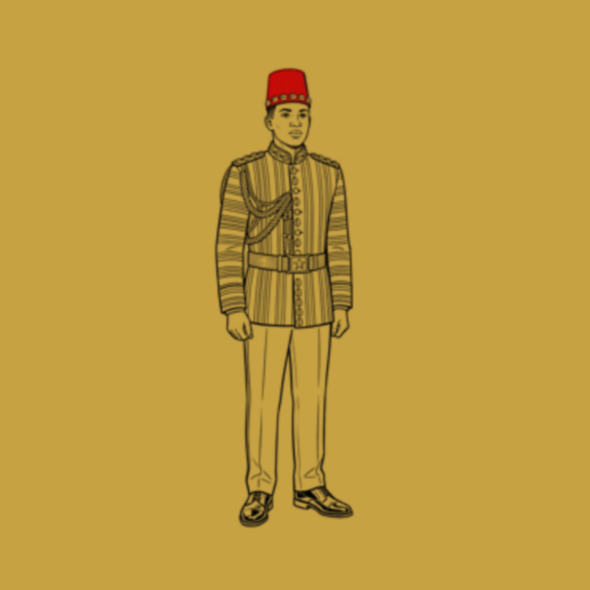
When Captain Ibrahim Traoré signed decrees mandating Faso Dan Fani for judicial robes, school uniforms, and launching the TEXFORCES-BF textile complex in Bobo-Dioulasso, he was doing far more than issuing a patriotic fashion statement. He was executing a targeted strike against a subtle, multi-billion-franc channel of economic extraction: state procurement dependency. For over six decades across Francophone Africa, national defense budgets, school systems, and civil institutions have functioned as guaranteed revenue pipelines for foreign defense firms—chiefly based in France. Retaking this supply chain cuts to the core of monetary and industrial sovereignty.
1. Ground Zero: The Economic Transformation of Women’s Weaving Cooperatives
At the heart of Traoré’s policy is a revival of Thomas Sankara’s 1980s mandate: "Wearing Faso Dan Fani is an economic, cultural, and political act of defiance against imperialism". But beyond ideology, the immediate beneficiaries are Burkina Faso's women-led weaving cooperatives.
[ Institutional Demand ] ──> [ Female Spinners & Weavers ] ──> [ Direct Household Income ]
   • Judicial Robes            • Cotton Thread Spinning          • Healthcare & School Fees
   • School Uniforms           • Organic Dyeing                  • Micro-Savings Capital
   • Civic Ceremonies          • Traditional Handweaving        • Bankable Cooperatives
Micro-Capital Injection: Historically, handweavers operated in the informal sector, exposed to seasonal fluctuations and cheap synthetic imports. Institutional mandates—such as requiring Faso Dan Fani for schools on Mondays and official court attire—create guaranteed, non-cyclical public procurement contracts.
Household Financial Sovereignty: In rural and peri-urban Burkina Faso, thread spinning and weaving are overwhelmingly conducted by female artisans. Earnings directly flow into female-headed households, lifting living standards, funding children’s education, and building autonomous micro-savings groups.
Formalization of Artisanal Guilds: Umbrella organizations (such as CABES and the GIEs) can now convert seasonal handcraft into bankable, structured cooperative enterprises capable of securing credit and scaling loom capacity.
2. The Raw Paradox: West African Cotton Production vs. Domestic Processing
West Africa is a global giant in cotton farming, yet it suffers from one of the most severe industrial value-addition gaps in the world.
The Structural Discrepancy
Global Export Weight: West African nations (Benin, Burkina Faso, Mali, Côte d'Ivoire) collectively produce millions of bales annually, accounting for over 10–12% of global raw cotton exports.
The Domestic Processing Gap:Fewer than 2% to 5% of the raw cotton lint grown in West Africa is processed or transformed into finished garments locally. Over 95% is shipped in raw lint form to foreign mills (primarily in Asia and Europe).
+----------------------------------------------------------------------------------+
| WEST AFRICAN COTTON VALUE CHAIN GAP                                              |
+----------------------------------------------------------------------------------+
| Raw Cotton Harvested locally        |  ████████████████████ 100%                 |
| Raw Cotton Exported un-processed    |  ███████████████████░  95% - 98%        |
| Raw Cotton Processed domestically   |  █░░░░░░░░░░░░░░░░░░░   2% - 5%          |
+----------------------------------------------------------------------------------+
When raw cotton is exported at approximately $1.50 to $2.00 per kilogram and bought back as finished military fatigues or court robes at $50 to $300 per unit, the region surrenders tens of thousands of manufacturing jobs and millions of dollars in industrial value-addition.
3. Calculating the Capital Flight: The CFA Franc Uniform Leakage
To understand what is at stake financially across the 14 Francophone nations using the CFA franc (WAEMU and CEMAC zones), we can model the annual capital drain caused by importing uniforms for state security forces.
Capital Flight Calculation Model
Let:
N = \text{Total active security personnel across 14 Francophone African states (Military, Gendarmerie, Police, Customs, Firefighters)} \approx 480,000 \text{ personnel}.
C = \text{Average annual procurement cost per officer (fatigues, daily service attire, boots, dress uniforms, badges)} \approx 200,000 \text{ CFA francs (~\$325 USD)}. \text{Annual Capital Flight} = N \times C \text{Annual Capital Flight} = 480,000 \times 200,000 \text{ CFA} = \mathbf{96,000,000,000\text{ CFA Francs}}\quad (\approx \mathbf{\$155\text{ Million USD / year}}) Over a single decade, this represents a capital flight of nearly 1 Trillion CFA Francs exiting West and Central African central banks directly into the balance sheets of foreign defense suppliers like France's Groupe Marck (Marck & Balsan) and Paul Boyé Technologies.
+------------------------------------------------------------------------------------+
| 10-YEAR MILITARY UNIFORM CAPITAL LEAKAGE (ESTIMATED AGGREGATE)                     |
+------------------------------------------------------------------------------------+
| Foreign Defense Contractors (e.g., Groupe Marck)  |  ~960 Billion CFA (~$1.55B USD) |
| Retained in Local Domestic Ecosystems             |  Near Zero (historically)      |
+------------------------------------------------------------------------------------+
4. Expanding the Lens: New Crucial Angles of Research
To capture the complete geopolitical picture, four critical dimensions must be examined:
A. The AES (Alliance of Sahel States) Regional Security Industrialization
Burkina Faso, Mali, and Niger have formed the Alliance of Sahel States (AES). Rather than acting in isolation, Burkina’s TEXFORCES-BF factory in Bobo-Dioulasso—a 15 billion CFA facility spanning 9 hectares—is explicitly designed to supply regional allied forces. This turns local industrial policy into a shared defense architecture.
B. The Dual-Production Strategy: Technical vs. Cultural Fabrics
A key operational distinction is how Traoré’s administration handles high-tech requirements versus formal attire:
Frontline Tactical Gear (TEXFORCES-BF): Ripstop, camouflage, and high-durability cotton-poly blends for combat zones are produced industrially at the Bobo-Dioulasso plant.
Civic & Formal Attire (Faso Dan Fani / Cencengu): Court robes, school uniforms, and parade dress are reserved for handweavers' cooperatives. This creates a balanced industrial ecosystem that combines modern factory capacity with traditional artisanal employment.
C. The Hypocrisy of Outsourced Foreign Manufacturing
French suppliers like Paul Boyé Technologies manufacture thousands of uniforms for European military recruits by utilizing low-cost offshore labor in Madagascar (a former French colony). This reveals an irony: French contractors use African industrial labor to manufacture uniforms, sell them back to European defense ministries, and then resell finished gear to African governments at a premium.
D. Judicial De-colonization as a Symbol of Sovereignty
Replaces imported black satin gowns—costing up to 3,000,000 CFA francs ($4,760 USD)—with 150,000 CFA franc ($240 USD) Faso Dan Fani robes means that every trial conducted in Burkina Faso takes place under a visual symbol of national autonomy.
Conclusion
By reclaiming state uniform procurement, Ibrahim Traoré's administration is demonstrating how public purchasing power can be weaponized for national development. Replacing foreign defense contracts with local value chains reclaims capital, empowers female artisans, and sets an example for economic sovereignty across Africa.
Despite producing some of the world's highest-grade, hand-harvested cotton lint, Sub-Saharan Africa remains decoupled from high-value downstream textile manufacturing. While West African nations—led by the C-4+ grouping (Benin, Burkina Faso, Mali, Côte d'Ivoire, and Chad)—harvest over 1 million metric tons of seed cotton annually, over 90% of regional lint is exported in primary form. Paradoxically, African consumer markets import over $4 billion to $6 billion annually in finished apparel and synthetic fabrics. This paper analyzes this structural disconnect through the lens of global value chain (GVC) governance and terms-of-trade degradation. It examines how institutional mechanics maintain primary commodity extraction, why statutory raw export bans face severe domestic processing bottlenecks, and how quality asymmetry displaces local artisans, tailors, and fashion designers in favor of imported synthetic alternatives.
1. The Regional Disconnect: Extractative Export vs. Processed Import
The African cotton-to-textile ecosystem exhibits a spatial divide between raw lint extraction in West Africa and downstream processing concentrated in North Africa and foreign markets:
West African Primary Extraction: The C-4+ nations are among the largest global exporters of unmanufactured cotton lint. Their production relies on smallholder farming, producing hand-picked cotton valued internationally for its fiber length and low contamination relative to machine-harvested alternatives. However, local spinning mill utilization across West Africa averages under 5%.
North African Value Addition: North African economies (Egypt, Morocco, Tunisia) export over $25 billion annually in processed textiles and apparel. This output is driven by proximity to European consumer markets, mature industrial infrastructure, and targeted trade agreements (such as EU-Mediterranean trade frameworks). Because intra-African trade infrastructure remains fragmented and tariff-heavy, primary lint from West Africa rarely supplies processing mills in North or East Africa. Instead, lint is shipped to East and South Asian mills before re-entering African markets as finished woven goods or synthetic-blend garments.
2. Institutional Mechanics: The Enforceability Gap of Export Bans
To capture downstream value, several West African governments have instituted policy mandates, including raw lint export restrictions and targeted export tariffs. However, converting raw export bans into domestic processing capacity reveals three structural barriers:
A. Capital Intensity and Utility Cost Disadvantages
Conversion of lint to yarn (spinning) and fabric (weaving) is highly capital- and energy-intensive. Industrial power tariffs in West Africa range between $0.15 and $0.25 per kWh, compared to $0.05 to $0.08 per kWh in competing Asian textile hubs. Without subsidized industrial power grids, domestic spinning mills operate at an immediate cost deficit.
B. Farm-Gate Liquidity Requirements
National cotton boards (e.g., Mali’s CMDT or Burkina Faso’s SOFITEX) rely on foreign cotton merchants to provide upfront hard-currency financing during harvest seasons. These liquidity injections ensure immediate payments to smallholder farmers. Enforcing a strict raw export ban without adequate local processing capacity risks devaluing farm-gate prices and depressing rural incomes.
C. Tariff Escalation in Global Trade
International tariff structures penalize value addition at origin. Raw lint enters most global consumer markets under zero or near-zero tariffs, whereas processed yarns, woven fabrics, and finished garments encounter escalating import duties unless protected by specific trade preferences (such as AGOA in the United States).
3. Quality Asymmetry: Fiber Extraction and the Displacement of Local Designers
A central friction in Africa’s cotton ecosystem is the quality grading asymmetry between export and domestic markets.
International cotton buyers utilize High-Volume Instrument (HVI) classing to grade lint based on staple length, strength, micronaire (fineness), and uniformity. Premium long-staple fiber commands a market premium and is systematically prioritized for overseas export to meet foreign spinning specifications. Consequently, domestic markets retain primarily:
Lower-grade, shorter-staple, or contaminated lint unsuited for high-speed industrial processing.
Imported synthetic thread (such as low-cost polyester), which replaces indigenous cotton yarns in traditional weaving hubs.
B. Creative Ecosystem Resistance: Designers, Tailors, and Consumers
African fashion designers, custom tailors, and apparel brands face a structural supply constraint: they cannot source high-grade, 100% locally grown African cotton fabric within their own domestic markets.
Material Substitution: Traditional artisanal weavers who historically produced 100% cotton textiles (e.g., Gbaguidi weaves, Kente, or Bogolan) are increasingly forced to use imported synthetic polyester threads due to the scarcity and cost of locally spun high-grade cotton yarn.
Domestic Market Demand: A growing segment of African fashion entrepreneurs and urban consumers actively seeks high-quality, traceable, locally produced cotton textiles. However, because local textile mills lack high-grade input fiber, designers must choose between low-quality domestic materials or expensive imported finished fabrics from Europe or Asia. This dynamic transfers the economic returns of African agricultural quality outward while saddling domestic creative industries with low-grade inputs or synthetic substitutes.
4. Reconfiguring Policy: Industrial Parks and the AfCFTA
To address structural extraction and quality displacement, regional strategies are pivoting toward integrated manufacturing ecosystems:
A. Special Economic Zones (SEZs)
Initiatives such as the Glo-Djigbé Industrial Zone (GDIZ) in Benin and the Plateforme Industrielle d'Adétikopé (PIA) in Togo represent a model shift. By providing tax incentives, continuous power supplies, and co-located spinning and garment manufacturing facilities, these zones aim to process primary lint into yarn and finished apparel domestically before export.
B. AfCFTA Rules of Origin (RoO)
Under the African Continental Free Trade Area (AfCFTA), the definition of Rules of Origin is critical. Enforcing double transformation rules—requiring raw cotton to be spun into yarn, woven into fabric, and assembled into garments within member states—incentivizes regional sourcing and protects domestic processors from third-country textile dumping.
5. Strategic Recommendations
Local Allocation Quotas: Implement gradual, capacity-indexed quotas that require a percentage of top-grade (HVI-classified) cotton fiber to be reserved for domestic spinning mills and local textile artisans before export licenses are issued.
Subsidized Industrial Power Infrastructure: Address energy costs for spinning and weaving mills within designated industrial corridors to ensure price parity with international processors.
Regional Input Trading Platforms: Utilize AfCFTA frameworks to facilitate direct trade of raw and semi-processed cotton between West African producers and manufacturing hubs across East, Southern, and North Africa.
References
Food and Agriculture Organization [FAO]. (2022). The Cotton-4 (C-4) countries in the context of the global cotton market: Situation and short-term market outlook. United Nations Food and Agriculture Organization. https://openknowledge.fao.org/
International Trade Centre [ITC]. (2025). How to invest in a viable textile and cotton value chain in Africa. United Nations International Trade Centre. https://www.intracen.org/
International Trade Centre [ITC]. (2009). Understanding cotton demand and promoting origin: The example of African cotton. International Trade Centre Bulletin. https://www.intracen.org/
TraceX Technologies. (2025). Africa textile value chain: From cotton to fashion. TraceX Global Value Chain Analysis. https://tracextech.com/
United Nations Conference on Trade and Development [UNCTAD]. (2017). Regional strategy for cotton-to-clothing value chain in COMESA. United Nations Conference on Trade and Development. https://unctad.org/
United Nations Industrial Development Organization [UNIDO]. (2024). World Cotton Day 2023: Making cotton fair and sustainable for all, from farm to fashion. UNIDO Publications. https://www.unido.org/
For more than three centuries, Africa has been the subject of programmes designed to educate, uplift, civilise, develop, modernise, empower, train, and transform its people. The language has changed with each era. Missionary societies spoke of salvation. Colonial administrations spoke of civilisation. Development agencies speak of capacity building. NGOs speak of empowerment.
Yet beneath the changing language lies a persistent question.
If empowerment is successful, why do so many beneficiaries remain beneficiaries? Why do so few become owners? Why do so few control the institutions, brands, markets, technologies, and capital created in their name?
Empowerment is often measured through participation. Ownership is measured through control. The two are not the same.
This chapter examines that distinction through the history of African textile production, tracing the institutional thread that connects plantation economies, missionary education, colonial labour systems, and contemporary development programmes.
The Plantation, the Mission, and the Formation of Labour
The thread begins on the plantation. The missionary societies that ran schools across Africa and the Caribbean were funded by the wealth extracted from enslaved labour. The objective of this analysis is not to argue that plantations, missionary schools, and NGOs are identical institutions. They are not. They emerged in different historical periods and operated under different legal and moral frameworks. The question is whether they occupied similar positions within a broader political economy in which African labour was mobilised while ownership, governance, and capital accumulation remained concentrated elsewhere.
The SPG owned the Codrington Plantation in Barbados, receiving a bequest in 1710 that required “three hundred negros at Least always Kept” on the estate (Fulham Palace, 2023). The Society branded enslaved people with the word “Society” on their chests with a hot iron (Fulham Palace, 2023). The London Missionary Society (LMS), founded in 1795, was supported by the Clapham Sect, whose members included slave traders and plantation owners (University College London, n.d.). The Church Missionary Society (CMS) received donations from the West India Interest, the powerful lobby representing Caribbean sugar planters who owned enslaved labour forces (Kinghorn, 2019). The plantation funded the mission. The mission educated the colonised. The education taught obedience. The cycle was complete.
From the plantation, the thread moved to the missionary school. The curriculum taught needlework, sewing, and embroidery. The goal was not creativity. The goal was discipline. The goal was a labour force that would serve the colonial economy without resistance. The missionary school was the bridge between the whip and the wage. The enslaved became the educated. The educated became the employed. The employed remained under control.
From the missionary school, the thread moved to the NGO. The missionaries did not disappear. They rebranded.
Diagram 1: Labour Extraction Timeline (Decision Path Diagram)
From Missionary Society to Development Agency
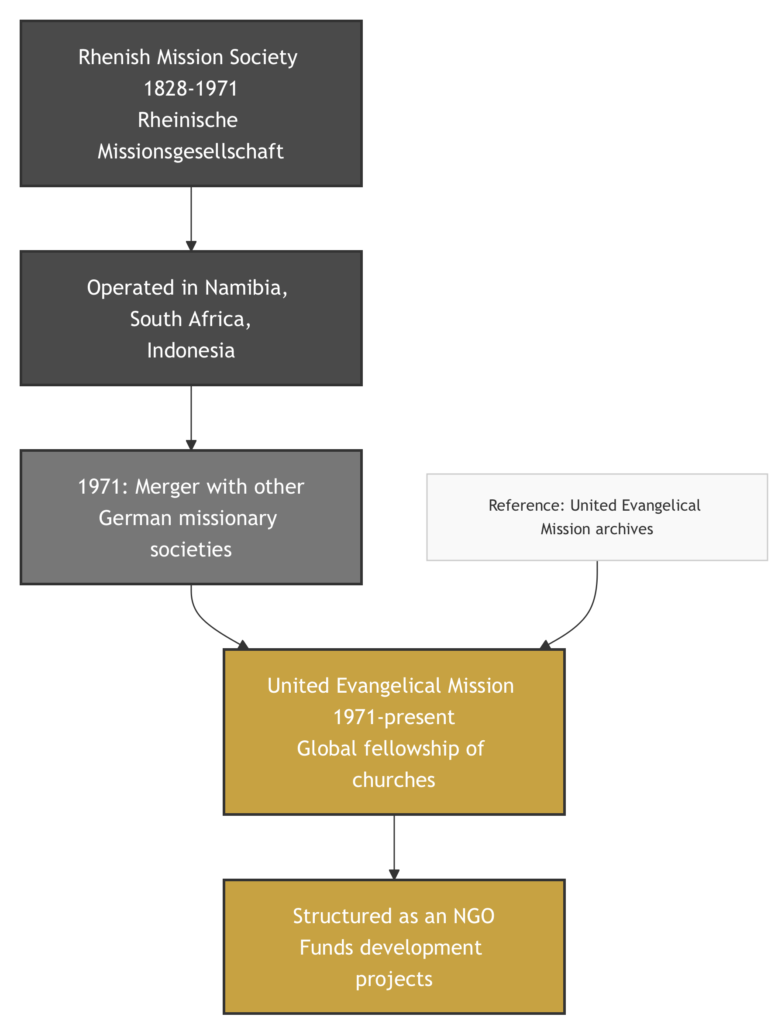
The Paris Evangelical Missionary Society (PMES, founded 1822) is now Défap, a French Protestant mission agency that funds development projects in Africa (Défap, n.d.). The Rhenish Mission Society (1828) is now the United Evangelical Mission, a global fellowship of churches that describes itself as a “development cooperation” organisation (UEM, n.d.). The Danish Mission Society (1821) is now Danmission, which runs development programmes in Tanzania, Nepal, and the Middle East (Danmission, n.d.). The Leipzig Mission (1836) is now part of EMS (Evangelisches Missionswerk), a German development agency (EMS, n.d.). The Methodists, the Baptists, the Presbyterians, the Lutherans—all built schools. All taught sewing. All now run NGOs.
The significance of these institutional transformations is not theological but organisational. In several cases, contemporary development agencies are not merely inspired by historical missionary organisations; they are their direct descendants. The question therefore becomes whether institutional missions changed only in language, or whether they also changed in their underlying relationship to power, governance, and economic control.
Diagram 2: Missionary to NGO Transition (Decision Path Diagram)
The framework was always economic. The plantation needed enslaved labour. The missionary school needed trained labour for the colonial administration. The NGO needs donor funding to survive. The artisan is the raw material in each phase. The institution captures the value. The worker remains at the bottom.
The language changed. The Paris Evangelical Missionary Society spoke of “spreading the Gospel.” Défap speaks of “development cooperation.” The Rhenish Mission spoke of “saving souls.” UEM speaks of “capacity building.” The Danish Mission spoke of “civilising the heathen.” Danmission speaks of “empowerment.” The words are new. The structure is the same.
The NGO Economy
The modern NGO is often presented as a temporary institution designed to address a specific social or economic challenge. Yet throughout Africa, NGOs have become permanent actors within local economies. They employ staff, manage grants, commission research, influence policy, broker market access, organise production, and shape development priorities.
This has produced what may be described as an NGO economy: an ecosystem sustained through the continuous circulation of donor funding, development projects, beneficiaries, consultants, auditors, programme officers, monitoring specialists, and international partners.
The issue is not whether NGOs perform useful work. Many undoubtedly do. The question is whether institutional incentives favour the production of independent owners or the continuous reproduction of beneficiaries.
A successful textile entrepreneur eventually ceases to require an empowerment programme. A cooperative that controls its own production, branding, intellectual property, and export relationships eventually ceases to require an intermediary. Yet development success is often measured by the number of beneficiaries reached rather than the number of beneficiaries who cease to be beneficiaries altogether.
The distinction matters. Beneficiary-centred systems reproduce participation. Ownership-centred systems reproduce power.
The framework was always economic. The plantation needed enslaved labour. The missionary school needed trained labour for the colonial administration. The NGO needs donor funding to survive. The artisan is the raw material in each phase. The institution captures the value. The worker remains at the bottom.
The Persistence of External Control
Across multiple historical periods, decision-making authority frequently remained external to the communities whose labour sustained the system. Under plantation slavery, ownership and capital accumulation were concentrated in Europe. Under colonial administration, policy and economic planning remained external. Under many contemporary development programmes, strategic authority often remains concentrated among donors, boards, international agencies, certification bodies, and programme managers located outside the communities being served.
Table
System
Labour
Decision Making
Ownership
Value Capture
Plantation
Africans
Europe
Europe
Europe
Mission School
Africans
Mission Board
Mission Board
Mission Institution
Colonial Economy
Africans
Colonial State
Colonial State
Metropole
NGO Programme
Africans
NGO/Donor Network
NGO/Board
Mixed
Cooperative
Members
Members
Members
Secular NGOs: New Institutions, Familiar Questions
Not all organisations working in African textiles follow the extractive model. Some are cooperatives. Some are artisan-owned. The distinction matters.
Espace Tissage Djougou (ETD) in Benin is a women-led weaving cooperative. It preserves the lokpa openwork fabric tradition. It is a partner in the EU-OACPS Business-Friendly Programme. The cooperative has 508 beneficiaries working through 18 cooperatives and 14 fashion brands. The stated mission is to preserve ancestral know-how and empower rural girls. The structure is a cooperative. The artisans are members, not employees. This is a different model. The value is shared.
Most NGOs, however, do not operate this way.
The ITC Ethical Fashion Initiative is a programme of the United Nations and the World Trade Organization. It operates in Burkina Faso, Mali, Benin, Kenya, and Zambia. It connects artisans to international fashion brands including Stella Jean and Vivienne Westwood. The language is “ethical fashion,” “sustainability,” “market access.” The artisans are members of cooperatives. The governance is not in their hands. The UN agency controls the buyer relationships, the quality standards, and the brand.
Maisha by Nisria in Nakuru, Kenya, trains vulnerable women, single mothers, refugees, and persons with disabilities in sewing and fashion design. The language is “empowerment,” “conscious engagement,” “sustainability.” The organisation is a registered non-profit. The women are trainees. The decisions about funding, programming, and branding are made by the non-profit’s leadership, not by the women.
Unkara Fashion is a US-registered 501(c)(3) non-profit operating in Kenya. It trains women fashion designers in underprivileged communities and promotes indigenous textile culture including batik dyeing techniques. The language is “financial inclusion,” “sustainable income,” “indigenous textile culture.” The organisation has a US board of directors. The women are trainees. The intellectual property of the training materials and the brand belong to the US non-profit.
WEL NGO (Women Entrepreneurs & Leaders) in Côte d’Ivoire trains low-income and vulnerable women in sewing and handmade goods. The language is “economic empowerment,” “African culture,” “income generating activities.” The organisation is an NGO partnered with Koné Consulting. The women are beneficiaries. They do not control the organisation.
These NGOs are not descended from missionaries. They are new. These organisations differ in history, mission, and intent. The relevant question is not whether they are exploitative, but whether beneficiaries exercise meaningful ownership over governance, intellectual property, buyer relationships, and long-term capital accumulation. The answer varies by institution and deserves closer examination.
The beneficiaries are not owners. The decision-makers are not local. The NGO captures the brand, the donor relationships, and the market access. The artisan receives training and wages. The value leaves. The pyramid remains.
The Cooperative Alternative
The cooperative model in Benin shows a different path. Artisan ownership. Shared governance. Value retained locally. The difference is not the product. The difference is who controls the organisation.
The significance of the Benin case is not that it is perfect. Its significance is that it shifts the position of the artisan from beneficiary to member. The distinction is fundamental. Beneficiaries receive programmes. Members exercise governance. Beneficiaries participate in projects. Members participate in ownership.
The religious language is gone. “Saving souls” became “empowerment.” “Civilising mission” became “capacity building.” “Conversion” became “financial inclusion.” The words are new. The extractive structure remains.
Beneficiaries Without Ownership
How many beneficiaries became exporters? How many became factory owners? How many became brand owners? How many became machinery manufacturers? How many became employers?
Across the development sector, success is often measured through outputs: workshops conducted, trainees reached, women empowered, livelihoods supported. Far less attention is paid to ownership outcomes. Who controls the assets created? Who accumulates capital? Who acquires market power? Who determines future strategy?
How NGOs Use Labour
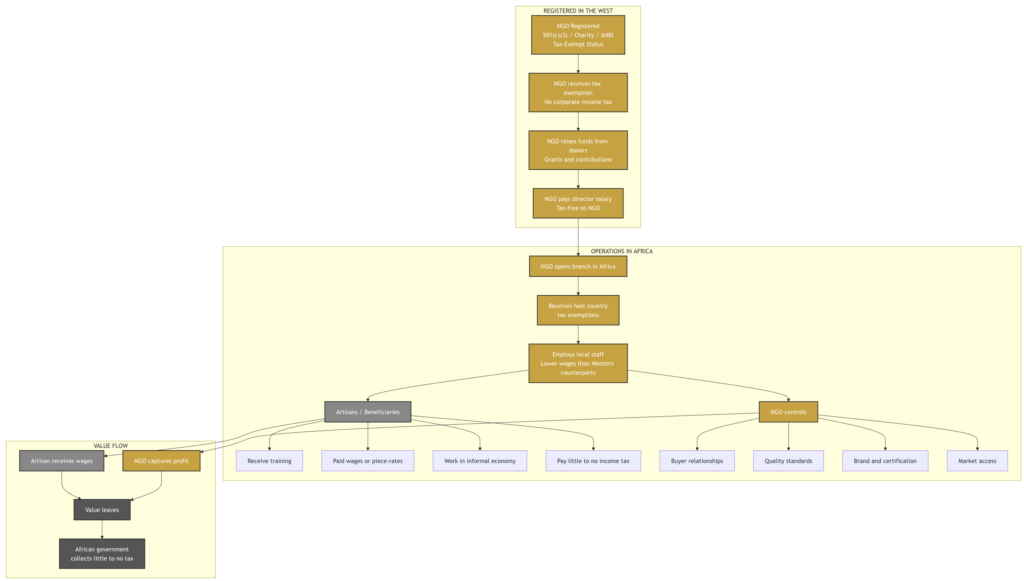
The NGO registers in a Western country. In the United States, it files for 501(c)(3) status, becoming exempt from federal corporate income tax (IRS, n.d.). In the United Kingdom, it registers as a charity, exempt from corporation tax (UK Government, n.d.). In the Netherlands, it registers as an ANBI, exempt from corporate tax and in some cases VAT (Dutch Tax Administration, n.d.). In Switzerland, it registers at the cantonal level, exempt from federal, cantonal, and municipal taxes (Swiss Federal Tax Administration, n.d.).
The NGO then opens a branch in an African country. It receives tax exemptions from the host government. It pays little to no corporate tax on its local activities. It employs local staff, often at lower wages than Western staff. It trains artisans. It organises production. It exports finished goods.
Diagram 3: NGO Value Pyramid (Decision Path Diagram)
[Place diagram here showing NGO at top, intermediaries in middle, artisans at bottom.]
The artisans are paid wages or piece-rates. They work in the informal economy. They pay little to no income tax. Their labour is the raw material of the NGO’s programmes. Their faces appear in annual reports. Their names are rarely listed. Their designs are not protected. Their knowledge is not owned by them.
The NGO sells the handicrafts through fair trade catalogues, online shops, and ethical fashion platforms. In the United States, if the sales are considered a regular commercial activity, Unrelated Business Income Tax (UBIT) applies at 21 percent (IRS, n.d.). But many NGOs avoid UBIT by arguing that the sales are “substantially related” to their charitable mission.
The NGO director receives a salary from the tax-free revenue. The salary is paid from the profits of the artisans’ labour. The director pays personal income tax. The NGO pays nothing. The artisan receives wages. The African government collects nothing. The Western government collects little to nothing. The value leaves.
The local market model works differently. Artisans sell directly to tourists and local consumers (University of Nairobi, 2010). There is no NGO intermediary. There is no fair trade certification. There is no tax exemption. The artisan keeps the majority of the sale price. She pays market fees. The local government collects revenue. The value stays.
The NGO model is not designed for the artisan. It is designed for the NGO. The pyramid is upside down. The largest piece goes to the top. The smallest piece goes to the bottom.
The framework did not end. It rebranded. The names changed. The pyramid did not.
But the cooperative in Benin shows that it could be different.
The thread has not been broken.
References
Basel Mission Archives / mission 21. “Nähschule in Kyebi (Sewing class in Kyebi).” Reference: D-30.13.039. Available at: https://bmarchives.org/items/show/56603 Basel Mission Archives / mission 21. “Nähschule in Akropong 1904 (Sewing school in Akropong 1904).” Reference: QD-30.106.0153. Available at: https://bmarchives.org/items/show/71875 Caley, Maria A. N. “The Modernized Traditional Dress of the Aawambo.” University of Turku. Coutau-Bégarie Auction House. “Three entre-deux and one carré in Chebka lace, North Africa, late 19th/early 20th century.” Lot 129. Available at: https://coutaubegarie.com/en/lot/157092/26525906 Danmission. “About Danmission.” Available at: https://danmission.dk Défap. “Service Protestant de Mission.” Available at: https://defap.fr Dutch Tax Administration. “ANBI - Public Benefit Organisations.” Available at: https://www.belastingdienst.nl/anbi EMS (Evangelisches Missionswerk). “About EMS.” Available at: https://www.ems-online.org Espace Tissage Djougou (ETD). “Preserving lokpa openwork fabric tradition.” EU-OACPS Business-Friendly Programme. Available at: https://www.businessfriendly.org/etd-benin Fulham Palace. “Church of England’s plantations in Barbados.” 13 March 2023. Available at: https://www.fulhampalace.org/resistance/church-of-england-plantations/ IRS. “Exemption Requirements - Section 501(c)(3) Organizations.” Available at: https://www.irs.gov/charities-non-profits/charitable-organizations/exemption-requirements-section-501c3-organizations IRS. “Unrelated Business Income Tax.” Available at: https://www.irs.gov/charities-non-profits/unrelated-business-income-tax ITC Ethical Fashion Initiative. “CABES Burkina Faso.” Available at: https://ethicalfashioninitiative.org Kinghorn, Alice. “The Church of England and the West India Interest.” PhD thesis, University of Bristol, 2019. Maisha by Nisria. Available at: https://maishabynisria.org McLean-Farrell, Janice, and Michael Anderson Clarke. “Missions in Contested Places/Spaces: The SPG, Slavery, and Codrington College, Barbados.” Mission Studies, 2021. Mission 21. Available at: https://mission-21.org Monk, Matthew, and Linda Eaton. “A Sampler’s Story from Sierra Leone.” Winterthur Museum, 5 September 2025. Available at: https://www.winterthur.org/blog/a-samplers-story-from-sierra-leone Porte Brown. “Watch for UBIT When Your Nonprofit Pursues New Activities.” 2025. Strickrodt, Silke. “African Girls’ Samplers from Mission Schools in Sierra Leone (1820s to 1840s).” History in Africa, 2010;37:189-245. Swiss Federal Tax Administration. “Taxation of Non-Profit Organisations.” Available at: https://www.estv.admin.ch TRC Leiden. “Embroidery and the White Sisters.” 29 June 2015. Available at: https://trc-leiden.nl/trc-needles/regional-traditions/middle-east-and-north-africa/pre-modern-middle-east-and-north-africa/embroidery-and-the-white-sisters UK Government. “Charities and tax.” Available at: https://www.gov.uk/charities-and-tax United Evangelical Mission (UEM). “About UEM.” Available at: https://uem-partnership.org University College London. “Legacies of British Slavery: Clapham Sect.” Available at: https://www.ucl.ac.uk/lbs/ University of Nairobi. “Access to E-Commerce in the Ethical trade Arena: A Case study of Artisans in Kenya.” 2010. Available at: https://erepository.uonbi.ac.ke Unkara Fashion. Available at: https://unkarafashion.org USPG (United Society Partners in the Gospel). “About USPG.” Available at: https://uspg.org.uk WEL NGO African Arts Creation. Available at: https://wel-ngo.org Winterthur Museum, Garden & Library. “Sampler by Lucy Davis.” Object number 2018.0007. Available at: http://museumcollection.winterthur.org/single-record.php?recid=2018.0007
Image Sources
Basel Mission Archives. “Nähschule in Kyebi (Ghana).” https://bmarchives.org/items/show/56603 Basel Mission Archives. “Nähschule in Akropong (Ghana).” https://bmarchives.org/items/show/71875 TRC Leiden. “White Sisters teaching lace making.” https://trc-leiden.nl/trc-needles Coutau-Bégarie Auction House. Chebka lace collection. https://coutaubegarie.com Winterthur Museum. Sampler by Lucy Davis. http://museumcollection.winterthur.org/single-record.php?recid=2018.0007 International Mission Photography Archive (USC). Mission sewing archives. https://digitallibrary.usc.edu Yale Divinity Library. Raphia weaving missions archive. https://collections.library.yale.edu Mennonite Archives. Sewing class Zaire. https://archives.mennonite.net United Church of Canada Archives. Sewing school Japan. https://archives.unitedchurch.ca
Additional Academic References
Political Economy, Dependency and Colonial Continuity
Rodney, Walter. How Europe Underdeveloped Africa. Dar es Salaam: Tanzania Publishing House, 1972.
Nkrumah, Kwame. Neo-Colonialism: The Last Stage of Imperialism. London: Thomas Nelson & Sons, 1965.
Amin, Samir. Unequal Development: An Essay on the Social Formations of Peripheral Capitalism. New York: Monthly Review Press, 1976.
Amin, Samir. Accumulation on a World Scale: A Critique of the Theory of Underdevelopment. New York: Monthly Review Press, 1974.
Beckford, George L. Persistent Poverty: Underdevelopment in Plantation Economies of the Third World. New York: Oxford University Press, 1972.
Best, Lloyd. Essays on the Theory of Plantation Economy. Mona: Institute of Social and Economic Research, University of the West Indies.
Girvan, Norman. The Caribbean Dependency Tradition: From New World Group to the Present. Kingston: Ian Randle Publishers.
Beckles, Hilary. Britain’s Black Debt: Reparations for Caribbean Slavery and Native Genocide. Kingston: University of the West Indies Press, 2013.
NGO Critique and Development Studies
Manji, Firoze and Carl O’Coill. “The Missionary Position: NGOs and Development in Africa.” International Affairs 78, no. 3 (2002): 567–583.
Escobar, Arturo. Encountering Development: The Making and Unmaking of the Third World. Princeton: Princeton University Press, 1995.
Ferguson, James. The Anti-Politics Machine: Development, Depoliticization and Bureaucratic Power in Lesotho. Minneapolis: University of Minnesota Press, 1990.
Fowler, Alan. Striking a Balance: A Guide to Enhancing the Effectiveness of Non-Governmental Organisations in International Development. London: Earthscan, 1997.
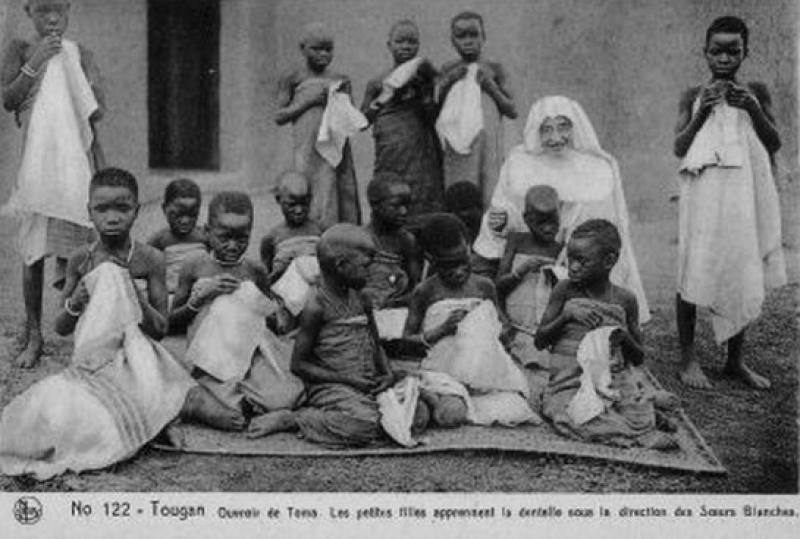
There is a photograph taken circa 1930 in Burkina Faso. It shows White Sisters teaching local girls "Western European embroidery." The scene appears benevolent, but here is what it does not show.
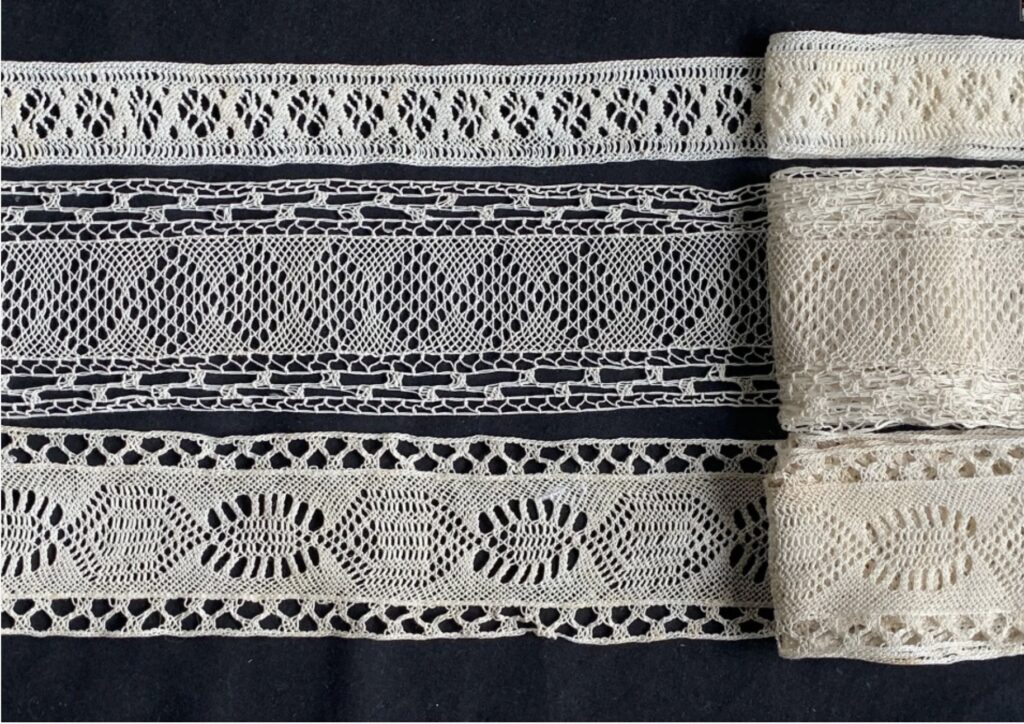
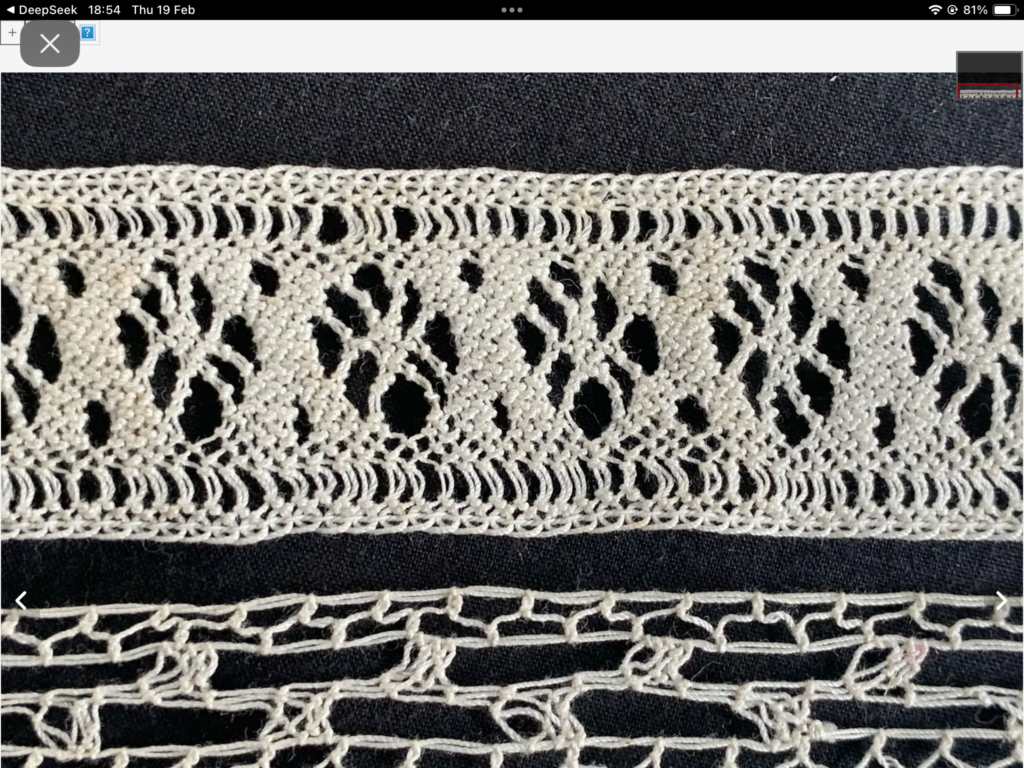
The same nuns, in North Africa, taught Chebka lace. Chebka is not European. It is North African, a sophisticated indigenous needle-knotted stitch. Yet it was extracted, renamed, and taught back to Africans as European knowledge. This was not cultural exchange, it was erasure by design.
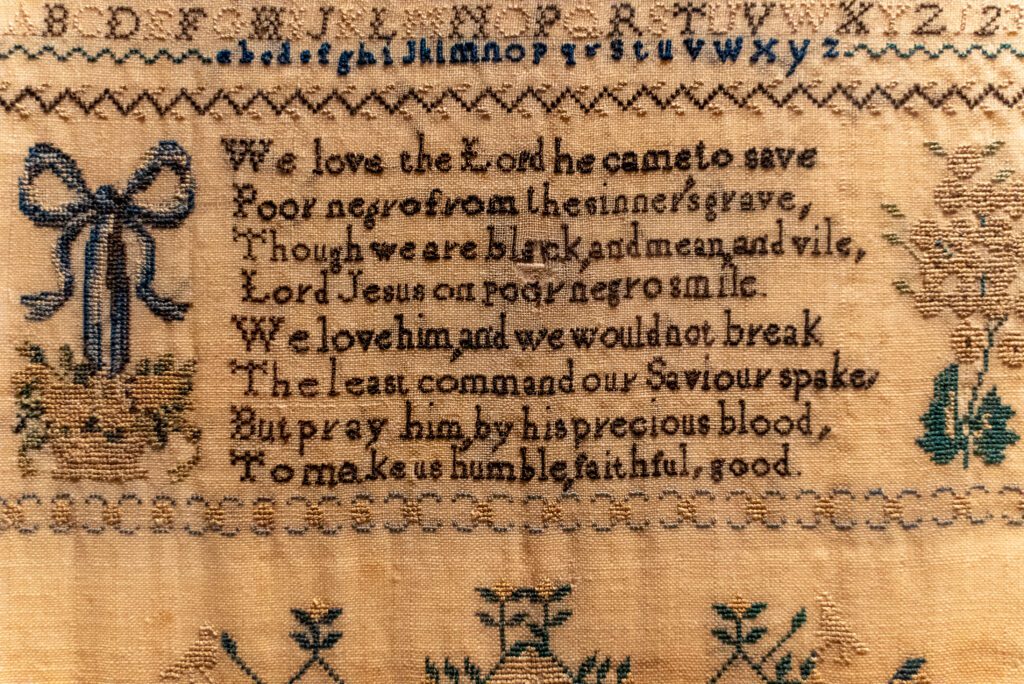
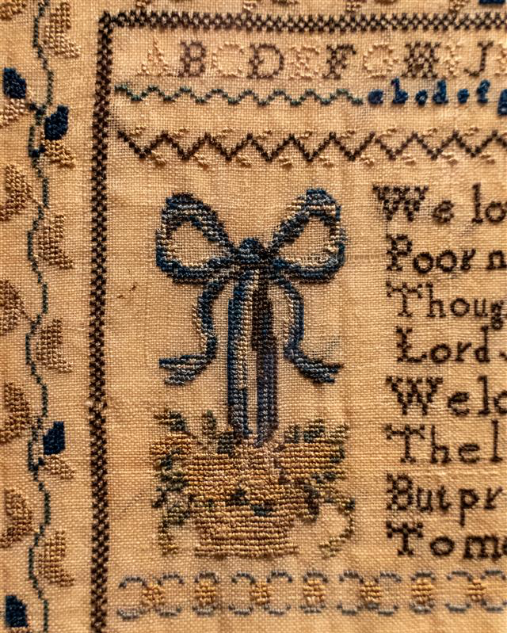
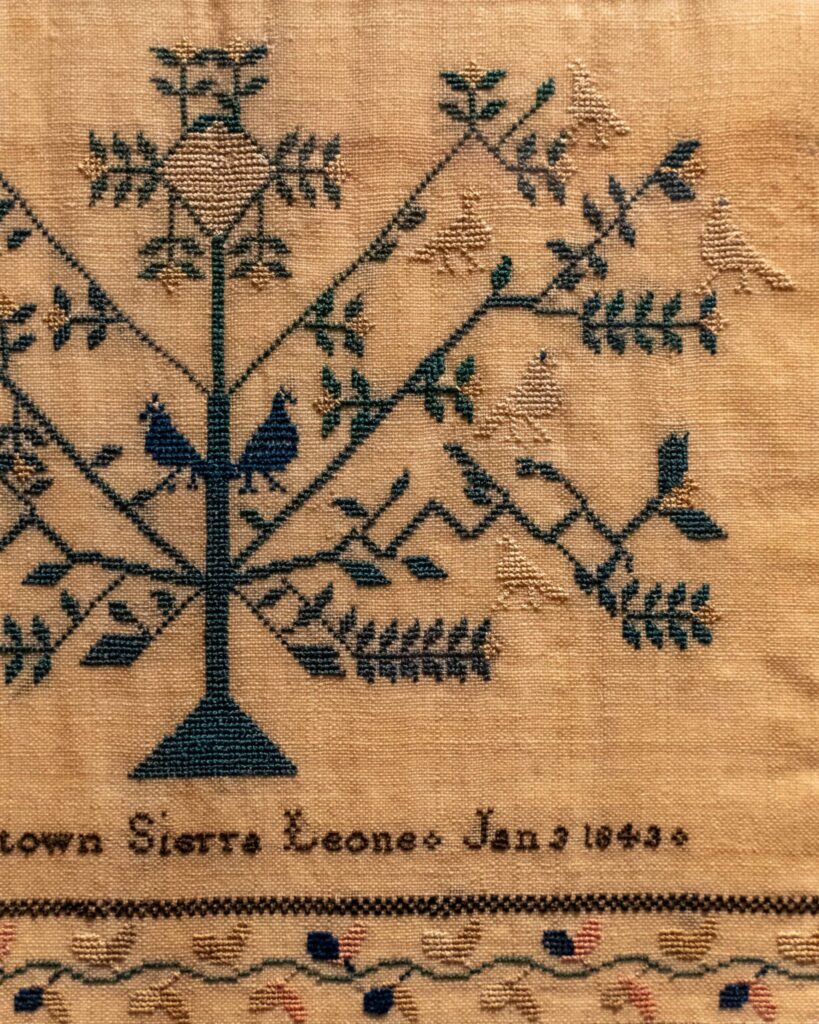
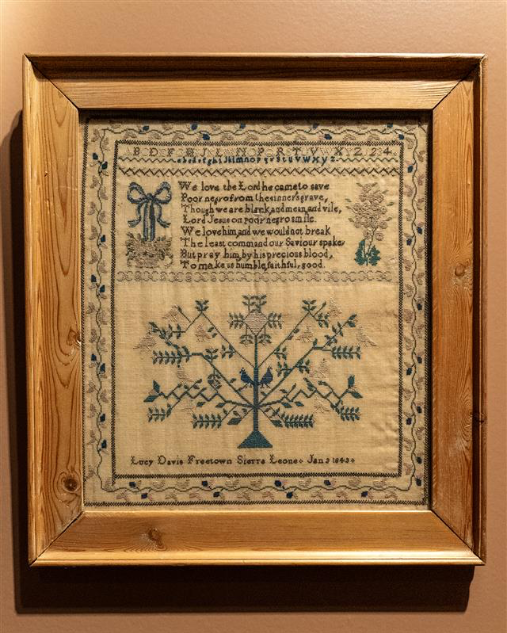
In a museum in Delaware, a small piece of linen holds a confession. The sampler was stitched on January 3, 1843, by a Black African girl named Lucy Davis at a Church Missionary Society (CMS) school in Freetown, Sierra Leone. Her needlework features a verse from a hymn published in The Missionary Repository for Youth:
"We love the Lord he came to save
Poor negro from the sinner's grave,
Though we are black, and mean, and vile,
Lord Jesus on poor negro smile.
We love him, and we would not break
The least command our Saviour spake,
But pray him, by his precious blood,
To make us humble, faithful, good."
The child is not learning to read, she is learning to recite her own inferiority. Stitched into fabric, made permanent, displayed as evidence of successful missionary education. The Lucy Davis sampler sold at auction in 2018 for $3,840. The auction house catalogue described it as "rare" and noted an "intentional cross-stitch error.
The Winterthur Museum, which holds the sampler, calls it a reflection of "the paradox of colonial education." Paradox suggests two truths held together. This is not paradox. This is psychological warfare conducted with thread. They acknowledge that missionaries used such literature to "Christianize and anglicize African youth and reinforce British colonial hierarchies of race and class."
The chain of teachers who trained Lucy Davis is revealing. Jane Hickson Boston Young (1810-1841) was an African woman educated at a CMS school in the Rio Pongo region (now Guinea). She learned needlework from an African American woman who had been resettled in Africa after the American Revolution. That woman was formerly enslaved. She had survived the Middle Passage, or been born into slavery in the Americas, and had chosen to return to Africa. She was a returnee.
Formerly enslaved African American woman → Jane Young (African woman) → Liberated African women → Lucy Davis (Black African girl)
The missionaries controlled the institution, the curriculum was theirs. The shame was theirs. But the instructors were not all white. Some were Black women who had navigated the same system of extraction and found a way to survive yet became complicit to that same system.
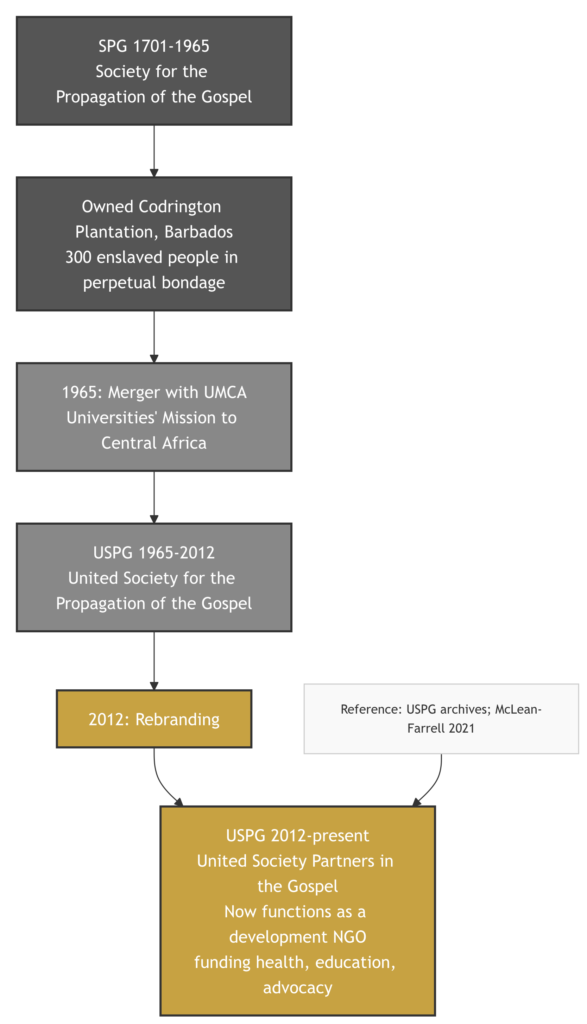
The Church Missionary Society was not the only missionary organisation operating in Africa. The Society for the Propagation of the Gospel (SPG) was older, richer, and more directly entangled with slavery. Founded in 1701, the SPG owned the Codrington Plantation in Barbados. The bequest that established the college explicitly required that 300 enslaved people be kept in perpetual bondage to support the institution.
The Barbadian scholar Janice McLean-Farrell documents that the SPG's "troubling missionizing principles advanced oppressive colonial structures, while failing to fully develop the personhood, agency, and full emancipation of the oppressed." The education of Black people was not altruistic. It was designed to make them obedient and hardworking labourers for the colonial economy.
Some enslaved and free Black people became complicit, they were trained, they were educated. They became teachers, catechists, and petty administrators. They enforced the rules, they taught the curriculum. This complicity is real, and it continues today in different forms.
Diagram 1: SPG → USPG
The White Sisters and the Lace That Left
In Burkina Faso, in 1930, the White Sisters taught local girls "Western European embroidery." The photograph shows the scene. The TRC Leiden notes that many items were sold to support the missionary schools. Some regard this as "colonial exploitation at a level near to slavery."
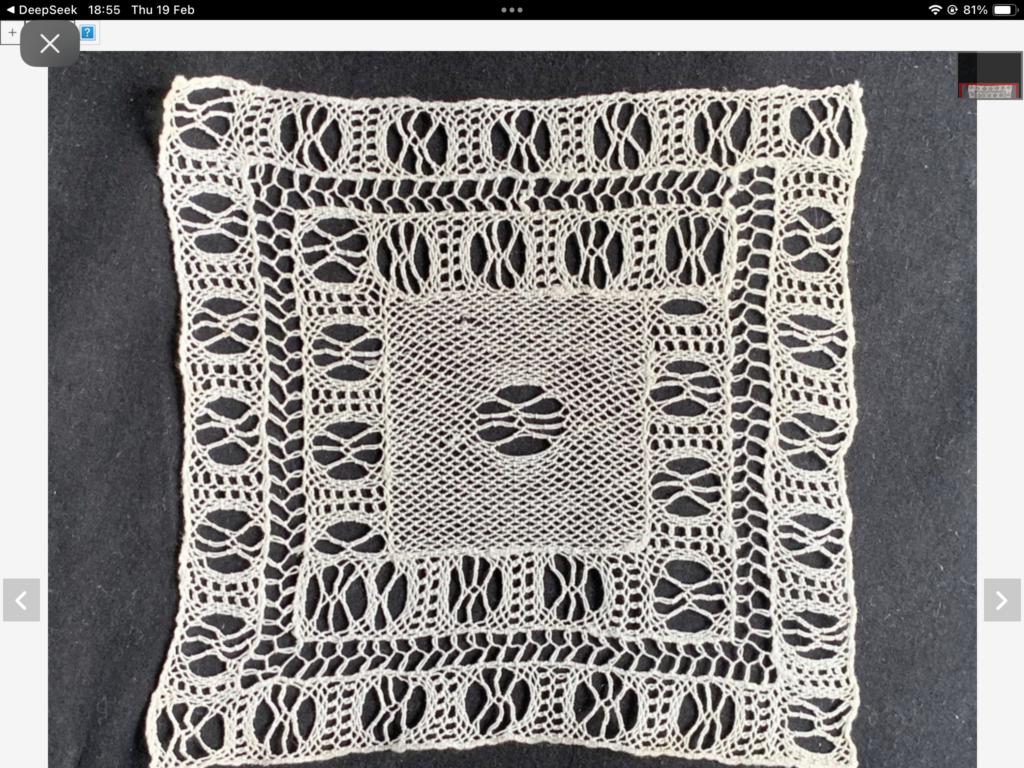
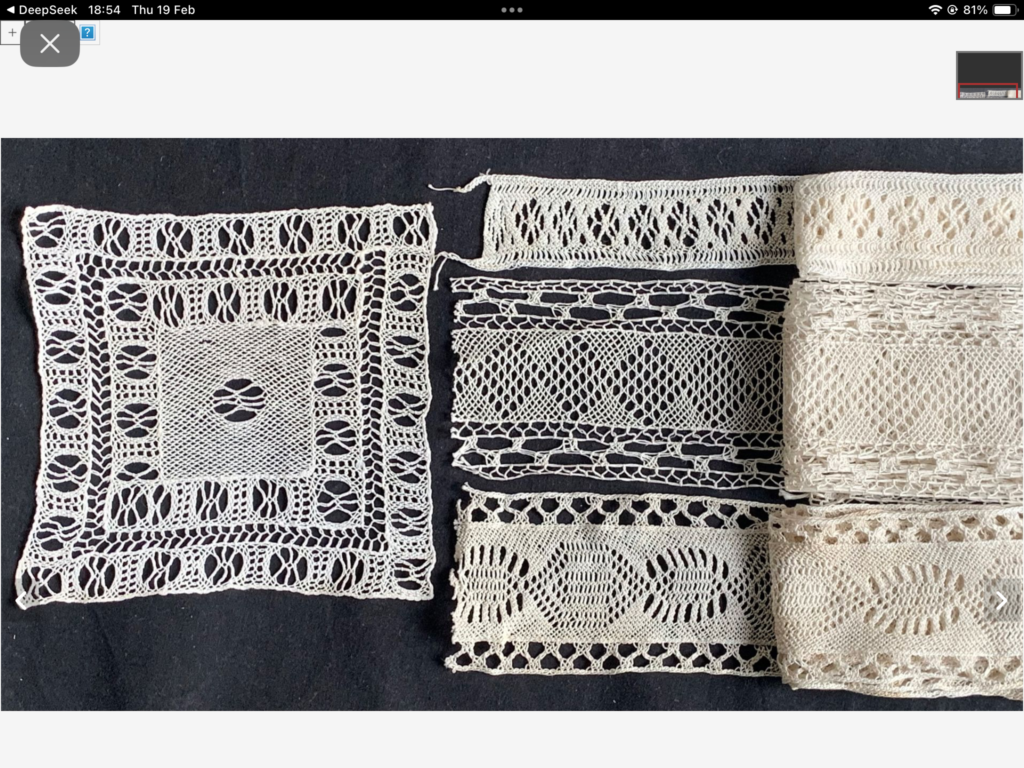
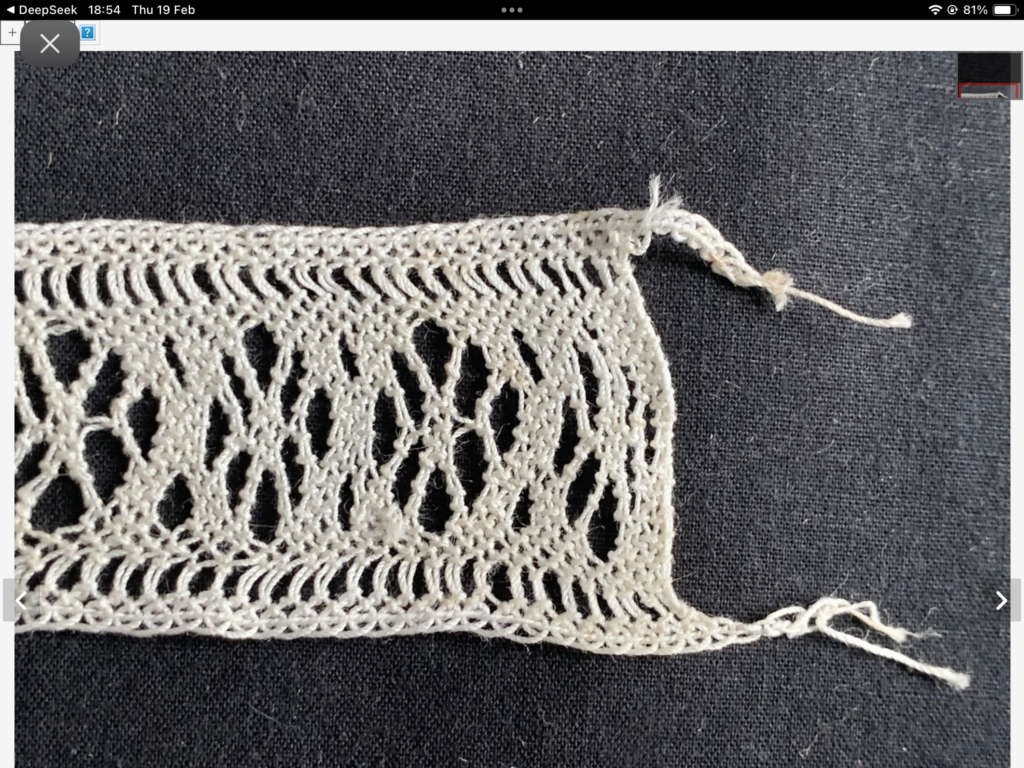
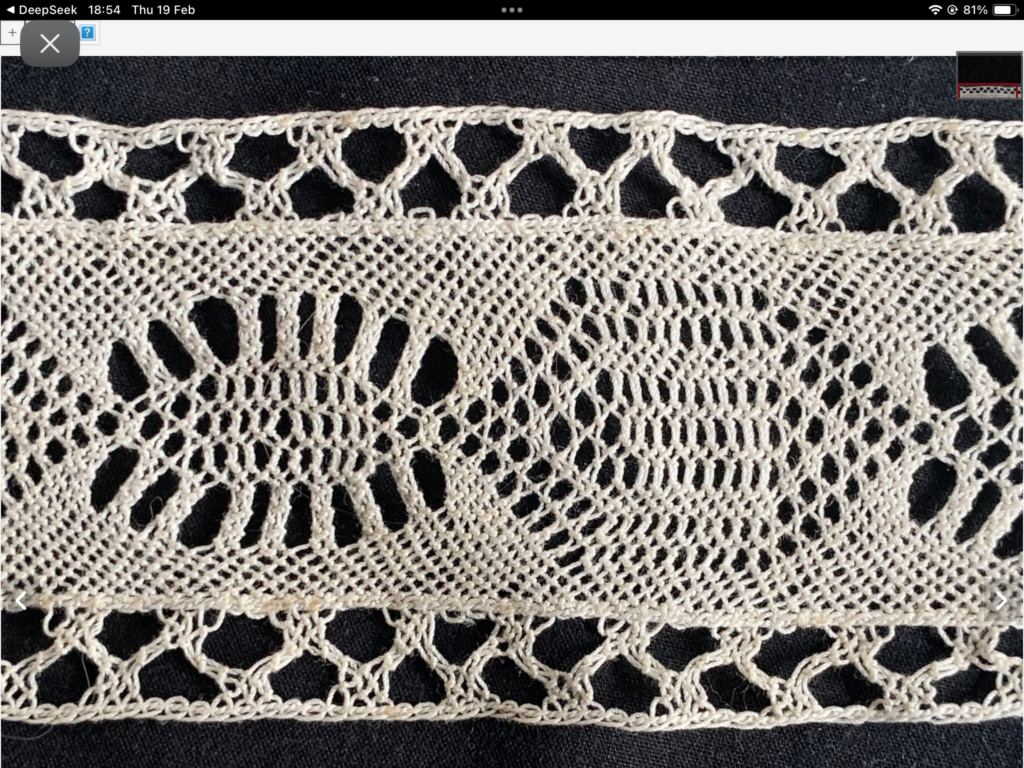
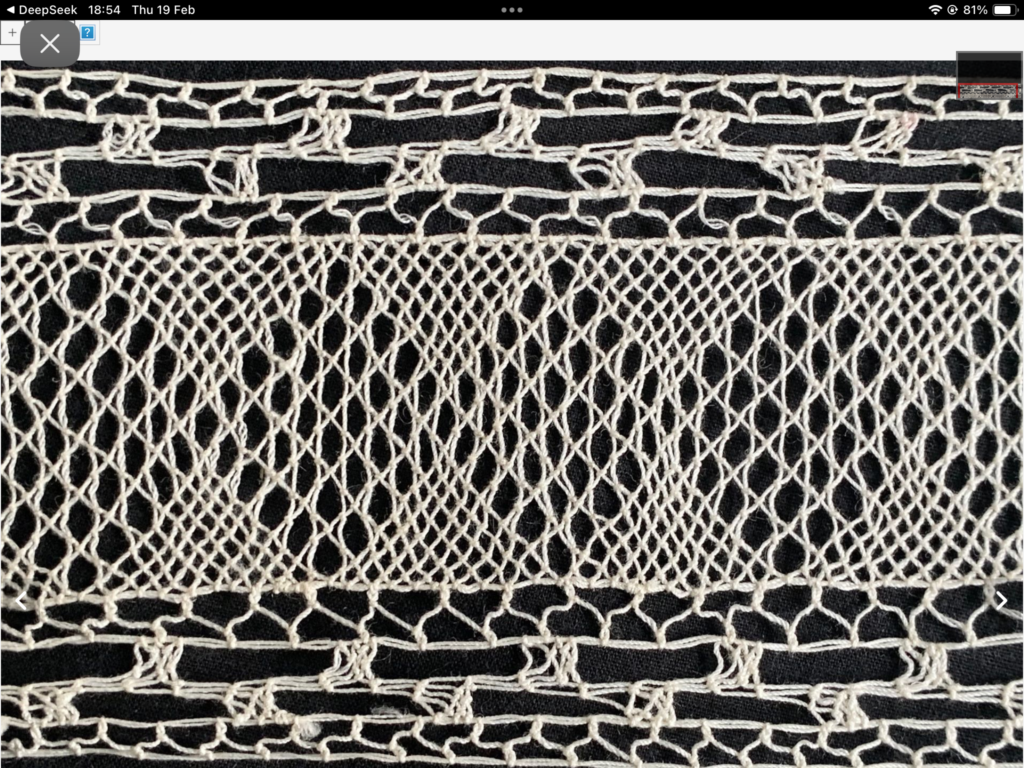
But the more sophisticated extraction happened in North Africa. Chebka lace is a needle-knotted stitch originating in North Africa. It was first practiced in Tunisia by individual women to adorn their traditional garments. Under the impetus of missionary nuns, the technique was developed further in Algeria and Morocco. The French protectorate encouraged its development because it found an important market in France.
Screenshot
Chebka lace creations were adapted to the French market. They produced collars, bibs, and doilies. The technique was extracted, renamed, and taught back to Africans as something valuable because Europeans valued it. The labour was African. The market was French. The profit was European. The original practitioners were not credited.
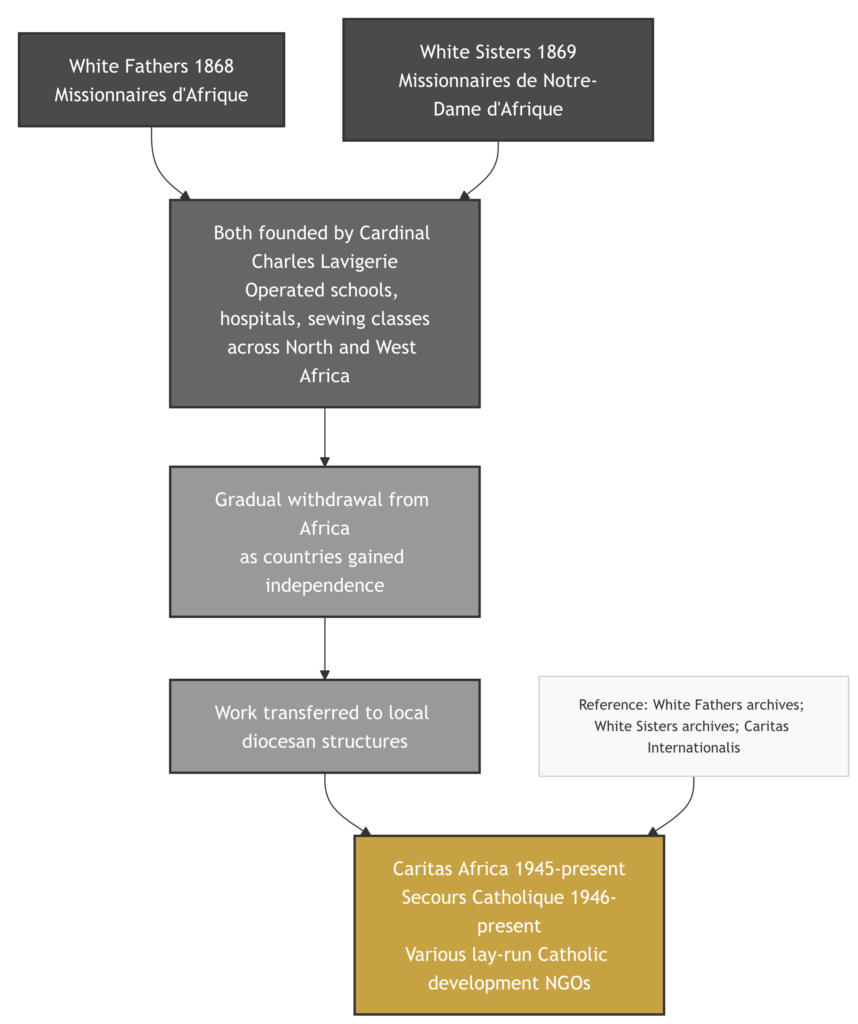
Diagram 2: White Fathers / White Sisters → Caritas
The Basel Mission Sewing Schools
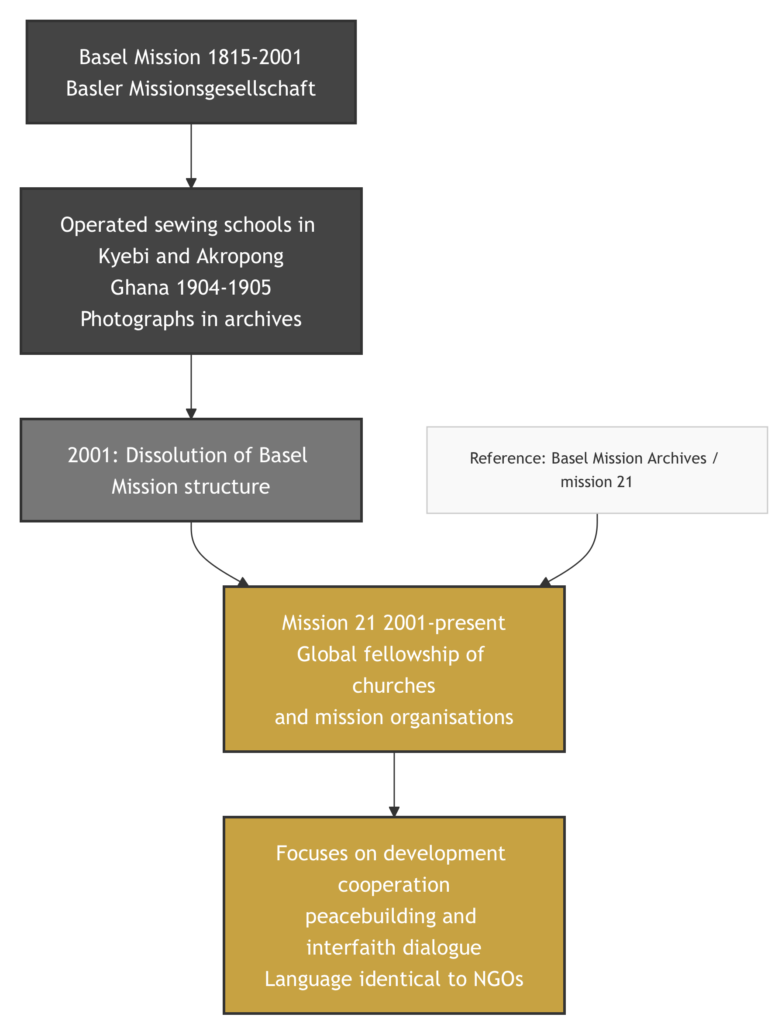
In Ghana, the Basel Mission operated sewing schools in Kyebi and Akropong. The photographs from 1904-1905 show African girls learning needlework under missionary supervision. The curriculum taught European techniques, European garment construction, and European aesthetics as superior.
The Basel Mission formally dissolved its missionary sending structure in 2001. It was replaced by Mission 21, a global fellowship of churches and mission organisations based in Basel. Mission 21 focuses on "development cooperation, peacebuilding, and interfaith dialogue"—language indistinguishable from NGOs.
Diagram 3: Basel Mission → Mission 21
The Lost
While African girls were learning to sew European embroidery, their own textile systems were going extinct.
In Buganda (Uganda), the Baganda had a thriving barkcloth industry. Barkcloth is made from fig trees. It is an indigenous fabric, not woven but beaten. The missionaries actively discouraged its use. They promoted the "clean shirt" or "white shirt" ideology, arguing that before the Western God, all people are alike if they keep their bodies clean—which the missionaries interpreted as "white." The result was the demise of the Baganda barkcloth industry.
In Namibia, among the Aawambo people, the Finnish missionaries taught that traditional costumes and ornaments were "heathen objects." The locals were persuaded to burn their traditional clothes. Sabina David states: "people eventually did away with traditional clothes and burned them." The imported European dress code has "no similarity or relevance to Aawambo cultural beliefs or lifestyle."
In the Democratic Republic of Congo, Kuba raffia textiles, cut-pile embroidery ("velvet raffia"), and other techniques declined. The colonial economy had no use for raffia. It could not be exported in bulk. It could not be processed in European factories. So it was ignored. Its knowledge system was not protected.
The pattern is consistent across the continent, the method is extraction, the tool is thread.
The Continuum: From Slave Owners to Missionaries to NGOs
The missionary organisations did not disappear, they rebranded.
· The SPG that owned slaves in Barbados is now USPG, a development NGO funding health, education, and advocacy projects.
· The Basel Mission that taught sewing in Ghana is now Mission 21, a global fellowship for "development cooperation."
· The White Sisters who taught lace making in Burkina Faso now work through Caritas Africa and Secours Catholique.
The names changed, the structure did not, the extraction continued. Only the language changed—from "saving souls" to "sustainable development," from "civilising mission" to "capacity building," from "conversion" to "empowerment."
Diagram 4: Labour Extraction Timeline
The missionaries did not come to teach Africans to sew for themselves. They came to teach Africans to sew for Europe. The hats, the lace, the embroidered cloth these were not for local use. They were for export. The labour was African, the profit was European. They have been actively creating skilled labour according to their needs, as time passes, Europeans come and extract labour under a variety of disguises, the main disguise being NGO’s
The same people who told Lucy Davis that she was "black, and mean, and vile" took the products of her hands and sold them abroad. The shame was not the end, It was the means. Convince the worker she is inferior, then extract her labour, then sell it back to her as charity.
The thread has not been broken. Read about this in Part 2: The Value Pyramid - Why the Artisan remains at the bottom.
References
· Basel Mission Archives / mission 21. "Nähschule in Kyebi (Sewing class in Kyebi)." Reference: D-30.13.039. https://bmarchives.org/items/show/56603 · Basel Mission Archives / mission 21. "Nähschule in Akropong 1904 (Sewing school in Akropong 1904)." Reference: QD-30.106.0153. https://bmarchives.org/items/show/71875 · Caley, Maria A. N. "The Modernized Traditional Dress of the Aawambo." University of Turku. · Coutau-Bégarie Auction House. "Three entre-deux and one carré in Chebka lace, North Africa, late 19th/early 20th century." Lot 129. https://coutaubegarie.com/en/lot/157092/26525906 · Fulham Palace. "Church of England's plantations in Barbados." 13 March 2023. https://www.fulhampalace.org/resistance/church-of-england-plantations/ · McLean-Farrell, Janice, and Michael Anderson Clarke. "Missions in Contested Places/Spaces: The SPG, Slavery, and Codrington College, Barbados." Mission Studies, 2021. · Mission 21. https://mission-21.org · Monk, Matthew, and Linda Eaton. "A Sampler's Story from Sierra Leone." Winterthur Museum, 5 September 2025. https://www.winterthur.org/blog/a-samplers-story-from-sierra-leone · Strickrodt, Silke. "African Girls' Samplers from Mission Schools in Sierra Leone (1820s to 1840s)." History in Africa, 2010;37:189-245. · TRC Leiden. "Embroidery and the White Sisters." 29 June 2015. https://trc-leiden.nl/trc-needles/regional-traditions/middle-east-and-north-africa/pre-modern-middle-east-and-north-africa/embroidery-and-the-white-sisters · USPG (United Society Partners in the Gospel). "About USPG." https://uspg.org.uk · Winterthur Museum, Garden & Library. "Sampler by Lucy Davis." Object number 2018.0007. http://museumcollection.winterthur.org/single-record.php?recid=2018.0007
Image Sources
· Winterthur Museum. "Sampler by Lucy Davis." Object number 2018.0007. http://museumcollection.winterthur.org/single-record.php?recid=2018.0007 · TRC Leiden. "White Sisters teaching lace making, Burkina Faso, 1930." https://trc-leiden.nl/trc-needles/regional-traditions/middle-east-and-north-africa/pre-modern-middle-east-and-north-africa/embroidery-and-the-white-sisters · Coutau-Bégarie Auction House. "Chebka lace pieces, North Africa, late 19th/early 20th century." Lot 129. https://coutaubegarie.com/en/lot/157092/26525906 · Basel Mission Archives. "Nähschule in Kyebi (Sewing class in Kyebi, Ghana, 1905)." Reference: D-30.13.039. https://bmarchives.org/items/show/56603 · Basel Mission Archives. "Nähschule in Akropong 1904 (Sewing school in Akropong, Ghana, 1904)." Reference: QD-30.106.0153. https://bmarchives.org/items/show/71875 · Mary Evans Picture Library / Media Storehouse. "Arab children in an embroidery school, Algiers, Algeria, c. 1920." https://www.mediastorehouse.co.uk/mary-evans-prints-online/arab-children-embroidery-school-algiers-algeria-14257618.html · International Mission Photography Archive. "Les Soeurs Bleues de Castres Au Gabon." Reference: impa-m12751. https://digitallibrary.usc.edu/asset-management/2A3BF1E5J4RX · Pearl Digital Collections, Presbyterian Historical Society. "A missionary nun trains a Malian woman in the use of a loom." Caption number C-46651. 14 August 1973. https://digital.history.pcusa.org/islandora/object/islandora%3A123456 · University of Southern California. Libraries. "Mission sewing class in Brazzaville, Congo, circa 1920-1940." https://dp.la/item/df6d2427c1d3a832fd0caa1cf129e59b · Yale Divinity Library. "Missies der PP. v. d. H. Geest - Missions des PP. du St. Esprit. -- Het bewerken van de raphia te Lubunda." https://collections.library.yale.edu/catalog/12345678 · Mennonite Archival Information Database. "Sewing Class at Kajiji Missions School, Zaire, 1983." Reference: 8bec-dk3a-4bnk. https://archives.mennonite.net · Africa Commons / University of Southern California. Libraries. "Needlework exhibition at Ntoma Home Craft School, Tanzania, 1980." Reference: impa-c123-100957. https://africacommons.net · International Mission Photography Archive. "Leçon de couture, Mme Lenoir. École de Makulane, Mozambique, August 1901." Reference: impa-m59014. https://digitallibrary.usc.edu/asset-management/2A3BF1E5J4RY · United Church of Canada Archives. "Cartmell Sewing School, Japan, circa 1910s." Reference: 2000.017P/2959. https://archives.unitedchurch.ca
That is the estimated retail value of Sub-Saharan Africa's wax print market. Billions spent every year on fabric worn by millions of Africans. Fabric that, for nearly two centuries, has been manufactured in Europe—not on the continent where it is sold and worn.
Vlisco has been selling to Africa since 1846. Almost 180 years. Their profits come almost exclusively from African consumers. The company's former British owner, Actis, had no connection to the continent except through the money Africans spent on their products.
In 2020, a $190 million financing facility was secured from Afreximbank to acquire Vlisco. The total bid was approximately $200 million. The African Continental Free Trade Area (AfCFTA) publicly supported the bid. Its Secretary General, Wamkele Mene, stated: "We cannot express a value judgement as to the reasons for the bid of Made in Africa – which was the higher bid – being rejected. We do however firmly believe that where an African company puts forward a formidable bid for a foreign company that appears to profit exclusively from sales to Africa, supported by a leading African trade finance bank, the African company has a reasonable expectation to successfully conclude the transaction in favour of Africa" .
The bid was rejected. The higher bid. Rejected.
In 2023, Vlisco was sold to Parcom, a Dutch private equity firm.
Why does this matter for Africa's economic future?
Because the same pattern repeats across the continent. Africa produces cotton. Africa exports raw materials. Africa imports finished goods. Today, 90 percent of Africa's cotton is exported raw. The continent imports over $23 billion in textiles, apparel, and footwear annually .
Think about that. We grow the cotton. We send it away. We buy back the clothes. We lose the jobs, the factories, the skills, the wealth.
The textile industry could be Africa's path to create more industries. It employs thousands. It creates value at every stage: ginning, spinning, weaving, dyeing, cutting, sewing, retail. The International Trade Centre estimates that if African countries fully developed their textile value chains, the continent could export €5.8 billion in cotton garments by 2026—and nearly 15% of that could be destined for African markets alone. Two-thirds of intra-regional export potential is still untapped. The industry could generate 5.8 million jobs across the continent .
Therefore we need to own the companies that serve our markets. Look at how Dangote Refinery is servicing the African market in times of oil scarcity around the world. Despite facing technical and political challenges—including difficulty securing local crude and competition from dumped foreign fuel—the 650,000 barrel-per-day refinery now produces some 550,000 barrels of refined products daily. Nigeria's fuel imports fell from 500,000 barrels per day in early 2023 to 88,000 barrels per day in early 2025 . That is what African ownership can do.
The Vlisco bid was not just about one company. It was about a vision.
The AfCFTA's objective is to accelerate industrialization in Africa, consolidate an integrated market of 1.3 billion people with a combined GDP of $3.4 trillion, and place Africa on a path to global competitiveness . At the heart of that vision is the textiles and clothing sector.
When a company that profits exclusively from Africa rejects African ownership—despite a higher bid, despite Afreximbank backing, despite AfCFTA support—that is not just a business decision. It is a statement.
And the statement is: we want your money, but not you.
The question is not whether we have the resources. We do. The question is whether we will keep playing a game where the rules are written against us—and where our own capital is rejected.
The AfCFTA cannot compel a private sale. But it can shape policy. It can reduce non-tariff barriers that cost the continent an estimated $20 billion in annual GDP growth . It can help build regional value chains that keep cotton in Africa and turn it into cloth, garments, and wealth.
Will African governments act? Will they prioritize local textile production? Will they create the conditions where African capital can buy African markets?
Some African nations are making the moves for our futures:
Mali is building its textile industry. The government, through the state-owned Compagnie malienne pour le développement des textiles (CMDT), is targeting over 650,000 tonnes of seed cotton for the 2026–2027 season—a more than 50% increase from current estimates. The West African Development Bank has committed significant resources to support Mali's cotton sector and local processing . This is not foreign-owned. This is Mali building for Mali.
Benin stopped exporting raw cotton. The country banned raw cotton exports to force local value addition. Through the Glo-Djigbé Industrial Zone (GDIZ), Benin is now manufacturing its own apparel—creating jobs, building skills, keeping wealth. The managing director of GDIZ stated: "We have decided that in this country, we are no longer going to sell this cotton raw. We are going to transform this cotton, in particular by installing integrated textile factories" . Benin is not waiting. Benin is doing.
Ethiopia is not waiting either. The country has 13 industrial parks with more than 177 manufacturing sheds, supporting over 100,000 jobs. New investments keep coming: a $200 million agreement with UK-based Intrade Co., a Chinese textile manufacturer setting up in Dire Dawa Industrial Park, an Italian textile giant exporting from Kombolcha Industrial Park . Kenya just opened the Vipingo Special Economic Zone—a $3 billion textiles and apparel hub with $800 million in financing from KCB Group and Afreximbank. Botswana launched "Made in BW" to revive local production. Ghana's garment sector is targeting $2 billion and 150,000 jobs by 2033.
The continent is moving.
Vlisco still sells to us. Wax prints still dominate. The profits still leave.
How do we move Africans to buy differently?
Not out of charity. Out of strategy. Out of self-interest.
Right now, 90% of Africa's cotton is exported raw. The continent imports over $23 billion in textiles, apparel, and footwear annually. We grow it. We send it away. We buy it back. We lose the jobs, the factories, the skills, the wealth.
If Africa fully developed its textile and apparel industry, processing cotton locally instead of exporting it raw, the sector could generate up to 5.8 million jobs. But only if we process the cotton here. Only if we manufacture the fabric here. Only if we buy from each other .
The Vlisco bid was not just about one company. It was about a vision.
The vision that African capital can own African markets. That African cotton can become African cloth. That African consumers can choose African manufacturers.
The bid failed. But the vision cannot.
Africa's textile industry is at a crossroads. We can continue to export raw cotton and import finished clothes. We can continue to let European and Asian companies profit from our markets while we collect the crumbs.
Or we can build.
References
African Law & Business. "Vlisco rejects USD 200 million acquisition offer." August 2021. Available at: https://www.africanlawbusiness.com/news/16948-vlisco-rejects-usd-200-million-acquisition-offer/
African News Agency. "Economie : la Zlecaf soutient Made in Africa pour le rachat de Vlisco." July 2021. Available at: https://africannewsagency.com/economie-la-zlecaf-soutient-made-in-africa-pour-le-rachat-de-vlisco/
University of Electronic Science and Technology of China West African Research Center. "Cotton exporter Benin developing home-grown textile industry." February 2025. Available at: https://cwas.uestc.edu.cn/info/1042/3464.htm
International Trade Centre (ITC). "How to invest in a viable textile and cotton value chain in Africa." April 2025. Available at: https://www.intracen.org/news-and-events/news/how-to-invest-in-a-viable-textile-and-cotton-value-chain-in-africa
S&P Global Commodity Insights. "Technical, political challenges thwarting African refining: Dangote." July 2025. Available at: https://www.spglobal.com/commodity-insights/en/news-research/latest-news/refined-products/072225-technical-political-challenges-thwarting-african-refining-dangote
African Center for Economic Transformation (ACET). "Reducing Non-Tariff Barriers to AfCFTA Implementation in the Cotton, Textiles, and Apparel Industry." August 2025. Available at: https://acetforafrica.org/research-and-analysis/reports-studies/reports/reducing-non-tariff-barriers-to-afcfta-implementation-in-the-cotton-textiles-and-apparel-industry/
Ecofin Agency. "Mali Increases Farm Spending to $289 Million With Focus on Cotton and Food." April 2026. Available at: https://www.ecofinagency.com/news-agriculture/0604-54437-mali-increases-farm-spending-to-289-million-with-focus-on-cotton-and-food
Overseas Recruitment Network. "东方工业园招聘信息" [Eastern Industrial Zone Recruitment Information]. 2025. Available at: https://www.hwzpw.com/job/27096.html
24 Heures au Bénin. "Voici pourquoi l'Etat autorise à nouveau l'exportation des produits vivriers." July 2025. Available at: https://24haubenin.info/?Voici-pourquoi-l-Etat-autorise-a-nouveau-l-exportation-des-produits-vivriers
There is a technique hidden in the folds of African textile history. It uses cassava paste—simple, abundant, biodegradable—to create patterns on fabric. The paste resists indigo dye. When the cloth is dipped, the paste protects the areas beneath it. What emerges is pattern. What emerges is mathematics. What emerges is centuries of knowledge encoded in starch and leaf.
The West knows wax. The West industrialised batik. The West also knows cassava resist. European traders collected samples. They studied the patterns. They understood the technique. They chose to ignore it.
This is not ignorance. This is a decision.
What Is Cassava Resist Dyeing?
The technique is called adire eleko among the Yoruba people of southwestern Nigeria. Cassava flour is mixed with water, boiled, and strained into a thick starch paste . The paste is applied to cotton cloth using a feather, a brush, or a stencil cut into a design . Where the paste touches the cloth, dye cannot penetrate. The cloth is then dipped into an indigo vat made from the elu plant (Lonchocarpus cyanescens), which is pounded, shaped into balls, dried, and fermented for anywhere from three weeks to six months . The cloth is dipped repeatedly. Each dip deepens the blue. When the final color is achieved, the starch is scraped off. What remains is a pattern of white or light blue against a deep indigo ground.
The technique is slow. It takes roughly three days to complete one yard, and about two weeks to complete five yards . The starch is applied by hand. The patterns are not random. They encode Yoruba history, mythology, social commentary, and even the sound of beads on dancers' hips—a pattern called Sun Bebe, which means "lifting up the sun" and refers to beads that would move up and down as girls danced before their future husbands .
This is not craft. This is technology. This is chemistry, material science, design logic, and cultural memory all at once.
The Knowledge Keepers
In Ogun State, particularly in Abeokuta, adire eleko is not taught in schools. It is not written in books. It is passed down within specific families. One particular family is known as the master of this art, and it remains so to this day . The technique is taught and learned only within the family.
This is not a limitation. This is protection.
While the patent system requires public disclosure, the Yoruba knowledge system protects through lineage, through trust, through generations of embodied practice. The knowledge does not leave the family because the family is the institution that holds it.
This is why the West ignored cassava resist. It could not be easily extracted. It could not be industrialised without the consent of the families who hold it. The technique survived not because it was documented, but because it was guarded.
The History That Was Never Written
Resist dyeing is not new to Africa. It was not imported. It was not taught by colonizers. The Yoruba people developed adire independently, using cassava starch as their resist agent of choice . The technique was practiced almost exclusively by women, who made, designed, dyed, and sold the cloth . Knowledge was passed from mother to daughter, from grandmother to granddaughter.
The first major production of adire began in the late nineteenth century . By the 1910s and 1920s, it was flourishing. Then came the disruption.
The Hostile Takeover
European traders did not bring resist dyeing to Africa. What they brought was competition—unfair competition. Companies like GB Ollivant Ltd, a Manchester-based firm, collected samples of adire cloth to study . They were not collecting out of admiration. They were collecting to replicate. They wanted to understand the patterns, the aesthetics, the market preferences so they could produce their own versions and sell them back to African consumers .
The same pattern we have seen before. Study the knowledge. Industrialize a different technique. Undermine the local producer. Capture the market.
The West knew about cassava resist. They chose not to develop it. Not because it was inferior. Because developing African knowledge would mean competing with African producers on their own terms. It was easier to industrialize wax, control the supply chain, and capture the market.
By World War II, adire production had dwindled . The colonial economy had done its work. Cheaper, faster, machine-made imitations flooded the market. The women who had spent generations perfecting the technique could not compete.
Wax became the dominant resist agent. Not because it was better. Because it was industrial. Because it was controlled by European manufacturers. Because the system was rigged.
The Environmental Cost
Wax resist dyeing is polluting. The wax must be removed from the fabric after dyeing, often using hot water and chemicals. In Thailand, where similar wax-resist techniques are used to produce batik, the wax residue clogs drainage pipes and contaminates water sources . The textile and dyeing industries release wastewater containing dye remnants and chemical substances into rivers and streams .
Cassava paste does none of this. It is made from cassava flour—a food crop. It is water-soluble. It scrapes off cleanly. It biodegrades. There is no chemical residue. There is no pipe-clogging wax. There is no pollution.
Cassava is also abundant across Africa. Nigeria is one of the world's largest producers of cassava. The raw material is already here. The knowledge is already here. The technique is already here.
So why are we not using it?
What Others Are Doing
While Africa has allowed cassava resist dyeing to remain a footnote, other nations are paying attention.
In Thailand, researchers at Rajamangala University of Technology Phra Nakhon are developing cassava starch as a substitute for fabric dye blockers and natural powder colors . They recognize the environmental damage caused by wax resists. They are looking for alternatives. They are looking at cassava.
Vietnam is also exploring the technique. The global market for sustainable textiles is growing. Consumers are demanding eco-friendly alternatives to polluting industrial processes. Cassava resist dyeing offers exactly that.
Meanwhile, on the African continent, the technique survives in pockets. Practitioners like Gasali Adeyemo, a Yoruba artist based in Santa Fe, New Mexico, travel internationally teaching traditional adire eleko techniques . He learned from his elders. He teaches in America. Not because he wants to leave, but because there is more demand for his knowledge outside Africa than inside it.
This is the irony. The knowledge is African. The technique is African. The material is African. But the innovation, the investment, the market development—these are happening elsewhere.
The Opportunity We Are Missing
Cassava resist dyeing could be a cornerstone of a sustainable, ecologically responsible, distinctly African textile industry. It uses local materials. It produces zero toxic waste. It generates employment for rural women who already know the technique or could be trained in it. It produces cloth that is beautiful, culturally specific, and globally marketable.
But none of this will happen without investment. Without research. Without government support. Without a conscious decision to develop the technique, scale it, and bring it to market.
The revival of adire began in the 1960s, with new patterns and new uses emerging . But revival is not enough. We need transformation.
Other countries are developing cassava-based textile technologies. If Africa does not act, the same pattern will repeat: African knowledge, developed elsewhere, patented elsewhere, sold back to Africa.
What Must Change
First, documentation. The knowledge exists in the hands of elderly practitioners and within families. It must be documented, archived, and made available for future generations—with the consent and benefit of the knowledge holders. Universities and research institutions across Africa should prioritize the study of indigenous textile techniques.
Second, research and development. Cassava paste formulations can be improved. Application methods can be mechanized. Color fastness can be enhanced. All of this requires investment in materials science and textile engineering—on African soil, with African researchers, leading the agenda.
Third, market development. Sustainable textiles are a growing global market. African cassava-resist cloth could be positioned as a premium eco-friendly product. But this requires branding, certification, supply chain development, and access to international markets.
Fourth, policy support. Governments must prioritize indigenous textile techniques in procurement, education, and industrial policy. If Nigerian schools wore uniforms made with cassava-resist cloth, the industry would have an immediate market. If public events required locally made textiles, demand would rise.
Fifth, respect for family knowledge. The families in Abeokuta who have guarded this knowledge for generations must be centered in any effort to develop the technique. Their consent, their benefit, and their leadership are non-negotiable.
Sixth, rejection of the colonial framework. We must stop treating wax as the default. We must stop treating European techniques as superior. Cassava resist is not primitive. It is not a craft to be preserved in museums. It is a technology to be developed, scaled, and owned.
The Question
I first read about cassava resist dyeing in Claire Polakoff's African Textiles and Dyeing Techniques. The book is decades old. The technique is centuries older. The West knew about it. The West chose to ignore it.
The question is not whether the knowledge exists. It does. The question is whether we will finally decide to develop what we already have.
Other countries are watching. Other countries are learning. Other countries are investing.
Cassava grows in our soil. Indigo grows in our soil. The knowledge lives in our communities and in the families who have guarded it for generations.
Rajamangala University of Technology Phra Nakhon. "Using cassava starch as a substitute for fabric dye blockers and natural powder colors." Green RMUTP, 2023. Available at: https://green.rmutp.ac.th/cassava-starch/
Penland School of Craft. "Traditional Yoruba Dyeing Techniques with Indigo." 2023. Available at: https://penland.org/class/traditional-yoruba-dyeing-techniques-with-indigo/
The Centenary Project. "Adire: The Art of Tie and Dye." Google Arts & Culture. Available at: https://artsandculture.google.com/story/adire-the-art-of-tie-and-dye/8gXxRjT3ZkRUKg
Cornell University Library. "Inspiration: Resist Dyeing." Fashion & Feathers Exhibit. Available at: https://rmc.library.cornell.edu/fashion/exhibition/inspiration/
KOTITI Testing & Research Institute. "Resist dye patterning." Textile Information, 2002. Available at: https://www.kotiti.or.jp/eng/publication/backnumber/2002/12/
Lancashire Textile Gallery. "Sample of Nigerian adire resist dyeing with fish and chevron pattern." 2023. Available at: https://lancashiretextilegallery.org/adire-fish-chevron
Smithsonian National Museum of African Art. "Wrapper (Adire)." Object 96-1-17. Available at: https://africa.si.edu/collections/view/objects/asitem/items@11222
Nigerian textile practitioner account. "Adire Eleko: The Family Art of Abeokuta." (Source as provided)
Polakoff, Claire. African Textiles and Dyeing Techniques. (Original source)
During the years 2021/ 22, I was able to take a life changing journey through 11 African countries. I was able to make valuable observations that would enable me to formulate methodologies, methods and research directions altering the ways the traditional textile designs and practitioners are being affected throughout the African continent.
The Traditional textiles and the people making them are not a very visible part of the contemporary textile industry. You have to ask the right persons (Find the right people to ask).
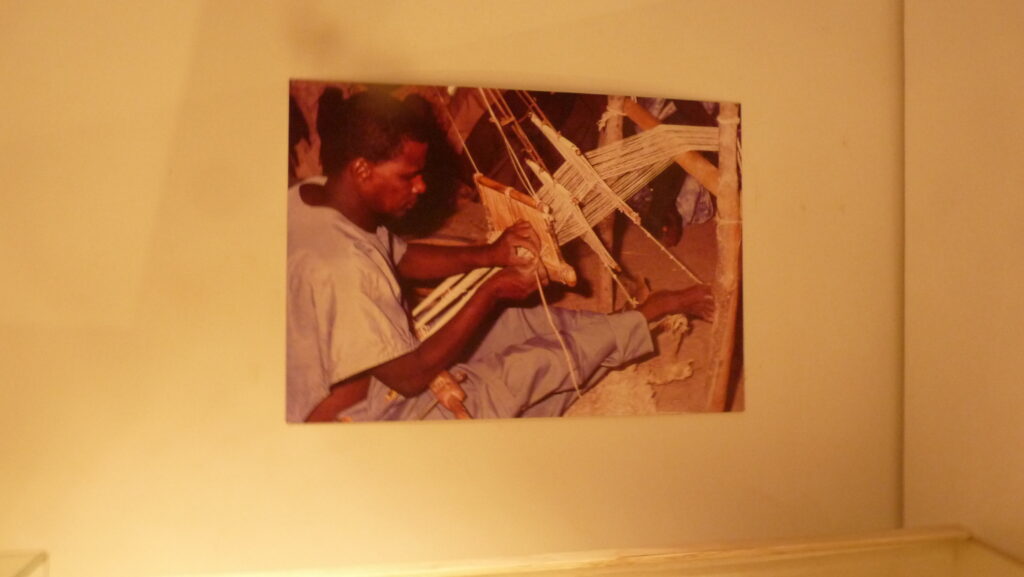
You might then be able to be brought to remote places where a person might still be practicing the textile craft on the traditional loom.
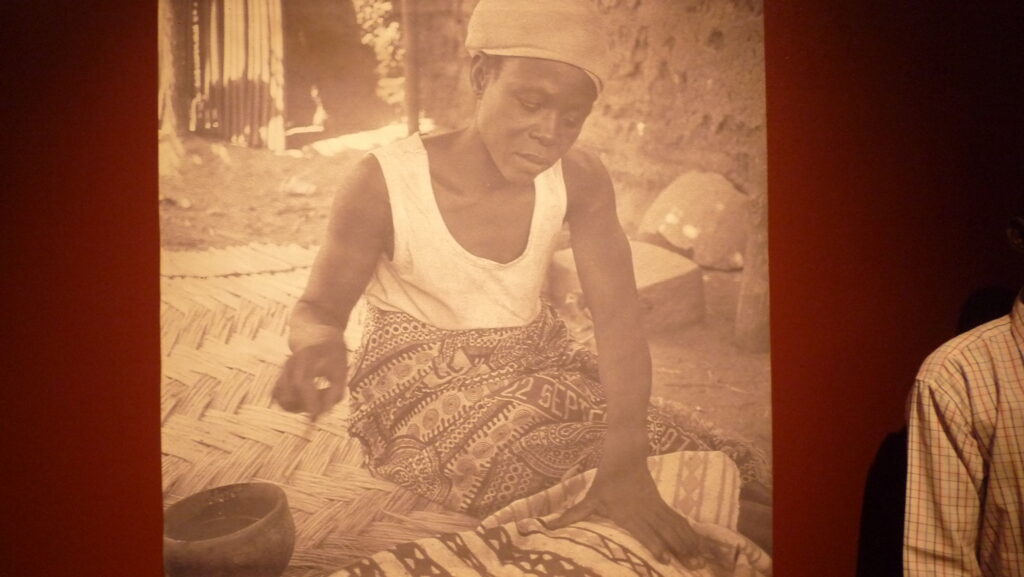
Image copyright Museum of Mali, Bamako 2025
During my drive I observed a mixed crowd wearing both European style clothing and Wax printed fabrics. It was rare, ver rare if ever I observed the traditional local textiles.
The roads in Africa are great, where there are patches of bad road, consorted efforts are being made to improve these. Large trucks drive throughout the continent taking goods from country to country, city to city.
Mali and Burkina Faso are countries very strong in their cultures. People there are very proud of their cultures and they incorporate traditions in contemporary settings.
Artisans have their shops throughout the cities of the country. In Burkina Faso for example I was able to visit a business centre where people from various African countries came to display their products.
On this particular day products from Morroco were the dominant products on display, as Morroco invest in Moroccan businesses to push their products on the continent. I would like to see more African nations promoting their local products in eachothers countries. There was no textiles from any country here.
My journey took me further through Togo, Benin, Nigeria, Niger, Tchad, Cameroon, CAR and eventually Republic of Congo.
As I was waiting for my Visa in Brazaville, I decided to explore the traditional Congolese textiles. During my visit to the cities large market of Poto Poto, I came across a Malian ran textile shop among the many Indian ran shops on the high street.
As I was asking for for the Congolese traditional headwraps, my eyes were drawn to a striped heavy cotton quality worn 20-25 cm stripe cloth. I knew immediately I stroke gold.
Before this, I was contemplating the lack of intercontinental trade, which would greatly boost the textile sector if these could be exported among the African countries.
My beautiful Burkinabe made textile, was 10x more expensive than the average textiles in that store. The shop owner explained to me that transportation, from Mali to Congo, was a large part for the high cost of the cloth. Employing a tailor, with experience in pattern cutting with strip fabrics was also a challenge. There is definitely space for specialised knowledge creation in design and pattern cutting using traditional textiles.
My fabric from Mali purchased in Congo
The cloth was beautifully hand woven, striking colour combinations allowing me to create a beautiful long dress.
I knew, based on the weaving patterns, that the artisan used years of passed on knowledge to construct this cloth.
Design analysis
The warp colours of this textile are yellow, black and orange. The weft is all black. The pattern sequence is constructed with a variety thicknesses of vertical lines of black, yellow and orange sitting perfectly on the weft.
The length of the textile is about 100cm, and the width was 15 inch. This would be in keeping with the use of the traditional handloom. This does not mean that larger looms looms are not also part of an older traditions of weavers in this region. This however not been investigated as of yet. But what is certain is that the yarn used in this piece are not hand spun yarn but mechanically produced yarn.
I can not state for sure that the yarn would of been imported into Mali, as Mali is a large cotton producer and has been making consorted efforts in rebuilding all parts of its textile industry while preserving its traditional artisan textile sector.
Having had the opportunity to speak to the seller/ owner at length, I was informed that these textiles are very much loved but for the prices. The cheap imports place a role, but also the transportation and import duties make the selling prices 10x higher.
Nevertheless there is still a niche market for these fabrics and in time, with further developments of trade among the African nations, in combination with effective government policies, the prices might eventually come down.
In 2015, surfaced the first signs out of the African continent that the governments are starting to make and implement the necessary policies in order to safeguard not only the livelihoods of local textile practitioners, but also the preservation of local designs and aesthetics alongside the weaving skills.
While there has been numerous African scholarly attention on own decline of the local textile industry, it has taken over 20 years to arrive at a point where local governments are active in the sector.
Each of the 54 countries in Africa, can boast of a rich ancient tradition of cloth making, dating far back in the BC's. Some textile designs have risen more in popularity than others, and some has been more researched and documented then others.
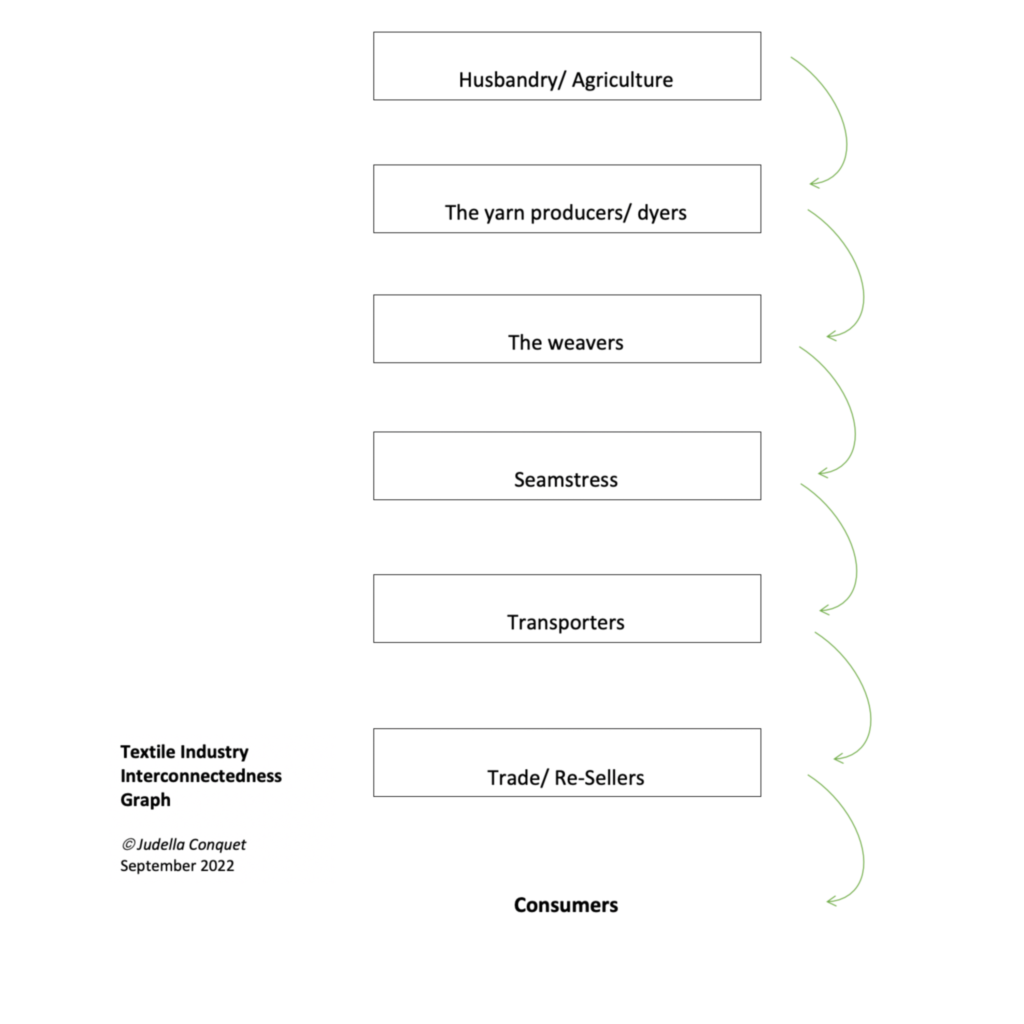
In 2019, the Rwanda president took a brave and bold step in halting second-hand clothing shipping containers that were arriving from America and Europe. These second-hand clothing (and cheap Chinese knock-off prints) were decimating the remaining textile practitioners chances of making some type of livelihood for them and their families.
These imports do not just affect one of people, but many segments and supporting Textile industry practitioners as illustrated in the graph.
With the Rwandan government interventions they were able to start the arduous task of rebuilding a prosperous industry, manufacturing industry in the Pearl of Africa.
In 2022, the Kenyan government started taking steps to protect the local textile industry from second-hand clothing imports and cheap Chinese faux prints fabrics.
Along side these policies, concerted efforts are being made by locally run NGO's to reintroduce weaving and other textile making skills back into the workforce.
Ghana in 2021 mandated that the school uniforms should have traditional Ghanaian designs. This policy does not only imparts identity back into the populous, but it also help boost the local manufacturing mills that will now be producing and selling throughout the country, regaining portions of the local market segments.
With the new governing system in Burkina Faso, the government, as one of their first policies, also made the school uniforms to be changed into local traditional designs. These policy changes strongly boost the Burkinabe identity and increase jobs locally.
The textile industry in Burkina Faso has long been suffering, but was able to still continue to exist with small export opportunities in Central Africa.
Ethiopia has long maintained its textile industry despite other African countries struggles. The famous white cotton woven fabric with beautiful colourful surface needle work has been exported worldwide as Ethiopians promote their cultures worldwide.
Ethiopians themselves are large consumers of their own cloth in so sharing in the continuity of textile practitioners livelihood and its technical making skills.
In Nigeria, the Yoruba, Ibos, Hausa and other groups, still largely wear their traditional textiles not only for special occasions, but also as part of daily life.
During my visit in 2022 to Port Harcourt in Nigeria, the fridays were used to allow hotel staff to wear traditional attire. The hotel itself had beautiful local textile artworks throughout, evidencing how the Nigerian people actively find ways to incorporate their traditional identity into a contemporary setting.
Unlike the western concepts of museaums in America and Europe, African traditions are lived, are very much alive and touches peoples life on a daily basis. Traditions interact with it's people, allowing it to be part of the peoples consciousness.