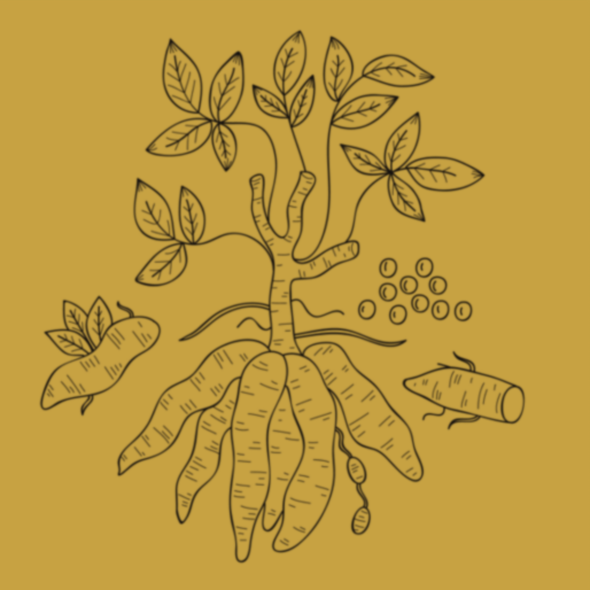
There is a technique hidden in the folds of African textile history. It uses cassava paste—simple, abundant, biodegradable—to create patterns on fabric. The paste resists indigo dye. When the cloth is dipped, the paste protects the areas beneath it. What emerges is pattern. What emerges is mathematics. What emerges is centuries of knowledge encoded in starch and leaf.
The West knows wax. The West industrialised batik. The West also knows cassava resist. European traders collected samples. They studied the patterns. They understood the technique. They chose to ignore it.
This is not ignorance. This is a decision.
What Is Cassava Resist Dyeing?
The technique is called adire eleko among the Yoruba people of southwestern Nigeria. Cassava flour is mixed with water, boiled, and strained into a thick starch paste . The paste is applied to cotton cloth using a feather, a brush, or a stencil cut into a design . Where the paste touches the cloth, dye cannot penetrate. The cloth is then dipped into an indigo vat made from the elu plant (Lonchocarpus cyanescens), which is pounded, shaped into balls, dried, and fermented for anywhere from three weeks to six months . The cloth is dipped repeatedly. Each dip deepens the blue. When the final color is achieved, the starch is scraped off. What remains is a pattern of white or light blue against a deep indigo ground.
The technique is slow. It takes roughly three days to complete one yard, and about two weeks to complete five yards . The starch is applied by hand. The patterns are not random. They encode Yoruba history, mythology, social commentary, and even the sound of beads on dancers' hips—a pattern called Sun Bebe, which means "lifting up the sun" and refers to beads that would move up and down as girls danced before their future husbands .
This is not craft. This is technology. This is chemistry, material science, design logic, and cultural memory all at once.
The Knowledge Keepers
In Ogun State, particularly in Abeokuta, adire eleko is not taught in schools. It is not written in books. It is passed down within specific families. One particular family is known as the master of this art, and it remains so to this day . The technique is taught and learned only within the family.
This is not a limitation. This is protection.
While the patent system requires public disclosure, the Yoruba knowledge system protects through lineage, through trust, through generations of embodied practice. The knowledge does not leave the family because the family is the institution that holds it.
This is why the West ignored cassava resist. It could not be easily extracted. It could not be industrialised without the consent of the families who hold it. The technique survived not because it was documented, but because it was guarded.
The History That Was Never Written
Resist dyeing is not new to Africa. It was not imported. It was not taught by colonizers. The Yoruba people developed adire independently, using cassava starch as their resist agent of choice . The technique was practiced almost exclusively by women, who made, designed, dyed, and sold the cloth . Knowledge was passed from mother to daughter, from grandmother to granddaughter.
The first major production of adire began in the late nineteenth century . By the 1910s and 1920s, it was flourishing. Then came the disruption.
The Hostile Takeover
European traders did not bring resist dyeing to Africa. What they brought was competition—unfair competition. Companies like GB Ollivant Ltd, a Manchester-based firm, collected samples of adire cloth to study . They were not collecting out of admiration. They were collecting to replicate. They wanted to understand the patterns, the aesthetics, the market preferences so they could produce their own versions and sell them back to African consumers .
The same pattern we have seen before. Study the knowledge. Industrialize a different technique. Undermine the local producer. Capture the market.
The West knew about cassava resist. They chose not to develop it. Not because it was inferior. Because developing African knowledge would mean competing with African producers on their own terms. It was easier to industrialize wax, control the supply chain, and capture the market.
By World War II, adire production had dwindled . The colonial economy had done its work. Cheaper, faster, machine-made imitations flooded the market. The women who had spent generations perfecting the technique could not compete.
Wax became the dominant resist agent. Not because it was better. Because it was industrial. Because it was controlled by European manufacturers. Because the system was rigged.
The Environmental Cost
Wax resist dyeing is polluting. The wax must be removed from the fabric after dyeing, often using hot water and chemicals. In Thailand, where similar wax-resist techniques are used to produce batik, the wax residue clogs drainage pipes and contaminates water sources . The textile and dyeing industries release wastewater containing dye remnants and chemical substances into rivers and streams .
Cassava paste does none of this. It is made from cassava flour—a food crop. It is water-soluble. It scrapes off cleanly. It biodegrades. There is no chemical residue. There is no pipe-clogging wax. There is no pollution.
Cassava is also abundant across Africa. Nigeria is one of the world's largest producers of cassava. The raw material is already here. The knowledge is already here. The technique is already here.
So why are we not using it?
What Others Are Doing
While Africa has allowed cassava resist dyeing to remain a footnote, other nations are paying attention.
In Thailand, researchers at Rajamangala University of Technology Phra Nakhon are developing cassava starch as a substitute for fabric dye blockers and natural powder colors . They recognize the environmental damage caused by wax resists. They are looking for alternatives. They are looking at cassava.
Vietnam is also exploring the technique. The global market for sustainable textiles is growing. Consumers are demanding eco-friendly alternatives to polluting industrial processes. Cassava resist dyeing offers exactly that.
Meanwhile, on the African continent, the technique survives in pockets. Practitioners like Gasali Adeyemo, a Yoruba artist based in Santa Fe, New Mexico, travel internationally teaching traditional adire eleko techniques . He learned from his elders. He teaches in America. Not because he wants to leave, but because there is more demand for his knowledge outside Africa than inside it.
This is the irony. The knowledge is African. The technique is African. The material is African. But the innovation, the investment, the market development—these are happening elsewhere.
The Opportunity We Are Missing
Cassava resist dyeing could be a cornerstone of a sustainable, ecologically responsible, distinctly African textile industry. It uses local materials. It produces zero toxic waste. It generates employment for rural women who already know the technique or could be trained in it. It produces cloth that is beautiful, culturally specific, and globally marketable.
But none of this will happen without investment. Without research. Without government support. Without a conscious decision to develop the technique, scale it, and bring it to market.
The revival of adire began in the 1960s, with new patterns and new uses emerging . But revival is not enough. We need transformation.
Other countries are developing cassava-based textile technologies. If Africa does not act, the same pattern will repeat: African knowledge, developed elsewhere, patented elsewhere, sold back to Africa.
What Must Change
First, documentation. The knowledge exists in the hands of elderly practitioners and within families. It must be documented, archived, and made available for future generations—with the consent and benefit of the knowledge holders. Universities and research institutions across Africa should prioritize the study of indigenous textile techniques.
Second, research and development. Cassava paste formulations can be improved. Application methods can be mechanized. Color fastness can be enhanced. All of this requires investment in materials science and textile engineering—on African soil, with African researchers, leading the agenda.
Third, market development. Sustainable textiles are a growing global market. African cassava-resist cloth could be positioned as a premium eco-friendly product. But this requires branding, certification, supply chain development, and access to international markets.
Fourth, policy support. Governments must prioritize indigenous textile techniques in procurement, education, and industrial policy. If Nigerian schools wore uniforms made with cassava-resist cloth, the industry would have an immediate market. If public events required locally made textiles, demand would rise.
Fifth, respect for family knowledge. The families in Abeokuta who have guarded this knowledge for generations must be centered in any effort to develop the technique. Their consent, their benefit, and their leadership are non-negotiable.
Sixth, rejection of the colonial framework. We must stop treating wax as the default. We must stop treating European techniques as superior. Cassava resist is not primitive. It is not a craft to be preserved in museums. It is a technology to be developed, scaled, and owned.
The Question
I first read about cassava resist dyeing in Claire Polakoff's African Textiles and Dyeing Techniques. The book is decades old. The technique is centuries older. The West knew about it. The West chose to ignore it.
The question is not whether the knowledge exists. It does. The question is whether we will finally decide to develop what we already have.
Other countries are watching. Other countries are learning. Other countries are investing.
Cassava grows in our soil. Indigo grows in our soil. The knowledge lives in our communities and in the families who have guarded it for generations.
What are we waiting for?
References
- Fashioning Africa. "R6139/6 Textile; Adire." Brighton Museums, 2020. Available at: https://brightonmuseums.org.uk/fashioningafrica/objects-and-stories/object/r6139-6-textile-adire/
- Rajamangala University of Technology Phra Nakhon. "Using cassava starch as a substitute for fabric dye blockers and natural powder colors." Green RMUTP, 2023. Available at: https://green.rmutp.ac.th/cassava-starch/
- Penland School of Craft. "Traditional Yoruba Dyeing Techniques with Indigo." 2023. Available at: https://penland.org/class/traditional-yoruba-dyeing-techniques-with-indigo/
- Fashioning Africa. "R6038/6 Shirt; Adire." Brighton Museums, 2019. Available at: https://brightonmuseums.org.uk/fashioningafrica/objects-and-stories/object/r6038-6-shirt-adire/
- The Centenary Project. "Adire: The Art of Tie and Dye." Google Arts & Culture. Available at: https://artsandculture.google.com/story/adire-the-art-of-tie-and-dye/8gXxRjT3ZkRUKg
- Cornell University Library. "Inspiration: Resist Dyeing." Fashion & Feathers Exhibit. Available at: https://rmc.library.cornell.edu/fashion/exhibition/inspiration/
- KOTITI Testing & Research Institute. "Resist dye patterning." Textile Information, 2002. Available at: https://www.kotiti.or.jp/eng/publication/backnumber/2002/12/
- Lancashire Textile Gallery. "Sample of Nigerian adire resist dyeing with fish and chevron pattern." 2023. Available at: https://lancashiretextilegallery.org/adire-fish-chevron
- Smithsonian National Museum of African Art. "Wrapper (Adire)." Object 96-1-17. Available at: https://africa.si.edu/collections/view/objects/asitem/items@11222
- Nigerian textile practitioner account. "Adire Eleko: The Family Art of Abeokuta." (Source as provided)
- Polakoff, Claire. African Textiles and Dyeing Techniques. (Original source)