When Captain Ibrahim Traoré signed decrees mandating Faso Dan Fani for judicial robes, school uniforms, and launching the TEXFORCES-BF textile complex in Bobo-Dioulasso, he was doing far more than issuing a patriotic fashion statement. He was executing a targeted strike against a subtle, multi-billion-franc channel of economic extraction: state procurement dependency. For over six decades across Francophone Africa, national defense budgets, school systems, and civil institutions have functioned as guaranteed revenue pipelines for foreign defense firms—chiefly based in France. Retaking this supply chain cuts to the core of monetary and industrial sovereignty.
1. Ground Zero: The Economic Transformation of Women’s Weaving Cooperatives
At the heart of Traoré’s policy is a revival of Thomas Sankara’s 1980s mandate: "Wearing Faso Dan Fani is an economic, cultural, and political act of defiance against imperialism". But beyond ideology, the immediate beneficiaries are Burkina Faso's women-led weaving cooperatives.
[ Institutional Demand ] ──> [ Female Spinners & Weavers ] ──> [ Direct Household Income ]
   • Judicial Robes            • Cotton Thread Spinning          • Healthcare & School Fees
   • School Uniforms           • Organic Dyeing                  • Micro-Savings Capital
   • Civic Ceremonies          • Traditional Handweaving        • Bankable Cooperatives
Micro-Capital Injection: Historically, handweavers operated in the informal sector, exposed to seasonal fluctuations and cheap synthetic imports. Institutional mandates—such as requiring Faso Dan Fani for schools on Mondays and official court attire—create guaranteed, non-cyclical public procurement contracts.
Household Financial Sovereignty: In rural and peri-urban Burkina Faso, thread spinning and weaving are overwhelmingly conducted by female artisans. Earnings directly flow into female-headed households, lifting living standards, funding children’s education, and building autonomous micro-savings groups.
Formalization of Artisanal Guilds: Umbrella organizations (such as CABES and the GIEs) can now convert seasonal handcraft into bankable, structured cooperative enterprises capable of securing credit and scaling loom capacity.
2. The Raw Paradox: West African Cotton Production vs. Domestic Processing
West Africa is a global giant in cotton farming, yet it suffers from one of the most severe industrial value-addition gaps in the world.
The Structural Discrepancy
Global Export Weight: West African nations (Benin, Burkina Faso, Mali, Côte d'Ivoire) collectively produce millions of bales annually, accounting for over 10–12% of global raw cotton exports.
The Domestic Processing Gap:Fewer than 2% to 5% of the raw cotton lint grown in West Africa is processed or transformed into finished garments locally. Over 95% is shipped in raw lint form to foreign mills (primarily in Asia and Europe).
+----------------------------------------------------------------------------------+
| WEST AFRICAN COTTON VALUE CHAIN GAP                                              |
+----------------------------------------------------------------------------------+
| Raw Cotton Harvested locally        |  ████████████████████ 100%                 |
| Raw Cotton Exported un-processed    |  ███████████████████░  95% - 98%        |
| Raw Cotton Processed domestically   |  █░░░░░░░░░░░░░░░░░░░   2% - 5%          |
+----------------------------------------------------------------------------------+
When raw cotton is exported at approximately $1.50 to $2.00 per kilogram and bought back as finished military fatigues or court robes at $50 to $300 per unit, the region surrenders tens of thousands of manufacturing jobs and millions of dollars in industrial value-addition.
3. Calculating the Capital Flight: The CFA Franc Uniform Leakage
To understand what is at stake financially across the 14 Francophone nations using the CFA franc (WAEMU and CEMAC zones), we can model the annual capital drain caused by importing uniforms for state security forces.
Capital Flight Calculation Model
Let:
N = \text{Total active security personnel across 14 Francophone African states (Military, Gendarmerie, Police, Customs, Firefighters)} \approx 480,000 \text{ personnel}.
C = \text{Average annual procurement cost per officer (fatigues, daily service attire, boots, dress uniforms, badges)} \approx 200,000 \text{ CFA francs (~\$325 USD)}. \text{Annual Capital Flight} = N \times C \text{Annual Capital Flight} = 480,000 \times 200,000 \text{ CFA} = \mathbf{96,000,000,000\text{ CFA Francs}}\quad (\approx \mathbf{\$155\text{ Million USD / year}}) Over a single decade, this represents a capital flight of nearly 1 Trillion CFA Francs exiting West and Central African central banks directly into the balance sheets of foreign defense suppliers like France's Groupe Marck (Marck & Balsan) and Paul Boyé Technologies.
+------------------------------------------------------------------------------------+
| 10-YEAR MILITARY UNIFORM CAPITAL LEAKAGE (ESTIMATED AGGREGATE)                     |
+------------------------------------------------------------------------------------+
| Foreign Defense Contractors (e.g., Groupe Marck)  |  ~960 Billion CFA (~$1.55B USD) |
| Retained in Local Domestic Ecosystems             |  Near Zero (historically)      |
+------------------------------------------------------------------------------------+
4. Expanding the Lens: New Crucial Angles of Research
To capture the complete geopolitical picture, four critical dimensions must be examined:
A. The AES (Alliance of Sahel States) Regional Security Industrialization
Burkina Faso, Mali, and Niger have formed the Alliance of Sahel States (AES). Rather than acting in isolation, Burkina’s TEXFORCES-BF factory in Bobo-Dioulasso—a 15 billion CFA facility spanning 9 hectares—is explicitly designed to supply regional allied forces. This turns local industrial policy into a shared defense architecture.
B. The Dual-Production Strategy: Technical vs. Cultural Fabrics
A key operational distinction is how Traoré’s administration handles high-tech requirements versus formal attire:
Frontline Tactical Gear (TEXFORCES-BF): Ripstop, camouflage, and high-durability cotton-poly blends for combat zones are produced industrially at the Bobo-Dioulasso plant.
Civic & Formal Attire (Faso Dan Fani / Cencengu): Court robes, school uniforms, and parade dress are reserved for handweavers' cooperatives. This creates a balanced industrial ecosystem that combines modern factory capacity with traditional artisanal employment.
C. The Hypocrisy of Outsourced Foreign Manufacturing
French suppliers like Paul Boyé Technologies manufacture thousands of uniforms for European military recruits by utilizing low-cost offshore labor in Madagascar (a former French colony). This reveals an irony: French contractors use African industrial labor to manufacture uniforms, sell them back to European defense ministries, and then resell finished gear to African governments at a premium.
D. Judicial De-colonization as a Symbol of Sovereignty
Replaces imported black satin gowns—costing up to 3,000,000 CFA francs ($4,760 USD)—with 150,000 CFA franc ($240 USD) Faso Dan Fani robes means that every trial conducted in Burkina Faso takes place under a visual symbol of national autonomy.
Conclusion
By reclaiming state uniform procurement, Ibrahim Traoré's administration is demonstrating how public purchasing power can be weaponized for national development. Replacing foreign defense contracts with local value chains reclaims capital, empowers female artisans, and sets an example for economic sovereignty across Africa.
For more than three centuries, Africa has been the subject of programmes designed to educate, uplift, civilise, develop, modernise, empower, train, and transform its people. The language has changed with each era. Missionary societies spoke of salvation. Colonial administrations spoke of civilisation. Development agencies speak of capacity building. NGOs speak of empowerment.
Yet beneath the changing language lies a persistent question.
If empowerment is successful, why do so many beneficiaries remain beneficiaries? Why do so few become owners? Why do so few control the institutions, brands, markets, technologies, and capital created in their name?
Empowerment is often measured through participation. Ownership is measured through control. The two are not the same.
This chapter examines that distinction through the history of African textile production, tracing the institutional thread that connects plantation economies, missionary education, colonial labour systems, and contemporary development programmes.
The Plantation, the Mission, and the Formation of Labour
The thread begins on the plantation. The missionary societies that ran schools across Africa and the Caribbean were funded by the wealth extracted from enslaved labour. The objective of this analysis is not to argue that plantations, missionary schools, and NGOs are identical institutions. They are not. They emerged in different historical periods and operated under different legal and moral frameworks. The question is whether they occupied similar positions within a broader political economy in which African labour was mobilised while ownership, governance, and capital accumulation remained concentrated elsewhere.
The SPG owned the Codrington Plantation in Barbados, receiving a bequest in 1710 that required “three hundred negros at Least always Kept” on the estate (Fulham Palace, 2023). The Society branded enslaved people with the word “Society” on their chests with a hot iron (Fulham Palace, 2023). The London Missionary Society (LMS), founded in 1795, was supported by the Clapham Sect, whose members included slave traders and plantation owners (University College London, n.d.). The Church Missionary Society (CMS) received donations from the West India Interest, the powerful lobby representing Caribbean sugar planters who owned enslaved labour forces (Kinghorn, 2019). The plantation funded the mission. The mission educated the colonised. The education taught obedience. The cycle was complete.
From the plantation, the thread moved to the missionary school. The curriculum taught needlework, sewing, and embroidery. The goal was not creativity. The goal was discipline. The goal was a labour force that would serve the colonial economy without resistance. The missionary school was the bridge between the whip and the wage. The enslaved became the educated. The educated became the employed. The employed remained under control.
From the missionary school, the thread moved to the NGO. The missionaries did not disappear. They rebranded.
Diagram 1: Labour Extraction Timeline (Decision Path Diagram)
From Missionary Society to Development Agency
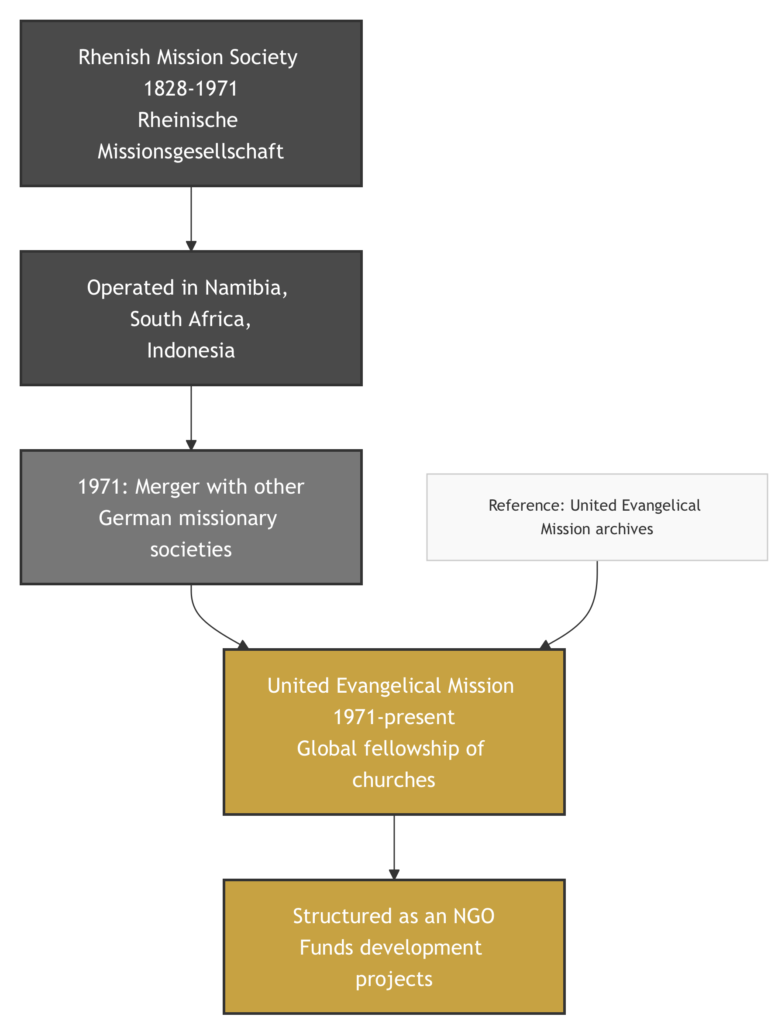
The Paris Evangelical Missionary Society (PMES, founded 1822) is now Défap, a French Protestant mission agency that funds development projects in Africa (Défap, n.d.). The Rhenish Mission Society (1828) is now the United Evangelical Mission, a global fellowship of churches that describes itself as a “development cooperation” organisation (UEM, n.d.). The Danish Mission Society (1821) is now Danmission, which runs development programmes in Tanzania, Nepal, and the Middle East (Danmission, n.d.). The Leipzig Mission (1836) is now part of EMS (Evangelisches Missionswerk), a German development agency (EMS, n.d.). The Methodists, the Baptists, the Presbyterians, the Lutherans—all built schools. All taught sewing. All now run NGOs.
The significance of these institutional transformations is not theological but organisational. In several cases, contemporary development agencies are not merely inspired by historical missionary organisations; they are their direct descendants. The question therefore becomes whether institutional missions changed only in language, or whether they also changed in their underlying relationship to power, governance, and economic control.
Diagram 2: Missionary to NGO Transition (Decision Path Diagram)
The framework was always economic. The plantation needed enslaved labour. The missionary school needed trained labour for the colonial administration. The NGO needs donor funding to survive. The artisan is the raw material in each phase. The institution captures the value. The worker remains at the bottom.
The language changed. The Paris Evangelical Missionary Society spoke of “spreading the Gospel.” Défap speaks of “development cooperation.” The Rhenish Mission spoke of “saving souls.” UEM speaks of “capacity building.” The Danish Mission spoke of “civilising the heathen.” Danmission speaks of “empowerment.” The words are new. The structure is the same.
The NGO Economy
The modern NGO is often presented as a temporary institution designed to address a specific social or economic challenge. Yet throughout Africa, NGOs have become permanent actors within local economies. They employ staff, manage grants, commission research, influence policy, broker market access, organise production, and shape development priorities.
This has produced what may be described as an NGO economy: an ecosystem sustained through the continuous circulation of donor funding, development projects, beneficiaries, consultants, auditors, programme officers, monitoring specialists, and international partners.
The issue is not whether NGOs perform useful work. Many undoubtedly do. The question is whether institutional incentives favour the production of independent owners or the continuous reproduction of beneficiaries.
A successful textile entrepreneur eventually ceases to require an empowerment programme. A cooperative that controls its own production, branding, intellectual property, and export relationships eventually ceases to require an intermediary. Yet development success is often measured by the number of beneficiaries reached rather than the number of beneficiaries who cease to be beneficiaries altogether.
The distinction matters. Beneficiary-centred systems reproduce participation. Ownership-centred systems reproduce power.
The framework was always economic. The plantation needed enslaved labour. The missionary school needed trained labour for the colonial administration. The NGO needs donor funding to survive. The artisan is the raw material in each phase. The institution captures the value. The worker remains at the bottom.
The Persistence of External Control
Across multiple historical periods, decision-making authority frequently remained external to the communities whose labour sustained the system. Under plantation slavery, ownership and capital accumulation were concentrated in Europe. Under colonial administration, policy and economic planning remained external. Under many contemporary development programmes, strategic authority often remains concentrated among donors, boards, international agencies, certification bodies, and programme managers located outside the communities being served.
Table
System
Labour
Decision Making
Ownership
Value Capture
Plantation
Africans
Europe
Europe
Europe
Mission School
Africans
Mission Board
Mission Board
Mission Institution
Colonial Economy
Africans
Colonial State
Colonial State
Metropole
NGO Programme
Africans
NGO/Donor Network
NGO/Board
Mixed
Cooperative
Members
Members
Members
Secular NGOs: New Institutions, Familiar Questions
Not all organisations working in African textiles follow the extractive model. Some are cooperatives. Some are artisan-owned. The distinction matters.
Espace Tissage Djougou (ETD) in Benin is a women-led weaving cooperative. It preserves the lokpa openwork fabric tradition. It is a partner in the EU-OACPS Business-Friendly Programme. The cooperative has 508 beneficiaries working through 18 cooperatives and 14 fashion brands. The stated mission is to preserve ancestral know-how and empower rural girls. The structure is a cooperative. The artisans are members, not employees. This is a different model. The value is shared.
Most NGOs, however, do not operate this way.
The ITC Ethical Fashion Initiative is a programme of the United Nations and the World Trade Organization. It operates in Burkina Faso, Mali, Benin, Kenya, and Zambia. It connects artisans to international fashion brands including Stella Jean and Vivienne Westwood. The language is “ethical fashion,” “sustainability,” “market access.” The artisans are members of cooperatives. The governance is not in their hands. The UN agency controls the buyer relationships, the quality standards, and the brand.
Maisha by Nisria in Nakuru, Kenya, trains vulnerable women, single mothers, refugees, and persons with disabilities in sewing and fashion design. The language is “empowerment,” “conscious engagement,” “sustainability.” The organisation is a registered non-profit. The women are trainees. The decisions about funding, programming, and branding are made by the non-profit’s leadership, not by the women.
Unkara Fashion is a US-registered 501(c)(3) non-profit operating in Kenya. It trains women fashion designers in underprivileged communities and promotes indigenous textile culture including batik dyeing techniques. The language is “financial inclusion,” “sustainable income,” “indigenous textile culture.” The organisation has a US board of directors. The women are trainees. The intellectual property of the training materials and the brand belong to the US non-profit.
WEL NGO (Women Entrepreneurs & Leaders) in Côte d’Ivoire trains low-income and vulnerable women in sewing and handmade goods. The language is “economic empowerment,” “African culture,” “income generating activities.” The organisation is an NGO partnered with Koné Consulting. The women are beneficiaries. They do not control the organisation.
These NGOs are not descended from missionaries. They are new. These organisations differ in history, mission, and intent. The relevant question is not whether they are exploitative, but whether beneficiaries exercise meaningful ownership over governance, intellectual property, buyer relationships, and long-term capital accumulation. The answer varies by institution and deserves closer examination.
The beneficiaries are not owners. The decision-makers are not local. The NGO captures the brand, the donor relationships, and the market access. The artisan receives training and wages. The value leaves. The pyramid remains.
The Cooperative Alternative
The cooperative model in Benin shows a different path. Artisan ownership. Shared governance. Value retained locally. The difference is not the product. The difference is who controls the organisation.
The significance of the Benin case is not that it is perfect. Its significance is that it shifts the position of the artisan from beneficiary to member. The distinction is fundamental. Beneficiaries receive programmes. Members exercise governance. Beneficiaries participate in projects. Members participate in ownership.
The religious language is gone. “Saving souls” became “empowerment.” “Civilising mission” became “capacity building.” “Conversion” became “financial inclusion.” The words are new. The extractive structure remains.
Beneficiaries Without Ownership
How many beneficiaries became exporters? How many became factory owners? How many became brand owners? How many became machinery manufacturers? How many became employers?
Across the development sector, success is often measured through outputs: workshops conducted, trainees reached, women empowered, livelihoods supported. Far less attention is paid to ownership outcomes. Who controls the assets created? Who accumulates capital? Who acquires market power? Who determines future strategy?
How NGOs Use Labour
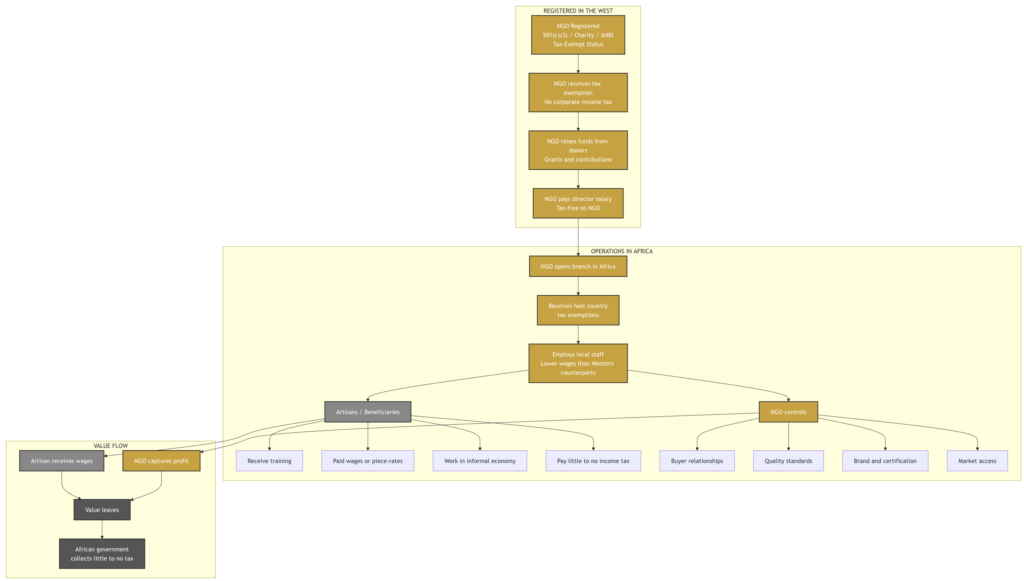
The NGO registers in a Western country. In the United States, it files for 501(c)(3) status, becoming exempt from federal corporate income tax (IRS, n.d.). In the United Kingdom, it registers as a charity, exempt from corporation tax (UK Government, n.d.). In the Netherlands, it registers as an ANBI, exempt from corporate tax and in some cases VAT (Dutch Tax Administration, n.d.). In Switzerland, it registers at the cantonal level, exempt from federal, cantonal, and municipal taxes (Swiss Federal Tax Administration, n.d.).
The NGO then opens a branch in an African country. It receives tax exemptions from the host government. It pays little to no corporate tax on its local activities. It employs local staff, often at lower wages than Western staff. It trains artisans. It organises production. It exports finished goods.
Diagram 3: NGO Value Pyramid (Decision Path Diagram)
[Place diagram here showing NGO at top, intermediaries in middle, artisans at bottom.]
The artisans are paid wages or piece-rates. They work in the informal economy. They pay little to no income tax. Their labour is the raw material of the NGO’s programmes. Their faces appear in annual reports. Their names are rarely listed. Their designs are not protected. Their knowledge is not owned by them.
The NGO sells the handicrafts through fair trade catalogues, online shops, and ethical fashion platforms. In the United States, if the sales are considered a regular commercial activity, Unrelated Business Income Tax (UBIT) applies at 21 percent (IRS, n.d.). But many NGOs avoid UBIT by arguing that the sales are “substantially related” to their charitable mission.
The NGO director receives a salary from the tax-free revenue. The salary is paid from the profits of the artisans’ labour. The director pays personal income tax. The NGO pays nothing. The artisan receives wages. The African government collects nothing. The Western government collects little to nothing. The value leaves.
The local market model works differently. Artisans sell directly to tourists and local consumers (University of Nairobi, 2010). There is no NGO intermediary. There is no fair trade certification. There is no tax exemption. The artisan keeps the majority of the sale price. She pays market fees. The local government collects revenue. The value stays.
The NGO model is not designed for the artisan. It is designed for the NGO. The pyramid is upside down. The largest piece goes to the top. The smallest piece goes to the bottom.
The framework did not end. It rebranded. The names changed. The pyramid did not.
But the cooperative in Benin shows that it could be different.
The thread has not been broken.
References
Basel Mission Archives / mission 21. “Nähschule in Kyebi (Sewing class in Kyebi).” Reference: D-30.13.039. Available at: https://bmarchives.org/items/show/56603 Basel Mission Archives / mission 21. “Nähschule in Akropong 1904 (Sewing school in Akropong 1904).” Reference: QD-30.106.0153. Available at: https://bmarchives.org/items/show/71875 Caley, Maria A. N. “The Modernized Traditional Dress of the Aawambo.” University of Turku. Coutau-Bégarie Auction House. “Three entre-deux and one carré in Chebka lace, North Africa, late 19th/early 20th century.” Lot 129. Available at: https://coutaubegarie.com/en/lot/157092/26525906 Danmission. “About Danmission.” Available at: https://danmission.dk Défap. “Service Protestant de Mission.” Available at: https://defap.fr Dutch Tax Administration. “ANBI - Public Benefit Organisations.” Available at: https://www.belastingdienst.nl/anbi EMS (Evangelisches Missionswerk). “About EMS.” Available at: https://www.ems-online.org Espace Tissage Djougou (ETD). “Preserving lokpa openwork fabric tradition.” EU-OACPS Business-Friendly Programme. Available at: https://www.businessfriendly.org/etd-benin Fulham Palace. “Church of England’s plantations in Barbados.” 13 March 2023. Available at: https://www.fulhampalace.org/resistance/church-of-england-plantations/ IRS. “Exemption Requirements - Section 501(c)(3) Organizations.” Available at: https://www.irs.gov/charities-non-profits/charitable-organizations/exemption-requirements-section-501c3-organizations IRS. “Unrelated Business Income Tax.” Available at: https://www.irs.gov/charities-non-profits/unrelated-business-income-tax ITC Ethical Fashion Initiative. “CABES Burkina Faso.” Available at: https://ethicalfashioninitiative.org Kinghorn, Alice. “The Church of England and the West India Interest.” PhD thesis, University of Bristol, 2019. Maisha by Nisria. Available at: https://maishabynisria.org McLean-Farrell, Janice, and Michael Anderson Clarke. “Missions in Contested Places/Spaces: The SPG, Slavery, and Codrington College, Barbados.” Mission Studies, 2021. Mission 21. Available at: https://mission-21.org Monk, Matthew, and Linda Eaton. “A Sampler’s Story from Sierra Leone.” Winterthur Museum, 5 September 2025. Available at: https://www.winterthur.org/blog/a-samplers-story-from-sierra-leone Porte Brown. “Watch for UBIT When Your Nonprofit Pursues New Activities.” 2025. Strickrodt, Silke. “African Girls’ Samplers from Mission Schools in Sierra Leone (1820s to 1840s).” History in Africa, 2010;37:189-245. Swiss Federal Tax Administration. “Taxation of Non-Profit Organisations.” Available at: https://www.estv.admin.ch TRC Leiden. “Embroidery and the White Sisters.” 29 June 2015. Available at: https://trc-leiden.nl/trc-needles/regional-traditions/middle-east-and-north-africa/pre-modern-middle-east-and-north-africa/embroidery-and-the-white-sisters UK Government. “Charities and tax.” Available at: https://www.gov.uk/charities-and-tax United Evangelical Mission (UEM). “About UEM.” Available at: https://uem-partnership.org University College London. “Legacies of British Slavery: Clapham Sect.” Available at: https://www.ucl.ac.uk/lbs/ University of Nairobi. “Access to E-Commerce in the Ethical trade Arena: A Case study of Artisans in Kenya.” 2010. Available at: https://erepository.uonbi.ac.ke Unkara Fashion. Available at: https://unkarafashion.org USPG (United Society Partners in the Gospel). “About USPG.” Available at: https://uspg.org.uk WEL NGO African Arts Creation. Available at: https://wel-ngo.org Winterthur Museum, Garden & Library. “Sampler by Lucy Davis.” Object number 2018.0007. Available at: http://museumcollection.winterthur.org/single-record.php?recid=2018.0007
Image Sources
Basel Mission Archives. “Nähschule in Kyebi (Ghana).” https://bmarchives.org/items/show/56603 Basel Mission Archives. “Nähschule in Akropong (Ghana).” https://bmarchives.org/items/show/71875 TRC Leiden. “White Sisters teaching lace making.” https://trc-leiden.nl/trc-needles Coutau-Bégarie Auction House. Chebka lace collection. https://coutaubegarie.com Winterthur Museum. Sampler by Lucy Davis. http://museumcollection.winterthur.org/single-record.php?recid=2018.0007 International Mission Photography Archive (USC). Mission sewing archives. https://digitallibrary.usc.edu Yale Divinity Library. Raphia weaving missions archive. https://collections.library.yale.edu Mennonite Archives. Sewing class Zaire. https://archives.mennonite.net United Church of Canada Archives. Sewing school Japan. https://archives.unitedchurch.ca
Additional Academic References
Political Economy, Dependency and Colonial Continuity
Rodney, Walter. How Europe Underdeveloped Africa. Dar es Salaam: Tanzania Publishing House, 1972.
Nkrumah, Kwame. Neo-Colonialism: The Last Stage of Imperialism. London: Thomas Nelson & Sons, 1965.
Amin, Samir. Unequal Development: An Essay on the Social Formations of Peripheral Capitalism. New York: Monthly Review Press, 1976.
Amin, Samir. Accumulation on a World Scale: A Critique of the Theory of Underdevelopment. New York: Monthly Review Press, 1974.
Beckford, George L. Persistent Poverty: Underdevelopment in Plantation Economies of the Third World. New York: Oxford University Press, 1972.
Best, Lloyd. Essays on the Theory of Plantation Economy. Mona: Institute of Social and Economic Research, University of the West Indies.
Girvan, Norman. The Caribbean Dependency Tradition: From New World Group to the Present. Kingston: Ian Randle Publishers.
Beckles, Hilary. Britain’s Black Debt: Reparations for Caribbean Slavery and Native Genocide. Kingston: University of the West Indies Press, 2013.
NGO Critique and Development Studies
Manji, Firoze and Carl O’Coill. “The Missionary Position: NGOs and Development in Africa.” International Affairs 78, no. 3 (2002): 567–583.
Escobar, Arturo. Encountering Development: The Making and Unmaking of the Third World. Princeton: Princeton University Press, 1995.
Ferguson, James. The Anti-Politics Machine: Development, Depoliticization and Bureaucratic Power in Lesotho. Minneapolis: University of Minnesota Press, 1990.
Fowler, Alan. Striking a Balance: A Guide to Enhancing the Effectiveness of Non-Governmental Organisations in International Development. London: Earthscan, 1997.
That is the estimated retail value of Sub-Saharan Africa's wax print market. Billions spent every year on fabric worn by millions of Africans. Fabric that, for nearly two centuries, has been manufactured in Europe—not on the continent where it is sold and worn.
Vlisco has been selling to Africa since 1846. Almost 180 years. Their profits come almost exclusively from African consumers. The company's former British owner, Actis, had no connection to the continent except through the money Africans spent on their products.
In 2020, a $190 million financing facility was secured from Afreximbank to acquire Vlisco. The total bid was approximately $200 million. The African Continental Free Trade Area (AfCFTA) publicly supported the bid. Its Secretary General, Wamkele Mene, stated: "We cannot express a value judgement as to the reasons for the bid of Made in Africa – which was the higher bid – being rejected. We do however firmly believe that where an African company puts forward a formidable bid for a foreign company that appears to profit exclusively from sales to Africa, supported by a leading African trade finance bank, the African company has a reasonable expectation to successfully conclude the transaction in favour of Africa" .
The bid was rejected. The higher bid. Rejected.
In 2023, Vlisco was sold to Parcom, a Dutch private equity firm.
Why does this matter for Africa's economic future?
Because the same pattern repeats across the continent. Africa produces cotton. Africa exports raw materials. Africa imports finished goods. Today, 90 percent of Africa's cotton is exported raw. The continent imports over $23 billion in textiles, apparel, and footwear annually .
Think about that. We grow the cotton. We send it away. We buy back the clothes. We lose the jobs, the factories, the skills, the wealth.
The textile industry could be Africa's path to create more industries. It employs thousands. It creates value at every stage: ginning, spinning, weaving, dyeing, cutting, sewing, retail. The International Trade Centre estimates that if African countries fully developed their textile value chains, the continent could export €5.8 billion in cotton garments by 2026—and nearly 15% of that could be destined for African markets alone. Two-thirds of intra-regional export potential is still untapped. The industry could generate 5.8 million jobs across the continent .
Therefore we need to own the companies that serve our markets. Look at how Dangote Refinery is servicing the African market in times of oil scarcity around the world. Despite facing technical and political challenges—including difficulty securing local crude and competition from dumped foreign fuel—the 650,000 barrel-per-day refinery now produces some 550,000 barrels of refined products daily. Nigeria's fuel imports fell from 500,000 barrels per day in early 2023 to 88,000 barrels per day in early 2025 . That is what African ownership can do.
The Vlisco bid was not just about one company. It was about a vision.
The AfCFTA's objective is to accelerate industrialization in Africa, consolidate an integrated market of 1.3 billion people with a combined GDP of $3.4 trillion, and place Africa on a path to global competitiveness . At the heart of that vision is the textiles and clothing sector.
When a company that profits exclusively from Africa rejects African ownership—despite a higher bid, despite Afreximbank backing, despite AfCFTA support—that is not just a business decision. It is a statement.
And the statement is: we want your money, but not you.
The question is not whether we have the resources. We do. The question is whether we will keep playing a game where the rules are written against us—and where our own capital is rejected.
The AfCFTA cannot compel a private sale. But it can shape policy. It can reduce non-tariff barriers that cost the continent an estimated $20 billion in annual GDP growth . It can help build regional value chains that keep cotton in Africa and turn it into cloth, garments, and wealth.
Will African governments act? Will they prioritize local textile production? Will they create the conditions where African capital can buy African markets?
Some African nations are making the moves for our futures:
Mali is building its textile industry. The government, through the state-owned Compagnie malienne pour le développement des textiles (CMDT), is targeting over 650,000 tonnes of seed cotton for the 2026–2027 season—a more than 50% increase from current estimates. The West African Development Bank has committed significant resources to support Mali's cotton sector and local processing . This is not foreign-owned. This is Mali building for Mali.
Benin stopped exporting raw cotton. The country banned raw cotton exports to force local value addition. Through the Glo-Djigbé Industrial Zone (GDIZ), Benin is now manufacturing its own apparel—creating jobs, building skills, keeping wealth. The managing director of GDIZ stated: "We have decided that in this country, we are no longer going to sell this cotton raw. We are going to transform this cotton, in particular by installing integrated textile factories" . Benin is not waiting. Benin is doing.
Ethiopia is not waiting either. The country has 13 industrial parks with more than 177 manufacturing sheds, supporting over 100,000 jobs. New investments keep coming: a $200 million agreement with UK-based Intrade Co., a Chinese textile manufacturer setting up in Dire Dawa Industrial Park, an Italian textile giant exporting from Kombolcha Industrial Park . Kenya just opened the Vipingo Special Economic Zone—a $3 billion textiles and apparel hub with $800 million in financing from KCB Group and Afreximbank. Botswana launched "Made in BW" to revive local production. Ghana's garment sector is targeting $2 billion and 150,000 jobs by 2033.
The continent is moving.
Vlisco still sells to us. Wax prints still dominate. The profits still leave.
How do we move Africans to buy differently?
Not out of charity. Out of strategy. Out of self-interest.
Right now, 90% of Africa's cotton is exported raw. The continent imports over $23 billion in textiles, apparel, and footwear annually. We grow it. We send it away. We buy it back. We lose the jobs, the factories, the skills, the wealth.
If Africa fully developed its textile and apparel industry, processing cotton locally instead of exporting it raw, the sector could generate up to 5.8 million jobs. But only if we process the cotton here. Only if we manufacture the fabric here. Only if we buy from each other .
The Vlisco bid was not just about one company. It was about a vision.
The vision that African capital can own African markets. That African cotton can become African cloth. That African consumers can choose African manufacturers.
The bid failed. But the vision cannot.
Africa's textile industry is at a crossroads. We can continue to export raw cotton and import finished clothes. We can continue to let European and Asian companies profit from our markets while we collect the crumbs.
Or we can build.
References
African Law & Business. "Vlisco rejects USD 200 million acquisition offer." August 2021. Available at: https://www.africanlawbusiness.com/news/16948-vlisco-rejects-usd-200-million-acquisition-offer/
African News Agency. "Economie : la Zlecaf soutient Made in Africa pour le rachat de Vlisco." July 2021. Available at: https://africannewsagency.com/economie-la-zlecaf-soutient-made-in-africa-pour-le-rachat-de-vlisco/
University of Electronic Science and Technology of China West African Research Center. "Cotton exporter Benin developing home-grown textile industry." February 2025. Available at: https://cwas.uestc.edu.cn/info/1042/3464.htm
International Trade Centre (ITC). "How to invest in a viable textile and cotton value chain in Africa." April 2025. Available at: https://www.intracen.org/news-and-events/news/how-to-invest-in-a-viable-textile-and-cotton-value-chain-in-africa
S&P Global Commodity Insights. "Technical, political challenges thwarting African refining: Dangote." July 2025. Available at: https://www.spglobal.com/commodity-insights/en/news-research/latest-news/refined-products/072225-technical-political-challenges-thwarting-african-refining-dangote
African Center for Economic Transformation (ACET). "Reducing Non-Tariff Barriers to AfCFTA Implementation in the Cotton, Textiles, and Apparel Industry." August 2025. Available at: https://acetforafrica.org/research-and-analysis/reports-studies/reports/reducing-non-tariff-barriers-to-afcfta-implementation-in-the-cotton-textiles-and-apparel-industry/
Ecofin Agency. "Mali Increases Farm Spending to $289 Million With Focus on Cotton and Food." April 2026. Available at: https://www.ecofinagency.com/news-agriculture/0604-54437-mali-increases-farm-spending-to-289-million-with-focus-on-cotton-and-food
Overseas Recruitment Network. "东方工业园招聘信息" [Eastern Industrial Zone Recruitment Information]. 2025. Available at: https://www.hwzpw.com/job/27096.html
24 Heures au Bénin. "Voici pourquoi l'Etat autorise à nouveau l'exportation des produits vivriers." July 2025. Available at: https://24haubenin.info/?Voici-pourquoi-l-Etat-autorise-a-nouveau-l-exportation-des-produits-vivriers