Part 3: Material Culture, Craft, and Textile Economies: The Politics of the Loom: Material Sovereignty and the Circular Economies of the Diaspora

Having established the theoretical foundations of design sovereignty in Part 1 and spatial justice in Part 2, Part 3 pivots from physical architecture to tactile design, material culture, and textile economies. Material sovereignty asserts that raw fiber ecosystems, heritage processing methods, and artisanal repair engineering are not static artifacts, but sophisticated, high-margin intellectual property.
For centuries, continental textile traditions were reduced by colonial trade arrangements to unrefined agricultural commodities. Reclaiming industrial advantage across African and Caribbean corridors requires transforming these material archives into autonomous, sustainable luxury frameworks and high-value sovereign production networks.

1. Textile Heritage as High-Level Luxury and Intellectual Property

As fashion theorist Ken Kweku Nimo establishes, African textile systems were historically stripped of their intellectual property rights and framed as mere folklore or raw material inputs for foreign mills. In reality, traditions such as Kente, Aṣọ-Òkè, Bògòlanfini, and Ndop represent sophisticated luxury frameworks grounded in rigorous material science, complex geometric algorithms, and elite craftsmanship. Continental industrialization must reassert these textiles as proprietary, high-value visual IP.

2. Slow Design, Indigo Archives, and Material Epistemologies

Dr. Folayemi Foster’s work on West African textile archives highlights the philosophy of slow design and indigo vatting as advanced biochemical and spatial knowledge systems. West African indigo dyeing across the Senegambian basin and Nigeria connects botanical cultivation, fermentation chemistry, and structural resist-dyeing into an integrated archive of resilience. Scaling organic indigo vatting over synthetic petroleum dyes creates an unassailable luxury standard that commands premium global pricing while eliminating toxic environmental run-off.

3. Esthétique de la Récupération: Engineering Street-Level Circularity

Design scholar Kouassi Akpetou introduces the esthétique de la récupération, evaluating informal street-level repair, material upcycling, and artisanal reconstruction as high-level industrial engineering. Rather than viewing informal repair networks as signs of poverty, Akpetou demonstrates that these circular practices form an advanced blueprint for modern zero-waste manufacturing, post-consumer textile management, and decentralized material regeneration.

4. Transatlantic Material Resistance and Diaspora Craft Agency

Material culture across the African diaspora functions as a continuous archive of survival and political resistance. As scholars Malene Barnett, Charmaine Nelson, and Manuel Zapata Olivella articulate, transatlantic craft practices across the Caribbean and Americas carried embedded spatial memory, ancestral technical codes, and economic agency. From plantation-era textile workarounds to contemporary ceramic and woven forms, craft has consistently operated as political self-determination.

Master Bibliography (Curated Project Sources)

  • Akpetou, K. (2021). L'esthétique de la récupération: Design, recyclage et économie informelle en Afrique de l'Ouest. Éditions de l'Harmattan.
  • Barnett, M. (2024). Crafted Kinship: Ancestral Memory in Caribbean Craft. Artisan Books.
  • Bennett, A. G. (2012). Interactive Aesthetics: Digital Design and Culture. Palgrave Macmillan.
  • Business & Human Rights Resource Centre. (2026). Garment workers protest demanding Tk 30,000 minimum wage increase.
  • Dhaka Tribune. (2026). Fresh wage protests erupt in Gazipur, police disperse workers.
  • Djibril, A., et al. (2022). Manifeste pour un Design Contextuel Africain. Éditions l'Harmattan.
  • Eglash, R., & Bennett, A. G. (2014). African Fractals: Computing and Culture. Rutgers University Press.
  • Eshun, E. (2021). In the Black Fantastic. Hayward Publishing.
  • Foster, F. (2023). Indigo Geographies: West African Textile Archives and Slow Design Philosophies. Journal of Material Culture, 28(2), 145–168.
  • Gonzalez, L. (1988). A categoria político-cultural de amefricanidade. Tempo Brasileiro, 92/93, 69–82.
  • Johnson, C. (1982). Grassroots Organizing: Women in Anti-Colonial Protests in Nigeria. African Studies Review, 25(2/3), 137–157.
  • Kamara, M. (2022). Vernacular Tectonics and Earth Architecture in the Sahel. Architectural Review, 1489, 72–79.
  • Lokko, L. (Ed.). (2023). The Laboratory of the Future: Biennale Architettura 2023 Exhibition Catalogue. La Biennale di Venezia.
  • Marona, F. (2021). Habitação Evolutiva e apropriação do solo urbano em Luanda. Luanda Architectural Press.
  • Mba, N. E. (1982). Nigerian Women Mobilized: Women's Political Activity in Southern Nigeria, 1900-1965. University of California Press.
  • Nascimento, B. (1989). O Quilombo do Palmares: A Modernidade do Quilombo. Revista de História das Ideias.
  • Nelson, C. (2022). The Visual Life of Legitimate/Illegitimate Slavery: Material Culture of the Transatlantic Plantation. Duke University Press.
  • Nimo, K. K. (2022). Africa in Fashion: Luxury, Craft and Textile Heritage. Laurence King Publishing.
  • Ofosu-Asare, Y. (2024). Decolonising Design in Africa: Towards New Theories, Methods, and Practices. Routledge.
  • Okwumabua, N. (2020). Afrocentric Architecture: Reclaiming Indigenous Spatial Languages. CPDI Africa Global Monograph.
  • Ortiz, F. (1940). Contrapunteo cubano del tabaco y el azúcar. Editorial de Ciencias Sociales.
  • Osayimwese, I. (2017). Colonialism and Modern Architecture in West Africa. Yale University Press.
  • Shah, A. (2026). Bangladesh textile workers strike: Wage crisis, India's edge explained. The Indian Express.
  • The Voice News. (2026). 469 Garment Factories Shut Amid Wage Protests as Tarique Rahman Intervenes.
  • WION News. (2026). Bangladesh garment workers defy wage board call, demand 30,000 taka minimum pay.
  • Wilson, M. O. (2021). Black Bodies / White Spaces: Architecture and the Making of Modern America. University of Chicago Press.
  • Yorùbá Aesthetics & Material Culture Series. (2018). Ọ̀nà: The Philosophy of Form and Character in West African Craft. African Arts Journal, 51(3).
  • Zapata Olivella, M. (1989). Las Claves Mágicas de América: Raza, Mitos y Cultura. Plaza & Janés.

Part 1: Foundations & Epistemologies: Beyond the Eurocentric Canon: Toward an Autonomous African Design Philosophy

The Industrial Crisis of the Fast-Fashion Model

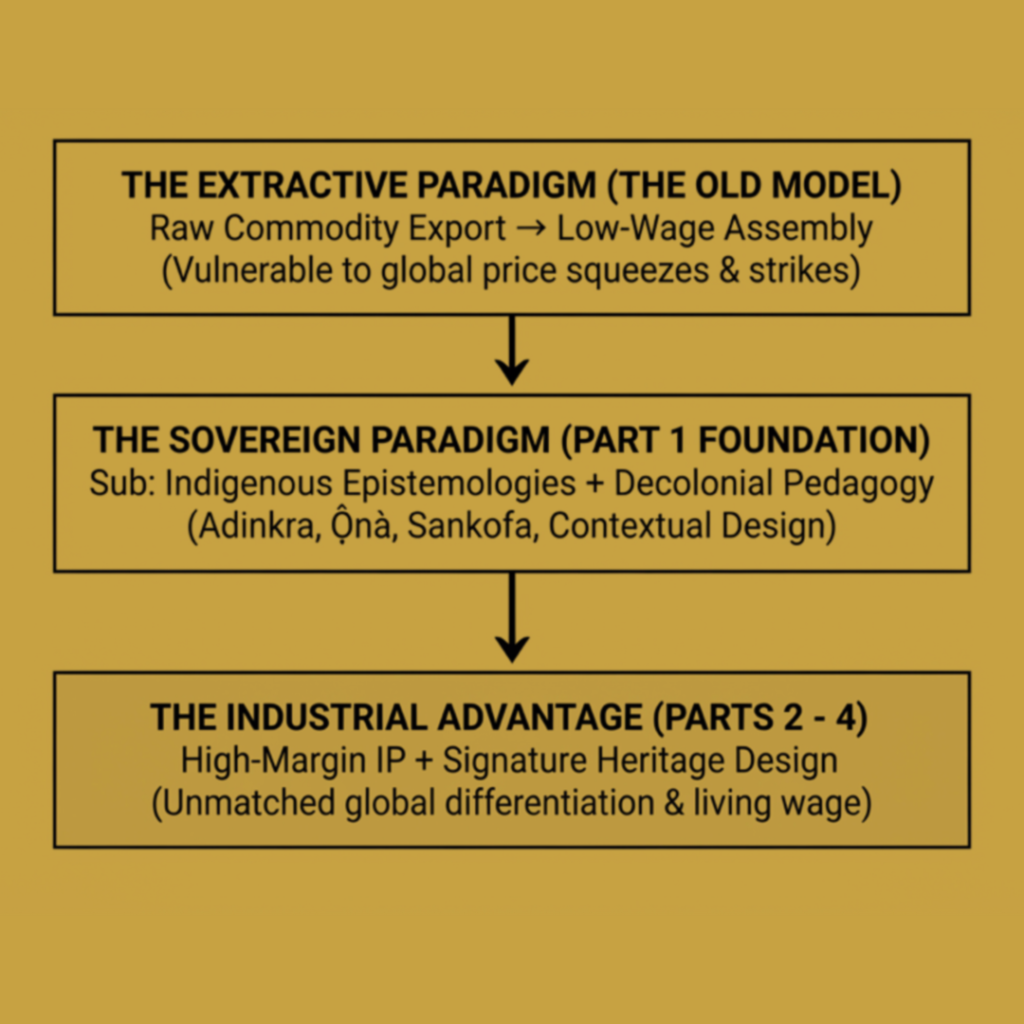
In our foundational analysis of the Global South’s garment crisis, specifically the structural unraveling across South Asian Ready-Made Garment (RMG) hubs, established a stark economic reality: industrialization built on bottom-dollar labor and raw commodity extraction is a dead end (Shah, 2026). Competing in a race to the bottom by offering cheap factory labor to global fast-fashion conglomerates exposes domestic economies to severe purchasing-power erosion, supply chain friction, and inevitable industrial stoppage (Business & Human Rights Resource Centre, 2026).
To break out of the raw extraction loop, where African cotton is exported for pennies, processed abroad, and re-imported as high-markup finished goods, the continent must pivot from low-margin assembly to high-margin design sovereignty.
African textile competitiveness cannot rely on undercutting global minimum wages; it must rely on signature, innovative design theories, heritage methodologies, and material culture. By marrying end-to-end industrial value retention with sovereign intellectual property, Africa establishes an unassailable competitive advantage in the global market.

1. The Epistemological Bottleneck: Why "Modern Design" Is Not Universal

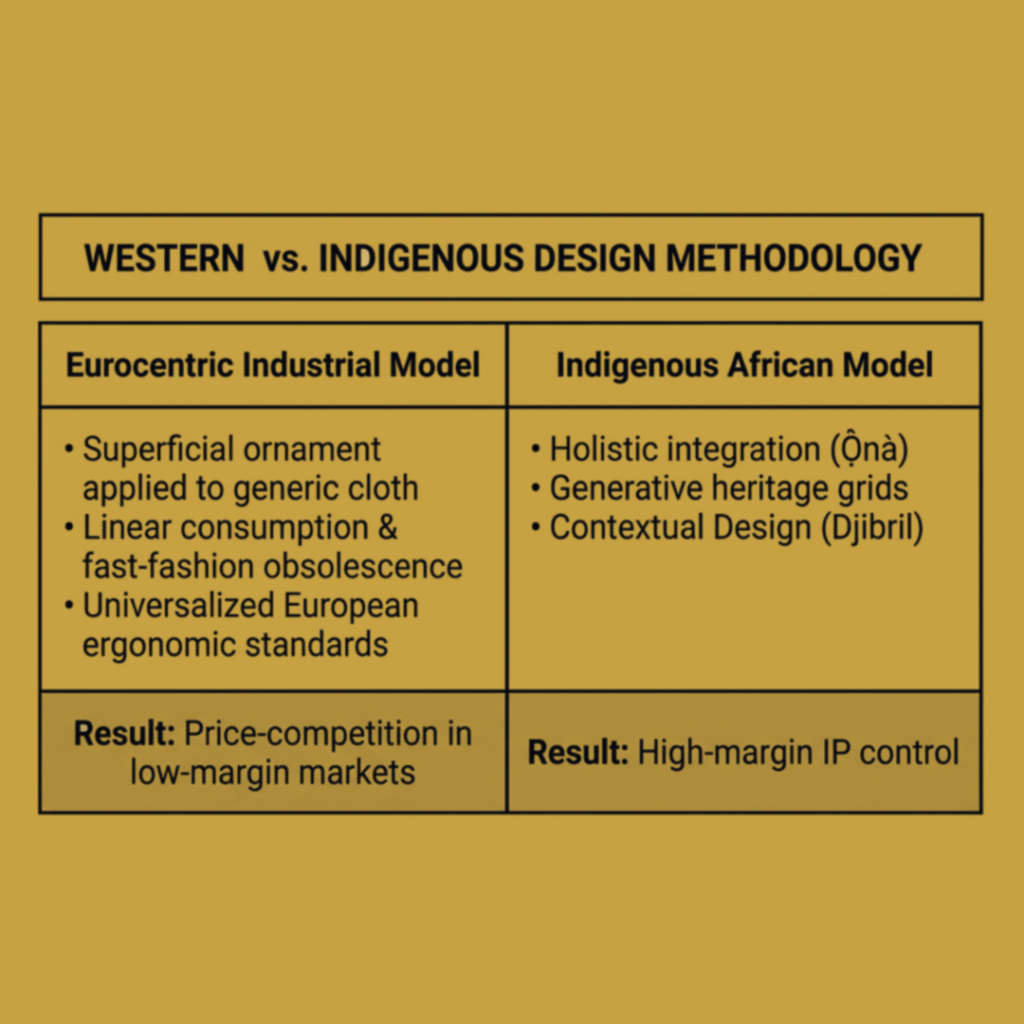
For over a century, global industrial design has operated under the illusion that Western aesthetics, European industrial standards, and Bauhaus functionalism constitute a universal canon. Within this Eurocentric paradigm, African material creation has been systematically misclassified: stripped of its underlying intellectual frameworks and reduced to mere "craft," "folklore," or "exotic motif" to be sampled by Western fashion houses.
Decolonial design theorists challenge this fundamental mischaracterization. As Ghanaian scholar Yaw Ofosu-Asare demonstrates, African design is not a derivative of Western aesthetics, nor is it a passive tradition waiting to be modernized (Ofosu-Asare, 2024). It is a sovereign, mathematically rigorous knowledge system possessing its own pedagogy, logic, and functional philosophies.
When an emerging African textile corridor adopts European design pedagogy wholesale, it inherits a structural weakness: it formats its designers to produce generic, Western-oriented garments that compete directly with hyper-standardized, low-cost Asian factories. Decolonizing design education is therefore not a symbolic academic exercise, it is a critical industrial strategy.

2. Indigenous Design Methodologies: Ọ̀nà, Sankofa, and Contextual Design

To build a distinct global advantage, African textile hubs must anchor their production in indigenous design methodologies that integrate form, purpose, and community ethics.

A. The Yorùbá Philosophy of Ọ̀nà and Ìwà

In Yorùbá design theory, Ọ̀nà represents the purposeful application of form, pattern, and technique (Yorùbá Aesthetics & Material Culture Series, 2018). However, Ọ̀nà cannot exist in isolation; it is intrinsically tied to Ìwà (character, essential nature, or moral balance).

  • The Industrial Application: Under Western industrialism, design is often treated as superficial ornament applied to a mass-produced substrate. In Ọ̀nà methodology, the textile structure, dye, pattern, and intended social utility form an indivisible whole. Designing with Ọ̀nà ensures that garments carry intrinsic cultural narrative and structural integrity, shifting the product from disposable fast fashion to high-value investment attire.

B. Sankofa as a Generative Design Grid

The Akan concept of Sankofa ("it is not taboo to fetch that which is at risk of being left behind") is frequently cited, yet its methodological mechanics remain underutilized in industrial design.

  • The Industrial Application: Sankofa is a forward-looking generative grid. Scholars like Audrey G. Bennett demonstrate how traditional African interlace patterns, Adinkra geometric symbols, and fractal textile layouts operate as complex computational design systems (Bennett, 2012; Eglash & Bennett, 2014). Rather than copying historical garments, Sankofa methodology uses indigenous algorithmic patterns as a foundation for digital textile printing, technical weaving, and modern pattern-making.

C. Design Contextuel (Contextual Design Pedagogy)

Promoted by figures such as Aziz Djibril and theorists at the Africa Design School in Cotonou, Benin, le design contextuel explicitly rejects imported industrial templates (Djibril et al., 2022).

  • The Industrial Application: Contextual design dictates that material selection, loom technology, and garment ergonomics must stem directly from local environmental conditions, regional body shapes, and community utility. Designing for the West African climate using locally spun long-staple cotton and indigo-dye techniques produces a functional product far superior to imported synthetic blends, creating immediate regional market dominance.

3. From Raw Commodity to Intellectual Property: The Economic Mechanics of Design Sovereignty

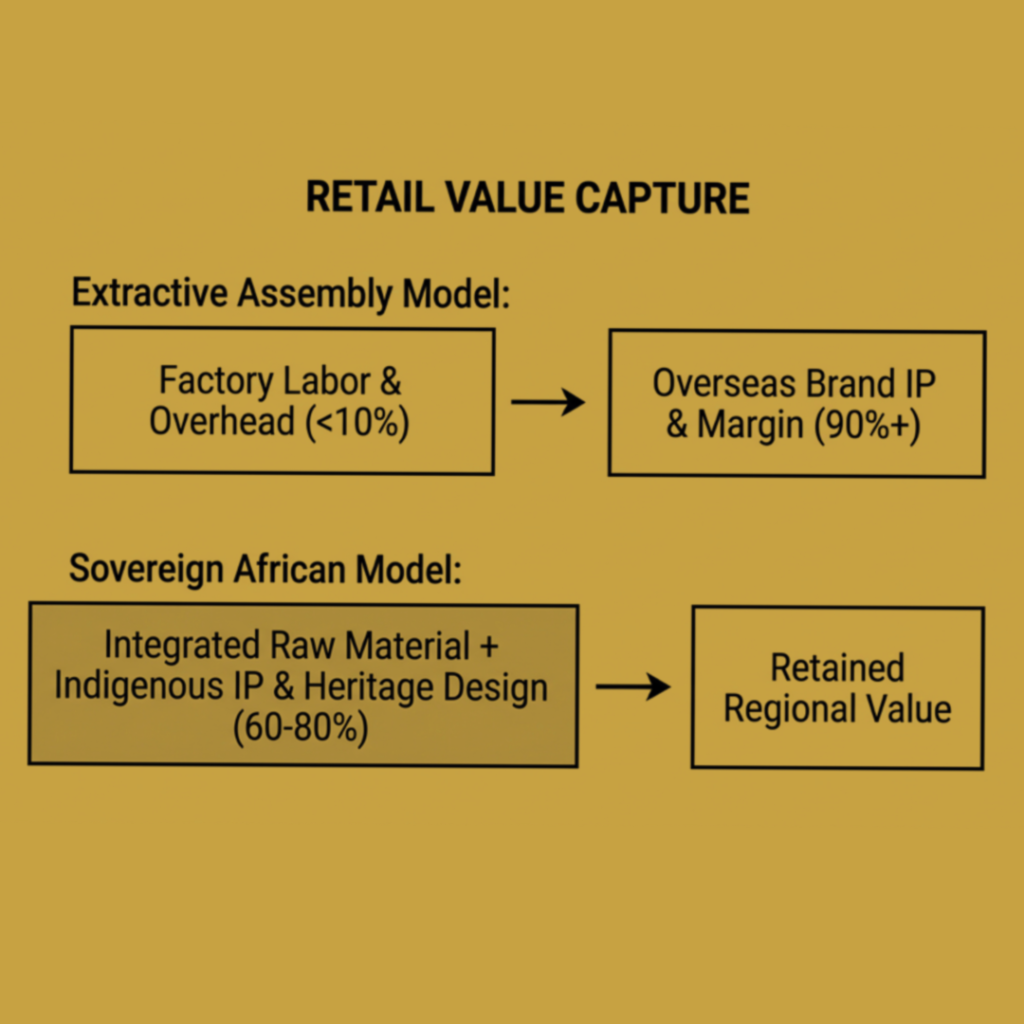
The core failure of the Asian RMG model analyzed in our report is its inability to capture value (Shah, 2026). When a factory in Gazipur or Ashulia sews a basic T-shirt for a Western buyer, the factory retains only a tiny fraction of the retail price, often leaving less than $1.00 per unit to split between energy, overhead, and worker wages (Dhaka Tribune, 2026). The remaining 90%+ of the value is captured by the brand that owns the design, marketing, and intellectual property (IP).

By founding African textile corridors on signature heritage methodologies, continental manufacturers flip this dynamic:

  1. Capturing the Design Margin: When African textile hubs export finished collections featuring proprietary weave patterns, natural dye formulations, and distinct cultural narratives, they operate as IP owners rather than contract sewers.
  2. Buffering Against Inflation: High-margin, design-led products absorb fluctuations in local energy costs and global shipping rates without forcing factory owners to depress labor wages.
  3. Establishing Living-Wage Viability: Industrial margins driven by design sovereignty create the economic headroom required to pay living wages (such as the 30,000 taka / $242 benchmark demanded by striking workers), cultivating a stable, highly skilled domestic workforce (WION News, 2026).

Comprehensive Master Bibliography (All Curated Series Scholars & Research Sources)

  • Barnett, M. (2024). Crafted Kinship. Artisan Books. (Featured in Part 3)
  • Bennett, A. G. (2012). Interactive Aesthetics: Digital Design and Culture. Palgrave Macmillan.
  • Business & Human Rights Resource Centre. (2026). Garment workers protest demanding Tk 30,000 minimum wage increase. Available at: https://www.business-humanrights.org
  • Dhaka Tribune. (2026). Fresh wage protests erupt in Gazipur, police disperse workers. Published November 8, 2026. Available at: https://www.dhakatribune.com
  • Djibril, A., et al. (2022). Manifeste pour un Design Contextuel Africain. Éditions l'Harmattan.
  • Eglash, R., & Bennett, A. G. (2014). African Fractals: Computing and Culture. Rutgers University Press.
  • Eshun, E. (2021). In the Black Fantastic. Hayward Publishing. (Featured in Part 4)
  • Foster, F. (2023). Indigo Geographies: West African Textile Archives and Slow Design Philosophies. Journal of Material Culture, 28(2), 145–168. (Featured in Part 3)
  • Gonzalez, L. (1988). A categoria político-cultural de amefricanidade. Tempo Brasileiro, 92/93, 69–82. (Featured in Part 4)
  • Johnson, C. (1982). Grassroots Organizing: Women in Anti-Colonial Protests in Nigeria. African Studies Review, 25(2/3), 137–157.
  • Kamara, M. (2022). Vernacular Tectonics and Earth Architecture in the Sahel. Architectural Review, 1489, 72–79. (Featured in Part 2)
  • Lokko, L. (Ed.). (2023). The Laboratory of the Future: Biennale Architettura 2023 Exhibition Catalogue. La Biennale di Venezia. (Featured in Part 2)
  • Marona, F. (2021). Habitação Evolutiva e apropriação do solo urbano em Luanda. Luanda Architectural Press. (Featured in Part 2)
  • Mba, N. E. (1982). Nigerian Women Mobilized: Women's Political Activity in Southern Nigeria, 1900-1965. Institute of International Studies, University of California, Berkeley.
  • Nascimento, B. (1989). O Quilombo do Palmares: A Modernidade do Quilombo. Revista de História das Ideias. (Featured in Part 2)
  • Nelson, C. (2022). The Visual Life of Legitimate/Illegitimate Slavery: Material Culture of the Transatlantic Plantation. Duke University Press. (Featured in Part 3)
  • Nimo, K. K. (2022). Africa in Fashion: Luxury, Craft and Textile Heritage. Laurence King Publishing. (Featured in Part 3)
  • Ofosu-Asare, Y. (2024). Decolonising Design in Africa: Towards New Theories, Methods, and Practices. Routledge.
  • Okwumabua, N. (2020). Afrocentric Architecture: Reclaiming Indigenous Spatial Languages. CPDI Africa Global Monograph. (Featured in Part 2)
  • Ortiz, F. (1940). Contrapunteo cubano del tabaco y el azúcar. Editorial de Ciencias Sociales. (Featured in Part 4)
  • Osayimwese, I. (2017). Colonialism and Modern Architecture in West Africa. Yale University Press. (Featured in Part 2)
  • Shah, A. (2026). Bangladesh textile workers strike: Wage crisis, India's edge explained. The Indian Express. Published November 9, 2026. Available at: https://indianexpress.com
  • The Voice News. (2026). 469 Garment Factories Shut Amid Wage Protests as Tarique Rahman Intervenes. Published November 8, 2026. Available at: https://thevoice.news
  • WION News. (2026). Bangladesh garment workers defy wage board call, demand 30,000 taka minimum pay. Published November 1, 2026. Available at: https://www.wionews.com
  • Wilson, M. O. (2021). Black Bodies / White Spaces: Architecture and the Making of Modern America. University of Chicago Press. (Featured in Part 2)
  • Yorùbá Aesthetics & Material Culture Series. (2018). Ọ̀nà: The Philosophy of Form and Character in West African Craft. African Arts Journal, 51(3).
  • Zapata Olivella, M. (1989). Las Claves Mágicas de América: Raza, Mitos y Cultura. Plaza & Janés. (Featured in Part 4)
The Inter-generational Imperative; Beyond the myth of the monolithic youth; Adult and Youth agency in the architectural sovereignty of Africa’s Transformation

Introduction: The Tyranny of the Imported Trope and the Erasure of the Sovereign Adult

The prevailing discourse surrounding the horizon of Africa is anchored by a singular, persistent trope, which is the absolute fixation on the demographic youthfulness of our populations. Global think tanks, international development agencies, and foreign policy forums continuously broadcast the narrative that Africa's future belongs exclusively to the youth, treating the continent as a blank slate awaiting digital and economic salvation from its youngest citizens. While this focus is rooted in the undeniable demographic reality of our vast population, its unexamined byproduct has been a subtle, systemic side-lining of the adult and mature populations, those currently holding the institutional memory, economic capital, and active leadership of our sovereign nations.
As noted within continental economic research and structural analysis, "sustainable continental productivity requires multi-generational skill upgrades and addressing the missing middle of the active adult workforce" (ACET, 2020). To accept the premise that Africa must look solely to its youth while pushing its adults into premature obsolescence is to accept a deeply flawed, Eurocentric framework that fundamentally misunderstands the historical and structural architecture of African societies. True continental transformation requires dismantling this artificial generational fracture, ensuring that the accumulated agency of adults and the dynamic energy of youth converge in an unbroken line of collective greatness.

The Neo-Colonial Fracture: Dissecting the Foreign Import of the "Youth-Only" Future

The modern obsession with isolating the youth as the sole agents of African change is not an indigenous concept, but a neo-colonial construct imported from Western development models. In traditional Western sociology and neoliberal economic planning, populations are ruthlessly atomized into disconnected demographic categories, pitting generations against one another in a manufactured competition for scarce resources and political relevance. By framing the older and adult generations as bottlenecks, obstacles, or relics of a stagnant past, foreign development metrics seek to bypass the institutional sovereignty that mature Africans hold.
As explored in critical sociological assessments regarding post-colonial educational frameworks, imported models historically "marginalize adult learning infrastructures in favor of primary and tertiary schooling" (CODESRIA, 2022). This strategy of generational erasure serves a deliberate purpose, as it weakens the collective bargaining power of African societies, erodes deep-rooted historical consciousness, and installs a hyper-individualized, corporate-driven mindset that treats human beings as disposable economic units. Recognizing this manipulation allows African societies to reject the false binary of "youthocracy versus gerontocracy" and return to a paradigm where the wisdom of experience and the vigor of innovation are harmonized.

Ontological Continuity: How African Societies Have Historically Thrived Through Intergenerational Complementarity

When we examine the deep philosophical and social foundations of African societies, we find that human personhood and societal development have never been measured by age segregation. As the philosopher Ifeanyi Menkiti established in foundational texts on African relational ontology, human personhood is "not a static, individualistic milestone achieved in youth, but an accumulative, lifelong moral and social achievement" (Menkiti, 1984). Wisdom, responsibility, and societal stewardship naturally increase with maturity, forming an unbroken chain of generational continuity.
Furthermore, as Kwasi Wiredu demonstrates through indigenous frameworks of consensus and shared community responsibility, traditional African decision-making structures operated on a "complementary trusteeship model where the energy of the young and the accumulated operational experience of adults functioned interdependently" (Wiredu, 1996). In these indigenous structures, leadership and community survival were never pitted against each other. Instead, African societies thrived because every stage of life carried distinct, indispensable duties that reinforced the collective greatness of the community, proving that our past was built on synthesis, harmony, and mutual respect across the entire spectrum of age.

The Economic Cost of Discontinuity: Preserving the "Missing Middle" for Continental Sovereignty

To secure the economic independence of our nations, we must confront the dangerous economic fallacy that youth-led innovation alone can industrialize a continent. Economic research from institutions like the African Center for Economic Transformation demonstrates that sustainable productivity requires what is termed the missing middle, defined as "the prime-age adult workforce holding the capital reserves, regulatory navigation skills, and industrial execution capacity" (ACET, 2021).
When development funds and national programs obsess exclusively over youth entrepreneurship while ignoring adults trapped in informal trade or legacy sectors, the result is structural amnesia and economic fracture. As empirical labor market data from the African Development Bank highlights, "the vast majority of stable productivity, tax generation, and informal-to-formal enterprise scaling is managed by prime-age adults" (AfDB, 2024). Scaling micro-enterprises into continental manufacturing complexes, navigating the complex trade corridors of the African Continental Free Trade Area, and maintaining critical infrastructure require the deep operational experience of adults. Sidelining this core demographic starves our economies of the very people who translate raw ideas into lasting, sovereign institutions.

Conscientization and Re-tooling: The Blueprint for Adult Education in Decolonized Societies

If African societies are to reclaim their sovereign trajectory, we must radically expand adult education and continuous development, anchoring them in the liberating philosophies articulated by thinkers like Julius Nyerere. In his seminal political and philosophical framework, the Declaration of Dar es Salaam, Nyerere defined adult education not as formal schooling, but as "a critical tool for political consciousness, self-reliance, and active economic agency" (Nyerere, 1978).
Adult education must transcend basic literacy or vocational compliance, evolving into a deliberate process of political and economic conscientization that decolonizes the mindset of the mature population. By establishing community learning centers and targeted technical re-tooling programs, we equip prime-age adults to master modern digital systems, regional trade logistics, and advanced resource management alongside the youth. Just as physical infrastructure requires constant maintenance, the intellectual and operational infrastructure of our adult workforce requires continuous upgrading. When adults are actively re-tooled to meet the demands of a rising Africa, they become an unstoppable force of institutional stability, ensuring that our collective trajectory is guided by historical clarity and uncompromising sovereignty.

Conclusion: Forging a Grand Future Through the Unbroken Power of All Generations

The future magnitude of Africa does not belong to a single demographic slice, but to the unified, unshakeable strength of our entire societal tapestry. By casting off the imported, divisive myth of the monolithic youth, African societies can restore a holistic vision of progress where adults and youth stand shoulder to shoulder as co-architects of our destiny.
As continental survey data from sources like Afrobarometer confirm, "African citizens across all age brackets overwhelmingly favor collaborative, cross-generational governance rather than age-cleansed political or economic spaces" (Afrobarometer, 2024). Our history testifies to a magnificent heritage of communal resilience, relational continuity, and structural wisdom that spans across generations. As we look toward the boundless greatness that awaits us on the continental horizon, we must declare that no generation will be sidelined, no adult will be rendered obsolete, and no artificial foreign construct will fracture our unity. Through intergenerational solidarity, continuous adult education, and uncompromising sovereign agency, we will build an Africa that honors its past, empowers all its citizens, and commands the respect of the entire world.

Bibliography

  1. Adegbindin, O. (2011). Indigenous Knowledge Systems and the Crisis of Development in Africa. Journal of Pan African Studies.
  2. African Center for Economic Transformation (ACET). (2020). African Transformation Report: Growth with Depth. ACET Publications, Accra, Ghana.
  3. African Center for Economic Transformation (ACET). (2021). The Quest for Growth with Depth: Transforming African Economies. Palgrave Macmillan, Accra/London.
  4. African Development Bank (AfDB). (2024–2025). African Economic Outlook: Structural Transformation, Human Capital, and Natural Capital for Inclusive Growth. AfDB Group, Abidjan, Côte d'Ivoire.
  5. Afrobarometer. (2024). Democracy, Governance, and Citizen Participation Across Generations in Africa. Afrobarometer Dispatch Series.
  6. Amoako, K. Y. (Ed.). (2021). The Quest for Growth with Depth: Transforming African Economies. Palgrave Macmillan / ACET.
  7. Council for the Development of Social Science Research in Africa (CODESRIA). (2022). State, Society, and Lifelong Learning: Re-evaluating Educational Policy in Post-Colonial Africa. CODESRIA Book Series, Dakar, Senegal.
  8. Gboku, M., & Lekoko, R. N. (2007). Developing Programmes for Adult Learners in Africa. Pearson Education / University of Botswana Publications.
  9. Mastercard Foundation. (2025–2026). Africa Youth Employment Outlook: Navigating Labour Market Transitions and Adult-Youth Synergy. Mastercard Foundation Research Series.
  10. Menkiti, I. (1984). Person and Community in African Traditional Thought. In E. A. Ruch & K. C. Anyanwu (Eds.), African Philosophy: An Introduction. Catholic Book Agency.
  11. Murove, M. R. (2009). African Ethics: An Anthology of Comparative and Applied Ethics. University of KwaZulu-Natal Press.
  12. Nyerere, J. K. (1978). Adult Education and Development / The Declaration of Dar es Salaam. International Council for Adult Education (ICAE).
  13. Wiredu, K. (1996). Cultural Universals and Particulars: An African Philosophy of the First Order. Indiana University Press.