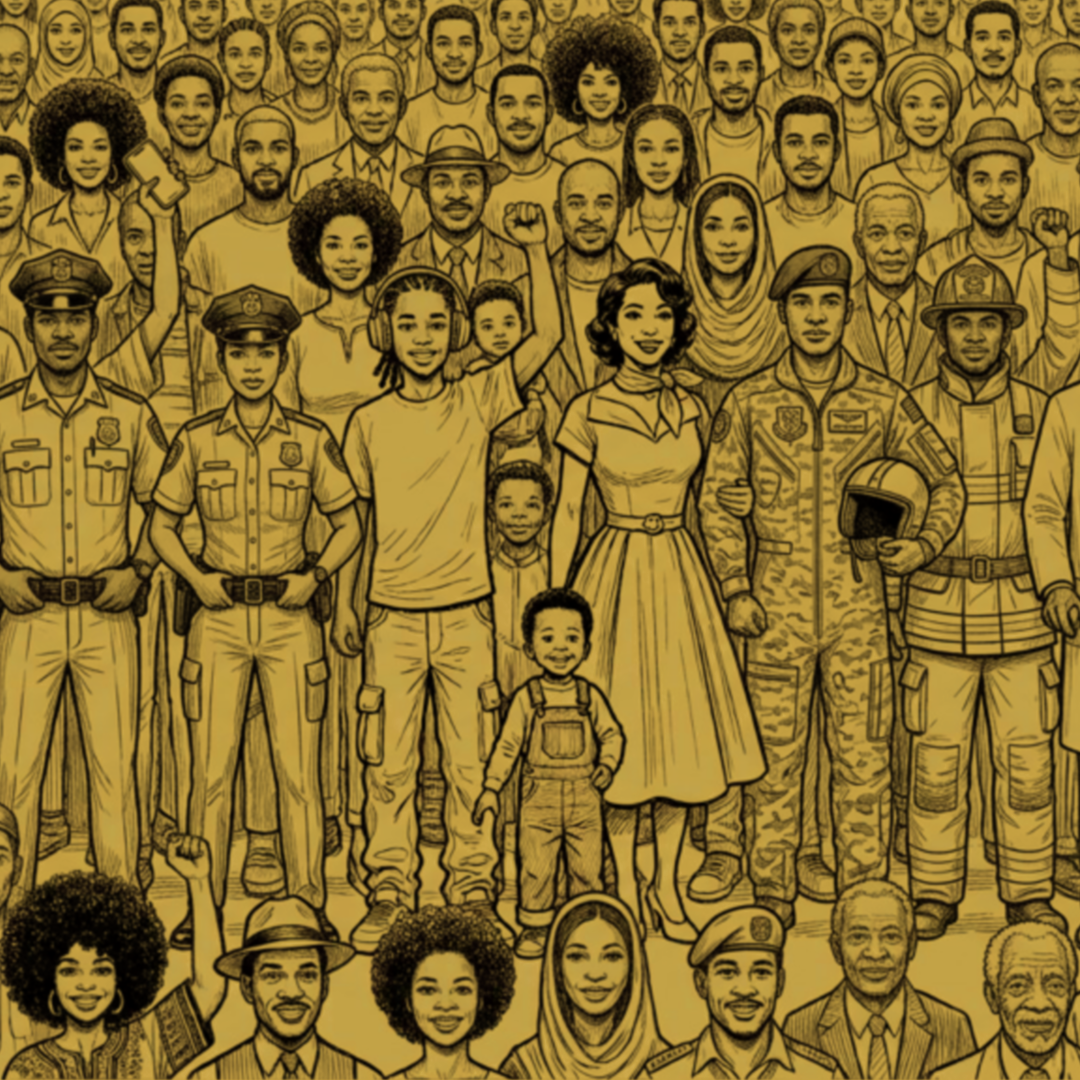
The Inter-generational Imperative; Beyond the myth of the monolithic youth; Adult and Youth agency in the architectural sovereignty of Africa’s Transformation

Introduction: The Tyranny of the Imported Trope and the Erasure of the Sovereign Adult

The prevailing discourse surrounding the horizon of Africa is anchored by a singular, persistent trope, which is the absolute fixation on the demographic youthfulness of our populations. Global think tanks, international development agencies, and foreign policy forums continuously broadcast the narrative that Africa's future belongs exclusively to the youth, treating the continent as a blank slate awaiting digital and economic salvation from its youngest citizens. While this focus is rooted in the undeniable demographic reality of our vast population, its unexamined byproduct has been a subtle, systemic side-lining of the adult and mature populations, those currently holding the institutional memory, economic capital, and active leadership of our sovereign nations.
As noted within continental economic research and structural analysis, "sustainable continental productivity requires multi-generational skill upgrades and addressing the missing middle of the active adult workforce" (ACET, 2020). To accept the premise that Africa must look solely to its youth while pushing its adults into premature obsolescence is to accept a deeply flawed, Eurocentric framework that fundamentally misunderstands the historical and structural architecture of African societies. True continental transformation requires dismantling this artificial generational fracture, ensuring that the accumulated agency of adults and the dynamic energy of youth converge in an unbroken line of collective greatness.

The Neo-Colonial Fracture: Dissecting the Foreign Import of the "Youth-Only" Future

The modern obsession with isolating the youth as the sole agents of African change is not an indigenous concept, but a neo-colonial construct imported from Western development models. In traditional Western sociology and neoliberal economic planning, populations are ruthlessly atomized into disconnected demographic categories, pitting generations against one another in a manufactured competition for scarce resources and political relevance. By framing the older and adult generations as bottlenecks, obstacles, or relics of a stagnant past, foreign development metrics seek to bypass the institutional sovereignty that mature Africans hold.
As explored in critical sociological assessments regarding post-colonial educational frameworks, imported models historically "marginalize adult learning infrastructures in favor of primary and tertiary schooling" (CODESRIA, 2022). This strategy of generational erasure serves a deliberate purpose, as it weakens the collective bargaining power of African societies, erodes deep-rooted historical consciousness, and installs a hyper-individualized, corporate-driven mindset that treats human beings as disposable economic units. Recognizing this manipulation allows African societies to reject the false binary of "youthocracy versus gerontocracy" and return to a paradigm where the wisdom of experience and the vigor of innovation are harmonized.

Ontological Continuity: How African Societies Have Historically Thrived Through Intergenerational Complementarity

When we examine the deep philosophical and social foundations of African societies, we find that human personhood and societal development have never been measured by age segregation. As the philosopher Ifeanyi Menkiti established in foundational texts on African relational ontology, human personhood is "not a static, individualistic milestone achieved in youth, but an accumulative, lifelong moral and social achievement" (Menkiti, 1984). Wisdom, responsibility, and societal stewardship naturally increase with maturity, forming an unbroken chain of generational continuity.
Furthermore, as Kwasi Wiredu demonstrates through indigenous frameworks of consensus and shared community responsibility, traditional African decision-making structures operated on a "complementary trusteeship model where the energy of the young and the accumulated operational experience of adults functioned interdependently" (Wiredu, 1996). In these indigenous structures, leadership and community survival were never pitted against each other. Instead, African societies thrived because every stage of life carried distinct, indispensable duties that reinforced the collective greatness of the community, proving that our past was built on synthesis, harmony, and mutual respect across the entire spectrum of age.

The Economic Cost of Discontinuity: Preserving the "Missing Middle" for Continental Sovereignty

To secure the economic independence of our nations, we must confront the dangerous economic fallacy that youth-led innovation alone can industrialize a continent. Economic research from institutions like the African Center for Economic Transformation demonstrates that sustainable productivity requires what is termed the missing middle, defined as "the prime-age adult workforce holding the capital reserves, regulatory navigation skills, and industrial execution capacity" (ACET, 2021).
When development funds and national programs obsess exclusively over youth entrepreneurship while ignoring adults trapped in informal trade or legacy sectors, the result is structural amnesia and economic fracture. As empirical labor market data from the African Development Bank highlights, "the vast majority of stable productivity, tax generation, and informal-to-formal enterprise scaling is managed by prime-age adults" (AfDB, 2024). Scaling micro-enterprises into continental manufacturing complexes, navigating the complex trade corridors of the African Continental Free Trade Area, and maintaining critical infrastructure require the deep operational experience of adults. Sidelining this core demographic starves our economies of the very people who translate raw ideas into lasting, sovereign institutions.

Conscientization and Re-tooling: The Blueprint for Adult Education in Decolonized Societies

If African societies are to reclaim their sovereign trajectory, we must radically expand adult education and continuous development, anchoring them in the liberating philosophies articulated by thinkers like Julius Nyerere. In his seminal political and philosophical framework, the Declaration of Dar es Salaam, Nyerere defined adult education not as formal schooling, but as "a critical tool for political consciousness, self-reliance, and active economic agency" (Nyerere, 1978).
Adult education must transcend basic literacy or vocational compliance, evolving into a deliberate process of political and economic conscientization that decolonizes the mindset of the mature population. By establishing community learning centers and targeted technical re-tooling programs, we equip prime-age adults to master modern digital systems, regional trade logistics, and advanced resource management alongside the youth. Just as physical infrastructure requires constant maintenance, the intellectual and operational infrastructure of our adult workforce requires continuous upgrading. When adults are actively re-tooled to meet the demands of a rising Africa, they become an unstoppable force of institutional stability, ensuring that our collective trajectory is guided by historical clarity and uncompromising sovereignty.

Conclusion: Forging a Grand Future Through the Unbroken Power of All Generations

The future magnitude of Africa does not belong to a single demographic slice, but to the unified, unshakeable strength of our entire societal tapestry. By casting off the imported, divisive myth of the monolithic youth, African societies can restore a holistic vision of progress where adults and youth stand shoulder to shoulder as co-architects of our destiny.
As continental survey data from sources like Afrobarometer confirm, "African citizens across all age brackets overwhelmingly favor collaborative, cross-generational governance rather than age-cleansed political or economic spaces" (Afrobarometer, 2024). Our history testifies to a magnificent heritage of communal resilience, relational continuity, and structural wisdom that spans across generations. As we look toward the boundless greatness that awaits us on the continental horizon, we must declare that no generation will be sidelined, no adult will be rendered obsolete, and no artificial foreign construct will fracture our unity. Through intergenerational solidarity, continuous adult education, and uncompromising sovereign agency, we will build an Africa that honors its past, empowers all its citizens, and commands the respect of the entire world.

Bibliography

  1. Adegbindin, O. (2011). Indigenous Knowledge Systems and the Crisis of Development in Africa. Journal of Pan African Studies.
  2. African Center for Economic Transformation (ACET). (2020). African Transformation Report: Growth with Depth. ACET Publications, Accra, Ghana.
  3. African Center for Economic Transformation (ACET). (2021). The Quest for Growth with Depth: Transforming African Economies. Palgrave Macmillan, Accra/London.
  4. African Development Bank (AfDB). (2024–2025). African Economic Outlook: Structural Transformation, Human Capital, and Natural Capital for Inclusive Growth. AfDB Group, Abidjan, Côte d'Ivoire.
  5. Afrobarometer. (2024). Democracy, Governance, and Citizen Participation Across Generations in Africa. Afrobarometer Dispatch Series.
  6. Amoako, K. Y. (Ed.). (2021). The Quest for Growth with Depth: Transforming African Economies. Palgrave Macmillan / ACET.
  7. Council for the Development of Social Science Research in Africa (CODESRIA). (2022). State, Society, and Lifelong Learning: Re-evaluating Educational Policy in Post-Colonial Africa. CODESRIA Book Series, Dakar, Senegal.
  8. Gboku, M., & Lekoko, R. N. (2007). Developing Programmes for Adult Learners in Africa. Pearson Education / University of Botswana Publications.
  9. Mastercard Foundation. (2025–2026). Africa Youth Employment Outlook: Navigating Labour Market Transitions and Adult-Youth Synergy. Mastercard Foundation Research Series.
  10. Menkiti, I. (1984). Person and Community in African Traditional Thought. In E. A. Ruch & K. C. Anyanwu (Eds.), African Philosophy: An Introduction. Catholic Book Agency.
  11. Murove, M. R. (2009). African Ethics: An Anthology of Comparative and Applied Ethics. University of KwaZulu-Natal Press.
  12. Nyerere, J. K. (1978). Adult Education and Development / The Declaration of Dar es Salaam. International Council for Adult Education (ICAE).
  13. Wiredu, K. (1996). Cultural Universals and Particulars: An African Philosophy of the First Order. Indiana University Press.


Research IS national security: calling all African nations: Part 3: Contemplating African expertise, rejecting African technology

There is a contradiction at the heart of how Africa builds.
We trust African minds. We hire African professionals. We consult African engineers. We celebrate African experts who lead global institutions, shape financial systems, and advise governments.
But when it comes to the machines they could design, the patents they could file, the technology they could build—we look elsewhere.
This is not a failure of capacity. It is a failure of confidence. And it is costing us more than we admit.

The experts we trust

In recent years, African governments have increasingly turned to African expertise for high-level technical support.
Rwanda recruited West African financial professionals to strengthen its banking and investment frameworks. The country also brought in Zimbabwean educators to rebuild its teaching workforce. These were not acts of charity. They were recognition that African professionals possess the skills to serve African institutions.
Burkina Faso, building a data center for digital infrastructure, hired Ethiopian expertise rather than defaulting to European or American consultants. A West African nation choosing East African technical knowledge—this is not common. It is significant.
These are examples of intra-African knowledge circulation at work. They signal a shift: African governments are beginning to trust African expertise.
But expertise is not technology. And the gap between the two is where the contradiction lives.

The refinery they tried to stop

Consider the Dangote Refinery in Nigeria. A twenty billion dollar investment. One of the largest single-train refineries in the world. Built by an African company, on African soil, with African capital, designed to process African crude into products Africans consume.
When the refinery was under construction, it should have been celebrated as a triumph of African industrial ambition. Instead, it faced fierce opposition from its own government.
Between 2025 and 2026, the refinery struggled to secure crude feedstock from domestic sources. Under Nigeria's Crude-for-Naira programme, the refinery was supposed to receive thirteen to fifteen cargoes of crude monthly. It received five. The shortfall was staggering: between October 2025 and mid-March 2026, the refinery received approximately 79.53 million barrels less crude than it needed to operate at full capacity.
Instead of supporting the refinery, regulators continued issuing import licences for refined products, effectively subsidizing foreign refineries while starving a domestic one. The Dangote Group's spokesperson publicly noted that the refinery had survived twenty-two acts of sabotage allegedly linked to oil industry insiders.
Olisa Agbakoba Legal, a Nigerian law firm, described the situation as more than a commercial dispute. They called it a fundamental failure of economic sovereignty. In their analysis, Nigeria was operating under a "Contract Oil" model—treating petroleum merely as a commodity for extraction and export, with value addition systematically externalized to foreign entities. They contrasted this with Saudi Arabia's "Development Oil" model, where petroleum resources are used for comprehensive national transformation, delivering world-class refineries, maritime fleets, and absolute control over the value chain.
The question they posed was direct: why does Nigeria, Africa's largest oil producer, still import refined products when it has a domestic refinery capable of meeting national demand?

The war that changed everything

Then the Middle East war began.
The conflict disrupted oil deliveries through the Strait of Hormuz. Global crude prices rose. Shipping costs climbed. The cheap refined products that had long dominated West African markets became scarce and expensive.
Suddenly, the refinery that had been systematically undermined became essential.
In March 2026, Dangote Refinery announced it was running at full capacity—650,000 barrels per day. It began exporting fuel to other African countries. Twelve cargoes totalling 456,000 tonnes were sold to Côte d'Ivoire, Cameroon, Tanzania, Ghana, and Togo. Nigeria's fuel imports, which had averaged 209,000 barrels per day, fell to 90,000. Imports from offshore Togo, previously a major source of fuel, dropped to zero.
The refinery also announced plans to double capacity to 1.4 million barrels per day under its "Vision 2030" strategy, aiming to deepen Africa's self-sufficiency in energy.
The contradiction could not be starker. When African governments trusted foreign supply chains, they actively undermined an African solution. When those foreign chains collapsed, the African solution proved its worth.

The machines we reject

The Dangote story is not unique. It mirrors what happens across African technology sectors.
While Burkina Faso trusted Ethiopian expertise for its data center, where did it source the hardware? Where did the servers, the software, the infrastructure come from? Almost certainly not from another African country. Because Africa does not yet produce those things at scale. Not because we cannot. Because we do not invest in the systems that would allow us to.
The same pattern repeats across industries.
Ethiopia invested heavily in textile industrial parks. Factories were built. Jobs were created. Machinery was imported—from China, from Europe, from India. Not from Nigeria, where the Raw Materials Research and Development Council had already patented an automated weaving machine that could have served that market.
The RMRDC machine exists. It works. It was patented. But when Ethiopia built its textile industry, no one thought to source machinery from another African country. Not because the Nigerian machine was inferior. Because there is no system for African countries to buy African technology.
We trust African minds. We do not trust African machines.
We hire African experts. We do not buy African patents.
We celebrate African innovation. We do not invest in African manufacturing.

The cost of this contradiction

The cost is not just economic. It is strategic.
When we import machinery, we import dependency. We pay for the machine, and we pay again for maintenance, for spare parts, for upgrades, for the expertise to keep it running. The value flows outward.
When we do not buy African technology, we ensure that African technology never scales. The RMRDC loom remains a prototype because there is no domestic market for it. Zarouk Imoro's mycelium innovation remains vulnerable because there is no system to fund its industrialization. Dangote's refinery faced sabotage because the system was designed to preserve import dependency.
The cycle is self-perpetuating: we do not invest, so the technology does not mature, so we do not trust it, so we do not invest.
And while we hesitate, others do not.
China, India, Turkey, and Vietnam have built industrial capacity not by waiting for technology to arrive, but by building it, protecting it, and buying it from each other. Intra-Asian technology transfer is a deliberate industrial strategy. Intra-African technology transfer is almost nonexistent.

The exception that proves the rule

There are signals of what could be.
Rwanda's use of West African financial expertise and Southern African educators shows that African governments can look to African talent for high-level systems work. The Burkina Faso–Ethiopia data center collaboration shows that technical expertise can move across the continent. Dangote's refinery—finally running at full capacity and supplying fuel across Africa—shows that African industrial infrastructure can serve continental needs.
But these remain individual decisions, not systemic policies. They are not backed by investment pipelines, by procurement mandates, by regional technology agreements.
The African Continental Free Trade Area (AfCFTA) was designed to increase intra-African trade. But its focus has been on goods, not technology. There is no equivalent framework for intra-African technology transfer, patent sharing, or industrial collaboration.
We have the framework for selling each other raw materials. We do not have the framework for selling each other machines.

What would change if we decided differently?

Imagine if every African government procurement process included a mandate to source African technology where it exists. The RMRDC loom would have a market. Ethiopian textile factories would be equipped with Nigerian machines. Ghanaian mycelium processing would be funded by Ghanaian development banks and sold to Ghanaian textile manufacturers.
Imagine if foreign-funded infrastructure projects required local technology transfer—not just training, but co-ownership of patents, joint manufacturing agreements, and the right to replicate.
Imagine if the AfCFTA included a protocol on technology transfer, creating a continental market for African-made machines, software, and industrial systems.
Imagine if, instead of undermining the Dangote Refinery, the Nigerian government had treated it as a strategic national asset from the beginning—guaranteeing crude supply, restricting import licences, and building a petrochemical industry around it. The refinery would have been supplying the continent years earlier, and the billions of dollars spent on imported fuel would have remained within Africa.
These are not fantasies. They are policy choices that other regions have made. We have not made them because we have not yet decided that African technology is worth betting on.

The question we must answer

Part 1 asked why our innovations leave. Part 2 asked why the knowledge we already had was never protected. Part 3 asks a harder question: why do we not buy what we build?
We trust African minds. We celebrate African innovation. We hire African experts. But when it comes to the machines, the patents, the systems—we still look elsewhere.
The Dangote Refinery shows us what is possible when African capital builds African infrastructure. It also shows us what happens when that infrastructure is undermined by the very governments that should be protecting it. And it shows us that when external systems fail, African solutions become essential.
This is not about capacity. It is about confidence. And confidence is built by choice.
We can continue to import dependency, or we can decide that African technology deserves an African market. The choice is ours. But the cost of not choosing is already visible.
The RMRDC machine sits in Nigeria, unused. Ethiopia's textile factories run on imported machinery. Ghana's mycelium innovation is celebrated globally but unprotected at home. Dangote's refinery fought for years to be taken seriously by its own government.
These are not failures of invention. They are failures of will.
And will is something no one can import.

The next question

Part 4 will ask a deeper question: how did African textile knowledge build industries we do not own? From indigo to Kuba to wax prints, the extraction of African textile knowledge is not a new story. It is the foundation of the industrial world we now navigate. And understanding it is essential to understanding why ownership deprivation is not an accident—it is a system.

References

· Federal Ministry of Science and Technology, Nigeria. Raw Materials Research and Development Council (RMRDC) Automated Rapier Weaving Machine Project Report. Abuja: RMRDC, 2021.
· EASTRIP. Kisumu National Polytechnic Textile Technology Factory Project Report. World Bank / East Africa Skills for Transformation and Regional Integration Project, 2026.
· Federal Ministry of Industry, Ethiopia. Textile Industrial Parks Development Strategy. Addis Ababa, 2020.
· African Union. African Continental Free Trade Area: Intellectual Property Protocol Negotiations Status Report. Addis Ababa, 2025.
· Science Granting Councils Initiative. Policy Brief: Strengthening Science Granting Councils in Sub-Saharan Africa. 2025.
· Olisa Agbakoba Legal. "The Dangote Refinery-NMDPRA Dispute: Beyond Commercial Disagreement To Questions Of Economic Sovereignty." Mondaq, December 2025.
· "Dangote to double refinery capacity to 1.4m bpd." The Sun Nigeria, March 2026.
· "Dangote's refinery fuel exports in Africa begin." New Era Namibia, March 2026.
· "Dangote reduces petrol gantry price to N1,200/litre." The Punch, March 2026.
· "Agbakoba, Firm Warn Dangote Refinery–NMDPRA Dispute Threatens Nigeria's National Development Goals." The Will News, December 2025.
· "Dangote announces 1.4mbpd as new target to leverage economies of scale." BusinessDay, March 2026.
· "Dangote Refinery pays $18 premium for Nigerian crude as supply shortfalls bite." BusinessDay, March 2026.
· "Group urges Tinubu to halt fuel import licences." The Guardian Nigeria, November 2025.
· "Dangote refinery tenders 84,000 tons of jet fuel and diesel for March loading." Business Insider Africa, March 2026.
· "Middle East tensions propel Dangote Refinery's fuel exports." SABC News, March 2026.

Research IS national security: calling all African nations: Part 2: Africa’s Ownership deprivations.

There is a question we are not asking.
Not in policy meetings. Not in university boardrooms. Not in government ministries where budgets for research are debated and often cut.
The question is simple: who owns what Africa creates?
It sounds straightforward. But when you follow the knowledge—from the communities who developed it, to the laboratories studying it, to the corporations patenting it—the answer becomes unsettling.

The knowledge we already have

Africa possesses a body of inherited ancestral knowledge accumulated over millennia of experience and interaction with the natural environment. This is not folklore. It is not nostalgia. It is technical knowledge: land management systems that sustain biodiversity, pharmacopeia derived from thousands of plant species, manufacturing techniques that transform raw materials into complex textiles and jewelry.
The continent holds more than fifty thousand identified plant species. Traditional ecological knowledge guides the restoration of fragile ecosystems. Indigenous technical knowledge manifests through mastery of materials—casting, hammering, setting, braiding—passed down through generations.
This knowledge is not abstract. It is practiced daily. In Zimbabwe, communities have long used Launaea taraxacifolia to soothe pain and inflammation. In West Africa, indigo dyeing techniques developed over centuries encode sophisticated chemical understanding. In the Democratic Republic of Congo, Kuba cloth patterns embed design logic that scholars now recognize as algorithmic.
But here is the problem: this knowledge was never protected.
Not because it lacked value. Because the system designed to protect knowledge was not built for us.

The system that excludes

The patent system was designed for individual inventors, written documentation, and mechanical innovations. It was not designed for collective knowledge, oral transmission, or techniques developed over generations.
This is not an accident. It is architecture.
As the African Regional Intellectual Property Organization (ARIPO) has documented, traditional knowledge faces specific threats: misappropriation of cultural expressions, biopiracy, and persistent lack of recognition of local communities' rights over their own knowledge.
What this means is simple: a foreign company can study an African textile technique, document it, patent a variation, and sell it back. They can isolate the active compound in a traditional medicinal plant, patent it, and own the rights to a remedy communities have used for centuries. They can reproduce Kuba cloth patterns on global runways without paying a single royalty.
This is not theft in the sense of breaking and entering. It is extraction within a legal system that was built to permit it.

The tools we are building

But the story does not end there. Because across Africa, a new legal architecture is emerging.
In 2024, the World Intellectual Property Organization (WIPO) adopted a landmark treaty on intellectual property, genetic resources, and associated traditional knowledge. For the first time, patent applicants relying on traditional knowledge must disclose the Indigenous Peoples or local communities who provided that knowledge.
This is not perfect. Administering the treaty presents challenges—Africa's rich cultural diversity means traditional knowledge varies widely between communities, and multiple holders may exist for similar knowledge. But it represents a fundamental shift: the recognition that knowledge developed outside Western laboratories deserves protection.
Regional bodies are also moving. ARIPO has developed the Swakopmund Protocol, the first regional instrument globally establishing a detailed legal framework for the protection of traditional knowledge in its member states. The Organisation Africaine de la Propriété Intellectuelle (OAPI) operates a uniform system across its members.
The African Continental Free Trade Area (AfCFTA) is currently negotiating an intellectual property protocol. Scholars argue that this presents a timely, albeit arduous, opportunity for Africa to reconstruct its broken IP architecture by aligning fragmented sub-regional regimes with development-oriented aspirations. The negotiators are being urged to prioritize geographical indications, plant variety protection, and—crucially—traditional knowledge and traditional cultural expressions, which embody Africa's innovative and creative strengths.

The bridge between past and future

This is where the two threads merge.
The knowledge we lost—the textile techniques never patented, the medicinal compounds never claimed, the designs extracted without payment—is not gone. It is still practiced. It is still held. And now, for the first time, there are legal tools to protect it.
But tools are not enough. They must be used.
Countries like Kenya, South Africa, and Uganda have already enacted legislation to protect traditional knowledge. But implementation is weak. Documentation is incomplete. Enforcement is nearly nonexistent.
The Swakopmund Protocol exists. The WIPO treaty exists. The AfCFTA negotiations are underway. But these frameworks only matter if governments prioritize them, if researchers document the knowledge, if communities are empowered to claim what is theirs.

The opportunity we cannot afford to miss

There is a growing global market for what is called "traditional knowledge-derived products." Natural dyes. Indigenous fibers. Medicinal compounds. Sustainable materials. These are not niche markets. They are multibillion-dollar industries.
Africa has the raw knowledge. What we do not have is the legal infrastructure to claim it.
The good news is that we are building it. The bad news is that we are building it slowly, inconsistently, and often without the urgency this moment demands.
Because while we debate, the extraction continues.

The question that remains

Part 1 asked why our innovations leave. This Part asks why the knowledge we already had was never protected—and what we are doing, finally, to claim it.
But there is an even harder question. And it is the subject of Part 3:
If we have African expertise, why do we not buy African technology?
Because the evidence suggests we might hire African professionals, we might consult African engineers—but when it comes to machines, to patents, to systems, we still look elsewhere.
That gap—between trusting African minds and rejecting African machines—is where the next part of this series begins.

References

· Vargas-Chaves, Iván. "Protecting Africa’s traditional knowledge: an approach to intellectual property governance and ARIPO’s role." Frontiers in Human Dynamics, 2026.
· Chuma-Okoro, Helen. "Promoting Traditional Textiles from West African Rural Communities through Communal Intellectual Property Models." AIE Conference, University of Oxford, 2013.
· Sithole, Juliet. "Faculty and Young Researchers at Africa University Transform Indigenous Knowledge into Global Health Solutions." Africa University News, 2025.
· Adebola, T. "Mapping Africa’s Complex Regimes: Towards an African Centred AfCFTA Intellectual Property Protocol." African Journal of International Economic Law, 2020.
· Adams & Adams. "Africa's Hidden Treasures: The WIPO Treaty Revolution." 2025.
· Kongolo, Tshimanga. African Contributions in Shaping the Worldwide Intellectual Property System. Ashgate, 2012.

Research IS national security: Calling All African Nations: We dont lack innovation. We lack the will to keep it.

There is a story Africa is told about itself. It goes like this: we do not invent. We do not create. We consume what others build, adopt what others design, import what others manufacture. Our role is to provide raw materials and wait for technology to arrive from elsewhere.

This story is convenient—for those who benefit from it.

Because the truth is the opposite. Africa does not lack innovation. What we lack is the will to keep it.

The machine Nigeria built and forgot

In 2021, Nigeria’s Raw Materials Research and Development Council (RMRDC) did something remarkable. They developed and patented an automated rapier weaving machine for commercial Aso‑oke production. This was not a small achievement. The machine worked. It produced large quantities of fabric with more consistent results than handwoven Aso‑oke. The technical breakthrough was significant: they modified the conventional rapier head from single weft insertion to multiple weft insertions in a single shed. The RMRDC stated the project would “catalyse the establishment of automated weaving loom manufacturing industries in Nigeria with attendant huge investment and employment opportunities.”

That was 2021.

Today, there is no evidence the machine was commercialized. No evidence it was licensed to manufacturers. No evidence it was scaled. The patent exists. The prototype exists. But where are the Nigerian-made automated looms? Where are the jobs? Where is the industry that was supposed to follow?

This is not a failure of invention. It is a failure of will.

The mycelium Ghana showed the world

In Ghana, Zarouk Imoro developed something that should have made headlines across the continent. An environmental technologist, he created “Myco-Substitutes”—a system that uses fungi to treat faecal waste and produce mycelial thread as an alternative to cotton or synthetic thread, and fungal mycelia leather as an alternative to animal hide. The process is elegant: bacteriophages remove bacteria from faecal sludge; fungi feed on the remaining waste; toilet paper in the sludge acts as a carbon source for mycelial growth. Ten litres of sludge produces 500 grams of mycelia.

Imoro won the “One to Watch” award at the Royal Academy of Engineering’s Africa Prize. International attention followed.

But here is the question that no award can answer: has the innovation been patented? Not in Ghana, as far as the public record shows. Not internationally. The technology is visible, recognized, celebrated—and legally exposed. Anyone, anywhere, can replicate it, refine it, and patent it elsewhere. The knowledge may leave Ghana not because it was stolen, but because it was never protected.

This is not a failure of creativity. It is a failure of protection.

The pattern we refuse to name

These two cases—Nigeria’s abandoned loom, Ghana’s exposed mycelium—are not isolated. They are symptoms of a continent-wide pattern.

We fund research without funding scale-up. We celebrate innovation without securing ownership. We send students abroad on scholarships with no IP agreements, watch them develop patents in foreign institutions, and tell ourselves this is simply how the world works.

But it is not how the world works. It is how the world works for us.

Because other nations do not behave this way. Brazil, where Dr. Abdulrazak Ibrahim helped develop and patent a whitefly control technology, retained that patent because Brazilian public funding and infrastructure made it possible. The technology was developed on Brazilian soil, with Brazilian money, under Brazilian law. That is how research becomes national security.

Where is the African EMBRAPA? Where are the African research institutions with the capacity to host PhD students so they do not have to leave to access other facilities? Where are the patent offices funded to help innovators file claims? Where are the industrial policies that take a proven prototype and turn it into a factory?

We have the talent. We have the ideas. We have the prototypes. What we do not have is the system that turns invention into wealth.

The real deficit

The deficit is not in African minds. It is in African institutions.

Research without ownership is extraction. Innovation without industrialization is loss. Knowledge without protection is vulnerability. We are not losing because we cannot create. We are losing because we do not demand retention.

This is not a technical problem. It is a political one.

Governments fund roads, armies, and ports as infrastructure of sovereignty. Research is the same. A nation that does not fund its own research cannot set its own agenda. It cannot protect its own resources. It cannot develop its own industries. It cannot retain its own talent.

When we celebrate innovation that leaves, when we fund research without scale-up, when we send students abroad with no IP agreements, we are not supporting development. We are subsidizing extraction.

Where this leads

This series is not about why Africa lacks innovation. It is about why we allow our innovations to leave. It is about the systems—or absence of systems—that turn our knowledge into someone else’s asset.

In the next parts, we will ask harder questions: Who really owns what Africa creates? Why do we buy African expertise but not African technology? How did African textile knowledge build industries we do not own? And finally, what must governments do to build, protect, and retain what is ours.

But the first step is to stop telling ourselves the story that we do not invent. We do. We always have. The question is whether we will finally decide to keep what we make.


References

· Federal Ministry of Science and Technology, Nigeria. Raw Materials Research and Development Council (RMRDC) Automated Rapier Weaving Machine Project Report. Abuja: RMRDC, 2021.
· Imoro, Zarouk. “Myco-Substitutes: Fungal-Based Textile Alternatives.” Royal Academy of Engineering Africa Prize for Engineering Innovation, 2024.
· Ibrahim, Abdulrazak. “RNA Interference Technology for Whitefly Control.” EMBRAPA, Brazil. Patent filed 2018.
· Science Granting Councils Initiative. Policy Brief: Strengthening Science Granting Councils in Sub-Saharan Africa. 2025.
· African Union. Science, Technology and Innovation Strategy for Africa (STISA-2024). Addis Ababa: African Union, 2014