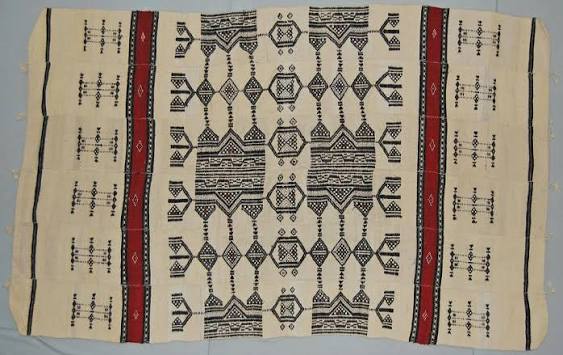
In the arc of the Niger River, where the desert meets the inland delta, a distinctive wool textile tradition developed that stands as one of West Africa's most sophisticated material technologies. The Niger Bend region—spanning what is now Mali and Niger—was historically a crossroads where Saharan camel caravans transferred goods to boats navigating the river. It also became, according to textile scholars Bernhard Gardi and Michelle Gilbert, "the foremost center of technical and visual diversity in West African treadle-loom weaving traditions."
What makes this tradition remarkable is not just its beauty but its engineering. The weavers of the Niger Bend produced wool textiles using two advanced techniques: extra-weft patterning and tapestry weave. These are not simple weaving methods. Extra-weft patterning involves adding non-structural threads that float across the surface to create complex, raised designs. Tapestry weave requires the weaver to manage multiple colored weft threads simultaneously, creating distinct blocks of pattern that form geometric compositions.
The wool itself comes from Massina sheep, raised in the Inland Delta of Mali—the only area in Sub-Saharan Africa where wool is traditionally produced. This is not incidental. The textile system is intimately linked to the social system of the Fulani people who own the sheep. The knowledge is encoded in animal husbandry, material practice, and visual language simultaneously.
The Algorithmic Pattern System
The patterns on these textiles are not random. They follow a rule-based logic that textile researchers have only recently begun to decode. The foundational element is a motif called bitshirgal—an "onset" pattern that serves as the generative seed for all other designs. All other motifs are recombinations of the different elements of the bitshirgal.
This is algorithmic generation. A finite set of elements produces an indefinite number of variations. Not in theory. Woven by hand.
The checkerboard pattern, achieved on the narrow-strip loom by alternating sections of light and dark weft threads, is mathematically systematic. The Smithsonian Institution notes that this pattern is related to "magic squares" that feature precise mathematical progressions.
The Niger Bend weavers did not write code. They encoded logic in thread.
Two Major Textile Types
The tradition produced two distinct categories of wool textiles, each with its own purpose and design logic.
Kaasa were heavy covers that changed significantly in appearance over the 20th century. A mid-20th century kaasa blanket in the Smithsonian collection demonstrates the checkerboard pattern achieved by "rapidly tossing his shuttle" as the weaver alternated light and dark weft threads.
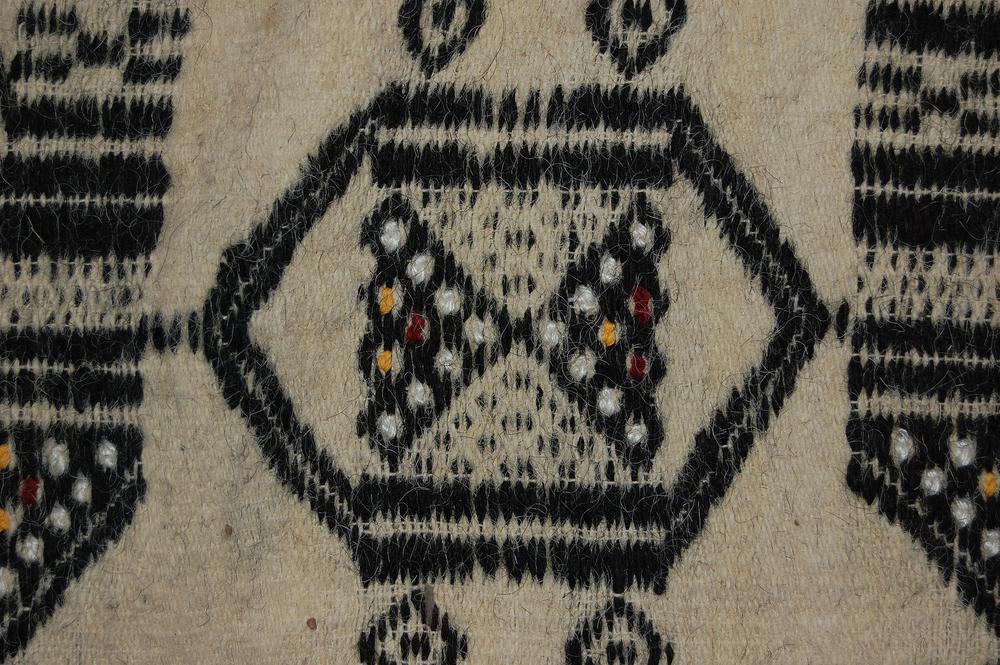
Arkilla (also called arkilla jenngo) were ceremonial marriage covers that maintained the same design language for centuries. The Textile Museum describes a 1940s arkilla as a "beautiful and complex woven panel" designed to hang inside or outside Tuareg tents. The word arkilla means "mosquito net"—the panel offered protection against the harsh mosquito-laden environment of the Niger Bend.
The construction is sophisticated. A typical arkilla is composed of fourteen narrow strips sewn together. A Fulbe weaver would create "an arrangement of triangles, chevrons and other motifs that has meaning in the Tuareg culture," often spending up to four months completing a single commission.
The Third Category: Wool Ornamentation on Cotton Ground
A third category featured wool ornamentation on a cotton ground, woven in the northeastern part of Burkina Faso, particularly around the town of Dori. These textiles were made by weavers of the Djerma (or Zarma) people, rather than the specialized Fulani maabuuɓe who produced the full-wool textiles.
The British Museum holds a striking example of this category, acquired in 1937. The cloth is constructed from eleven hand-woven cotton strips sewn together, with the pattern formed from bands of lines in continuous supplementary weft thread and discontinuous motifs including camels. The warp ends are twisted into tassels. Such cloths are called 'suban' and were used as marriage gifts.
The distinction in social status between weavers is significant. While the kaasa and arkilla were made by the specialized maabuuɓe caste, these wool-cotton covers "were made by weavers of lower status." The 1905 French abolition of slavery in their West African territories profoundly transformed the weaving landscape. A generation or more later, "formerly enslaved weavers versed in traditional techniques started their own weaving businesses supported by women who bought industrial threads." This shift helped diffuse extra-weft patterns and tapestry weave eastward, influencing Zarma weaving in Niger and Hausa weaving in Nigeria.
The Weavers: Maabuuɓe
The people who made the full-wool textiles were highly specialized male weavers called maabuuɓe (singular: maabo). They formed a distinct social group, a kind of specialized knowledge caste whose expertise was passed through generations. This was not casual craft. It was hereditary, technical knowledge.
The textiles were commissioned by Tuareg patrons, nomadic pastoralists who did not weave themselves but who valued the wool covers for their tents and ceremonies. A Fulbe weaver might travel to the Tuareg camp with his assistant and a simple pedal loom, spending months completing the project.
The French Colonial Attempts to Industrialize the Massina Sheep
The Massina sheep—the source of the wool—attracted the attention of French colonial administrators who saw an opportunity to supply the French textile industry. Between the 1920s and 1940s, they launched a series of interventions to "upgrade" the indigenous sheep for industrial wool production.
Georges Hugaud, a French veterinary student, submitted a 1934 thesis titled "Le mouton du Macina, son amélioration en vue de la production lainière" (The Macina Sheep, Its Improvement for Wool Production). The thesis proposed methods for increasing wool yield, specifically through cross-breeding local Macina sheep with European Merinos—the premier wool breed of Europe.
R.T. Wilson's 1981 analysis documents the "causes of the failure" of these colonial attempts. The Merino, bred for European climates and intensive management, could not tolerate the environmental conditions of the Inland Delta—seasonal flooding, arid periods, disease pressure. The Fulani traditional system of pastoral management did not conform to the industrial model the French attempted to impose.
The colonial intervention sought to replace an indigenous knowledge system with a European framework. It failed. The indigenous system did not need saving. It needed to be recognized for what it was: a sustainable, locally-adapted technology for producing wool.
The Reach of the Niger Bend Textiles
The influence of these engineered textiles was not contained to the Niger Bend. The wool covers were traded 1,000 kilometers south to the Akan kingdoms of Ghana and Côte d'Ivoire, where they were called nsaa and attained great ritual significance.
The technical influence also moved eastward. Extra-weft patterns and tapestry weave slowly diffused to the region stretching to Lake Chad. This is how, as Gardi and Gilbert document, "the rich Zarma weaving of the Republic of Niger came into being and Hausa weavers in Nigeria 'discovered' tapestry weaving." A much older line of influence went straight into Ewe weaving of Togo and Ghana.
One tradition, many offshoots. The Niger Bend was not isolated. It was a center of technical innovation that shaped weaving across West Africa.
The Absence of Protection
None of this was ever patented. Not because it lacked value. Because the patent system was not built for collective, oral, embodied knowledge.
The Niger Bend weavers—the maabuuɓe—did not file patents. They passed knowledge through caste, through family, through apprenticeship. The system worked for them. It did not fit the Western intellectual property framework.
But the knowledge is still there. The patterns are still there. The logic is still there. The Massina sheep still produce wool in the Inland Delta. The rule-based design system still generates new variations from the old motifs.
Engineering as Integration
What makes the Niger Bend wool textiles an "engineered" system is not any single feature. It is the integration.
Western Framework Niger Bend Reality
Separate categories (engineering, art, agriculture, social structure) All integrated into one system
Written documentation required Knowledge transmitted through caste, family, apprenticeship
Patent system for individual inventors Collective, multi-generational knowledge production
Raw material extraction Animal husbandry linked to social system of Fulani people
Product designed for market Commissioned for specific cultural and ceremonial use
The West would separate these into different disciplines—textile engineering, art history, animal science, sociology. The Niger Bend knowledge system never made those separations. The weaver knew the sheep, the loom, the pattern logic, the client, the ceremony, and the trade route as one interconnected field of knowledge.
This knowledge is real. It is. We will finally recognize it—not as heritage, not as craft, not as tradition—but as engineering. As technology. As an African knowledge system that deserves protection, development, and its place in the story of global innovation.
References
· Gardi, Bernhard and Gilbert, Michelle. "Arkilla, Kaasa, and Nsaa: The Many Influences of Wool Textiles from the Niger Bend in West Africa." The Textile Museum Journal, Volume 48, 2021, pp. 24-53.
· Wilson, R.T. "Livestock production in central Mali: Attempts to produce raw materials of animal origin for the French textile industry during the colonial period." Textile History, Volume 12, 1981, pp. 104-117.
· Wilson, R.T. "The Macina wool sheep of the Niger inundation zone." Tropical Animal Health and Production, Volume 15, 1983, pp. 189-196.
· Hugaud, Georges. Le mouton du Macina, son amélioration en vue de la production lainière. Veterinary thesis, École nationale vétérinaire d'Alfort, 1934.
· Gillow, John. African Textiles. San Francisco: Chronicle Books, 2003.
· The Textile Museum, George Washington University. Collection object 1977.23.2 (Arkilla jenngo, Mali, 1940s).
· Smithsonian National Museum of African Art. Collection object 75-9-1 (Kaasa blanket, Mali, mid-20th century).
· British Museum. Collection object 2018,2036.361 (Kaasa njokwaaka, woolen blanket, Mali, c. 1940-1980).
· British Museum. Collection object Af1937,1002.4 (Wool ornamentation on cotton ground, Dori, Burkina Faso, acquired 1937).
· Schaeder, Karl-Ferdinand. "Le Tissage en Afrique au sud du Sahara", Pantena Verlag, Munich, 1987.