
Economics of heritage; cultural currency; decentralised, textile production, for the preservation and future of the traditional textile process.

This has become a popular slogan among African people around the world. But what would it really entail and how would we go about creating African solutions in a Global mindset?

For the past 20 years the conversations intensified around Decolonisation and Decoloniality. African and Caribbean nations heighten their need to have the conversations transformed into actions, yet the larger sentiment of fear was holding us back. 

Not necessarily the fear of change, but rather the fear of failure. Who was going to chance their life’s into implementing long held sentiments, with millions of the fate of their people in their hands. It is never a small task. The risk not only for livelihood, but a change that could cost you your life. 

With so many external stakeholders subverting advancements of the African to force status quo multi level strategies implementation could usher in some impact for a long-term approach.   

Fabric remains found on the continent, dates back at least to the 10th century, some even earlier. We know of all the major and minor empires that existed in ancient times. The intricacy of the textiles found were so particular that it needed to be studied to be able to be recreated. And even as it was recreated, its essence, the ideas and philosophies that inspired the designed were never captured. 

They were relegated to geometrical understandings and mathematical content excluding the connectivity of these textiles. European taught seeks to extrapolate, take apart and keep apart, then assembly in a foreign context. Whereas the African Heritage textiles produced by the many nations were visualising each peoples paragons, communicated and express principles.

These textiles were produced in a system, a process, a collaboration of many knowledges coming together to manufacture covers suitable for our skin and the environments we were living in with the richly available resources.

An intact heritage would inspire designs to flow from it. Engineers and creative practitioners would be inspired and embolden by the visual availability of artefacts that was produced by predecessors informed by their lands, climates, languages and cultures. 

For Africans that were colonised and displaced, having their narratives interpreted and presented as factual by colonists and enslavers, the linear development of its society permanently derailed. The process of restoration could never exclude our forced interactions and subjections, except we actively counter the misrepresentations in all areas, disband them and decolonises first and foremost.

Ground work has to be done to address inaccuracies in the Heritage management stage to better inform the future and continuations of textile design and productions whit-in Africa and the Caribbean.

We would be in a unique position to learn from all tried and tested strategies, examine them to inform our own robust strategies. Strategies and approaches that evolved from a variety of sources including referencing our own sources can be transformed to innovate textile knowledge systems unique to the African continent. 

Frameworks and Methodologies designed to solve our particular circumstances should be explored and even encouraged. Such Frameworks and Methodologies would adjust the African continents trajectory in Textile manufacturing and Design, making Africa’s design solutions sufficiently unique to recapture local markets while recuperate its position on Global scale. 

“….al human beings need development in order to live well. Intended developments must be people-centered, people-intended and people oriented. (Nkwazi Mhango, 2018, P13, Development Naivety and Emergent Insecurities in a Monopolised World).

The African peoples can not afford a development with post-humanism practices at its heart. Our interconnectivity to our land, languages and humanity practices does not support a space where human beings take a back space, it is not African taught. 
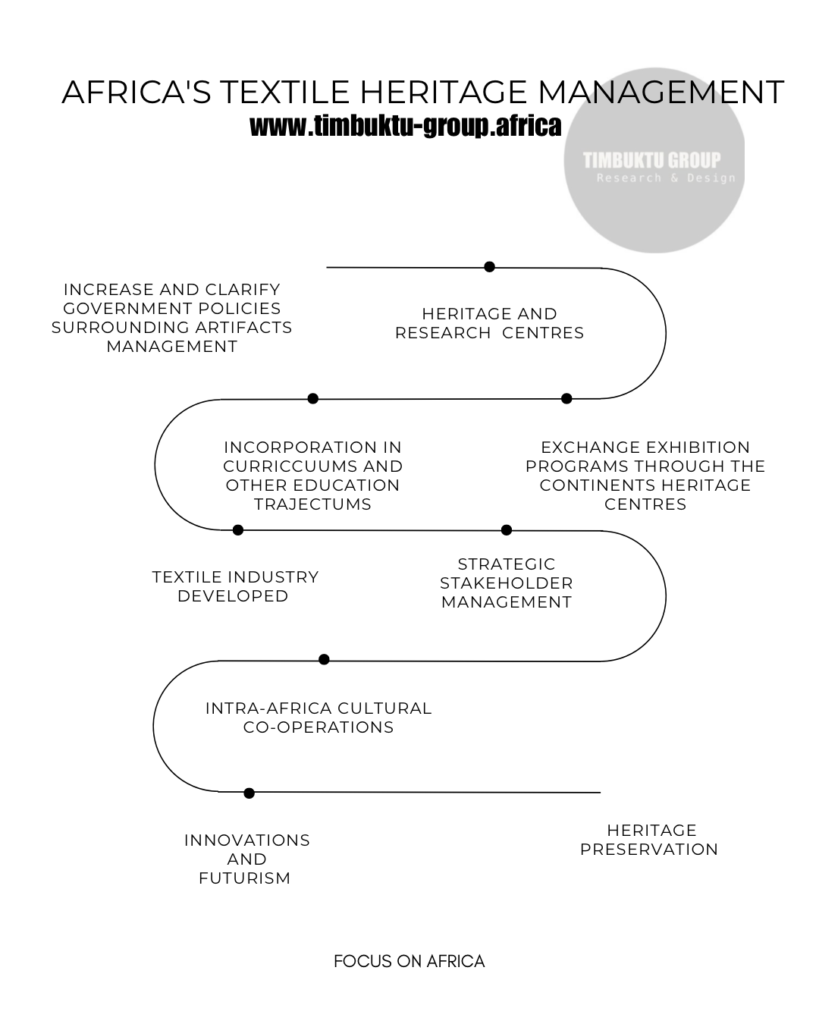
Copyright 2025 Timbuktu Research and Design

In Maendeleo philosophy, the ability to bring development to ones home area provided a way of shoring up legitimacy, it must be a responsible one based on the consent and needs of its stakeholders . (Nkwazi Mhango, 2018, P14, Development Naivety and Emergent Insecurities in a Monopolised World).

And these sentiments can be uphold by developing solutions that perhaps other countries do not have. The dynamics from North, East, West and South of Africa differ yet the result of the impact was the same. The factors that were implemented were largely the same and were able to be applied with the same result around the continent, so will be the solutions. 

The initiation of change starts with our Heritage management, giving it a new space in our societies. Our heritage and the outcome of the analysis of the artefacts based on the owners interpretations would then inspire new design frameworks and methodologies, leading to unique design outcomes specific to the various African nations.

We need to formulate key questions, Identify continually the problems affecting us and actively solve them. Adjusting our practices and Praxis as required in a flexible manner would allow us more room to make the moves necessary for a new textile industry in Africa.  

Intra-Africa exchanges could contribute to the early growth of many clothing manufacturing as governments adjust their policies to the peoples requests and requirements.  

The traditional textile processes will prove to be having lower accessibility issues then the automated expensive machines yet it can be more time consuming to bring the end product to market. The larger textile industry developments would not have to rely on a single strategy for its deployment, rather the amalgamation of strategies cantered around African taught would usher in the new era of the Africans. 

Textile Heritage Management: Economising legacy; the economy of design and African design thinking.

In order for the textile industry on the African continent to become prosporoues, the handcrafted textiles and the machine produced textiles, we have to bring something unique to the table that is not already here. The main disadvantage we currently have on the continent is the many external nations that have had, and continue to have, a long history in exploiting and looting the continent, a history of re-writting the African stories and appropiating indigenous African designs as their own.

The reclamation of our legacy: The main Phase

This phase has been developing since the declarations of 'indepence' from African nations from 1950's onward. While it had its growing pains, the process of reclamation of our ancestral legacy is desicive, driven by our strong heritage of identity and our strong will to counter historical and future erasure. We demanded the return of the remains of our fathers and mothers that were used as either throphies of battles, 'medical' studies or displayed in zoo's and museums to be gauged at and rediculed. We demanded the return of all our ancestral artifacts that were stolen, alongside recognation of our ancestors legacy. It was an upward battle for black people around the world to counter the mis-education that we inherited from the educational system that we went through which was designed to maintain and sustain a lie designed to oppress the African people around the globe.

We have had many academics that were ignored, discredited and rediculed for their knowledge of African history and African ideologies. Their work was never recognized or actively censored in a system where knowledge had to be filtered through european taught. These academics remained standfast in their arguments and left us with a trail and a body of investigative work that we can use today to further connect the knowledges we once possessed. It is this reconnection, that will pass through our current practices, allowing us to design and produce exceptional products and unique design aestetics for current and future markets.

The Economy of design

' Looking back enables looking foreward.'

The global product trade is driven by designs. Aesthetic design, problem solving designs, ecological design, sustainable design and luxury designs, solving design and product demands that were created through colonization and force.

The values and ideologies of these products does not necessarily represents real solutions for our continent. Some 'solutions' are gateways to bigger problems. Many designs are created to suit the culture, they adress specifically a conteporary solution to a cultural question. Hence you will find for example products in Indonesia and Malaysia that are not suitable for the european market, not because the product is not beautiful and 'modern', but because its specific use addresses a cultural practise that you will not find in Europe, or you will not find sufficiently in Europe to sustain mass imports of that product. It is not economically viable.

Due to enslavement, colonization and brutal force, Europeans saught to tranform certain aspect of our culture in order to secure economic benefits for their businesses.

Contrary to popular knowledge, resist dye was not a new phenomenon to the continent. It was another of the many textile practices that African textile practitioners practiced. It might not of been practiced throughout the continent, but there is clear evidence of resist dying of African traditional textiles, that today is done using wax, but was practised prior using Kasava paste. 

Further research has to be conducted in how this traditional practise can be revived on the continent to avoid environmental problems similarly experienced by other countries. It does not have to be part of our growing processes.

Instead of innovations around further development of the kassave paste as a sustainable and ecological product to use in textile dying, an industry plaqued by poluting its surroundings, a harsher material for the environment, wax, was / is used. It was an existing technique that Europeans were able to trade in, they did not bring the technique to the continent, they first destroyed Africa's textile industry and inserted themselves in it. It was an hostile takeover.

Kassava is a product consumed all over Africa, its biggest producers are African nations such as Nigeria. Devising methods from which resist dye can be used, would not only put made in Africa products on the market but would avoid high cost of import and it would be a product easily available in case of any logistic disturbances. 

Having design solutions that caters to the local culture allows for innovations whitin the culture. This not only contributes to the preservations of the culture but also allows for culture continuation practices in contemporaty settings.

Where traditionally, African artisans and craftmans were hightly valued and respected, changed during the periods of colonizations. Parents only encourages their childrens to pursuit professions such as doctors, lawyers and politicians where the income is perceived as being more secured.  Childrens were sent abroad to Europe and America to study at prestigious schools to only see how the Europeans and Americans value and incorporate their heritage into their daily lifes.

What was described as old on the African continent was placed behind thick secured glass in expensive luxury buildings called museums in Europe. It is alongside this that Africans abroad re-discovered the true value of their culture and perceived how their ancestral artifacts were informing the Europeans and Americans innovations and future develpments. This revelation now provided Africans abroad with the courage neccessary to reclaim their heritage and develop this for their own countries futures. Today you will find South-Africa, Nigeria, Ghana, Senegal and other African Nations being powerhouses where it comes to innovative fashion design inspired by their own traditions. Textiles and cloths are being innovated by Africans for Africans. African designers are learning about their ancestral practices and combine this with their contemporary design knowledge producing beautiful aestetics, unique to the African continent.

African Design Thinking

Design Innovations informed by traditions, translated and transfered by African designers

African designers have long been under-estimated and neglected, by not only the international community but also by our own societies. Their designs always adressed solutions for the societies that they are part of but more often then not they are overseen in projects where they can be of signigicant impact for the local culture. Like with many aspects of life, it was the European taught and aestetics that was taking presidence over our own, hence African designers inital focus to be recognized in their field is to produce European focused designs. Most of our important artifacts were taken abroad making it inaccessible to children growing up to learn about them in the midst of a European centered curriculum. But children that were sent broad for studies observed how 'old, insignifican, non-existing, backward' objects were taken special spaces in the colonizers communities. They came to understand how their histories was informing their oppressors future and dominance.