Research IS national security: calling all African nations: Part 3: Contemplating African expertise, rejecting African technology

There is a contradiction at the heart of how Africa builds.
We trust African minds. We hire African professionals. We consult African engineers. We celebrate African experts who lead global institutions, shape financial systems, and advise governments.
But when it comes to the machines they could design, the patents they could file, the technology they could build—we look elsewhere.
This is not a failure of capacity. It is a failure of confidence. And it is costing us more than we admit.

The experts we trust

In recent years, African governments have increasingly turned to African expertise for high-level technical support.
Rwanda recruited West African financial professionals to strengthen its banking and investment frameworks. The country also brought in Zimbabwean educators to rebuild its teaching workforce. These were not acts of charity. They were recognition that African professionals possess the skills to serve African institutions.
Burkina Faso, building a data center for digital infrastructure, hired Ethiopian expertise rather than defaulting to European or American consultants. A West African nation choosing East African technical knowledge—this is not common. It is significant.
These are examples of intra-African knowledge circulation at work. They signal a shift: African governments are beginning to trust African expertise.
But expertise is not technology. And the gap between the two is where the contradiction lives.

The refinery they tried to stop

Consider the Dangote Refinery in Nigeria. A twenty billion dollar investment. One of the largest single-train refineries in the world. Built by an African company, on African soil, with African capital, designed to process African crude into products Africans consume.
When the refinery was under construction, it should have been celebrated as a triumph of African industrial ambition. Instead, it faced fierce opposition from its own government.
Between 2025 and 2026, the refinery struggled to secure crude feedstock from domestic sources. Under Nigeria's Crude-for-Naira programme, the refinery was supposed to receive thirteen to fifteen cargoes of crude monthly. It received five. The shortfall was staggering: between October 2025 and mid-March 2026, the refinery received approximately 79.53 million barrels less crude than it needed to operate at full capacity.
Instead of supporting the refinery, regulators continued issuing import licences for refined products, effectively subsidizing foreign refineries while starving a domestic one. The Dangote Group's spokesperson publicly noted that the refinery had survived twenty-two acts of sabotage allegedly linked to oil industry insiders.
Olisa Agbakoba Legal, a Nigerian law firm, described the situation as more than a commercial dispute. They called it a fundamental failure of economic sovereignty. In their analysis, Nigeria was operating under a "Contract Oil" model—treating petroleum merely as a commodity for extraction and export, with value addition systematically externalized to foreign entities. They contrasted this with Saudi Arabia's "Development Oil" model, where petroleum resources are used for comprehensive national transformation, delivering world-class refineries, maritime fleets, and absolute control over the value chain.
The question they posed was direct: why does Nigeria, Africa's largest oil producer, still import refined products when it has a domestic refinery capable of meeting national demand?

The war that changed everything

Then the Middle East war began.
The conflict disrupted oil deliveries through the Strait of Hormuz. Global crude prices rose. Shipping costs climbed. The cheap refined products that had long dominated West African markets became scarce and expensive.
Suddenly, the refinery that had been systematically undermined became essential.
In March 2026, Dangote Refinery announced it was running at full capacity—650,000 barrels per day. It began exporting fuel to other African countries. Twelve cargoes totalling 456,000 tonnes were sold to Côte d'Ivoire, Cameroon, Tanzania, Ghana, and Togo. Nigeria's fuel imports, which had averaged 209,000 barrels per day, fell to 90,000. Imports from offshore Togo, previously a major source of fuel, dropped to zero.
The refinery also announced plans to double capacity to 1.4 million barrels per day under its "Vision 2030" strategy, aiming to deepen Africa's self-sufficiency in energy.
The contradiction could not be starker. When African governments trusted foreign supply chains, they actively undermined an African solution. When those foreign chains collapsed, the African solution proved its worth.

The machines we reject

The Dangote story is not unique. It mirrors what happens across African technology sectors.
While Burkina Faso trusted Ethiopian expertise for its data center, where did it source the hardware? Where did the servers, the software, the infrastructure come from? Almost certainly not from another African country. Because Africa does not yet produce those things at scale. Not because we cannot. Because we do not invest in the systems that would allow us to.
The same pattern repeats across industries.
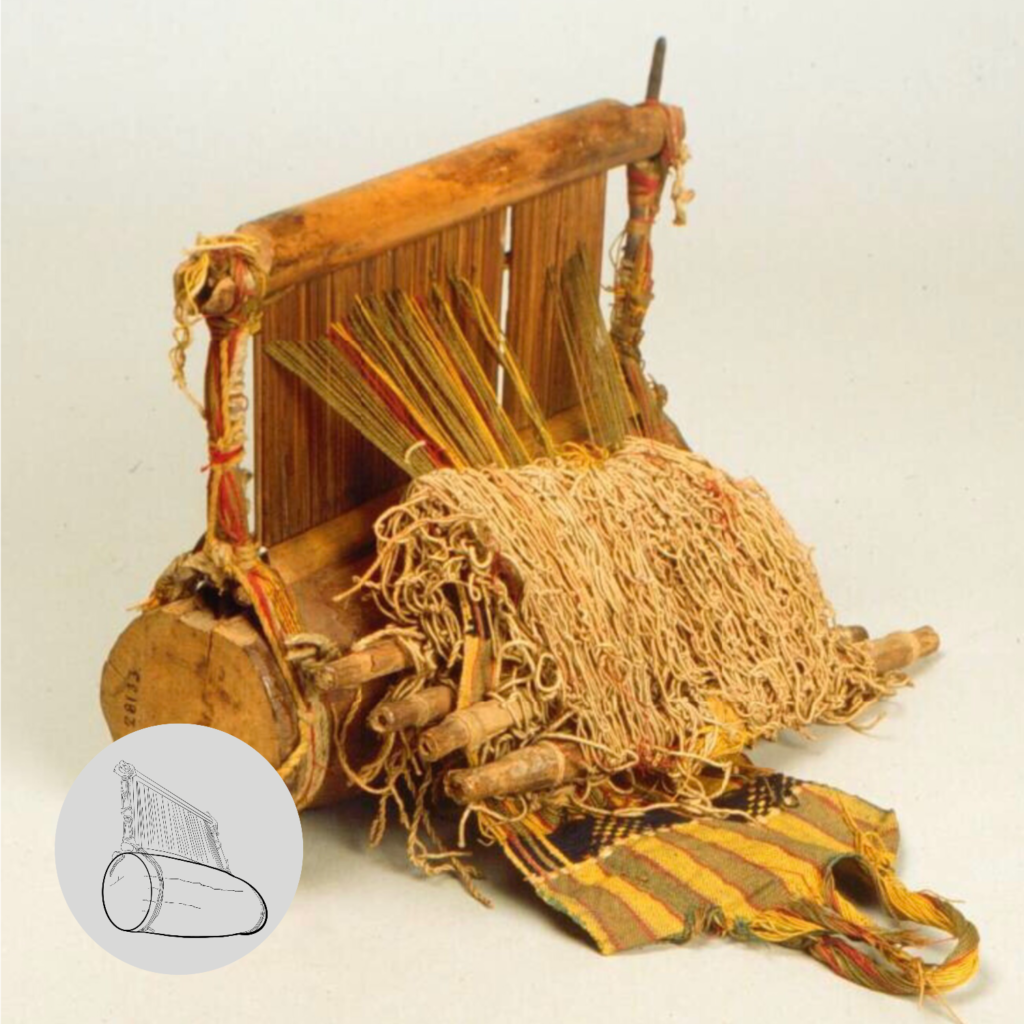
Ethiopia invested heavily in textile industrial parks. Factories were built. Jobs were created. Machinery was imported—from China, from Europe, from India. Not from Nigeria, where the Raw Materials Research and Development Council had already patented an automated weaving machine that could have served that market.
The RMRDC machine exists. It works. It was patented. But when Ethiopia built its textile industry, no one thought to source machinery from another African country. Not because the Nigerian machine was inferior. Because there is no system for African countries to buy African technology.
We trust African minds. We do not trust African machines.
We hire African experts. We do not buy African patents.
We celebrate African innovation. We do not invest in African manufacturing.

The cost of this contradiction

The cost is not just economic. It is strategic.
When we import machinery, we import dependency. We pay for the machine, and we pay again for maintenance, for spare parts, for upgrades, for the expertise to keep it running. The value flows outward.
When we do not buy African technology, we ensure that African technology never scales. The RMRDC loom remains a prototype because there is no domestic market for it. Zarouk Imoro's mycelium innovation remains vulnerable because there is no system to fund its industrialization. Dangote's refinery faced sabotage because the system was designed to preserve import dependency.
The cycle is self-perpetuating: we do not invest, so the technology does not mature, so we do not trust it, so we do not invest.
And while we hesitate, others do not.
China, India, Turkey, and Vietnam have built industrial capacity not by waiting for technology to arrive, but by building it, protecting it, and buying it from each other. Intra-Asian technology transfer is a deliberate industrial strategy. Intra-African technology transfer is almost nonexistent.

The exception that proves the rule

There are signals of what could be.
Rwanda's use of West African financial expertise and Southern African educators shows that African governments can look to African talent for high-level systems work. The Burkina Faso–Ethiopia data center collaboration shows that technical expertise can move across the continent. Dangote's refinery—finally running at full capacity and supplying fuel across Africa—shows that African industrial infrastructure can serve continental needs.
But these remain individual decisions, not systemic policies. They are not backed by investment pipelines, by procurement mandates, by regional technology agreements.
The African Continental Free Trade Area (AfCFTA) was designed to increase intra-African trade. But its focus has been on goods, not technology. There is no equivalent framework for intra-African technology transfer, patent sharing, or industrial collaboration.
We have the framework for selling each other raw materials. We do not have the framework for selling each other machines.

What would change if we decided differently?

Imagine if every African government procurement process included a mandate to source African technology where it exists. The RMRDC loom would have a market. Ethiopian textile factories would be equipped with Nigerian machines. Ghanaian mycelium processing would be funded by Ghanaian development banks and sold to Ghanaian textile manufacturers.
Imagine if foreign-funded infrastructure projects required local technology transfer—not just training, but co-ownership of patents, joint manufacturing agreements, and the right to replicate.
Imagine if the AfCFTA included a protocol on technology transfer, creating a continental market for African-made machines, software, and industrial systems.
Imagine if, instead of undermining the Dangote Refinery, the Nigerian government had treated it as a strategic national asset from the beginning—guaranteeing crude supply, restricting import licences, and building a petrochemical industry around it. The refinery would have been supplying the continent years earlier, and the billions of dollars spent on imported fuel would have remained within Africa.
These are not fantasies. They are policy choices that other regions have made. We have not made them because we have not yet decided that African technology is worth betting on.

The question we must answer

Part 1 asked why our innovations leave. Part 2 asked why the knowledge we already had was never protected. Part 3 asks a harder question: why do we not buy what we build?
We trust African minds. We celebrate African innovation. We hire African experts. But when it comes to the machines, the patents, the systems—we still look elsewhere.
The Dangote Refinery shows us what is possible when African capital builds African infrastructure. It also shows us what happens when that infrastructure is undermined by the very governments that should be protecting it. And it shows us that when external systems fail, African solutions become essential.
This is not about capacity. It is about confidence. And confidence is built by choice.
We can continue to import dependency, or we can decide that African technology deserves an African market. The choice is ours. But the cost of not choosing is already visible.
The RMRDC machine sits in Nigeria, unused. Ethiopia's textile factories run on imported machinery. Ghana's mycelium innovation is celebrated globally but unprotected at home. Dangote's refinery fought for years to be taken seriously by its own government.
These are not failures of invention. They are failures of will.
And will is something no one can import.

The next question

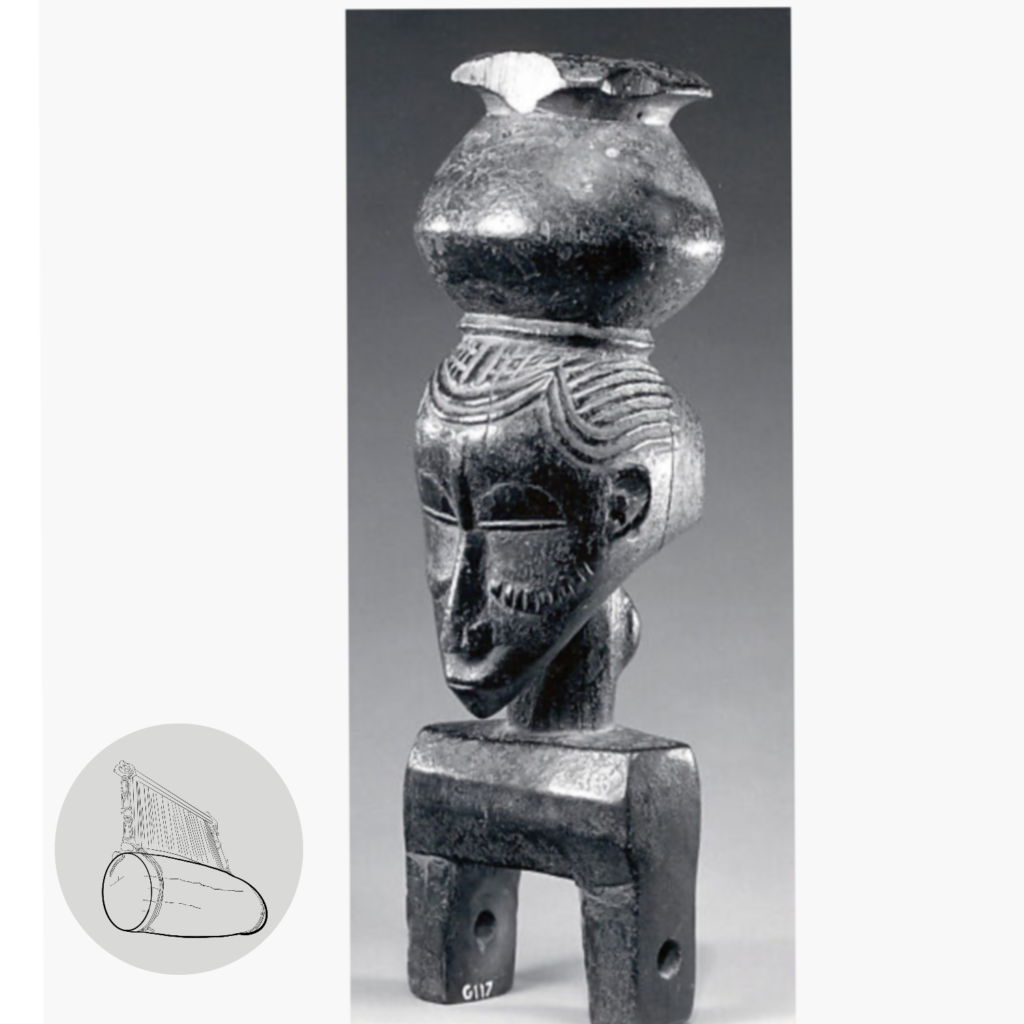
Part 4 will ask a deeper question: how did African textile knowledge build industries we do not own? From indigo to Kuba to wax prints, the extraction of African textile knowledge is not a new story. It is the foundation of the industrial world we now navigate. And understanding it is essential to understanding why ownership deprivation is not an accident—it is a system.

References

· Federal Ministry of Science and Technology, Nigeria. Raw Materials Research and Development Council (RMRDC) Automated Rapier Weaving Machine Project Report. Abuja: RMRDC, 2021.
· EASTRIP. Kisumu National Polytechnic Textile Technology Factory Project Report. World Bank / East Africa Skills for Transformation and Regional Integration Project, 2026.
· Federal Ministry of Industry, Ethiopia. Textile Industrial Parks Development Strategy. Addis Ababa, 2020.
· African Union. African Continental Free Trade Area: Intellectual Property Protocol Negotiations Status Report. Addis Ababa, 2025.
· Science Granting Councils Initiative. Policy Brief: Strengthening Science Granting Councils in Sub-Saharan Africa. 2025.
· Olisa Agbakoba Legal. "The Dangote Refinery-NMDPRA Dispute: Beyond Commercial Disagreement To Questions Of Economic Sovereignty." Mondaq, December 2025.
· "Dangote to double refinery capacity to 1.4m bpd." The Sun Nigeria, March 2026.
· "Dangote's refinery fuel exports in Africa begin." New Era Namibia, March 2026.
· "Dangote reduces petrol gantry price to N1,200/litre." The Punch, March 2026.
· "Agbakoba, Firm Warn Dangote Refinery–NMDPRA Dispute Threatens Nigeria's National Development Goals." The Will News, December 2025.
· "Dangote announces 1.4mbpd as new target to leverage economies of scale." BusinessDay, March 2026.
· "Dangote Refinery pays $18 premium for Nigerian crude as supply shortfalls bite." BusinessDay, March 2026.
· "Group urges Tinubu to halt fuel import licences." The Guardian Nigeria, November 2025.
· "Dangote refinery tenders 84,000 tons of jet fuel and diesel for March loading." Business Insider Africa, March 2026.
· "Middle East tensions propel Dangote Refinery's fuel exports." SABC News, March 2026.


Research IS national security: calling all African nations: Part 2: Africa’s Ownership deprivations.

There is a question we are not asking.
Not in policy meetings. Not in university boardrooms. Not in government ministries where budgets for research are debated and often cut.
The question is simple: who owns what Africa creates?
It sounds straightforward. But when you follow the knowledge—from the communities who developed it, to the laboratories studying it, to the corporations patenting it—the answer becomes unsettling.

The knowledge we already have

Africa possesses a body of inherited ancestral knowledge accumulated over millennia of experience and interaction with the natural environment. This is not folklore. It is not nostalgia. It is technical knowledge: land management systems that sustain biodiversity, pharmacopeia derived from thousands of plant species, manufacturing techniques that transform raw materials into complex textiles and jewelry.
The continent holds more than fifty thousand identified plant species. Traditional ecological knowledge guides the restoration of fragile ecosystems. Indigenous technical knowledge manifests through mastery of materials—casting, hammering, setting, braiding—passed down through generations.
This knowledge is not abstract. It is practiced daily. In Zimbabwe, communities have long used Launaea taraxacifolia to soothe pain and inflammation. In West Africa, indigo dyeing techniques developed over centuries encode sophisticated chemical understanding. In the Democratic Republic of Congo, Kuba cloth patterns embed design logic that scholars now recognize as algorithmic.
But here is the problem: this knowledge was never protected.
Not because it lacked value. Because the system designed to protect knowledge was not built for us.

The system that excludes

The patent system was designed for individual inventors, written documentation, and mechanical innovations. It was not designed for collective knowledge, oral transmission, or techniques developed over generations.
This is not an accident. It is architecture.
As the African Regional Intellectual Property Organization (ARIPO) has documented, traditional knowledge faces specific threats: misappropriation of cultural expressions, biopiracy, and persistent lack of recognition of local communities' rights over their own knowledge.
What this means is simple: a foreign company can study an African textile technique, document it, patent a variation, and sell it back. They can isolate the active compound in a traditional medicinal plant, patent it, and own the rights to a remedy communities have used for centuries. They can reproduce Kuba cloth patterns on global runways without paying a single royalty.
This is not theft in the sense of breaking and entering. It is extraction within a legal system that was built to permit it.

The tools we are building

But the story does not end there. Because across Africa, a new legal architecture is emerging.
In 2024, the World Intellectual Property Organization (WIPO) adopted a landmark treaty on intellectual property, genetic resources, and associated traditional knowledge. For the first time, patent applicants relying on traditional knowledge must disclose the Indigenous Peoples or local communities who provided that knowledge.
This is not perfect. Administering the treaty presents challenges—Africa's rich cultural diversity means traditional knowledge varies widely between communities, and multiple holders may exist for similar knowledge. But it represents a fundamental shift: the recognition that knowledge developed outside Western laboratories deserves protection.
Regional bodies are also moving. ARIPO has developed the Swakopmund Protocol, the first regional instrument globally establishing a detailed legal framework for the protection of traditional knowledge in its member states. The Organisation Africaine de la Propriété Intellectuelle (OAPI) operates a uniform system across its members.
The African Continental Free Trade Area (AfCFTA) is currently negotiating an intellectual property protocol. Scholars argue that this presents a timely, albeit arduous, opportunity for Africa to reconstruct its broken IP architecture by aligning fragmented sub-regional regimes with development-oriented aspirations. The negotiators are being urged to prioritize geographical indications, plant variety protection, and—crucially—traditional knowledge and traditional cultural expressions, which embody Africa's innovative and creative strengths.

The bridge between past and future

This is where the two threads merge.
The knowledge we lost—the textile techniques never patented, the medicinal compounds never claimed, the designs extracted without payment—is not gone. It is still practiced. It is still held. And now, for the first time, there are legal tools to protect it.
But tools are not enough. They must be used.
Countries like Kenya, South Africa, and Uganda have already enacted legislation to protect traditional knowledge. But implementation is weak. Documentation is incomplete. Enforcement is nearly nonexistent.
The Swakopmund Protocol exists. The WIPO treaty exists. The AfCFTA negotiations are underway. But these frameworks only matter if governments prioritize them, if researchers document the knowledge, if communities are empowered to claim what is theirs.

The opportunity we cannot afford to miss

There is a growing global market for what is called "traditional knowledge-derived products." Natural dyes. Indigenous fibers. Medicinal compounds. Sustainable materials. These are not niche markets. They are multibillion-dollar industries.
Africa has the raw knowledge. What we do not have is the legal infrastructure to claim it.
The good news is that we are building it. The bad news is that we are building it slowly, inconsistently, and often without the urgency this moment demands.
Because while we debate, the extraction continues.

The question that remains

Part 1 asked why our innovations leave. This Part asks why the knowledge we already had was never protected—and what we are doing, finally, to claim it.
But there is an even harder question. And it is the subject of Part 3:
If we have African expertise, why do we not buy African technology?
Because the evidence suggests we might hire African professionals, we might consult African engineers—but when it comes to machines, to patents, to systems, we still look elsewhere.
That gap—between trusting African minds and rejecting African machines—is where the next part of this series begins.

References

· Vargas-Chaves, Iván. "Protecting Africa’s traditional knowledge: an approach to intellectual property governance and ARIPO’s role." Frontiers in Human Dynamics, 2026.
· Chuma-Okoro, Helen. "Promoting Traditional Textiles from West African Rural Communities through Communal Intellectual Property Models." AIE Conference, University of Oxford, 2013.
· Sithole, Juliet. "Faculty and Young Researchers at Africa University Transform Indigenous Knowledge into Global Health Solutions." Africa University News, 2025.
· Adebola, T. "Mapping Africa’s Complex Regimes: Towards an African Centred AfCFTA Intellectual Property Protocol." African Journal of International Economic Law, 2020.
· Adams & Adams. "Africa's Hidden Treasures: The WIPO Treaty Revolution." 2025.
· Kongolo, Tshimanga. African Contributions in Shaping the Worldwide Intellectual Property System. Ashgate, 2012.

Research IS national security: Calling All African Nations: We dont lack innovation. We lack the will to keep it.

There is a story Africa is told about itself. It goes like this: we do not invent. We do not create. We consume what others build, adopt what others design, import what others manufacture. Our role is to provide raw materials and wait for technology to arrive from elsewhere.

This story is convenient—for those who benefit from it.

Because the truth is the opposite. Africa does not lack innovation. What we lack is the will to keep it.

The machine Nigeria built and forgot

In 2021, Nigeria’s Raw Materials Research and Development Council (RMRDC) did something remarkable. They developed and patented an automated rapier weaving machine for commercial Aso‑oke production. This was not a small achievement. The machine worked. It produced large quantities of fabric with more consistent results than handwoven Aso‑oke. The technical breakthrough was significant: they modified the conventional rapier head from single weft insertion to multiple weft insertions in a single shed. The RMRDC stated the project would “catalyse the establishment of automated weaving loom manufacturing industries in Nigeria with attendant huge investment and employment opportunities.”

That was 2021.

Today, there is no evidence the machine was commercialized. No evidence it was licensed to manufacturers. No evidence it was scaled. The patent exists. The prototype exists. But where are the Nigerian-made automated looms? Where are the jobs? Where is the industry that was supposed to follow?

This is not a failure of invention. It is a failure of will.

The mycelium Ghana showed the world

In Ghana, Zarouk Imoro developed something that should have made headlines across the continent. An environmental technologist, he created “Myco-Substitutes”—a system that uses fungi to treat faecal waste and produce mycelial thread as an alternative to cotton or synthetic thread, and fungal mycelia leather as an alternative to animal hide. The process is elegant: bacteriophages remove bacteria from faecal sludge; fungi feed on the remaining waste; toilet paper in the sludge acts as a carbon source for mycelial growth. Ten litres of sludge produces 500 grams of mycelia.

Imoro won the “One to Watch” award at the Royal Academy of Engineering’s Africa Prize. International attention followed.

But here is the question that no award can answer: has the innovation been patented? Not in Ghana, as far as the public record shows. Not internationally. The technology is visible, recognized, celebrated—and legally exposed. Anyone, anywhere, can replicate it, refine it, and patent it elsewhere. The knowledge may leave Ghana not because it was stolen, but because it was never protected.

This is not a failure of creativity. It is a failure of protection.

The pattern we refuse to name

These two cases—Nigeria’s abandoned loom, Ghana’s exposed mycelium—are not isolated. They are symptoms of a continent-wide pattern.

We fund research without funding scale-up. We celebrate innovation without securing ownership. We send students abroad on scholarships with no IP agreements, watch them develop patents in foreign institutions, and tell ourselves this is simply how the world works.

But it is not how the world works. It is how the world works for us.

Because other nations do not behave this way. Brazil, where Dr. Abdulrazak Ibrahim helped develop and patent a whitefly control technology, retained that patent because Brazilian public funding and infrastructure made it possible. The technology was developed on Brazilian soil, with Brazilian money, under Brazilian law. That is how research becomes national security.

Where is the African EMBRAPA? Where are the African research institutions with the capacity to host PhD students so they do not have to leave to access other facilities? Where are the patent offices funded to help innovators file claims? Where are the industrial policies that take a proven prototype and turn it into a factory?

We have the talent. We have the ideas. We have the prototypes. What we do not have is the system that turns invention into wealth.

The real deficit

The deficit is not in African minds. It is in African institutions.

Research without ownership is extraction. Innovation without industrialization is loss. Knowledge without protection is vulnerability. We are not losing because we cannot create. We are losing because we do not demand retention.

This is not a technical problem. It is a political one.

Governments fund roads, armies, and ports as infrastructure of sovereignty. Research is the same. A nation that does not fund its own research cannot set its own agenda. It cannot protect its own resources. It cannot develop its own industries. It cannot retain its own talent.

When we celebrate innovation that leaves, when we fund research without scale-up, when we send students abroad with no IP agreements, we are not supporting development. We are subsidizing extraction.

Where this leads

This series is not about why Africa lacks innovation. It is about why we allow our innovations to leave. It is about the systems—or absence of systems—that turn our knowledge into someone else’s asset.

In the next parts, we will ask harder questions: Who really owns what Africa creates? Why do we buy African expertise but not African technology? How did African textile knowledge build industries we do not own? And finally, what must governments do to build, protect, and retain what is ours.

But the first step is to stop telling ourselves the story that we do not invent. We do. We always have. The question is whether we will finally decide to keep what we make.


References

· Federal Ministry of Science and Technology, Nigeria. Raw Materials Research and Development Council (RMRDC) Automated Rapier Weaving Machine Project Report. Abuja: RMRDC, 2021.
· Imoro, Zarouk. “Myco-Substitutes: Fungal-Based Textile Alternatives.” Royal Academy of Engineering Africa Prize for Engineering Innovation, 2024.
· Ibrahim, Abdulrazak. “RNA Interference Technology for Whitefly Control.” EMBRAPA, Brazil. Patent filed 2018.
· Science Granting Councils Initiative. Policy Brief: Strengthening Science Granting Councils in Sub-Saharan Africa. 2025.
· African Union. Science, Technology and Innovation Strategy for Africa (STISA-2024). Addis Ababa: African Union, 2014

The Loom Was the First Computer: How Africa’s Textile Logic Built the World—And Why Colonizers Erased It

Introduction

Modern technology tells a convenient story about itself.
It begins in Europe.
It advances through invention.
It culminates in machines.

Everything else—everything before—is reduced to craft, culture, or tradition.

But this story depends on a fragile assumption: that technology only begins when knowledge becomes mechanical. If we reject that assumption, even briefly, the timeline collapses.

Long before machines, there were systems capable of encoding information, executing instructions, and generating complex, repeatable outputs. Those systems were textile systems. And textile production is not just craft—it is one of the foundational technological systems that shaped industrialization, automation, computing, and global capitalism (including slavery and colonial extraction).

Once we begin there, it becomes impossible to ignore a second truth: the intellectual foundations of modern technology were not only global—they were selectively recognized.


African Looms: Technology Without Recognition

Before mechanization, looms across Africa already functioned as precision technologies. In West Africa, strip‑weaving traditions—seen across regions including present‑day Ghana, Nigeria, and Mali—relied on narrow‑band looms, tension control systems, pattern memorization and execution, and modular construction (strip assembly into larger cloths).

These were not simple tools. They were controlled environments for executing patterned logic. The weaver configures the loom (setup phase), encodes pattern rules mentally or culturally, and executes sequences through repeated motion. This is not improvisation. It is structured.

As Mozambican mathematician Paulus Gerdes—who spent decades documenting African mathematical heritage—writes: “In many African crafts, mathematical ideas are not taught as abstract concepts but are embedded in the techniques themselves.” Gerdes’s work, particularly his studies of Mozambican and Angolan weaving, shows that African artisans used symmetry, repetition, translation, and rotation as fundamental operations in design.

This embedding is critical. Because it reveals something often ignored: the absence of written formulas does not mean the absence of mathematics. It means the mathematics is being performed.


Weaving as Algorithmic Execution: The Tellem Case Study

To understand weaving is to understand instruction. A textile is built through ordered sequences, repeated operations, and conditional variations. Each row depends on the previous one; each pattern depends on a rule.

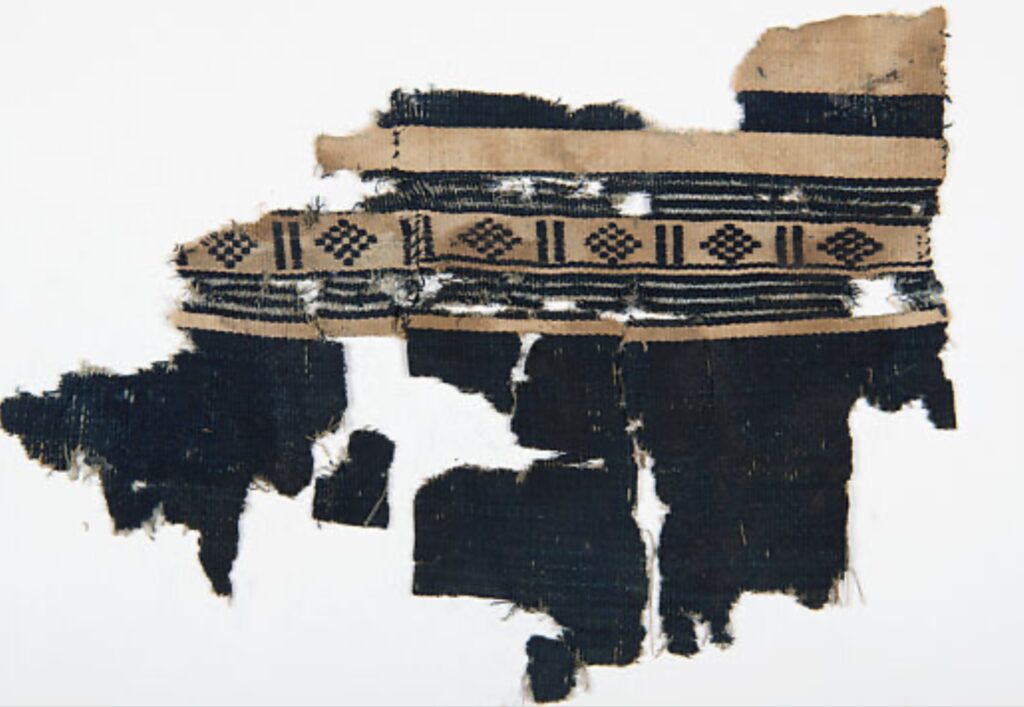
The Tellem people, who lived in the Bandiagara cliffs of present‑day Mali, left behind textiles that continue to challenge assumptions about pre‑industrial design. These textiles display geometric repetition, symmetry across axes, and structured variation within constraint. What makes them significant is not just their visual complexity but their generative logic.

Tellem textile
Tellem textile, Mali

Patterns are not isolated images. They are constructed through repeatable units, transformation rules, and extendable sequences. Gerdes’s work on African textiles broadly shows that such systems involve what he calls “systematic exploration of symmetry and pattern construction.” These are the same operations used in computer graphics, pattern generation algorithms, and digital modeling systems.

What the Tellem textiles demonstrate is that a finite rule system can produce an indefinitely extendable pattern. This is the essence of algorithmic generation—not in theory, but in material form.


The Benin Bronzes: African Metallurgy as Parallel Innovation

African technological sophistication was not limited to textiles. The Benin Kingdom (in modern‑day Nigeria) produced some of the world’s most technically advanced metal castings—the so‑called Benin Bronzes. Using the lost‑wax method, Benin artisans created lifelike heads, intricate plaques, and ritual objects from at least the 13th century onward. Their work displayed not only extraordinary artistry but also mastery of alloy composition, inlay techniques, and large‑scale casting.

Yet the raw material—brass—came from Europe. Portuguese traders brought brass manillas (bracelet‑shaped currency) from Germany’s Rhineland to West Africa as part of the same trade networks that carried enslaved people. African artisans melted these imported objects and transformed them into works of profound cultural and technical achievement. When British forces looted Benin City in 1897, they took thousands of these objects, sold them to museums, and erased the knowledge systems that produced them.

This pattern—African skill combined with raw materials extracted through colonial trade, followed by violent appropriation—mirrors what happened with textiles. In both cases, the colonial narrative reframed African innovation as mere “craft” while European institutions profited from the objects and the knowledge embedded in them.


Infinite Pattern, Recursion, and the Ifá Information System

Modern computing relies on the idea that simple instructions can generate complex outputs and that systems can scale without losing structure. This is the foundation of fractals, recursive algorithms, and procedural design.

The research of Ron Eglash, a scholar of African fractals, makes this connection explicit. He writes: “Many African designs use recursive scaling, where a pattern is repeated at different levels of size.” This is not symbolic; it is structural. “These are not just designs, but processes.” That distinction matters, because processes are what define computation.

African knowledge systems extend this logic beyond textiles. The Ifá system of the Yoruba people—documented extensively by the Nigerian scholar Wande Abimbola, who served as Vice Chancellor of Obafemi Awolowo University—is built on 256 odu (signs) generated through a combinatorial, binary‑like process. When a babalawo (priest) casts the sacred palm nuts or opele chain, they produce a specific odu based on established rules. Each odu is linked to a vast corpus of verses (ese) that encode history, philosophy, medicine, and ethics. The interpretation follows structured pathways, applying stored knowledge to the querent’s situation.

Western scholars labeled Ifá a “divination system.” The term carries assumptions of irrationality, mysticism, and guesswork. But Ifá is better understood as a knowledge system—a logical, rule‑based method of storing, retrieving, and applying information. The operations are not random; they follow predictable combinatorial logic. The years of training required to memorize the ese are no different from the training a computer scientist undergoes to master programming languages and algorithms.

In fact, Ifá and modern artificial intelligence share a fundamental structure. When you consult an AI, you ask a question; the system processes it through a vast dataset, retrieves relevant patterns, and generates a response based on encoded rules. A babalawo does the same: the querent’s concern is mapped to an odu; the odu retrieves the appropriate verses; the babalawo applies the wisdom to the situation. One practice is called “divination”; the other is called “artificial intelligence.” The difference in naming reflects not the nature of the practice, but the racial and colonial hierarchies that determine which knowledge counts as “science” and which is dismissed as “tradition.”

Long before the formalization of binary code in Europe, African knowledge systems such as Ifá developed complex combinatorial and binary‑like structures for storing and processing information. These systems, alongside textile pattern encoding, demonstrate that computational thinking was not invented in the West but has multiple global origins—many of which were later marginalized during colonialism.


The Industrial Revolution: Mechanization Without Acknowledgment

Textiles drove the Industrial Revolution. Mechanized spinning and weaving transformed production. But this transformation relied on raw materials extracted through colonial systems, labor extracted through slavery, and knowledge extracted through global contact.

European mechanization did not arise from a vacuum. The first successful power loom, patented by Edmund Cartwright in 1785, was developed in a context where British factories processed cotton grown by enslaved Africans in the Americas and sold finished cloth to West African consumers whose preferences shaped global production. The logic of weaving—sequencing, repetition, pattern encoding—had existed for centuries in African and other non‑European textile systems. Industrialization scaled that logic, but it did not invent it.

Why, then, did Africa not develop its own mechanical looms? Some scholars point to divergent technological trajectories: African ironworkers used bloomery furnaces, which produced malleable iron perfect for forging tools and weapons but not molten iron for casting large machine components; European blast furnaces, developed partly for cannon production, enabled cast‑iron looms. From this perspective, the difference reflects material constraints and choices, not a hierarchy of “advancement.” Yet this framing, while common in academic literature, risks deflecting attention from the more fundamental issue: African textile industries were actively undermined by colonial policies that flooded markets with cheap European machine‑made goods, redirected raw materials, and dismantled local production. Whether African ironworkers could have eventually developed cast‑iron looms under different conditions is a question that remains open—and one that colonial violence foreclosed.

As Walter Rodney, the Guyanese historian, wrote in How Europe Underdeveloped Africa: “The only positive development in Europe was at the expense of Africa and other parts of the world.” This applies not only to resources—but to systems of knowledge.


The Politics of Recognition: Why Knowledge Was Categorized by Race

The problem is not that African systems lacked sophistication. The problem is that they were not recognized as such.

Cedric J. Robinson, author of Black Marxism, argues that “the development, organization, and expansion of capitalist society pursued essentially racial directions.” This includes how knowledge is categorized. Under this system, African systems became “craft” or “tradition,” while European systems became “science” and “technology”—even when both operated through pattern, logic, repetition, and transformation.

This erasure was not passive. Colonial collecting was systematic. Take the Hina textile from northern Cameroon: a cotton fabric taken during a German “punitive expedition” in 1908, when villages were burned and people killed or taken hostage. The cloth was sold to a museum, inscribed with the catalog number of the officer who led the assault, and its original name, maker, and meaning were lost. Such looted textiles joined Benin Bronzes and other objects in European collections, where they were reclassified as “ethnographic artifacts” rather than evidence of technological sophistication. Colonial regulations often required that objects acquired during state‑sponsored expeditions go to museums, ensuring that African knowledge was physically removed and reframed.

The connection between textiles and computing is not speculative; it is historical. Punch cards from the Jacquard loom influenced early computing. Pattern encoding maps directly onto binary logic. Mechanical repetition prefigured automation. But beneath this history is a deeper continuity: the logic of computing did not originate with machines. Machines inherited it. And that logic was already present in textile systems, pattern traditions, and knowledge practices across Africa and its diaspora.


Conclusion: The Technology That Was Always There

The question is no longer whether textiles contributed to modern technology. The question is: why were they never fully recognized as technology in the first place?

If we redefine technology as systems of structured knowledge and processes that encode and reproduce information, then textiles—especially African textile systems—are not peripheral. They are foundational.

And the history of technology, as it is currently told, is not incomplete by accident. It is incomplete by design.


References

· Abimbola, Wande. Ifá: An Exposition of Ifá Literary Corpus. Oxford University Press, 1976.
· Eglash, Ron. African Fractals: Modern Computing and Indigenous Design. Rutgers University Press, 1999.
· Gerdes, Paulus. Geometry from Africa: Mathematical and Educational Explorations. Mathematical Association of America, 1999.
· Gerdes, Paulus. African Mathematics: From Bones to Computers. University Press of America, 2008.
· Robinson, Cedric J. Black Marxism: The Making of the Black Radical Tradition. University of North Carolina Press, 1983.
· Rodney, Walter. How Europe Underdeveloped Africa. Bogle‑L’Ouverture Publications, 1972.
· Soloum, Salomé. “The Hina Textile: Colonial Looting and Museum Collections.” TRAFO Blog, 2025.
· Skowronek, Tobias, et al. “German Brass for Benin Bronzes.” Journal of Archaeological Science, 2023.


Stolen Stitches: Recovering Africa’s Indigenous Hook-Based Textile Heritage

The African continent has a rich and wide textile practice spanning since the beginning of times. Hook based textile practices was also part of this rich heritage. It is therefore no mystery, that the craft of Crochet has become very popular in contemporary African nations. This popularity, however, exists within a paradox: many contemporary African practitioners understand crochet as a European import, severed from knowledge that their own continent possesses millennia-deep traditions of hook-based fiber manipulation.

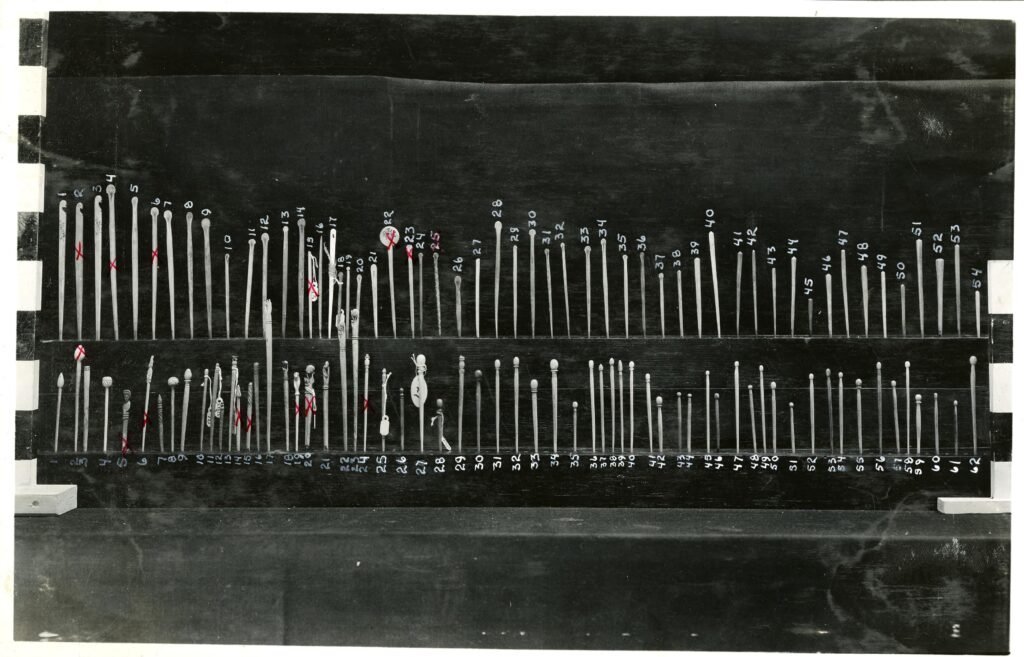
Early ancient hooks were found, possible a crochet hook in ancient excavated site of Karanis in Egypt.


"Karanis; Crochet Hook (?); Bone (Unidentified)." In the digital collection Kelsey Museum of Archaeology Art & Artifact Collection. https://quod.lib.umich.edu/k/kelsey/x-0000.02.1769/7_2527p02. University of Michigan Library Digital Collections. Accessed February 19, 2026.

This bone implement, housed at the University of Michigan, is one of several such tools recovered from Egyptian excavations. Implements from Karanis confirm that the technological principle of manipulating fiber with a hook was understood and practiced in ancient Africa. The tools are fashioned from materials that would have been readily available—bone, wood, ivory—suggesting that the technology was neither rare nor imported, but indigenous and established. While Eurocentric scholarship often defaults to cautious language ("possible crochet hook"), the evidence speaks for itself.

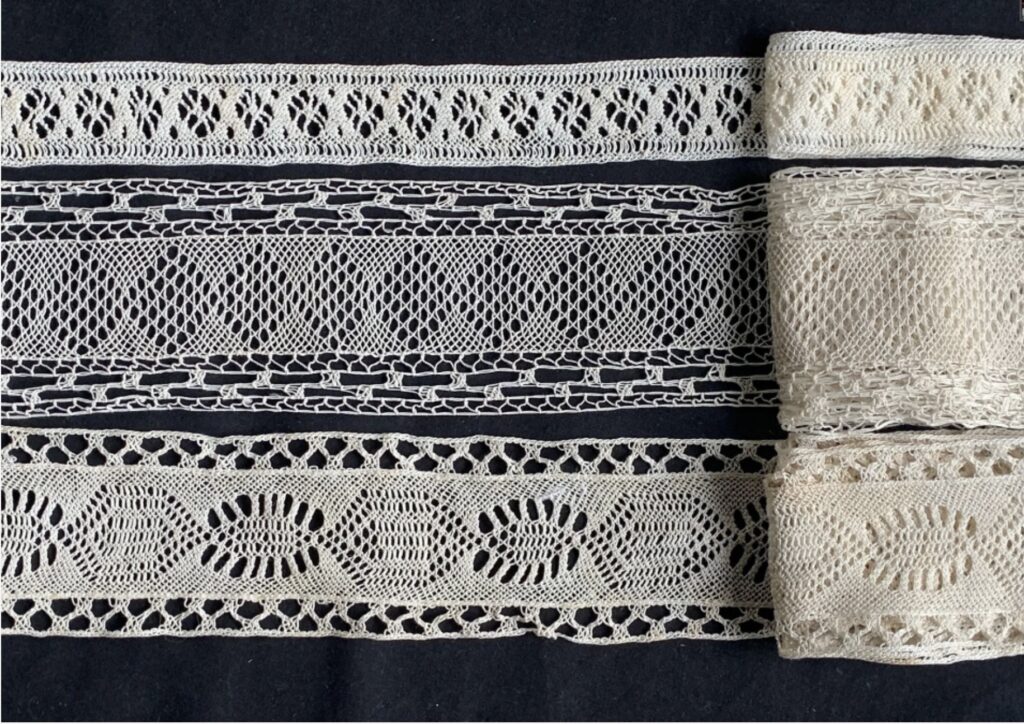
The Ancient Chebka Lace, needle-knotted stitch is a close relative to the filet crochet. Initially practiced in Tunisia, it was used to create geometric bands, while the filet crochet techniques allows you to create complete projects including vests or table wear.

Ref: https://coutaubegarie.com/lot/157092/26525906-three-entre-deux-and-one-carre-in-chebka-lace-north-africa

Chebka was first practiced by individual women in Tunisia to adorn their traditional garments. The technique later spread to Algeria and Morocco, where it remained in use. Its geometric patterns reflect design languages common across North Africa, developed entirely independently of European influence. The structure is identical in principle to filet crochet's netted grounds, but Chebka predates the European systematization of filet crochet by centuries. It represents an African solution to creating decorative net-like grids.

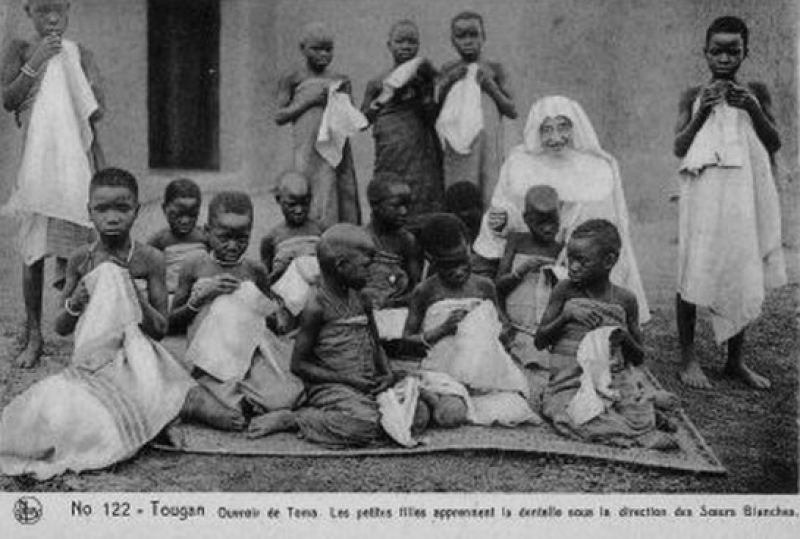
Under the disguise of atrocities committed in the name of benevolent missionary works, Nuns used textile practices to gain access to vulnerable communities, where they taught practices that were stolen from African nations and re-packaged and re-introduced as another way to further penetrate our communities.

The white nuns teaching "Western European embroidery and lace techniques to local girls. A practice continued under NGO's

Source: https://trc-leiden.nl/trc-needles/regional-traditions/middle-east-and-north-africa/pre-modern-middle-east-and-north-africa/embroidery-and-the-white-sisters

The photograph shows White Sisters in what is now Burkina Faso, circa 1930, instructing local girls in techniques presented as "Western European embroidery and lace." Yet Chebka lace, which these same nuns would have taught in North African missions, was not European at all. It was North African. The pattern is consistent: African techniques were extracted, stripped of their origin, and then taught back to Africans as European knowledge. This was not cultural exchange. It was cultural erasure. Nuns gained access to vulnerable communities by offering textile instruction, while simultaneously dismantling the very traditions that had produced those techniques. The goal was not education but domination—spiritual, cultural, and economic.

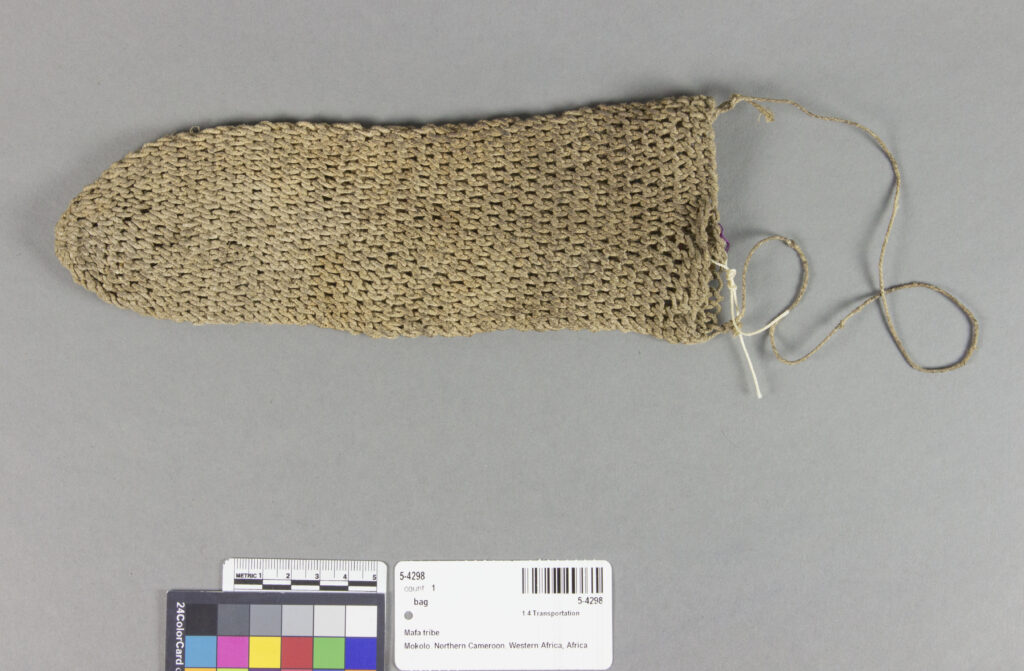
The knotless Netting is a material example of another African nations, Cameroon, Indigenous hook based textile technique. This netting sack called Nkekelewe, comes from the Mafa people in Cameroon. It is made using a knotless netting technique.

Source: https://portal.hearstmuseum.berkeley.edu/catalog/93f3405f-1823-4a24-886c-80c524a1eb60

The Mafa sack was collected in 1965 by Paul Hinderling and donated to the Phoebe A. Hearst Museum at Berkeley. It is made from bean fiber cordage, materials that would have been locally available. The object is catalogued with the technique explicitly identified: knotless netting. This is not a guess. It is documentation.

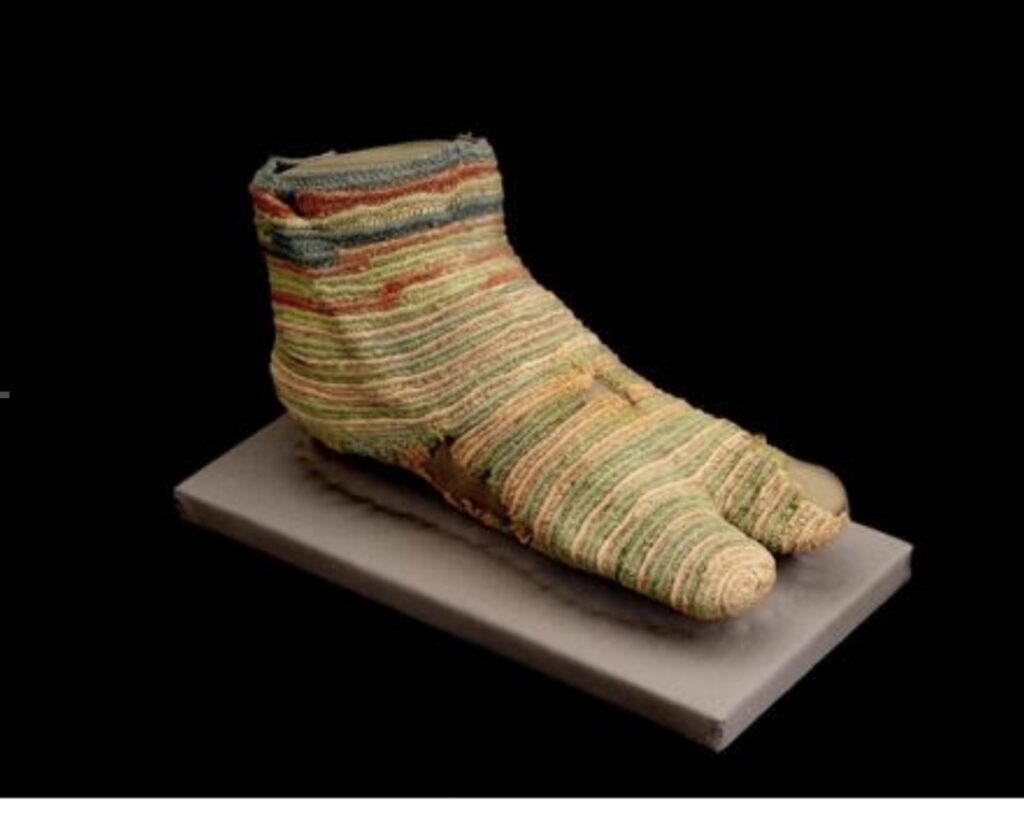
Ref: https://collections.rom.on.ca/objects/527320/adult-sock

The knotless netting technique is being made using bean fiber cordage. It is not a colonial-era introduction, it is an indigenous Cameroonian object that was collected in 1965, representing a longstanding local practice that survived despite colonial violence.

The Mafa knotless Netting technique predates knitting and crochet, with the oldest known fragments dating to c. 6500 BCE from the Judean Desert. Knotless netting, technically termed nålbinding, is an ancient technique whereby a single needle creates fabric through a series of loops and passes. The same technique appears in Egypt in the form of Coptic socks from the 4th to 7th centuries CE. The Royal Ontario Museum holds multiple examples (910.130.143, G1281). The National Museums Scotland holds a divided-toe sock from Akhmim (A.1911.315). The Petrie Museum houses a pair excavated from Hawara (UC16766). All are made using nålbinding—knotless netting—the same technique the Mafa people used to make their sack. European crochet, as codified in the nineteenth century, is a latecomer to a technological family Africa had already mastered.

Ref.: https://www.nms.ac.uk/search-our-collections/collection-search-results?entry=404856

This is not coincidence. It is continuity. The technology existed in Africa for thousands of years before European crochet was systematized. When Europeans claim crochet as their invention, they erase this history.

The future of African Hook textile practices

You don't have to go too far on TikTok to find a large community of Africans practicing the craft of Crochet. They hail from all the African nations. They create amazing looking designs, largely inspired by European aesthetics. It could be that these young and older practitioners were introduced to this technique from a European perspective, not knowing that their continent has a long established legacy with hook based textile practices.

That is why, it is important that Timbuktu research and design emphasise the rich textile heritage and practices in pre-colonial Africa.

The colonial project did not just steal land and resources. It stole knowledge and then sold it back. It taught us to look to Europe for validation, to value European techniques over our own. The result is a generation of African creators who can produce stunning crochet work but have never seen a Mafa netting sack or a Coptic sock or a piece of Chebka lace. They do not know that their ancestors were doing this work. Practitioners are introduced to crochet through patterns and tutorials presenting it as a Western craft. They are not shown the evidence. They inherit a severed history.

While the contemporary practice of Crochet and Hand knitting might differ from ancient practices, we uphold the fact that practices, like cultures, evolved. The African hook textile practices with practice changes and includes new techniques making it not far fetched to claim also crochet as emerging from African practices.

We do not need to prove that ancient Africans did exactly what European crocheters do today. That is not how culture works. We need to show that the technology—manipulating fiber with a hook to create fabric—was present in Africa for millennia. We need to show that African women were creating openwork textiles with needles and hooks before European contact. We need to show that when colonial nuns arrived to "teach" lacemaking, they were often teaching techniques that originated in Africa. The claim that crochet emerges legitimately from African technological traditions is not sentimental—it is factual.

An academic study by Vivian Korankye at the Takoradi Technical University, demonstrate that we seek to investigate how our heritage practices can inform our future contemporary practices. Vivian investigates techniques for innovating indigenous vegetable-tanned leather into yarn.

Manipulating Indigenous Vegetable-Tanned Leather for Use in Crocheting Art

The study explores techniques and methods used in converting indigenous vegetable-tanned leather into yarns that can serve as an alternative material and convert the locally made yarns into crocheted ladies containers and footwear using different stitches.

Ref: https://www.prophy.ai/article/169067466-Manipulating-Indigenous-Vegetable-Tanned-Leather-for-Use-in-Crocheting-Art/

The study employed a qualitative methodology combining descriptive and studio-based approaches, sampling crochet artisans, leatherwork teachers, and leather technologists. The study concludes that indigenous vegetable-tanned leather is suitable for use in making crocheting yarns due to its strength, flexibility, and suitability for hook construction. Spiral cutting techniques emerged as the most appropriate method for cutting leather into yarns, with recommended processing steps including cutting, softening through wet pounding, and dyeing using vat or mixed dye methods.

This research matters because it starts from African material and African technique. It does not ask permission from European tradition. It does not seek validation from European institutions. It simply works with what is here—leather tanned using indigenous methods, yarns produced by African hands, crochet hooks held by African fingers. It takes an African material and applies African research to develop contemporary applications. It is a continuation of the same technological tradition that produced the Mafa sack and the Coptic socks and Chebka lace.

Conclusion

The evidence is not ambiguous. Bone tools from Karanis. Chebka lace from Tunisia. Knotless netting from Cameroon. Coptic socks from Egypt. Hook-based textile practices constitute an authentic and enduring dimension of Africa's material culture, dating back millennia. Colonialism disrupted this heritage, stole credit for it, and repackaged it as European charity. But the techniques survived, and the knowledge persists.

The work now is to remember. To recover. To refuse the colonial narrative that taught us to forget.