
Introduction: The Problem with "Tradition"
When visitors to Curaçao admire the vibrant saya ku djèki during the Seú parade, or when cultural festivals showcase women in elaborate headwraps and men in cream-colored shirts, these garments are presented as timeless expressions of Curaçaoan identity. They are called "traditional dress."
But this label obscures a more uncomfortable truth. What we celebrate as cultural heritage was born from the bodies of taken African people—men and women torn from their homelands, forced into the holds of Dutch slave ships, and deposited on an island where they would be required to rebuild identity from fragments. This essay interrogates, through a critical design lens, how the experience of enslaved Africans—their trauma, their memory, their creativity—shaped what became Curaçao's traditional clothing. It asks a fundamental question: Is this tradition, or is this necessity—preserved, polished, and rebranded over generations?
The garments now called "traditional" were not designed in freedom. They were assembled from the materials of oppression: the cargo lists of Dutch merchants, the coarse fabric issued to laborers, the empty flour sacks of impoverished families, and the starch of a cassava root grown on land they did not own.
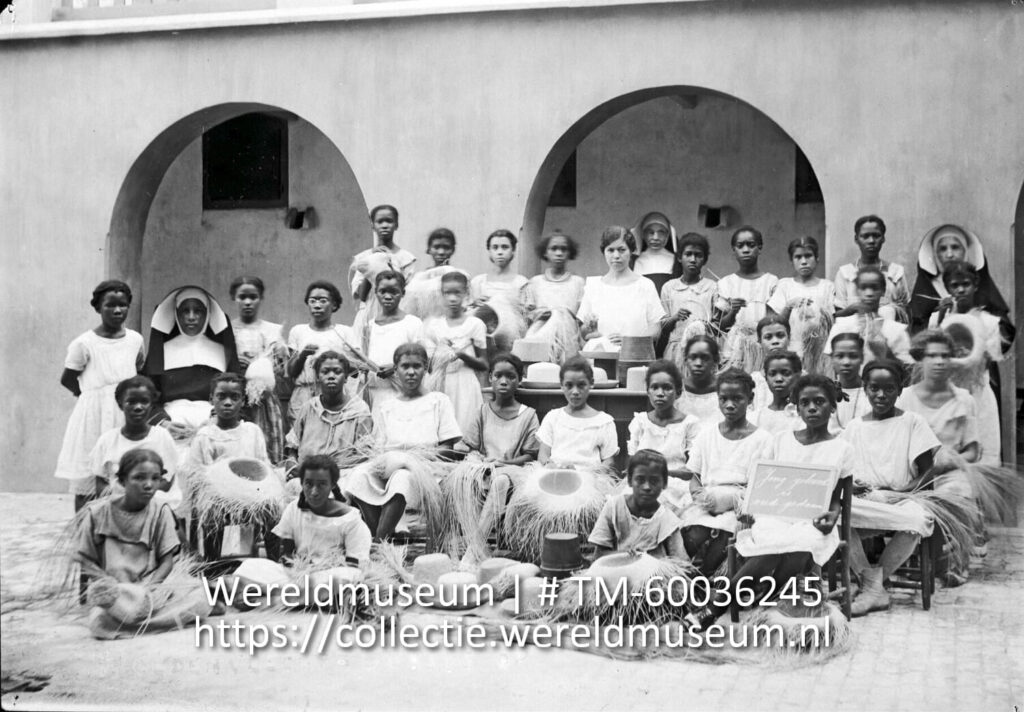
Yet there is something more at work here—something that resists simple explanations of material scarcity. The saya ku djèki—that distinctive combination of wide skirt and fitted top—is not unique to Curaçao. Travel across the Black diaspora, and you will find its echoes everywhere. In Brazil, the baiana dress of Salvador's Carnival carries the same volumetric skirt and elaborate headwrap. In Colombia's Palenque, in the pollera of Panama, in the bata of Cuba's Santería practitioners, in the nagua of Venezuela's Afro-descendant communities, the same silhouette appears and reappears. It emerges in the quadrille dress of Haiti and the douillette of Martinique. The forms are not identical—each carries the imprint of its specific colonial power, its local materials, its particular history—but the family resemblance is undeniable.
What are we to make of this? The connections are not always scientifically traceable. There is no single shipping manifest documenting the movement of a skirt pattern, no colonial decree that mandated this particular silhouette across Dutch, Spanish, Portuguese, and French colonies. And yet the form persists—a deep structure carried in memory, in muscle, in the hands of women who taught their daughters to sew as their mothers had taught them. It suggests that taken African people, dispersed across the Americas, developed similar aesthetic solutions to similar problems: how to dress modestly under the gaze of oppressors, how to preserve dignity through fabric, how to signal identity through silhouette.
This opening observation—that the saya ku djèki belongs to a pan-Afro-diasporic family of dress—points toward research still to be done. If the same form appears in Curaçao and Brazil, in Cuba and Colombia, what does that tell us about the deep connections that survived the Middle Passage? What knowledge traveled not in books but in bodies, not in patterns but in memory? This essay focuses on Curaçao as a case study, but the questions it raises ripple outward, inviting future scholars to trace the threads that bind the Black Americas together.
Part I: The Raw Materials of Oppression – Textiles in the Slave Era
Before there could be a saya ku djèki, there had to be fabric. And in 17th and 18th century Curaçao, fabric arrived not for the comfort of the enslaved, but for the profit of the enslaver. The very fibers that would eventually become "traditional dress" first touched the island as cargo—listed in ledgers, exchanged for human beings, and distributed according to the logic of empire.
The Dutch Textile Machine
The Dutch were master textile traders. Through the Dutch East India Company (VOC), they flooded the Atlantic world with Indian cottons—calicoes, chintzes, and the distinctive plaid Madras cloth. By the 1600s, these fabrics were reaching Curaçao, but their journey tells us everything about the broken connection this essay traces. These textiles arrived not as goods for the enslaved to wear with pride, but as:
· Currency in the slave trade, exchanged for human beings on the African coast
· Cargo to be re-exported to Spanish colonies
· Payment for plantation infrastructure
· Clothing issued to enslaved laborers at the lowest possible cost
Madras cloth, now celebrated as a symbol of Afro-Caribbean identity, arrived as a commodity of empire. Its transformation into a marker of resistance and belonging happened despite its origins, not because of them. The same fabric that wrapped African bodies in the hold of a slave ship would later wrap the heads of their descendants in ceremonies of freedom. The connection between origin and meaning is not just broken—it is violently severed and painstakingly repaired by generations of women who refused to let the cloth carry only the story of their oppression.
The Paradox of Trade Cloth
This paradox deserves attention. The Dutch did not import Madras cloth for enslaved people. They imported it as trade goods—to be sold, bartered, and exchanged along the West African coast for more human cargo. That some of these textiles eventually reached the hands of enslaved people in Curaçao was incidental to their purpose. They were not gifts; they were the loose change of a brutal economy.
And yet, once in those hands, the cloth was transformed. A length of Madras—called injiri or 'George' by the Kalabari people of Nigeria, who had worn it for centuries before the slave trade—might be woven in South India, shipped by Dutch merchants to the West African coast, and exchanged for enslaved human beings. That same cloth, carried across the Middle Passage in memory as much as in baggage, might end its journey as a headwrap in Curaçao—wrapped in a style that remembered Africa, worn with a dignity the Dutch never intended. The cloth carried the violence of its journey, but it also carried possibility. This is the broken connection made visible: the same object can contain both trauma and resilience, both theft and creation.
Clothing the Enslaved: The Bare Minimum
When enslaved people were given clothing—and the word "given" itself is a deception, for nothing was given that their labor did not purchase many times over—it was not an act of kindness but of economic calculation. Coarse, cheap fabrics were imported specifically to outfit laborers at the lowest possible cost. These included:
· Osnaburg: a rough linen named for the German city where it was produced, stiff and uncomfortable against skin
· Low-grade cotton: often unbleached, undyed, and quickly worn thin
· Heavy wool: entirely unsuited to the tropical climate, likely issued because it was cheap, not because it was appropriate
These were the textiles of subsistence. They were designed for durability, not dignity; for covering, not expression. The Dutch were not interested in whether enslaved people felt human in their clothing. They were interested in whether the clothing would last another season before requiring replacement.
And yet—and this is the central tension of this entire study—even these scant materials became sites of meaning. As scholarship on Curaçaoan women documents, enslaved women took the rough fabric they were issued and made something more of it. They did not simply wear what they were given; they transformed it.
The Headwrap: Memory in Cloth
Nowhere is this transformation more evident than in the headwrap. The styles documented at Landhuis Chobolobo—Punta di Skálo with its supportive knot for carrying buckets, Pèchi Yaya for special occasions—are not European inventions. They are direct lines back to the African continent, preserved through the Middle Passage, adapted to new materials and new circumstances.
The headwrap tells us something crucial about how taken African people approached cloth. When they received coarse osnaburg or cheap cotton, they did not see only what the Dutch intended. They saw possibility. They saw memory. They saw a way to continue, in a new land, practices their mothers had taught them. The cloth may have been European, but the meaning was African.
This is an early act of what we might call design resistance: the refusal to let material be merely material, the insistence on imprinting identity onto even the most meager resources. The headwrap is not just a piece of fabric wrapped around hair. It is a repository of memory, a marker of occasion, a tool for labor, and a statement of selfhood—all at once.
The Connection That Was Never Supposed to Survive
The Dutch textile machine was designed to move goods and people as efficiently as possible. It was not designed to preserve African aesthetics or enable cultural continuity. And yet, despite every effort to strip enslaved people of their identities, the knowledge of how to wrap a head, how to style fabric, how to make cloth carry meaning—this knowledge survived.
It survived in the hands of women. It survived in the whispered instructions from mother to daughter. It survived in the muscle memory of fingers folding and tucking fabric. It survived because taken African people refused to let it die.
The connection was broken, yes—violently, deliberately, systematically broken. But it was also repaired, stitch by stitch, wrap by wrap, generation by generation. The saya ku djèki and the headwraps of Curaçao are not simply "traditional dress." They are the material evidence of that repair.
Looking Ahead
This chapter has traced the raw materials of oppression—the fabrics that arrived in Curaçao as cargo and currency. But materials alone do not make clothing. The next chapter examines how taken African people, particularly women, transformed these materials into the garments we now call traditional. It asks: When you are given nothing but coarse cloth and memory, what do you make? The answer is the saya ku djèki.
Part II: The Saya ku Djèki – Whose Design, Whose Modesty?
The saya ku djèki—a long skirt paired with a flared, button-up shirt—is today's iconic Curaçaoan women's outfit. It is described as modest, practical, and beautiful. But a persistent narrative lingers in some histories: that this modesty was imposed upon enslaved and freed women by the wives of slave masters, who, threatened by the presence of Black women in their households, sought to cover them according to European Victorian standards.
This explanation is too simple. More importantly, it is an explanation that erases agency. It assumes that Black women were passive recipients of dress codes rather than active participants in their own self-fashioning. The scholarship on dress in the Caribbean tells a different story—one in which African women retained, nurtured, and adapted their own aesthetic traditions, making conscious choices about when to resist and when to accommodate.
The Narrative We Must Challenge
The claim that slave masters' wives imposed modesty on enslaved women rests on a plausible premise: that white women in colonial households felt threatened by the presence of Black women and sought to control their appearance. This may well have happened. But to conclude from this that the saya ku djèki is simply a hand-me-down of Victorian modesty is to ignore everything we know about how enslaved women actually used dress.
If modesty were purely an imposition, we would expect to find records of enslaved women passively accepting whatever clothing was given to them. Instead, the historical record shows the opposite. Enslaved women exercised significant control over their clothing, using it as a symbol of resistance against European attempts at cultural annihilation. They maintained and nurtured African cultural characteristics in their dress, preserving aesthetic values that had nothing to do with Victorian morality.
What the Scholarship Actually Shows
Steeve Buckridge's foundational work on Jamaican women's dress documents that African cultural features—folklore, music, language, religion, and dress—were retained and nurtured in the Caribbean because they guaranteed the survival of Africans and their descendants. Dress was not a passive accommodation to white expectations; it was an active strategy of survival. Women had some control over their clothing whether as resistors or accommodators. The key word here is control.
When European elements did appear in enslaved women's dress, Buckridge argues, this was not simply imposition. Changes from more African modes to more European-influenced styles accompanied greater possibilities for social mobility. Women made calculated choices: adopting certain European elements could open doors, but this was a strategy, not submission. As Buckridge puts it, resistance and accommodation were not polar opposites, but melded into each other.
The Evidence of Colonial Fear
If slave masters' wives were so successful at imposing modesty, why did colonial authorities feel the need to pass laws controlling what enslaved women wore? Charlotte Hammond's research on the francophone Caribbean documents that dress was so powerful a form of expression that it stirred the colonists to restrain this seemingly dangerous form of slave ascension through legislative prohibition. These ordinances policed the way certain bodies could be attired precisely because enslaved women were dressing in ways the colonizers found threatening, not compliant.
The existence of these laws tells us everything: enslaved women were not passively accepting the dress codes of their oppressors. They were actively using clothing to assert themselves, and the colonial state had to intervene to stop them.
The Evidence of Creativity
Perhaps most powerfully, Danielle Skeehan's work reveals that enslaved women used clothing as a medium of authorship. She documents the case of Coobah, an enslaved seamstress in Jamaica, who embroidered names and messages onto another woman's smock—creating what Skeehan calls a "material epistle" that circulated publicly on the wearer's body. This was not passive acceptance of imposed modesty. This was a woman using needle and thread to "write" her own stories of love and kinship, to assert her own voice in a world that denied her literacy.
As Skeehan argues, these material texts complicate our understanding of who counts as an "author" in the Atlantic world. Enslaved women converted the very tools of her labor as an enslaved seamstress into a medium through which she can tell stories of love and kinship, as well as sexual exploitation and loss.
The Question of African Aesthetics
If the saya ku djèki is not simply an imposed Victorian garment, what are its sources? The scholarship points to African aesthetic values that survived the Middle Passage. Buckridge discusses the aesthetic value of West African women's dress and the African customs that were brought to Jamaica and nurtured across generations. The headwrap traditions documented in Curaçao—Punta di Skálo and Pèchi Yaya—are explicitly linked to African origins. Why would headwraps retain their African connections while the saya ku djèki did not?
The answer is that both retain African aesthetic sensibilities, adapted to new materials and circumstances. The wide skirt and fitted top silhouette that appears across the Black diaspora—from Brazil's baiana to Cuba's bata to Curaçao's saya ku djèki—suggests deep structural continuities that cannot be explained by European influence alone.
Revisiting the Chobolobo Timeline
The Chobolobo source states that traditional clothing started after the slavery times with our ancestors. This timing is significant, but not for the reasons usually given. After 1863, formerly enslaved women were free—but they were also poor. Their clothing had to serve multiple purposes: affordable, durable, appropriate for labor.
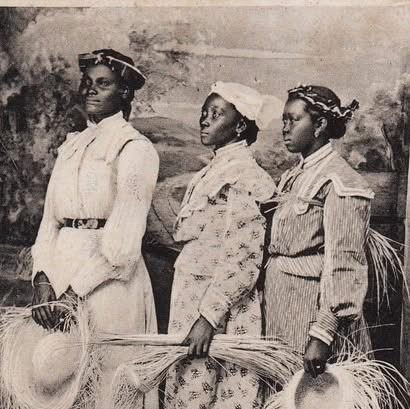
But this does not mean they simply adopted whatever styles were available. As Buckridge's work shows, even in freedom, women continued to make choices about their dress that reflected both African heritage and strategic accommodation to new social realities. The saya ku djèki was often made from the same fabric or a combination of two or three patterns. This pattern-mixing was not merely economical; it was a continuation of African aesthetic practices that valued pattern and texture.
Conclusion: Whose Modesty?
So, whose modesty does the saya ku djèki represent?
The evidence suggests that the question itself may be wrong. The garment does not represent someone else's modesty imposed upon Black women. It represents the choices of Black women themselves—choices made within constraints, yes, but choices nonetheless. They chose when to retain African modes and when to adopt European elements. They chose how to wrap their heads and how to mix their patterns. They chose, like Coobah, to use needle and thread to tell their own stories.
The modesty of the saya ku djèki may have less to do with Victorian morality and more to do with African values of dignity, self-presentation, and community. It may reflect what it meant for a woman to present herself with respect in a world that denied her respect at every turn.
The question lingers, but the scholarship shifts its terms. It is no longer: "Did white women impose this on Black women?" It becomes: "What did Black women make of the materials they had, and what stories did they tell through the clothes they made?"
📚 References for Post 1 (Introduction, Parts I & II)
Becker, Jill. (2013). Cassava Resist Dyeing: Traditional dyeing techniques in a new environment. Paper presented at the Biennial Conference of The University of the West Indies Schools of Education, St. Augustine, Trinidad and Tobago.
Buckridge, Steeve O. The Language of Dress: Resistance and Accommodation in Jamaica, 1750-1890. Kingston: University of the West Indies Press, 2004.
Buckridge, Steeve O. "Dem caa dress yah!" : dress as resistance and accommodation among Jamaican women from slavery to freedom, 1760-1890. Doctoral dissertation, Ohio State University, 1998.
Buckridge, Steeve O. African Lace-Bark in the Caribbean: The Construction of Race, Class, and Gender. London: Bloomsbury Academic, 2016.
Contiguous Cloth: Textiles and the Slave Trade in New Netherland. The Gotham Center for New York City History.
Curaçaoan Women in the Late 18th and Early 19th Centuries. Brill Publishing.
Design History In Curaçao. Design Encyclopedia.
Hammond, Charlotte. "Costuming Colonial Resistance in the New World." In Entangled Otherness: Cross-gender Fabrications in the Francophone Caribbean, 48-81. Liverpool: Liverpool University Press, 2018.
Indian Cotton Textiles in the 18th-Century Atlantic Economy. LSE Research.
Madras and the Poetics of Sartorial Resistance. Age of Revolutions.
Skeehan, Danielle C. "Materializing the Black Atlantic: African Captives, Caribbean Slaves, and Creole Fashioning." In The Fabric of Empire: Material and Literary Cultures of the Global Atlantic, 1650-1850. Baltimore: Johns Hopkins University Press, 2020.
Systad, Gunnhild. (2020). The Use of Flour and Sugar Sacks in Clothing, Bedding, and More. Norwegian Textile Letter.
Textile Circulation in the Dutch Global Market. Journal of Historians of Netherlandish Art (JHNA).
The Story Behind the Traditional Clothing of Curaçao. Landhuis Chobolobo.
Utilization and Characterization of Cassava Starch as a Natural Thickening Agent for Reactive Dye Printing on Cotton Fabric. ResearchGate.
White Gold: Cassava as an Industrial Base. Scientific Research Publishing.
How to Make Laundry Starch from Cassava. Starch Project Solution / Doing Group.