
The Industrial Crisis of the Fast-Fashion Model
In our foundational analysis of the Global South’s garment crisis, specifically the structural unraveling across South Asian Ready-Made Garment (RMG) hubs, established a stark economic reality: industrialization built on bottom-dollar labor and raw commodity extraction is a dead end (Shah, 2026). Competing in a race to the bottom by offering cheap factory labor to global fast-fashion conglomerates exposes domestic economies to severe purchasing-power erosion, supply chain friction, and inevitable industrial stoppage (Business & Human Rights Resource Centre, 2026).
To break out of the raw extraction loop, where African cotton is exported for pennies, processed abroad, and re-imported as high-markup finished goods, the continent must pivot from low-margin assembly to high-margin design sovereignty.
African textile competitiveness cannot rely on undercutting global minimum wages; it must rely on signature, innovative design theories, heritage methodologies, and material culture. By marrying end-to-end industrial value retention with sovereign intellectual property, Africa establishes an unassailable competitive advantage in the global market.
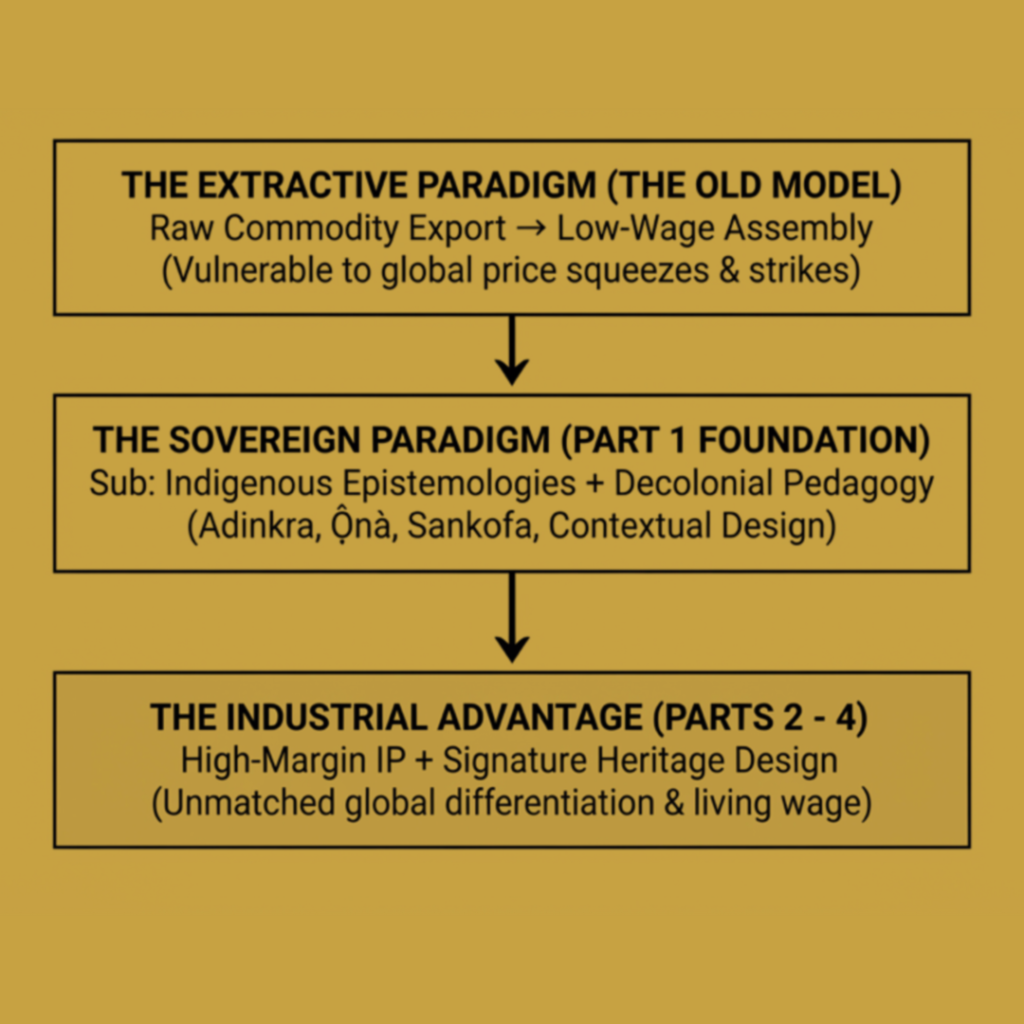
1. The Epistemological Bottleneck: Why "Modern Design" Is Not Universal
For over a century, global industrial design has operated under the illusion that Western aesthetics, European industrial standards, and Bauhaus functionalism constitute a universal canon. Within this Eurocentric paradigm, African material creation has been systematically misclassified: stripped of its underlying intellectual frameworks and reduced to mere "craft," "folklore," or "exotic motif" to be sampled by Western fashion houses.
Decolonial design theorists challenge this fundamental mischaracterization. As Ghanaian scholar Yaw Ofosu-Asare demonstrates, African design is not a derivative of Western aesthetics, nor is it a passive tradition waiting to be modernized (Ofosu-Asare, 2024). It is a sovereign, mathematically rigorous knowledge system possessing its own pedagogy, logic, and functional philosophies.
When an emerging African textile corridor adopts European design pedagogy wholesale, it inherits a structural weakness: it formats its designers to produce generic, Western-oriented garments that compete directly with hyper-standardized, low-cost Asian factories. Decolonizing design education is therefore not a symbolic academic exercise, it is a critical industrial strategy.
2. Indigenous Design Methodologies: Ọ̀nà, Sankofa, and Contextual Design
To build a distinct global advantage, African textile hubs must anchor their production in indigenous design methodologies that integrate form, purpose, and community ethics.
A. The Yorùbá Philosophy of Ọ̀nà and Ìwà
In Yorùbá design theory, Ọ̀nà represents the purposeful application of form, pattern, and technique (Yorùbá Aesthetics & Material Culture Series, 2018). However, Ọ̀nà cannot exist in isolation; it is intrinsically tied to Ìwà (character, essential nature, or moral balance).
- The Industrial Application: Under Western industrialism, design is often treated as superficial ornament applied to a mass-produced substrate. In Ọ̀nà methodology, the textile structure, dye, pattern, and intended social utility form an indivisible whole. Designing with Ọ̀nà ensures that garments carry intrinsic cultural narrative and structural integrity, shifting the product from disposable fast fashion to high-value investment attire.
B. Sankofa as a Generative Design Grid
The Akan concept of Sankofa ("it is not taboo to fetch that which is at risk of being left behind") is frequently cited, yet its methodological mechanics remain underutilized in industrial design.
- The Industrial Application: Sankofa is a forward-looking generative grid. Scholars like Audrey G. Bennett demonstrate how traditional African interlace patterns, Adinkra geometric symbols, and fractal textile layouts operate as complex computational design systems (Bennett, 2012; Eglash & Bennett, 2014). Rather than copying historical garments, Sankofa methodology uses indigenous algorithmic patterns as a foundation for digital textile printing, technical weaving, and modern pattern-making.
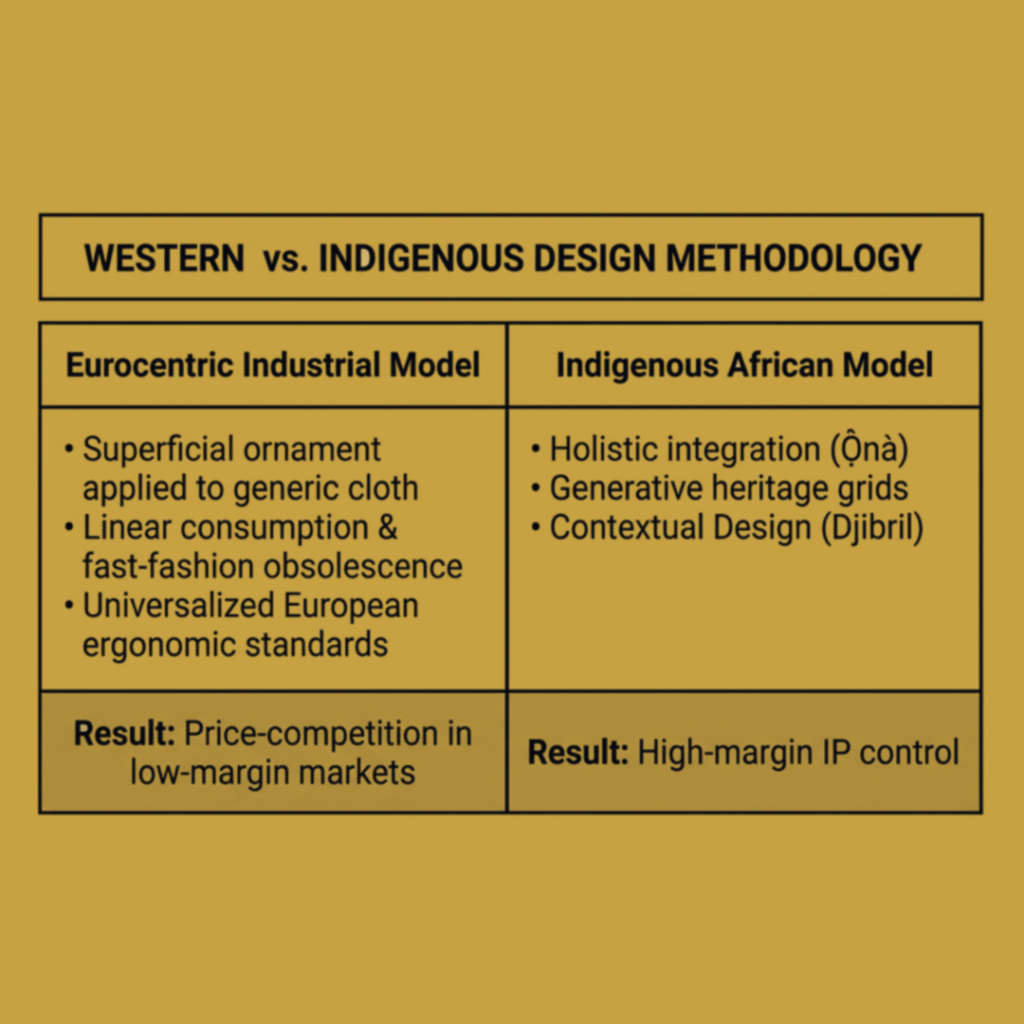
C. Design Contextuel (Contextual Design Pedagogy)
Promoted by figures such as Aziz Djibril and theorists at the Africa Design School in Cotonou, Benin, le design contextuel explicitly rejects imported industrial templates (Djibril et al., 2022).
- The Industrial Application: Contextual design dictates that material selection, loom technology, and garment ergonomics must stem directly from local environmental conditions, regional body shapes, and community utility. Designing for the West African climate using locally spun long-staple cotton and indigo-dye techniques produces a functional product far superior to imported synthetic blends, creating immediate regional market dominance.
3. From Raw Commodity to Intellectual Property: The Economic Mechanics of Design Sovereignty
The core failure of the Asian RMG model analyzed in our report is its inability to capture value (Shah, 2026). When a factory in Gazipur or Ashulia sews a basic T-shirt for a Western buyer, the factory retains only a tiny fraction of the retail price, often leaving less than $1.00 per unit to split between energy, overhead, and worker wages (Dhaka Tribune, 2026). The remaining 90%+ of the value is captured by the brand that owns the design, marketing, and intellectual property (IP).
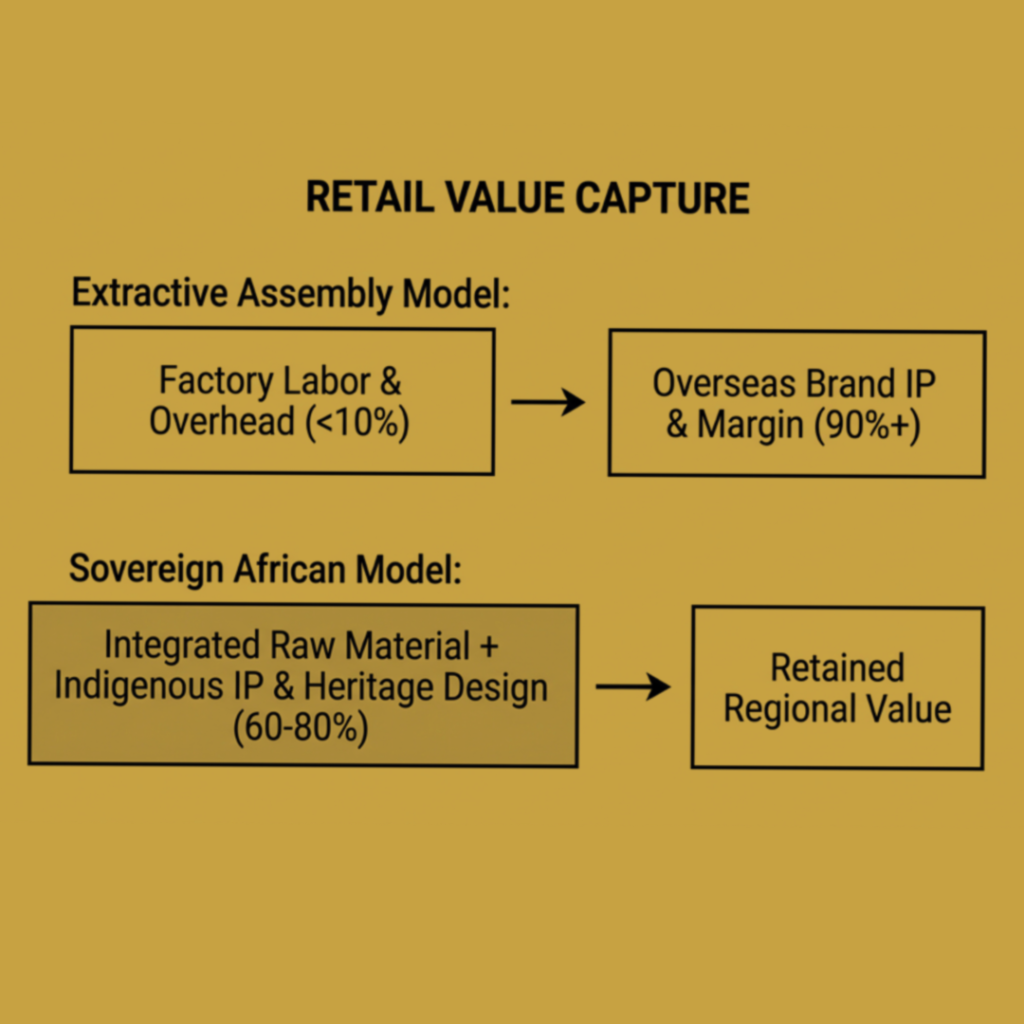
By founding African textile corridors on signature heritage methodologies, continental manufacturers flip this dynamic:
- Capturing the Design Margin: When African textile hubs export finished collections featuring proprietary weave patterns, natural dye formulations, and distinct cultural narratives, they operate as IP owners rather than contract sewers.
- Buffering Against Inflation: High-margin, design-led products absorb fluctuations in local energy costs and global shipping rates without forcing factory owners to depress labor wages.
- Establishing Living-Wage Viability: Industrial margins driven by design sovereignty create the economic headroom required to pay living wages (such as the 30,000 taka / $242 benchmark demanded by striking workers), cultivating a stable, highly skilled domestic workforce (WION News, 2026).
Comprehensive Master Bibliography (All Curated Series Scholars & Research Sources)
- Barnett, M. (2024). Crafted Kinship. Artisan Books. (Featured in Part 3)
- Bennett, A. G. (2012). Interactive Aesthetics: Digital Design and Culture. Palgrave Macmillan.
- Business & Human Rights Resource Centre. (2026). Garment workers protest demanding Tk 30,000 minimum wage increase. Available at: https://www.business-humanrights.org
- Dhaka Tribune. (2026). Fresh wage protests erupt in Gazipur, police disperse workers. Published November 8, 2026. Available at: https://www.dhakatribune.com
- Djibril, A., et al. (2022). Manifeste pour un Design Contextuel Africain. Éditions l'Harmattan.
- Eglash, R., & Bennett, A. G. (2014). African Fractals: Computing and Culture. Rutgers University Press.
- Eshun, E. (2021). In the Black Fantastic. Hayward Publishing. (Featured in Part 4)
- Foster, F. (2023). Indigo Geographies: West African Textile Archives and Slow Design Philosophies. Journal of Material Culture, 28(2), 145–168. (Featured in Part 3)
- Gonzalez, L. (1988). A categoria político-cultural de amefricanidade. Tempo Brasileiro, 92/93, 69–82. (Featured in Part 4)
- Johnson, C. (1982). Grassroots Organizing: Women in Anti-Colonial Protests in Nigeria. African Studies Review, 25(2/3), 137–157.
- Kamara, M. (2022). Vernacular Tectonics and Earth Architecture in the Sahel. Architectural Review, 1489, 72–79. (Featured in Part 2)
- Lokko, L. (Ed.). (2023). The Laboratory of the Future: Biennale Architettura 2023 Exhibition Catalogue. La Biennale di Venezia. (Featured in Part 2)
- Marona, F. (2021). Habitação Evolutiva e apropriação do solo urbano em Luanda. Luanda Architectural Press. (Featured in Part 2)
- Mba, N. E. (1982). Nigerian Women Mobilized: Women's Political Activity in Southern Nigeria, 1900-1965. Institute of International Studies, University of California, Berkeley.
- Nascimento, B. (1989). O Quilombo do Palmares: A Modernidade do Quilombo. Revista de História das Ideias. (Featured in Part 2)
- Nelson, C. (2022). The Visual Life of Legitimate/Illegitimate Slavery: Material Culture of the Transatlantic Plantation. Duke University Press. (Featured in Part 3)
- Nimo, K. K. (2022). Africa in Fashion: Luxury, Craft and Textile Heritage. Laurence King Publishing. (Featured in Part 3)
- Ofosu-Asare, Y. (2024). Decolonising Design in Africa: Towards New Theories, Methods, and Practices. Routledge.
- Okwumabua, N. (2020). Afrocentric Architecture: Reclaiming Indigenous Spatial Languages. CPDI Africa Global Monograph. (Featured in Part 2)
- Ortiz, F. (1940). Contrapunteo cubano del tabaco y el azúcar. Editorial de Ciencias Sociales. (Featured in Part 4)
- Osayimwese, I. (2017). Colonialism and Modern Architecture in West Africa. Yale University Press. (Featured in Part 2)
- Shah, A. (2026). Bangladesh textile workers strike: Wage crisis, India's edge explained. The Indian Express. Published November 9, 2026. Available at: https://indianexpress.com
- The Voice News. (2026). 469 Garment Factories Shut Amid Wage Protests as Tarique Rahman Intervenes. Published November 8, 2026. Available at: https://thevoice.news
- WION News. (2026). Bangladesh garment workers defy wage board call, demand 30,000 taka minimum pay. Published November 1, 2026. Available at: https://www.wionews.com
- Wilson, M. O. (2021). Black Bodies / White Spaces: Architecture and the Making of Modern America. University of Chicago Press. (Featured in Part 2)
- Yorùbá Aesthetics & Material Culture Series. (2018). Ọ̀nà: The Philosophy of Form and Character in West African Craft. African Arts Journal, 51(3).
- Zapata Olivella, M. (1989). Las Claves Mágicas de América: Raza, Mitos y Cultura. Plaza & Janés. (Featured in Part 4)