Part III: Men's Dress – The Sugar Sack as Fabric
Perhaps nowhere is the tension between tradition and necessity more visible than in men's traditional clothing. The Chobolobo article is explicit:
"The clothing was made from sugar and flour packaging. In the past, sugar, and flour used to come in big sacks. The resourceful minds of the locals took these sacks and created clothing with it."
This single sentence contains a world of meaning. It tells us that what is now considered "traditional" men's attire—the cream-colored pants and shirt worn at cultural celebrations—began as industrial waste, repurposed by people who had no other options. The resourcefulness was theirs; the necessity was imposed.
The Global Practice of Sack Clothing
This was not unique to Curaçao. Across the Atlantic world, from the 1880s through the 1950s, people repurposed flour and sugar sacks into clothing, bedding, and household items. The practice intensified during the Great Depression and World War II, when textiles were scarce and expensive. In the United States, feed sacks were so widely used that by the late 1930s, an estimated three million Americans were wearing feed sack clothing—dresses, shirts, quilts, curtains, sheets, mattress covers, pajamas, and even undergarments. In Norway, women made blouses and undergarments from flour sacks, sometimes leaving the printed labels visible as a quiet joke about the origins of their clothing. In the Turks and Caicos Islands, elders recall that underwear was made from the bags that flour came in, and seamstresses would obtain cloth and supplies from merchant boats.
The practice was born of poverty, but it was sustained by skill. Women everywhere developed techniques to transform coarse, stamped sacks into wearable garments. They knew how to remove printed labels—soaking in green soap, scrubbing, bleaching in sunlight—and how to soften rough fabric through washing and beating. This was not tradition in the sense of cultural inheritance passed down unchanged. This was tradition as survival strategy, repeated wherever people faced scarcity.
What the Curaçao Record Shows
In Curaçao, men wore "cream colored pants with a loose shirt or a button-up shirt of a similar shade." That cream color was not chosen from a palette of options. It was the natural, undyed color of the unbleached cotton sacks in which flour and sugar arrived on the island. The garment was defined by the material available, not by aesthetic preference.
The Chobolobo source places this practice within living memory, noting that today's traditional clothing uses "different types of textile that are more colorful and with patterns." The flour sack is gone, replaced by fabrics chosen for beauty rather than scarcity. But the cream color persists—reproduced deliberately, in finer materials, as a marker of heritage. The connection between the color and its origin has been broken. What was once the signature of poverty is now a signifier of tradition.
The Labor Behind the Garment
The Chobolobo article tells us what the sacks became, but it does not detail how they were transformed. To understand that, we must look to community knowledge preserved through generations of Curaçaoan women, and to the broader Caribbean context of textile practices.
The coarse sackcloth would have been stiff, uncomfortable against skin, marked with printed labels from the mills. Before it could become clothing, it had to be worked. Women developed techniques:
· Softening the fabric through beating, washing, and working the fibers until they yielded
· Stiffening it with cassava paste to create crisp creases and a finished appearance worthy of formal wear
· Adding lace for embellishment and dignity, refusing to let their families wear plain sacking
The cassava paste is particularly significant. Cassava—manioc, yuca—was an indigenous crop of the Americas, long cultivated by the Arawak, Carib, and Taino peoples long before European arrival. By the time of slavery, it had become a staple throughout the Caribbean, valued for its versatility and its ability to grow in poor soils. The starch could be extracted by grating the root, mixing with water, straining through cloth, and allowing the sediment to settle. The resulting paste could be used wet or dried and stored.
Jill Becker's research at the University of Technology, Jamaica, confirms that cassava was used in Caribbean textile applications, including resist dyeing. The Caribbean Association of Home Economists has documented cassava's role in regional textile crafts. Scientific studies verify that cassava starch increases the stiffness of cotton fabric, making it ideal for creating the crisp finish required for formal wear. And the practical method—accessible to anyone with access to the root—involved mashing, straining through cloth to produce "starch milk," and applying the wet sediment directly to fabric.
In Aruba, ethnographic sources note that ground cassava was "used as starch for fabrics," a practice carried from indigenous ancestors through generations. The knowledge of how to process cassava for food and for cloth was part of the inherited wisdom of Caribbean women.
The Unrecorded Labor of Women
Notice who performed this labor. The Chobolobo article tells us that women sewed their own clothing. It tells us that traditional clothing is still "often made by elderly women." But it does not tell us about the hours of beating fabric to soften it, the careful preparation of cassava starch, the delicate addition of lace trim. This work was too mundane to record, too feminine to merit documentation, too ordinary for the archives.
And yet this unrecorded labor was the very thing that transformed a flour sack into a garment worthy of being called traditional. The men's cream-colored shirt, now a symbol of Curaçaoan heritage, began as a sack, softened by hand, starched with cassava, and trimmed with lace by a wife or mother who refused to let her family wear plain sacking. She could not control the economic conditions that left her dependent on flour sacks for cloth. But she could control what she made of them.
The Question of Tradition
So we return to the question that runs through this entire study: Is this tradition, or is this necessity?
The men's cream-colored shirt is both. It is necessity because it began as a flour sack, the only material available to people too poor to buy cloth. It is tradition because generations of women developed the skills to transform that sack into something wearable, even beautiful. It is necessity because the color was not chosen. It is tradition because that color has been remembered and reproduced long after the sacks themselves disappeared.
The connection between the shirt and its origin is broken. Most people who wear it today at Seú or other cultural celebrations do not think of flour sacks. They think of heritage, of identity, of belonging. And they are not wrong. The heritage is real. But it is a heritage forged in scarcity, not chosen in freedom. The shirt carries within it the memory of poverty, even if that memory has been smoothed over by time and pride.
Creative Survival
The details of how survival was made creative—the softening, the starching, the lace—were acts of dignity performed in conditions that offered little dignity. The women who did this work could not choose their material. But they could choose what to make of it. They could choose to add lace. They could choose to starch the fabric until it held a crease as sharp as any gentleman's. They could choose to transform a sack into a garment their husband or son could wear with pride.
This is not tradition as timeless inheritance, passed down unchanged from ancestors who designed it in freedom. This is tradition as creative survival—the material record of a people who, denied everything, made something of their own. The connection may be broken, but what was made in that broken space still matters.
Part IV: Headwraps and Straw Hats – Status, Labor, and Performance
The Headwrap: African Continuity and Sartorial Insurgency
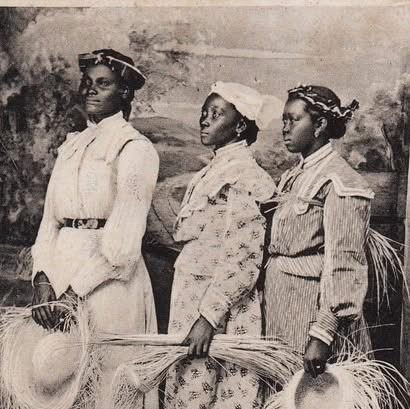
The headwrap styles documented at Chobolobo—Punta di Skálo for labor, Pèchi Yaya for celebration—reveal how a single garment could encode complex social information. The Punta di Skálo's supportive knot was functional: it allowed women to carry buckets of fish or vegetables door-to-door as vendors. This was not ceremonial dress; it was workwear, designed by women for women's labor.
Yet these same headwraps, when made of finer Madras cloth and tied in the Pèchi Yaya style, became garments of celebration, worn to baptisms and first communions. The same practice—wrapping the head—could signify either subsistence labor or spiritual occasion. The difference lay in the cloth and the tie, choices made within tight economic constraints.
But to read the headwrap only through the lens of function or occasion is to miss its deeper significance. Recent scholarship has reframed the Afro-Creole headwrap as a site of what Nicole Willson terms "sartorial insurgency"—a form of revolutionary counternarrative authored by women of colour through acts of creativity, ingenuity, and domestic labour. In the colonial circum-Caribbean, headwraps were not merely practical accessories; they were material texts through which Black women asserted agency in societies designed to deny it.
The colonial archive, dominated by the voices of white men, often reduced women of colour to the trope of the "tropical temptress"—a figure of seduction, excess, and degeneracy that served to justify racial hierarchies. Yet encoded within these very accounts, Willson argues, is a subtextual fear of Black female agency. The elaborate headwraps that so fascinated and unsettled colonial observers were not signs of submission but of rebellion. They represented what Danielle Skeehan has called "extra-discursive and material texts"—traces of Black female insurgency that bear unique witness to experiences the formal archive sought to erase.
Before the headwrap even touched the hair, there was the labor of grooming—combing with forks, plaiting, twisting, and threading hair with twine, practices carried directly from Africa that prevented tangles and maintained a sense of cultivated personhood in conditions designed to strip it away.
The Tignon Laws: Imposition and Subversion
This tension between control and creativity is nowhere more visible than in the history of the tignon laws of Louisiana. In 1786, Governor Esteban Rodríguez Miró issued a decree requiring all women of African descent—whether enslaved or free—to cover their hair with a knotted headwrap. The stated purpose was to maintain racial distinctions and curb the "audacious" displays of free women of colour, whose elaborate hairstyles and fashionable dress were seen as threatening to the social order.
The law was intended as humiliation. The headwrap had long been associated with enslavement and labour; forcing all Black women to wear it was meant to mark them as inferior, to strip them of the visual markers of status and beauty they had claimed for themselves.
But the women subverted this intention. Rather than accept the headwrap as a badge of shame, they transformed it into an opportunity for creativity. They sourced the finest fabrics—silks, satins, imported Madras—and wrapped their heads in increasingly elaborate and artistic styles. They added jewels, feathers, and ornaments. What was meant to diminish them became a canvas for their artistry and a marker of their dignity. The tignon law did not suppress Black women's self-fashioning; it inadvertently created a new tradition that spread throughout the Americas.
This history matters for Curaçao. While the Dutch Caribbean had its own specific legal codes, the pattern is consistent across the colonial Americas: headwraps were sites of struggle between the impulse to control Black women's bodies and the determination of those women to define themselves. The Punta di Skálo and Pèchi Yaya are not merely functional or festive styles. They are the descendants of this longer history—styles that carry within them the memory of both oppression and resistance.
Straw Hats: Local Craft, Imperial Education, and Global Markets
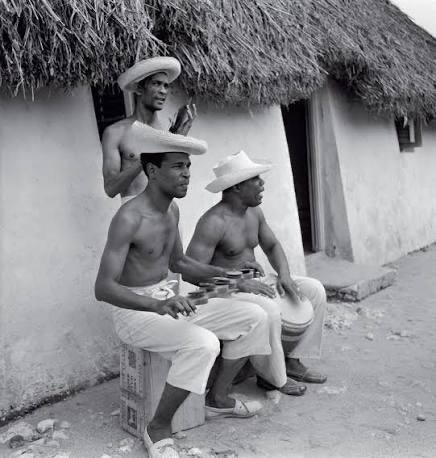
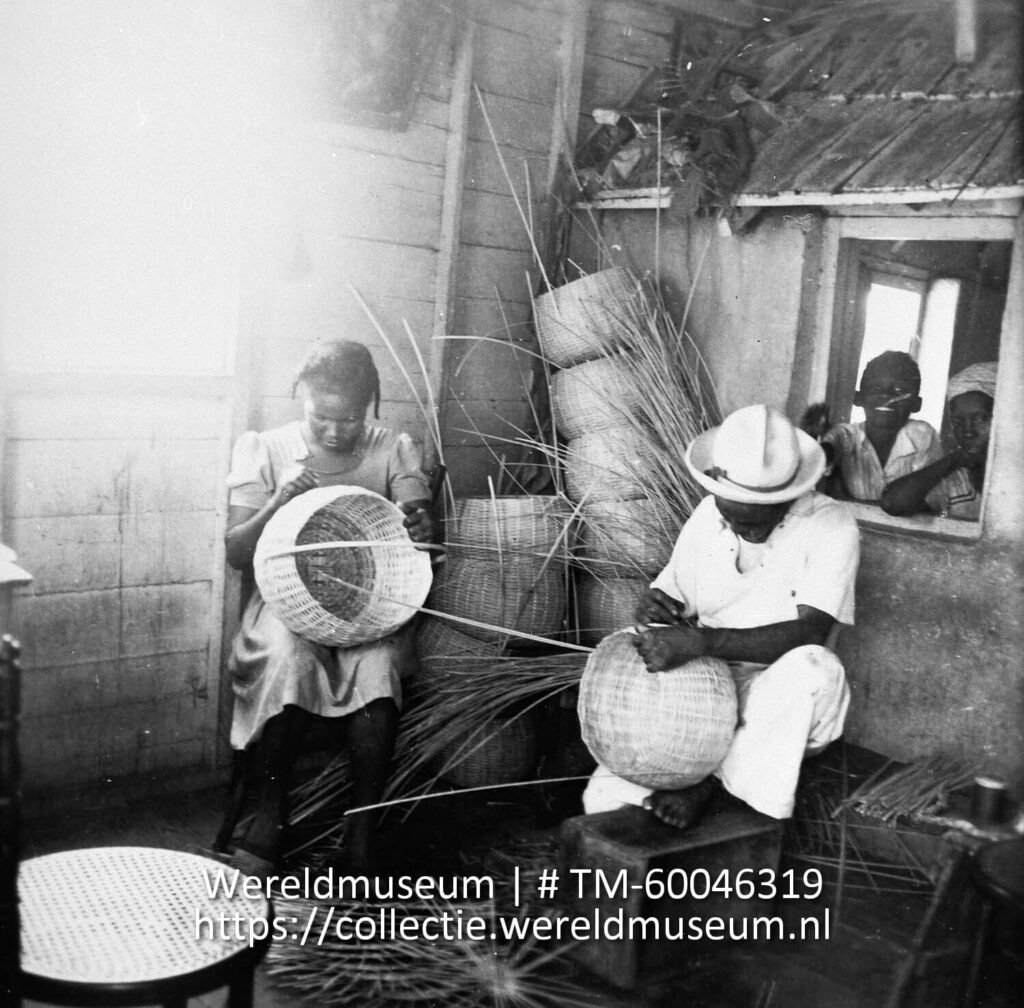
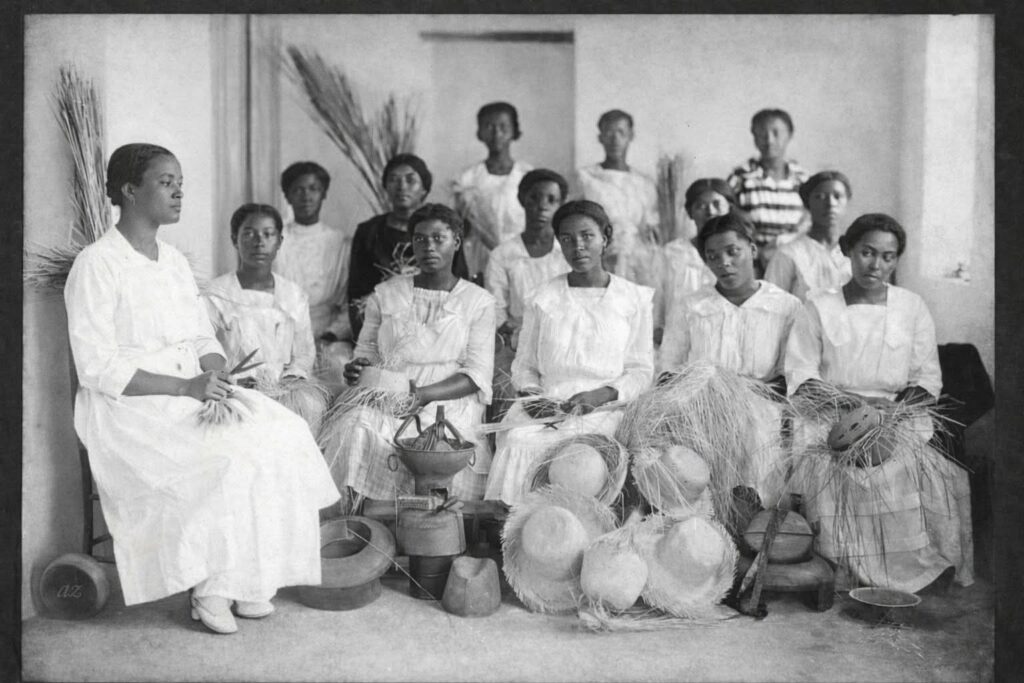
The men's straw hat tells a parallel story of stratified necessity, but with its own distinct entanglements of labour, colonialism, and global commerce. The Chobolobo source notes that for work on the kunuku (plantation), men wore locally hand-braided straw hats with "damaged edges and were less finely braided." These were functional objects, made from local fibers, designed for sun protection, and discarded when worn. For formal occasions, however, men sought hats imported from Cuba—finer, better made, status objects. The local product was for labor; the imported product was for presentation.
But the story of straw hat production in Curaçao is more complex than this simple hierarchy suggests. As Charlotte Hammond's research documents, from the late nineteenth through the mid-twentieth century, straw hat making in Curaçao became entangled with colonial education, international exhibitions, and global capitalist markets.
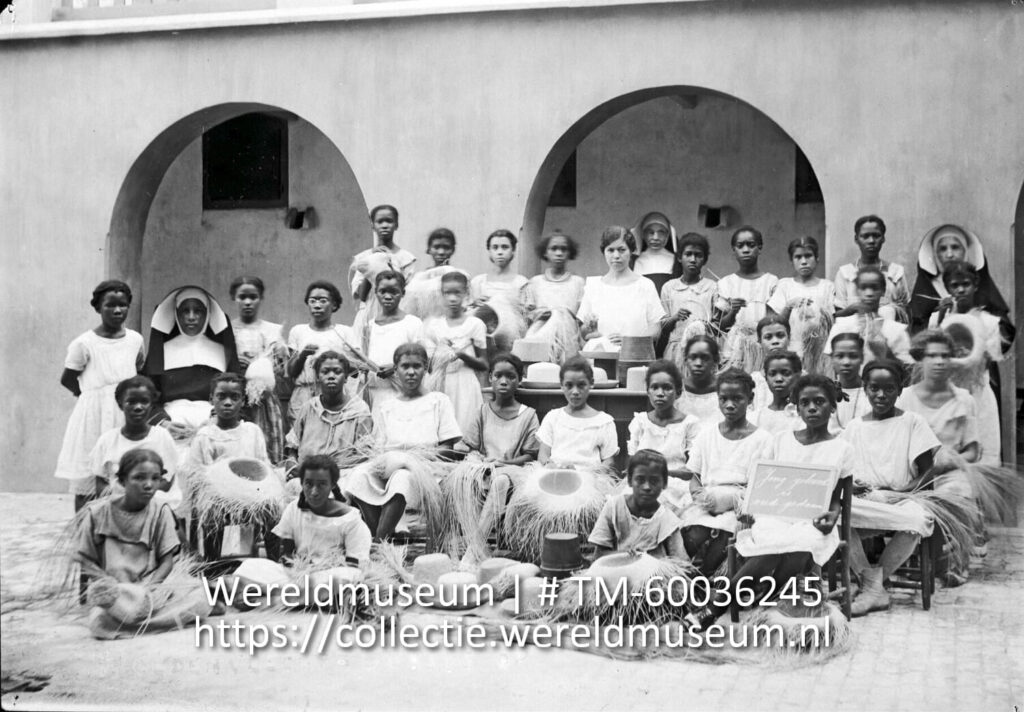
Up until 1946, as a strategy of the Catholic church's "civilising mission," young women in Curaçao were trained to plait the so-called "Panama hat" at technical schools run by the church. The schools focussed on training young Black women in sewing and a range of hat-plaiting techniques. The church legitimised this education as an important tool to combat unemployment and instil respectability and morality in young Curaçaoan women. The ideology underpinning this "civilising mission" touted the education of a work ethic—imposed by God—as a means to counter the threat of idleness associated with sinful activity and the post-emancipation freedom of enslaved workers.
The products of this labour were often exhibited at international expositions and exported for sale in Europe and the United States. A report from the Brussels 1910 world exhibition describes the huge sales of both "simple" and "finely woven" straw hats from Curaçao that led to a second shipment quickly selling out. Conscious of the economic potential, the Dutch reporter lamented the lack of funds allocated to bring several Curaçaoan women hat braiders to the exhibition "to better acquaint them with the requirements of the European market." The bulletin reveals Dutch admiration for this indigenous skill, yet this respect was ambivalent: local craft production was framed as outside modernity, static, and unable to meet the "progressive" standards of a European market without foreign intervention.
Hammond's analysis is trenchant: missionary education that claimed to modernise, industrialise, and revalue local handicraft skills for the benefit of local populations instead perpetuated colonial gendered and racialised divisions of labour. These schools prepared and disciplined students for factory work in global textile industries. The straw hat industry in Curaçao was not simply a matter of local craft serving local needs; it was integrated into a global capitalist system that extracted value from Black women's labour while simultaneously devaluing it.
Counter-Plantation Knowledge and Resistance
Yet even here, within systems designed for exploitation, there were spaces of resistance. Drawing on Jean Casimir's concept of contre-plantation (counter-plantation), Hammond explores how histories of indigenous craft knowledge during specific periods of resistance nurtured what she calls "disidentification with a gendered logic of labour exploitation and racial capitalism."
Casimir's concept is crucial: the contre-plantation refers to the ways enslaved and freed people developed survival strategies and cultural practices on the margins of the formal plantation economy. Craft knowledge, developed covertly on the margins of the plantation or through urban artisanal production, nourished resistance to continued attempts to restore plantation economies after emancipation. When young women in Curaçao learned to plait straw, they were not simply absorbing a colonial work ethic. They were also participating in a longer tradition of indigenous craft knowledge that had sustained their ancestors through slavery and into freedom.
The straw hat, like the headwrap, is thus a contradictory object. It carries the marks of its production within colonial education systems and global capitalist markets. But it also carries the knowledge of hands that learned from mothers and grandmothers, techniques that predated the missionary schools and would outlast them. The "damaged edges" and "less finely braided" work hats that men wore on the kunuku were not merely inferior versions of the fine Cuban imports. They were products of a different economy—one oriented toward survival and use rather than export and profit.
Conclusion: What Covers the Head Tells a Story
Both the headwrap and the straw hat, then, are sites where multiple histories converge. They are functional objects that protect from sun and labour. They are markers of status that distinguish work from celebration, local from imported. They are products of colonial economies that sought to discipline Black bodies and extract value from Black labour. And they are canvases for creativity and resistance, through which women and men asserted their dignity and their personhood.
The Punta di Skálo with its supportive knot, the Pèchi Yaya for special occasions, the rough work hat for the kunuku, the fine Cuban import for formal wear—each carries a story. Together, they remind us that what covers the head is never merely covering. It is communication, identity, memory, and sometimes, insurgency.
Part V: The Seú Parade – From Labor to Spectacle
The Seú harvest parade, held annually on Easter Monday, is described as a celebration of "connectedness to mother nature" and a reenactment of enslaved workers dancing and singing while carrying their harvest to the storage house. Today, over forty-five groups—nearly five thousand people—process through the streets of Otrobanda and the western districts, their colorful costumes and headwraps transforming the route into a river of movement and memory.
But the transformation of this procession demands critical analysis. What was once a forced march—enslaved people transporting the fruits of their unpaid labor to their enslavers' storehouses—is now a voluntary cultural parade. The songs of resistance become heritage performances. The work clothes become costume. The question at the heart of this study—tradition or necessity—finds no clearer expression than in the annual journey of the Seú.
The Ritual in History
The Seú tradition emerged during slavery, specifically around the harvest of sorghum, a grain introduced from West Africa that became a staple crop on Curaçao's plantations. In the eighteenth and nineteenth centuries, the purpose of the Seú celebration was to thank the gods for the harvest. Enslaved workers would cut the sorghum stalks in the fields—men doing the cutting, women gathering the harvest into baskets—and then process, singing and dancing, to the magazina (warehouse) where the crop would be stored. After the harvest was secured, celebrations continued in the square near the plantation house, where the shon (landowner) could observe the festivities.
The ritual unfolded in three distinct phases. The first phase was the harvest itself, accompanied by the rhythmic playing of the kachu (cow horn). The second phase was the procession to the warehouse, with workers singing songs in a fixed rhythm. The third phase, after the work was complete, brought the community together to sing and dance to the music of the tambú drum.
These phases encoded within them both the structure of enslaved labor and the creative response to it. The songs that accompanied the harvest and procession were work songs—but they were also repositories of memory, complaint, and coded resistance. The tambú music that closed the celebration carried particular danger: it was considered pagan by the Catholic Church and threatening by the colonial authorities. After emancipation, the tambú portion of the Seú was banned outright, an explicit attempt to suppress the creativity of the Afro-Curaçaoan population.
Suppression and Revival
The trajectory of the Seú after emancipation mirrors the larger story of Afro-Curaçaoan cultural expression. With the arrival of the Shell oil refinery in 1915 and the accompanying modernization, the Seú gradually lost its original function. The harvest economy that had given it meaning was being supplanted by industrial labor. The tradition risked fading entirely.
It was rescued by women. In the 1940s and 1950s, Ursulita Martis led an effort to breathe new life into the Seú celebration. Thanks to her work, and to the many women who carried the knowledge of songs, dances, and dress, the tradition was revived. What had been a labor ritual tied to the agricultural calendar became an annual cultural parade, a conscious performance of Afro-Curaçaoan identity.
This revival was not simple preservation. It was transformation. The Seú became something new: a celebration of heritage rather than a requirement of labor. The participants were no longer enslaved workers compelled to march; they were free people choosing to remember. The songs were no longer sung under the eye of the shon; they were offered to ancestors and to the community.
The Costume Today
Today's Seú features "colorful clothing designs and headwraps" that "reflect both the modernization and the creativity of the community." The saya ku djèki is now made from "different types of textile that are more colorful and with patterns." The flour sack is gone, replaced by fabrics chosen for aesthetics, not scarcity. The cassava paste that once stiffened a man's collar has been forgotten by all but the oldest families. The lace added by candlelight survives only in the heirlooms passed down through generations.
The men wear straw hats—but these are no longer the rough work hats with "damaged edges" worn on the kunuku. They are finer, more deliberate, chosen to complete an outfit rather than to shield a laborer from the sun. The distinction between local work hat and imported formal hat has blurred into a single "traditional" accessory.
And yet, the connection to the past is not entirely lost. Participants still speak of honoring their grandinan (ancestors). The music still uses instruments born of the plantation—the chapi (garden hoe), the kachu (cow horn), the tambú drum. The procession still moves un pia un pia (slow step by slow step), as it did when workers carried their harvest to the warehouse. The body remembers what the mind may have forgotten.
Is This Loss or Gain?
The question is unavoidable. The parade preserves memory, but it also sanitizes it. The contemporary viewer sees beauty and tradition; they do not see the flour sack, the cassava paste, the lace added in candlelight by women determined to create dignity from deprivation. The design has been abstracted from its conditions of production. The struggle that produced it has been smoothed over by pride and by time.
This is what Jean Casimir, the Haitian sociologist, might call the movement from plantation to counter-plantation. The plantation was the system that planted people to plant crops, that reduced human beings to adjuncts of commodity production. The counter-plantation was everything the enslaved and their descendants built in opposition to that system: the smallholdings, the kinship networks, the cultural practices, the autonomous spaces where dignity could be cultivated even in the absence of freedom.
The Seú, in its origins, was a product of the plantation—a ritual embedded in the rhythms of forced labor. But in its survival and transformation, it became something of the counter-plantation. It became a space where Afro-Curaçaoan identity could be performed, remembered, and passed on. The flour sack became a shirt. The work song became a heritage. The forced march became a voluntary parade.
This is not simple loss, nor is it simple gain. It is the complex process by which oppressed people take the materials of their oppression and make something of their own. The connection between the Seú of the eighteenth century and the Seú of today is broken—but what was made in that broken space still matters.
The Carnival Connection
Scholars of the African diaspora have traced similar transformations across the Americas. Raphael Njoku's work on West African masking traditions and diaspora masquerade carnivals shows how enslaved Africans carried with them not static customs, but dynamic practices of memory and performance. The masquerade, like the Seú procession, served multiple functions: it was a form of spiritual practice, a method of social control, a technique of remembering, and a medium of resistance.
When Africans were forcibly brought to the Americas, these practices did not simply disappear or survive unchanged. They adapted. They incorporated new materials, new contexts, new meanings. The Caribbean carnival traditions—Trinidad's Carnival, Cuba's comparsas, Haiti's rara—all bear the marks of this creative adaptation. They are neither purely African nor purely European. They are something new, born of the violent encounter between worlds.
The Seú belongs to this family. It is Curaçao's version of a pan-Afro-diasporic phenomenon: the transformation of forced ritual into voluntary celebration, of labor into performance, of survival into art.
Conclusion: What Do We Call Tradition?
This analysis has traced the threads of Curaçaoan dress through:
· The holds of Dutch slave ships carrying Madras cloth, traded for human beings on the African coast
· The backs of enslaved women wrapping African-style headwraps from European fabric, transforming commodity into memory
· The sumptuary laws of colonial regimes that sought to control Black women's bodies, and the creative subversion of those laws through fabric and style
· The empty flour sacks of the post-emancipation poor, transformed into cream-colored shirts that would become markers of heritage
· The cassava root, mashed and strained into starch to give those shirts shape and dignity
· The lace, added by hand, turning necessity into beauty
· The missionary schools that trained young women in straw plaiting for global markets, even as they sought to discipline them into colonial norms
· The Seú parade, transforming forced labor into voluntary celebration, work song into heritage performance
At every stage, the clothing now called "traditional" was shaped by forces its wearers did not control: the global textile trade, the economics of slavery, the scarcity of the Depression, the social codes of colonial society, the educational interventions of church and state. Yet at every stage, Curaçaoans made choices within those constraints. They preserved African headwrap styles. They sewed their own garments. They developed techniques—softening, starching, embellishing—that turned industrial waste into wearable art. They wore their best to baptisms and their work-wraps to sell vegetables. They adapted masking traditions from West Africa to new contexts, new materials, new meanings.
The Counter-Plantation Framework
Jean Casimir's concept of the counter-plantation offers a powerful lens for understanding what this process means. The plantation system was designed to reduce human beings to adjuncts of commodity production. It sought to strip them of memory, of culture, of autonomous social life. But the enslaved and their descendants refused to be reduced. They built something else on the margins of the plantation: smallholdings, kinship networks, religious practices, aesthetic traditions. They created, in Casimir's terms, a "counter-plantation" that existed in opposition to the logic of the master.
The traditional clothing of Curaçao is a product of this counter-plantation. It was made from the scraps and discards of the plantation economy—the coarse fabric issued to laborers, the empty sacks that had held imported flour. But it was made according to aesthetic principles that remembered Africa. It was worn with a dignity that the plantation never intended. It was passed down through generations of women who taught their daughters to sew as their mothers had taught them.
This is not to romanticize. The counter-plantation was not a space of freedom; it was a space of survival within unfreedom. The clothing made in that space bears the marks of its origins. It is simple, modest, economical. It is made from what was available, not what was desired. But it is also beautiful, creative, meaningful. It carries within it the stories of the women who made it and the men who wore it.
So: Is This Tradition or Necessity?
The answer is both. It is necessity transformed by generations of creativity into something that feels like tradition. It is the flour sack, remembered not as poverty but as resourcefulness. It is the cassava paste, forgotten by written records but preserved in the hands of families. It is the headwrap, African in origin, Caribbean in practice, Curaçaoan in identity.
To call it merely "traditional" is to erase the struggle that produced it. To call it merely "necessary" is to erase the artistry that elevated it. The truer term might be survival design—the material record of a people who, denied everything, made something of their own.
The Broken Connection
The title of this essay names the problem: the connection is broken. The flour sack is no longer a flour sack; it is a "traditional" cream-colored shirt. The headwrap is no longer a marker of African identity preserved under oppression; it is a festive accessory. The Seú parade is no longer a memory of forced marches; it is a tourist attraction and a source of community pride. The cassava paste, the lace, the softening techniques—these survive only in the memories of the oldest women, if they survive at all.
This is not to say that contemporary Curaçaoan dress is inauthentic. Authenticity is not located in a fixed past, frozen and unreachable. Culture is always changing, always adapting, always making itself new. The women who sew saya ku djèki today for the Seú parade are not less authentic than their grandmothers who sewed from flour sacks. They are simply working with different materials, different contexts, different meanings.
But the broken connection is itself part of the story. It is what happens when oppressed people take the materials of their oppression—whether fabric from Dutch merchants or sacks from imported flour—and transform them into something of their own. The break is not a loss; it is the space where creativity happens. It is the gap between what was imposed and what was made, between the master's provision and the wearer's meaning.
What Remains
What remains, after this analysis, is not a simple story of victimhood or of triumph. It is a complex story of people who, facing conditions not of their choosing, made choices nonetheless. They chose to remember Africa in the wrapping of a headwrap. They chose to add lace to a flour sack. They chose to revive a harvest ritual that had lost its original function. They chose to pass their knowledge to their daughters.
The clothing they made carries the marks of these choices. It is modest because modesty was required of them, but it is also beautiful because beauty was something they required of themselves. It is economical because materials were scarce, but it is creative because creativity was how they survived. It is traditional because they kept making it, generation after generation.
So, what do we call tradition?
Perhaps we call it this: the material record of a people's ongoing conversation with their past, conducted under conditions not of their choosing, but carried out with whatever materials they had at hand. The connection may be broken, but the conversation continues. And what is made in that broken, continuing space—the shirt, the headwrap, the parade, the song—is worthy of the name tradition, if we understand that name to mean not timeless inheritance but creative survival.
References for Post 2 (Parts III, IV, V & Conclusion)
Allen, R. "The Harvest Ceremony Seú as a Case Study of the Dynamics of Power in Post-Emancipation Curaçao (1863-1915)." Caribbean Quarterly 56, no. 3 (2010): 13-29.
Becker, Jill. "Cassava Resist Dyeing: Traditional dyeing techniques in a new environment." Paper presented at the Biennial Conference of The University of the West Indies Schools of Education, St. Augustine, Trinidad and Tobago, April 2013.
Casimir, Jean. The Haitians: A Decolonial History. Chapel Hill: University of North Carolina Press, 2020.
Casimir, Jean. "La plantacion y la contraplantacion en la Historia del Caribe." In La Invención del Caribe. San Juan: Editorial de la Universidad de Puerto Rico, 1997.
"Cassava Resist Dyeing." Caribbean Association of Home Economists. http://caribbeanhomeeconomist.org/cassava-resist-dyeing/
"Curaçaose muziek." Wikipedia. https://nl.wikipedia.org/wiki/Cura%C3%A7aose_muziek
"Episode CXXI -121: Yuca an Amerindian cultural heritage." Aruba Today, September 2021.
Hammond, Charlotte. "Straw craft, imperial education and ethnographic exhibitions as tightly braided sites of gender production in Haiti and Curaçao." Journal of Material Culture 28, no. 4 (2023): 515-538.
Jenson, Deborah. "Plot and counter-plantation: Jean Casimir and captive modernity." Cultural Dynamics 36, no. 3 (August 2024): 360-366.
Kirkland, Teleica. "Clothing as Resistance." Costume Institute of the African Diaspora. https://ciad.org.uk/directory/clothing-as-resistance/
Njoku, Raphael Chijioke. West African Masking Traditions and Diaspora Masquerade Carnivals: History, Memory, and Transnationalism. Rochester: University of Rochester Press, 2020.
Njoku, Raphael Chijioke. "Igbo/West African Masquerade Culture and the Dynamics of African Diaspora Carnivals." Lecture, Frontier Culture Museum.
Rathgeb, Jody. "Wear? Where? Keeping Islanders clothed in 'the old days'." Times of the Islands, Summer 2022.
"Seú." Wikipedia. https://nl.wikipedia.org/wiki/Seu
"730. Curaçao's Thanksgiving Parade." 1000 Awesome Things About Curaçao. https://1000awesomethingsaboutcuracao.com/2013/04/12/730-curacao-awesome-thanksgiving-parade-seu/
Systad, Gunnhild. "The Use of Flour and Sugar Sacks in Clothing, Bedding, and More." Norwegian Textile Letter, February 2020.
The Story Behind the Traditional Clothing of Curaçao. Landhuis Chobolobo.
"Unraveling the History: When Did Flour Sacks Become Fashion?" Fashion Trend Tips, August 2025.
"A Sliver of Deep Blue Cloth." Haptic & Hue podcast, April 2023. https://hapticandhue.com/tales-of-textiles-series-5/
Willson, Nicole. "Sartorial insurgencies: Rebel women, headwraps and the revolutionary Black Atlantic." Atlantic Studies 19, no. 1 (2022): 86-106.