
The African continent has a rich and wide textile practice spanning since the beginning of times. Hook based textile practices was also part of this rich heritage. It is therefore no mystery, that the craft of Crochet has become very popular in contemporary African nations. This popularity, however, exists within a paradox: many contemporary African practitioners understand crochet as a European import, severed from knowledge that their own continent possesses millennia-deep traditions of hook-based fiber manipulation.
Early ancient hooks were found, possible a crochet hook in ancient excavated site of Karanis in Egypt.
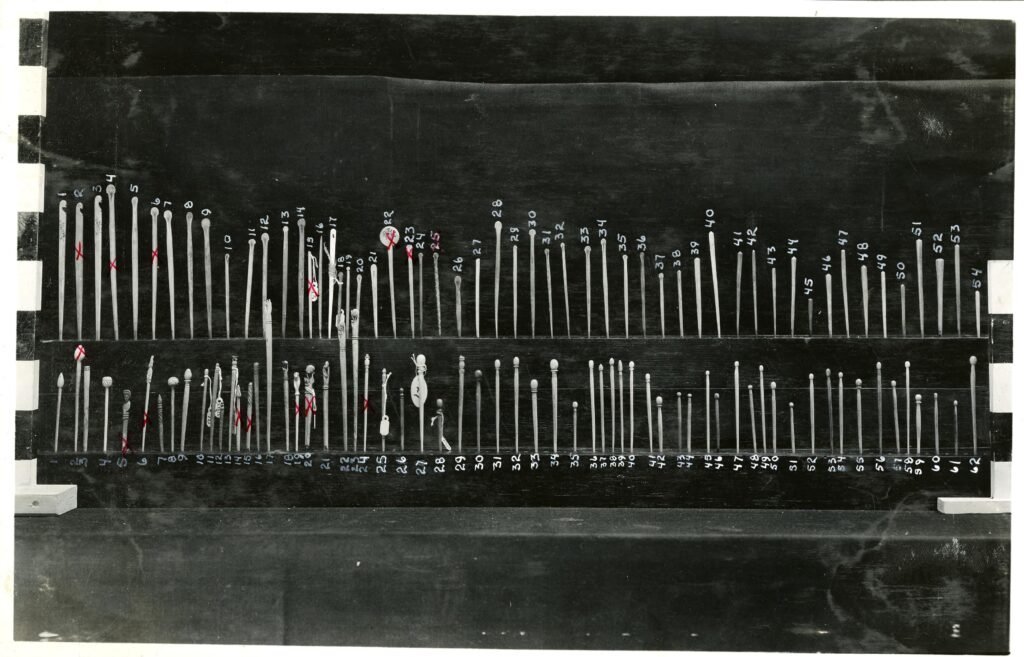
"Karanis; Crochet Hook (?); Bone (Unidentified)." In the digital collection Kelsey Museum of Archaeology Art & Artifact Collection. https://quod.lib.umich.edu/k/kelsey/x-0000.02.1769/7_2527p02. University of Michigan Library Digital Collections. Accessed February 19, 2026.
This bone implement, housed at the University of Michigan, is one of several such tools recovered from Egyptian excavations. Implements from Karanis confirm that the technological principle of manipulating fiber with a hook was understood and practiced in ancient Africa. The tools are fashioned from materials that would have been readily available—bone, wood, ivory—suggesting that the technology was neither rare nor imported, but indigenous and established. While Eurocentric scholarship often defaults to cautious language ("possible crochet hook"), the evidence speaks for itself.
The Ancient Chebka Lace, needle-knotted stitch is a close relative to the filet crochet. Initially practiced in Tunisia, it was used to create geometric bands, while the filet crochet techniques allows you to create complete projects including vests or table wear.
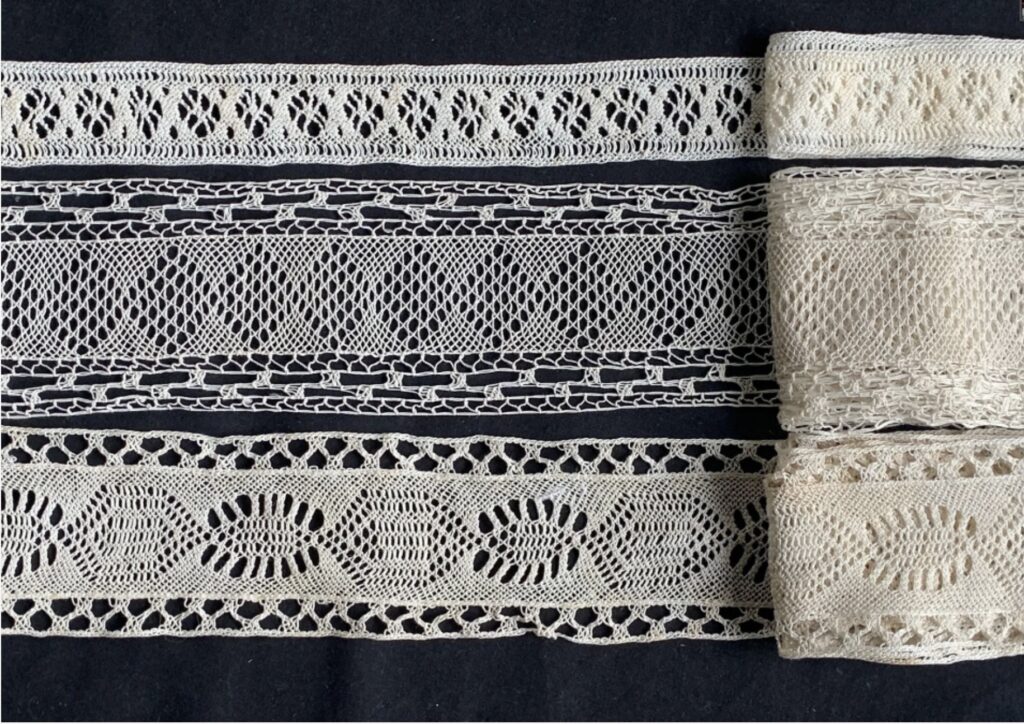
Ref: https://coutaubegarie.com/lot/157092/26525906-three-entre-deux-and-one-carre-in-chebka-lace-north-africa
Chebka was first practiced by individual women in Tunisia to adorn their traditional garments. The technique later spread to Algeria and Morocco, where it remained in use. Its geometric patterns reflect design languages common across North Africa, developed entirely independently of European influence. The structure is identical in principle to filet crochet's netted grounds, but Chebka predates the European systematization of filet crochet by centuries. It represents an African solution to creating decorative net-like grids.
Under the disguise of atrocities committed in the name of benevolent missionary works, Nuns used textile practices to gain access to vulnerable communities, where they taught practices that were stolen from African nations and re-packaged and re-introduced as another way to further penetrate our communities.
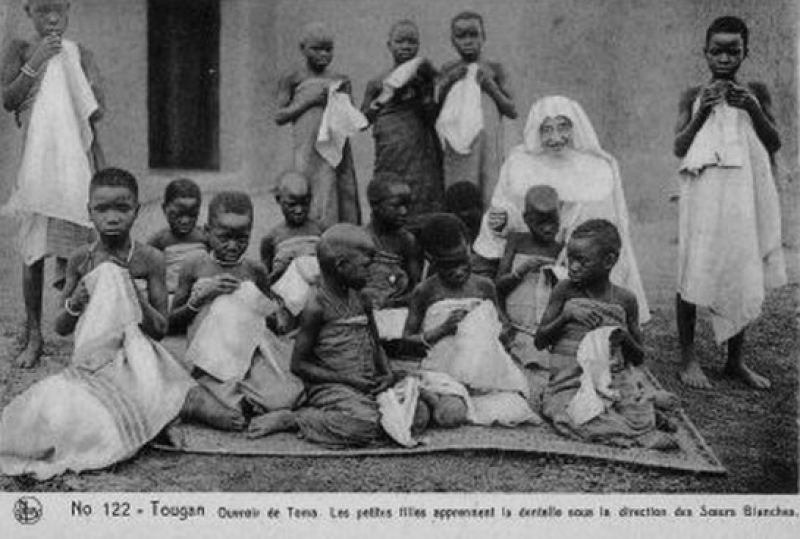
The white nuns teaching "Western European embroidery and lace techniques to local girls. A practice continued under NGO's
Source: https://trc-leiden.nl/trc-needles/regional-traditions/middle-east-and-north-africa/pre-modern-middle-east-and-north-africa/embroidery-and-the-white-sisters
The photograph shows White Sisters in what is now Burkina Faso, circa 1930, instructing local girls in techniques presented as "Western European embroidery and lace." Yet Chebka lace, which these same nuns would have taught in North African missions, was not European at all. It was North African. The pattern is consistent: African techniques were extracted, stripped of their origin, and then taught back to Africans as European knowledge. This was not cultural exchange. It was cultural erasure. Nuns gained access to vulnerable communities by offering textile instruction, while simultaneously dismantling the very traditions that had produced those techniques. The goal was not education but domination—spiritual, cultural, and economic.
The knotless Netting is a material example of another African nations, Cameroon, Indigenous hook based textile technique. This netting sack called Nkekelewe, comes from the Mafa people in Cameroon. It is made using a knotless netting technique.
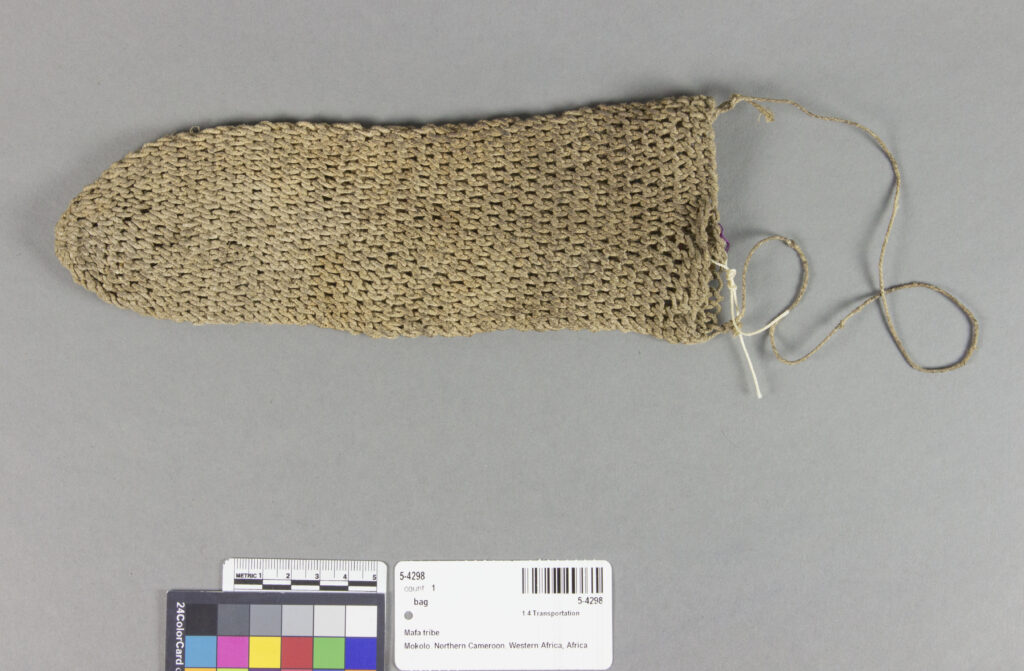
Source: https://portal.hearstmuseum.berkeley.edu/catalog/93f3405f-1823-4a24-886c-80c524a1eb60
The Mafa sack was collected in 1965 by Paul Hinderling and donated to the Phoebe A. Hearst Museum at Berkeley. It is made from bean fiber cordage, materials that would have been locally available. The object is catalogued with the technique explicitly identified: knotless netting. This is not a guess. It is documentation.
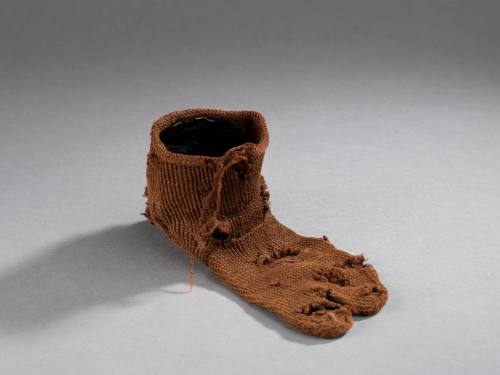
Ref: https://collections.rom.on.ca/objects/527320/adult-sock
The knotless netting technique is being made using bean fiber cordage. It is not a colonial-era introduction, it is an indigenous Cameroonian object that was collected in 1965, representing a longstanding local practice that survived despite colonial violence.
The Mafa knotless Netting technique predates knitting and crochet, with the oldest known fragments dating to c. 6500 BCE from the Judean Desert. Knotless netting, technically termed nålbinding, is an ancient technique whereby a single needle creates fabric through a series of loops and passes. The same technique appears in Egypt in the form of Coptic socks from the 4th to 7th centuries CE. The Royal Ontario Museum holds multiple examples (910.130.143, G1281). The National Museums Scotland holds a divided-toe sock from Akhmim (A.1911.315). The Petrie Museum houses a pair excavated from Hawara (UC16766). All are made using nålbinding—knotless netting—the same technique the Mafa people used to make their sack. European crochet, as codified in the nineteenth century, is a latecomer to a technological family Africa had already mastered.
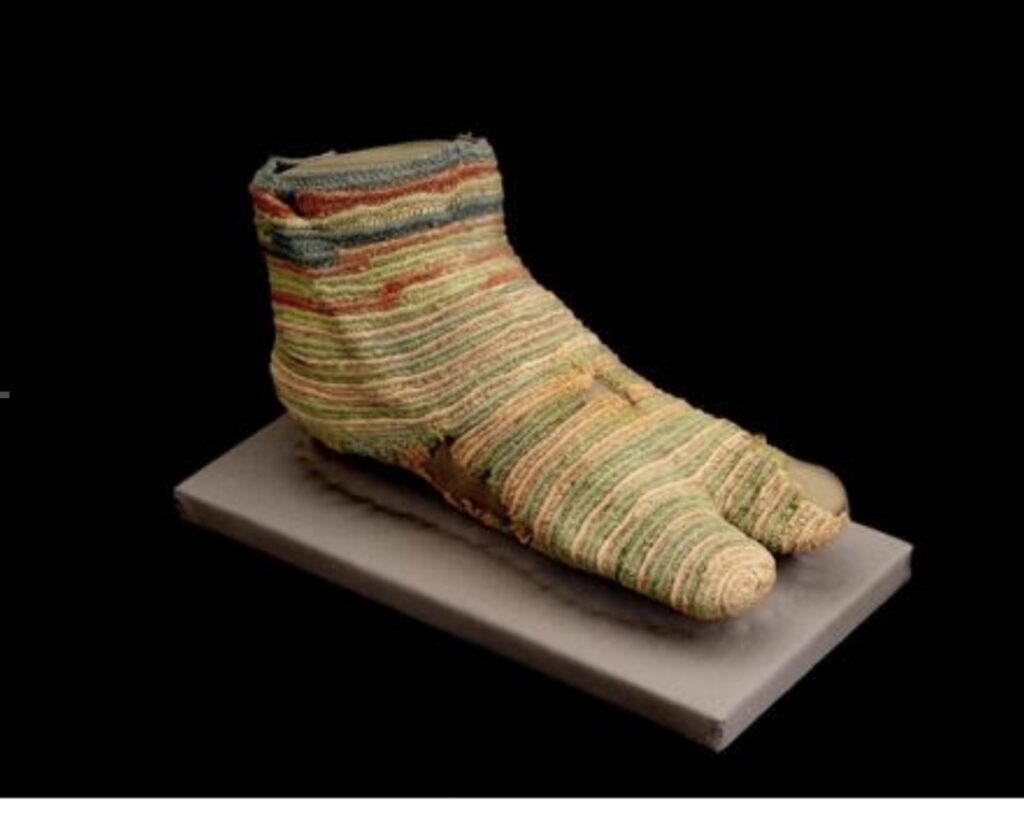
Ref.: https://www.nms.ac.uk/search-our-collections/collection-search-results?entry=404856
This is not coincidence. It is continuity. The technology existed in Africa for thousands of years before European crochet was systematized. When Europeans claim crochet as their invention, they erase this history.
The future of African Hook textile practices
You don't have to go too far on TikTok to find a large community of Africans practicing the craft of Crochet. They hail from all the African nations. They create amazing looking designs, largely inspired by European aesthetics. It could be that these young and older practitioners were introduced to this technique from a European perspective, not knowing that their continent has a long established legacy with hook based textile practices.
That is why, it is important that Timbuktu research and design emphasise the rich textile heritage and practices in pre-colonial Africa.
The colonial project did not just steal land and resources. It stole knowledge and then sold it back. It taught us to look to Europe for validation, to value European techniques over our own. The result is a generation of African creators who can produce stunning crochet work but have never seen a Mafa netting sack or a Coptic sock or a piece of Chebka lace. They do not know that their ancestors were doing this work. Practitioners are introduced to crochet through patterns and tutorials presenting it as a Western craft. They are not shown the evidence. They inherit a severed history.
While the contemporary practice of Crochet and Hand knitting might differ from ancient practices, we uphold the fact that practices, like cultures, evolved. The African hook textile practices with practice changes and includes new techniques making it not far fetched to claim also crochet as emerging from African practices.
We do not need to prove that ancient Africans did exactly what European crocheters do today. That is not how culture works. We need to show that the technology—manipulating fiber with a hook to create fabric—was present in Africa for millennia. We need to show that African women were creating openwork textiles with needles and hooks before European contact. We need to show that when colonial nuns arrived to "teach" lacemaking, they were often teaching techniques that originated in Africa. The claim that crochet emerges legitimately from African technological traditions is not sentimental—it is factual.
An academic study by Vivian Korankye at the Takoradi Technical University, demonstrate that we seek to investigate how our heritage practices can inform our future contemporary practices. Vivian investigates techniques for innovating indigenous vegetable-tanned leather into yarn.
Manipulating Indigenous Vegetable-Tanned Leather for Use in Crocheting Art
The study explores techniques and methods used in converting indigenous vegetable-tanned leather into yarns that can serve as an alternative material and convert the locally made yarns into crocheted ladies containers and footwear using different stitches.
Ref: https://www.prophy.ai/article/169067466-Manipulating-Indigenous-Vegetable-Tanned-Leather-for-Use-in-Crocheting-Art/
The study employed a qualitative methodology combining descriptive and studio-based approaches, sampling crochet artisans, leatherwork teachers, and leather technologists. The study concludes that indigenous vegetable-tanned leather is suitable for use in making crocheting yarns due to its strength, flexibility, and suitability for hook construction. Spiral cutting techniques emerged as the most appropriate method for cutting leather into yarns, with recommended processing steps including cutting, softening through wet pounding, and dyeing using vat or mixed dye methods.
This research matters because it starts from African material and African technique. It does not ask permission from European tradition. It does not seek validation from European institutions. It simply works with what is here—leather tanned using indigenous methods, yarns produced by African hands, crochet hooks held by African fingers. It takes an African material and applies African research to develop contemporary applications. It is a continuation of the same technological tradition that produced the Mafa sack and the Coptic socks and Chebka lace.
Conclusion
The evidence is not ambiguous. Bone tools from Karanis. Chebka lace from Tunisia. Knotless netting from Cameroon. Coptic socks from Egypt. Hook-based textile practices constitute an authentic and enduring dimension of Africa's material culture, dating back millennia. Colonialism disrupted this heritage, stole credit for it, and repackaged it as European charity. But the techniques survived, and the knowledge persists.
The work now is to remember. To recover. To refuse the colonial narrative that taught us to forget.