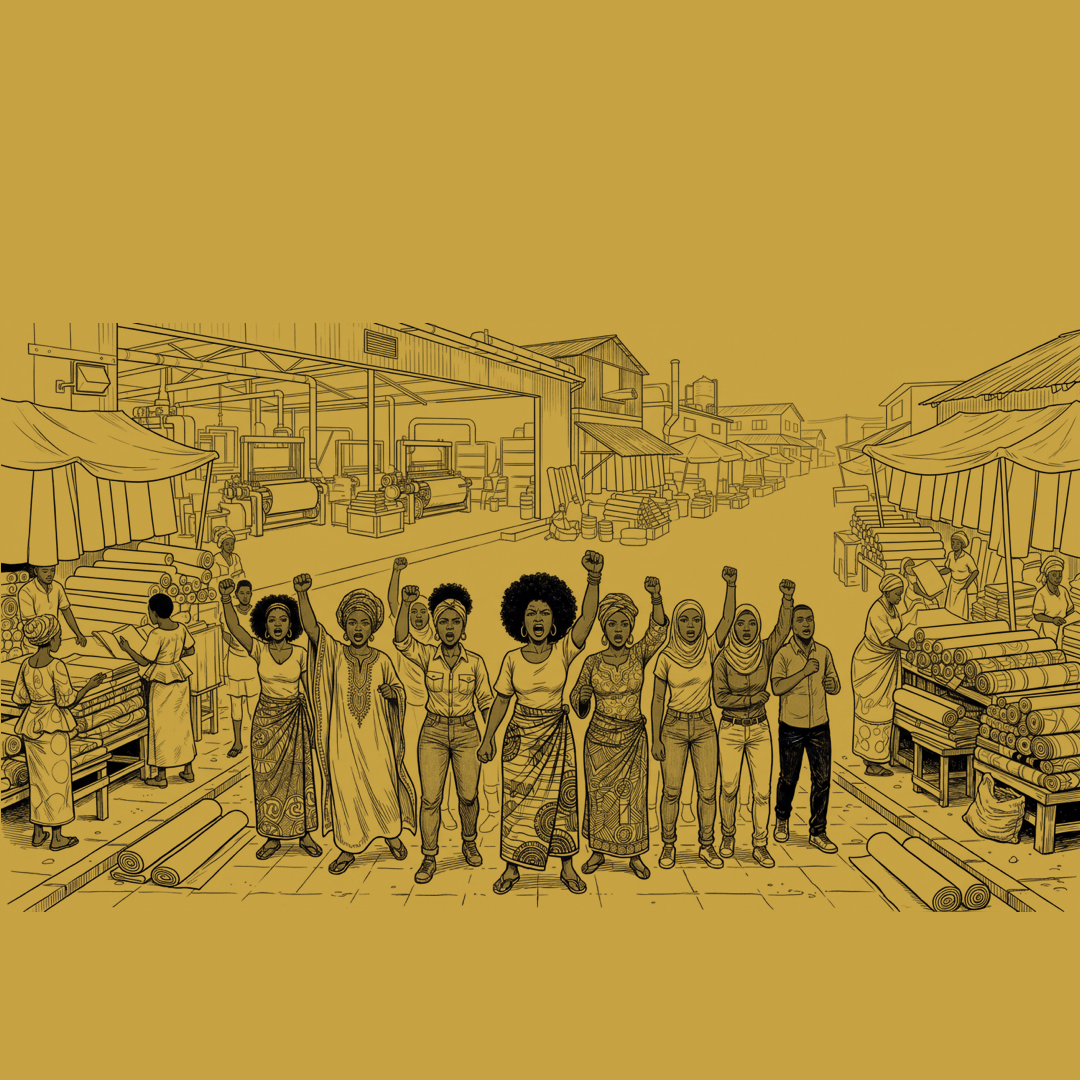
The industrial crisis across Bangladesh’s Ready-Made Garment (RMG) manufacturing hubs, spanning Gazipur, Ashulia, and Mirpur, serves as an urgent warning for emerging manufacturing corridors in the Global South. Over 700 production facilities suspended operations or declared holidays as hundreds of thousands of workers engaged in labor strikes, demanding a minimum monthly wage of 30,000 taka (~$242 / £180), more than double the current 12,500 taka ($100 / £80) baseline established in late 2023.
Amid severe domestic inflation, energy price surges, and rising food costs, workers report an inability to cover basic nutrition, rent, and medical care under current rates. The escalation has led to violent confrontations with state security forces, dozens of injuries, and recorded fatalities.
This report evaluates the structural dynamics of the Bangladesh wage impasse, examines the historical precedent of anti-colonial labor resistance led by West African market women, and presents strategic policy directives for integrated textile hubs, industrial parks, and special economic zones (SEZs) currently being developed across Africa and the Global South.
1. The Bangladesh RMG Wage Crisis: Anatomy of an Unraveling Model
Bangladesh stands as the world’s second-largest garment exporter after China, generating upwards of $39–$40 billion annually, accounting for roughly 80% of the nation's total export revenue and employing over 4 million workers. Despite the sector’s global footprint, its core competitive edge has historically rested on ultra-low labor costs.
                     +---------------------------------------+
                     |  Global Retail Sourcing Pressures     |
                     |  (Demands low FOB unit pricing)       |
                     +-------------------+-------------------+
                                         |
                                         v
                     +-------------------+-------------------+
                     |  Domestic Macro Crises (Bangladesh)   |
                     |  • Energy shortages & gas rationing   |
                     |  • Food inflation & real income loss  |
                     +-------------------+-------------------+
                                         |
                                         v
                     +-------------------+-------------------+
                     |  Squeezed Factory Floor Operations    |
                     |  • Unviable 12,500 Taka floor wage    |
                     |  • Operational disruptions (700+ SEZs)|
                     +-------------------+-------------------+
                                         |
                                         v
                     +-------------------+-------------------+
                     |  Industrial Unrest & Supply Failure   |
                     |  • Protests demanding 30,000 Taka     |
                     |  • Security clashes & fatal worker impact|
                     +---------------------------------------+
Key Drivers of the Disruption
- Purchasing Power Erosion: The 12,500 taka ($100) minimum wage set in late 2023 was rapidly eroded by double-digit domestic food inflation and structural economic shifts.
- Energy Squeezes & Supply Chain Friction: Domestic natural gas output in Bangladesh fell by over 30% between 2024 and 2026, forcing factory operators to rely on expensive imported Liquefied Natural Gas (LNG) and fuel rationing while facing tight Western peak-season delivery deadlines.
- Structural Disconnect in the Buyer Model: Global apparel brands market "ethical sourcing" and corporate sustainability while continuing to enforce low Free On Board (FOB) purchasing prices. When local inflation surges, factory owners pass the margin compression downward to labor, converting factory floors into volatile labor environments.
2. Historical Parallel: West African Women’s Collective Resistance
The dynamic of labor resistance to oppressive economic structures is not unique to modern South Asia. When examining West African economic history, particularly the collective actions of Nigerian market women and textile traders under colonial rule, clear structural parallels emerge.
During periods of colonial economic consolidation in Southern Nigeria, most notably during the anti-colonial tax and trade rebellions such as the Abeokuta Women's Revolt led by Funmilayo Ransome-Kuti and broader market strikes across Lagos and the Eastern provinces, working women organized systematic resistance against imposed economic controls, arbitrary price ceilings, and oppressive taxation regimes.
+-----------------------------------------------------------------------------------+
|               COLONIAL/EXTRACTIVE PARADIGM vs. LABOR REACTION                     |
+--------------------------------------------------+--------------------------------+
| Historical Colonial Model (West Africa)          | Contemporary Fast-Fashion Model|
+--------------------------------------------------+--------------------------------+
| • Fixed commodity purchasing prices             | • Depressed FOB supplier prices|
| • Taxation without local infrastructure          | • Low floor minimum wages      |
| • Resistance: Abeokuta & Market Women Rebellions | • Resistance: Garment Strikes  |
+--------------------------------------------------+--------------------------------+
| Outcome: Systematic instability when baseline producer survival is compromised.   |
+-----------------------------------------------------------------------------------+
Key Historical Lessons
- Baselines of Legitimacy: Working women recognized that an economic paradigm which deprives primary producers of baseline subsistence is structurally illegitimate. When livelihoods were threatened, market networks transformed into organized, economic-blockade machines.
- The Danger of Shifting Costs onto Primary Producers: Colonial administrators attempted to balance budgets by squeezing local trade networks, mirroring how modern garment brands attempt to manage consumer inflation by depressing factory labor rates.
- Historical Inevitability of Disruption: An industrial model that relies on suppressing primary producers inevitably triggers systemic disruption that threatens the broader export infrastructure.
3. A Strategic Roadmap for Emerging African Textile Corridors
As regions across Africa construct integrated cotton-to-apparel industrial parks, textile corridors, and special economic zones under regional agreements like the AfCFTA, policymakers and private developers must avoid duplicating the bottom-dollar labor models of South Asia.
Policy Directives for Sustainable Hub Development
A. Transition from "Cheap Labor" to High-Efficiency Living Wage Benchmarks
Competitiveness built exclusively on bottom-tier wages is fragile. When inflation hits, low-wage regimes experience violent labor stoppages that disrupt export schedules. African hubs must index minimum wage structures against real regional cost-of-living metrics and invest in capital automation, energy grid integration, and labor skills training to maintain productivity-driven competitiveness.
B. Mandate Binding Enforceable Brand Purchasing Frameworks
Special economic zone authorities must establish regulatory requirements for global brands operating within their jurisdictions. These frameworks should include transparent pricing mechanisms that require purchasing orders to accommodate mandatory living-wage adjustments without reducing overall order volumes.
C. Local Value Addition & Supply Chain Integration
To avoid the raw commodity extraction trap, regional textile hubs must prioritize end-to-end integration, from local cotton farming and ginning to regional spinning, weaving, and garment fabrication. Value retention within the region provides the margin buffer necessary to absorb wage increases without jeopardizing factory viability.
                  ===========================================
                  AGROECOLOGICAL COTTON FARMING & PRODUCTION
                  ===========================================
                                       |
                                       v
                  ===========================================
                  REGIONAL SPINNING, WEAVING & TEXTILE MILLS
                  ===========================================
                                       |
                                       v
                  ===========================================
                  HIGH-VALUE APPAREL FABRICATION (SEZ HUBS)
                  ===========================================
                                       |
                                       v
                  ===========================================
                  ENFORCEABLE LIVING WAGE & FAIR BUYER PRICING
                  ===========================================
References
- Business & Human Rights Resource Centre. (2026). Garment workers protest demanding Tk 30,000 minimum wage increase. Available at: https://www.business-humanrights.org
- Dhaka Tribune. (2026). Fresh wage protests erupt in Gazipur, police disperse workers. Published November 8, 2026. Available at: https://www.dhakatribune.com
- Johnson, C. (1982). Grassroots Organizing: Women in Anti-Colonial Protests in Nigeria. African Studies Review, 25(2/3), 137–157.
- Mba, N. E. (1982). Nigerian Women Mobilized: Women's Political Activity in Southern Nigeria, 1900-1965. Institute of International Studies, University of California, Berkeley.
- Shah, A. (2026). Bangladesh textile workers strike: Wage crisis, India's edge explained. The Indian Express. Published November 9, 2026. Available at: https://indianexpress.com
- The Voice News. (2026). 469 Garment Factories Shut Amid Wage Protests as Tarique Rahman Intervenes. Published November 8, 2026. Available at: https://thevoice.news
- WION News. (2026). Bangladesh garment workers defy wage board call, demand 30,000 taka minimum pay. Published November 1, 2026. Available at: https://www.wionews.com