
The blanket is a central piece in Basotho culture. It is worn for births, marriages, initiations, and funerals. The Basotho people have a saying: Kobo ke Bophelo — "the blanket is life". It is a national symbol, a source of warmth in the high-altitude Kingdom of Lesotho, and a marker of identity. But the blanket is also a scar. The story of the Basotho blanket is not a story of tradition. It is a story of terraforming: the deliberate reshaping of a landscape and its people through the weaponisation of disease, economics, and dress.
Before the blanket, the Basotho wore the kaross — an animal skin cloak. Chiefs and royalty wore cloaks of wild cat or leopard skin, called lehlosi. Priests wore specific capes of black and white sheepskin. Common people wore cloaks of cowhide or goatskin. The kaross was not a primitive covering. Written accounts from the 19th century describe the cloak of King Moshoeshoe I as "a great black leopard-skin kaross, as soft as the best silk". The indigenous sheep of Southern Africa were not wool producers. The Nguni, Damara, Namaqua Afrikaner, and Ronderib Afrikaner breeds have coarse hair rather than wool and a significant fatty deposit at the base of the tail. They were kept for meat, fat, and skins, not for fibre. These breeds are still present today. They are drought tolerant and kept by smallholder farmers. But they produce no wool. Lesotho has no historical tradition of woven textiles. The Basotho did not weave cloth. They worked with skins, not looms.
Wool production in Lesotho began in the 1850s, barely twenty years after the founding of the nation by Moshoeshoe I. Basotho acquired wooled Merino sheep through labour migration and employment on South African sheep farms, and sometimes through stock theft. By the end of the 19th century, almost the entire local sheep flock had been transformed from traditional meat-producing varieties to exotic Merino sheep. The Angora goat population was similarly replaced. Between 1900 and 1931, the Merino population increased tenfold, from 300,000 to nearly 3 million head. The Angora population increased from about 100,000 to over 1 million. The introduction of wool was part of a colonial project to integrate Lesotho into the Southern African market economy. Yet the kaross remained. The old ways persisted until the rinderpest came.
In 1887, a small Italian expeditionary force landed in the Horn of Africa. The soldiers were fighting a colonial war against the Ethiopians. Accompanying them were Indian cattle, imported to feed the troops. Those cattle carried the rinderpest virus, a close relative of measles and canine distemper, native to the steppes of Central Asia. Rinderpest was not native to Africa. The continent's cattle had no immunity. The virus spread with catastrophic speed. It reached the Atlantic within five years. Within a decade, it had arrived in South Africa. By the end of the century, an estimated 5.5 million cattle had died south of the Zambezi alone. Rinderpest killed over 95 percent of African herds throughout Southern Africa. Farmers had no oxen to pull ploughs or drive the waterwheels that irrigated fields. Hungry populations fell prey to smallpox, cholera, typhoid, and new diseases brought by Europeans. The rinderpest was not an act of God. It was an act of war. The Italian army imported infected cattle to feed its campaign against Ethiopia. The virus escaped. It spread across the continent. The same wave reached Lesotho in 1896-1897 and killed over 95 percent of African herds.
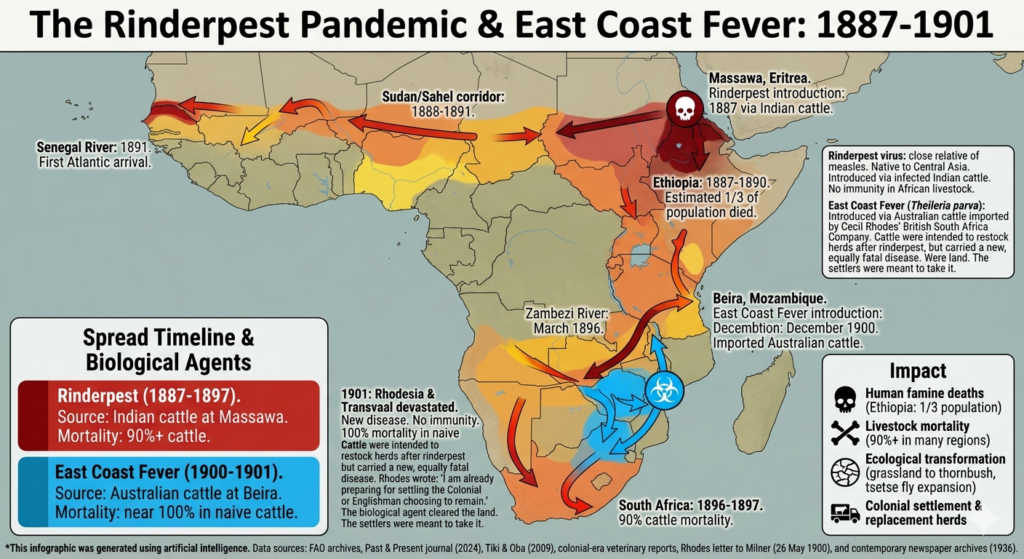
The rinderpest panzootic had already destroyed over 90 percent of African cattle herds. In response, Cecil Rhodes urgently sought replacement cattle. In December 1900, nearly 1,000 cattle imported from Australia arrived at the port of Beira in Mozambique. These cattle carried an entirely new disease that had never before been seen in Africa: East Coast Fever. The disease proved equally fatal to rinderpest. Robert Koch, the renowned German bacteriologist, was called in to investigate but made critical errors. The first instinct of the colonial authorities was to deny the existence of the disease for fear of discouraging investment. Cecil Rhodes wrote explicitly about his intentions: "I am already preparing for settling the Colonial or Englishman choosing to remain… I want to settle the Colonials, start the railway to the Victoria Falls, see the mines personally." The cattle were imported specifically to support white settlement. African herds were destroyed. White farms were stocked. Half a million cattle still die from East Coast Fever every year in East and Central Africa. In Zimbabwe alone, 5.5 million cattle have to be dipped in insecticide every week to control the brown tick that transmits the disease.
By 1860, securing sufficient skins for karosses was increasingly difficult. By 1872, a large majority of sheepskin covers had been replaced by poor quality cotton or wool. The kaross was not abandoned because it was inferior. The kaross was abandoned because the source of its raw material had been systematically destroyed by biological weapons: first rinderpest, then East Coast Fever. Into this void stepped the blanket. Legend holds that the first blanket was given to King Moshoeshoe I in 1860 by a British trader. The king liked it and took to wearing it around his shoulders as a kaross. His subjects followed suit. The blanket was worn in the same way as the animal skin cloak. The line (mola) on modern wool blankets is a direct transfer of the design from the traditional kaross, where the spinal seam of the pelt created a visible line along the wearer's back. The British Museum confirms that the history of the Basotho blanket dates back to the 1860s, when "a blanket of European manufacture was presented to King Moshoeshoe I". The blanket was a manufactured product of the British Industrial Revolution, made possible by the Jacquard weaving machine. The blanket is not the tradition. The blanket is the scar.
The Basotho blanket is made of wool. Wool is not only for cold climates. Merino wool acts as a natural thermoregulator. The fibres are highly porous and hygroscopic, absorbing moisture vapour before it turns into sweat on the skin. It wicks moisture away from the body, keeping the wearer dry and aiding natural cooling. Wool also offers natural UV protection, with a Ultraviolet Protection Factor of 30 or higher. A typical cotton t-shirt has a UPF of around 5. The fibre is odour resistant, trapping bacteria rather than releasing it. Other African countries could buy Lesotho's wool to reduce their dependence on imported synthetic fibres. This would help Lesotho grow less dependent on AGOA and on the low prices offered by South African brokers. The wool is there. The quality is high. The market exists. The only missing piece is political will.
Wool and mohair account for 60 percent of Lesotho's agricultural exports and support more than 25 percent of the rural population, approximately 45,000 households. Yet most of the fibres are exported raw. South Africa is the world's dominant mohair producer, supplying over 50 percent of global output. The fibre comes from Angora goats and fetches up to $53 per kilogram for luxury knitwear. Lesotho shares the same breed and produces the same high-quality fibre. The local Merino sheep is hardy and well adapted but a low yielder. The sector is dominated by rural small-scale farmers. The Boer goat, an indigenous South African breed, is primarily kept for meat, milk, and skins. It is not a wool or mohair producer. Who is still making money on Lesotho's wool and mohair today? The South African brokers. The international buyers. The luxury fashion houses in Europe and the United States. The Basotho farmers receive a fraction of the final price. The weavers receive less.
Masetumo Lebitsa is a 73-year-old weaver who started weaving in 1975. She worked with an international designer who commissioned a tapestry. She and her group were paid M5,000. The designer sold the piece for US$136,000. He returned and offered M7,000 for another piece. She refused. Maseru Tapestry, her business, once had a regular buyer in Cape Town. A package of 20 tapestries sent through Lesotho's postal service did not arrive on time. The buyer ended the relationship. Since then, she has stopped using Lesotho's postal system. The middlemen capture the value. The weavers are paid a fraction of what their work commands.
Lesotho's garment industry employs approximately 34,000 workers, roughly three-quarters of them women. The sector accounts for about 35 percent of the country's exports, most destined for the United States. This export-driven model was deliberately built around AGOA. When AGOA expired in September 2025, compounded by 15 percent tariffs imposed the previous month, factory orders were cancelled. Production slowed. Some facilities shut down. The government declared a national state of disaster. Women absorbed the shock first. Layoffs and reduced hours hit them disproportionately. AGOA was renewed in February 2026 but runs only until December 31, 2026. Less than a year of certainty. This short timeline discourages long-term investment.
A Chinese investor named Baokunyaoda has entered the market. The company has begun purchasing wool and mohair locally at prices higher than those offered by South African brokers. They are stockpiling fibre in anticipation of the lifting of a Foot and Mouth Disease ban. They aim to create a direct link between Basotho farmers and the Chinese market, eliminating intermediaries, ensuring faster payments, and capitalising on zero-tariff trade opportunities. They have also promised to build processing factories in Lesotho. The weavers are watching. They have seen promises before.
The International Trade Centre's Ethical Fashion Initiative launched a programme in Lesotho in November 2025 to rebrand Lesotho's wool and mohair for international markets while building local capacity. The programme is part of the Wool and Mohair Value Chain Competitiveness Project (WaMCoP), a partnership between the government of Lesotho, the Ministry of Agriculture, and IFAD. The previous Wool and Mohair Promotion Project (WAMPP) closed in 2023. The weavers at Maseru Tapestry report that support has not reached them under the new project. A baseline survey is still being conducted. Activities have not started.
Most weavers in Lesotho today are women who learned the trade decades ago through foreign-run workshops. Masetumo Lebitsa started weaving in 1975 after attending workshops run by Elizabeth Everett. Her weavers have no formal training. At the Leribe Craft Centre, Mamookho Mangope, who is deaf, travels over 134 kilometres to the centre. "Before, we were very withdrawn, hidden and did not understand what life was like. But after coming here, it opened our eyes," she says. Most weavers are elderly. Lebitsa hopes government plans to train new weavers will materialise soon. "We want the new generation to take over," she says. "We have to teach them."
The rinderpest opened a gap. The Australian cattle opened another. Leading to the kaross raw materials to be destroyed. The blanket was introduced during that void. But the blanket was not a solution, It was a substitute. The kaross is gone, no signs of revival or reinstateting. How many more extinctions can we take?
References
· British Museum. Collection object E_2012-2018-5. 'Motlatsi' Jacquard woven blanket, 'Khosana' (chief) design.
· British Museum. "Blanket of European manufacture presented to King Moshoeshoe I." Collection notes.
· Brighton Museums. Fashioning Africa project. Basotho blanket 'Badges of the Brave'.
· National Museum Publications. Basotho blanket classifications and material composition.
· International Wool Textile Organisation (IWTO). Lesotho wool and mohair production statistics.
· Agricultural Research Council of South Africa. Indigenous Veld Sheep Breeders' Society.
· Rinderpest history: FAO archives; Past & Present journal (2024) on Italian imperial mirage.
· East Coast Fever history: Rhodes, Cecil. Letter to Alfred Milner, 26 May 1900.
· Masetumo Lebitsa. Interview. Maseru Tapestry.
· Mamookho Mangope. Interview. Leribe Craft Centre.
· ITC Ethical Fashion Initiative. WaMCoP project documents. 2025-2026.
· AGOA renewal. US Trade Representative. February 2026.